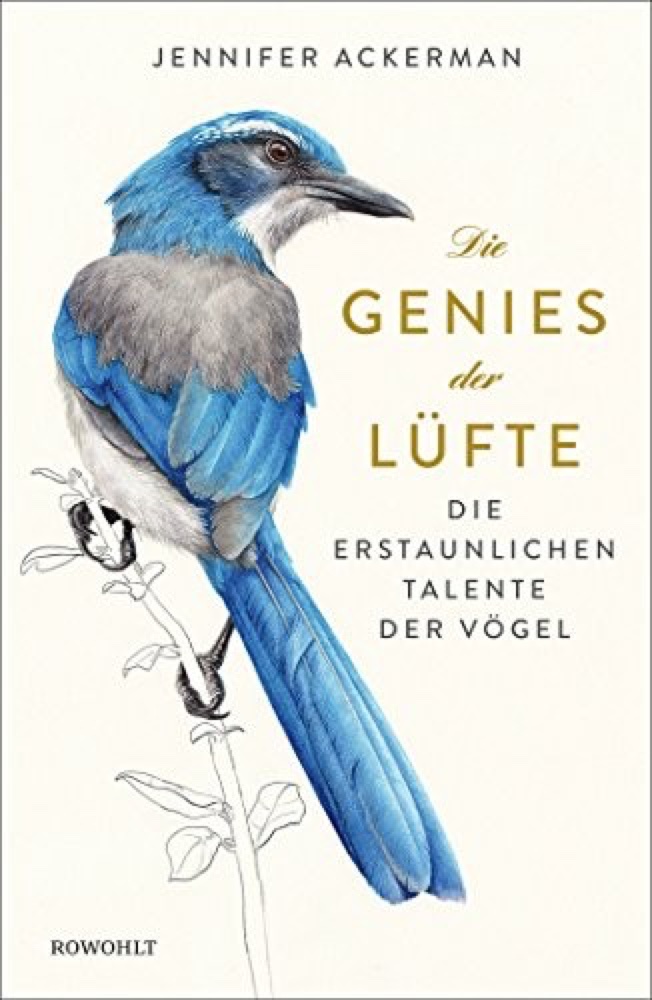

 Are We Smart Enough to Know How Smart Animals Are?
Quotes from the Book
AS A HUMAN BEING,” Einstein once wrote, “one has been endowed with just enough intelligence to be able to see clearly how utterly inadequate that intelligence is when confronted with what exists.
9
Each spring the robins nesting in our cherry tree attack the side mirror of our car as if it were a rival, pecking furiously at their own reflections while streaking the door with guano. But who among us hasn’t been toppled by our vanity or made an enemy of our own image?
4
If one of the species you’re using in your experiment fails every test you give it, the problem may be you, the researcher, not the animal. You may have failed to understand what is relevant to the way a bird sees the world.
3
A narrow-minded man can lead one to devalue others, and in the end, to desperately dangerous hates of outsiders, ranging in expression from discrimination against minorities to world conflagrations,' Tolman wrote. The solution? Create broader cognitive maps in the mind that encompass bigger geographical boundaries and a wider social scope, embracing those we might consider others, and in this way encourage empathy and understanding.
2
He taught me the difference between casual “birdwatching” and the more intense, focused “birding,” and urged me to go beyond identifying birds to noting their actions and behavior.
2
Birds are facing change on a scale unknown in their evolutionary history. This is a result of the Anthropocene—the new epoch of man-made change that is contributing to what has been called the sixth mass extinction.
2
Tempting as it may be to interpret the behavior of other animals in terms of human mental processes, it's perhaps even more tempting to reject the possibility of kinship. It's what primatologist Frans de Waal calls "anthropodenial," blindness to humankind characteristics of other species,"Those who are in anthropodenial," says de Waal, "try to build a brick wall to separate humans from the rest of the animal kingdom.
2
I love this idea, that nature dreamed up the same kind of sleep in both humans and birds, fostering the growth of big brains in creatures so far apart on life’s tree.
2
Words will do that. We are a naming species, and what we call things influences the way we think about them and the experiments we deem worthy of doing.
1
What kind of intelligence allows a bird to anticipate the arrival of a distant storm? Or find its way to a place it has never been before, though it may be thousands of miles away? Or precisely imitate the complex songs of hundreds of other species? Or hide tens of thousands of seeds over hundreds of square miles and remember where it put them six months later? (I would flunk these sorts of intelligence tests as readily as birds might fail mine.)
1
In the 1990s, reports began to roll in from New Caledonia, a small island in the South Pacific, of crows that fashion their own tools in the wild and appear to transmit local styles of toolmaking from one generation to the next—a feat reminiscent of human culture and proof that sophisticated tool skills do not require a primate brain.
1
If you happened to find yourself at the foot of the stairs in the White House on a typical afternoon sometime around 1804 or 1805, you might have noticed a perky bird in a pearl-gray coat ascending the steps behind Thomas Jefferson, hop by hop, as the president retired to his chambers for a siesta. This was Dick. Although the president didn’t dignify his pet mockingbird with one of the fancy Celtic or Gallic names he gave his horses and sheepdogs—Cucullin, Fingal, Bergère—still it was a favorite pet. “I sincerely congratulate you on the arrival of the Mocking bird,” Jefferson wrote to his son-in-law, who had informed him of the advent of the first resident mockingbird. “Learn all the children to venerate it as a superior being in the form of a bird.” Dick may well have been one of the two mockingbirds Jefferson bought in 1803. These were pricier than most pet birds ($10 or $15 then—around $125 now) because their serenades included not only renditions of all the birds of the local woods, but also popular American, Scottish, and French songs. Not everyone would pick this bird for a friend. Wordsworth called him the “merry mockingbird.” Brash, yes. Saucy and animated. But merry? His most common call is a bruising tschak!—a kind of unlovely avian expletive that one naturalist described as a cross between a snort of disgust and a hawking of phlegm. But Jefferson adored Dick for his uncommon intelligence, his musicality, and his remarkable ability to mimic. As the president’s friend Margaret Bayard Smith wrote, “Whenever he was alone he opened the cage and let the bird fly about the room. After flitting for a while from one object to another, it would alight on his table and regale him with its sweetest notes, or perch on his shoulder and take its food from his lips.” When the president napped, Dick would sit on his couch and serenade him with both bird and human tunes.
1
In some cities, you can find smoked cigarette butts in sparrow nests, which effectively function as a parasite repellent. Butts from smoked cigarettes retain large amounts of nicotine and other toxic substances, including traces of pesticides that repel all kinds of harmful creepy crawlies—an apparently ingenious new use of materials.
1
A frigate bird with a seven-foot wingspan has a skeleton that weighs less than its feathers.
1
It’s a notion that was proposed three decades ago by Jane Goodall and her colleague Hans Kummer. The pair made a plea for measuring a wild animal’s intelligence by looking at its ability to find solutions to problems in its natural setting. What’s needed is an ecological rather than a laboratory measure of intelligence, they suggested. This can be found in an animal’s ability to innovate in its own environment, “to find a solution to a novel problem, or a novel solution to an old one.
1
If a bird’s hair cells are damaged by disease or loud noises—say, by the blasting decibels of a rock concert in a domed stadium—they can regenerate. Ours can’t.)
1
One African grey I know, Throckmorton, pronounces his name with Shakespearean precision. Named for the man who served as an intermediary for Mary, Queen of Scots (and was hanged in 1584 for conspiring against Queen Elizabeth I), Throckmorton has a wide repertoire of household sounds, including the voices of his family members, Karin and Bob, which he uses to his advantage. He calls out Karin’s name in a “Bob voice” that Karin describes as spot-on; she can’t tell the difference. He also mimics the different rings of Karin’s and Bob’s cell phones. One of his favorite ploys is to summon Bob from the garage by imitating his cell phone ring. When Bob comes running, Throckmorton “answers” the call in Bob’s voice: “Hello! Uh-huh, uh-huh, uh-huh.” Then he finishes with the flat ring tone of hanging up. Throckmorton imitates the glug, glug sound of Karin drinking water and the slurping sound of Bob trying to cool his hot coffee while he sips it, as well as the bark of the family’s former dog, a Jack Russell terrier dead nine years. He has also nailed the bark of the current family pet, a miniature schnauzer, and will join him in a chorus of barking, “making my house sound like a kennel,” says Karin. “Again, he’s pitch perfect; no one can tell it’s a parrot barking and not a dog.” Once, when Bob had a cold, Throckmorton added to his corpus the sounds of nose blowing, coughing, and sneezing. And another time, when Bob came home from a business trip with a terrible stomach bug, Throckmorton made sick-to-my-stomach sounds for the next six months. For one long stretch, his preferred “Bob” word was “Shhhhhhhhiiiit.
Indeed, when researchers at McGill University scanned the brains of older adults who used GPS and those who didn't, they found that the people accustomed to navigating on their own had more grey matter in the hippocampus and showed less overall cognitive impairment than those who relied on GPS. As we lose the habit of forming cognitive maps, we may be losing grey matter (and along with it ... our capacity for social understanding).
The now-famous video of these crows in a city in Japan shows one stationed above a pedestrian crossing. When the light turns red, it positions its nut on the crossing, then flies back to the perch and waits while the light changes and traffic passes; when the light turns red again, it flutters down to safely collect the cracked nut. If no car smashed the nut, the bird repositions it.
Being a sentinel babbler is a dodgy job—they get picked off much more often than foragers, especially by hawks and owls. But life can be dicey for all babblers.
The scientists chalked up the flocks’ greater successes to the odds that they included birds with varying abilities, experiences, and temperaments: “Large groups succeed because they’re more likely to contain a diverse range of individuals,” the team writes, “some of whom will be very good at problem-solving.
this whiff of tissue harbors our mental maps—and our memories. In fact, our recollections appear to be all bound up with where we experienced an event.
In both proto- and modern birds, on the other hand, the skull maintained its youthful shape as the birds matured, leaving plenty of space for enormous eyes and enlarged brains. “When we look at birds,” says Abzhanov, “we are looking at juvenile dinosaurs.” As it happens, we humans may have pulled just such a Peter Pan–like move. As adults, we share the big head, flat face, small jaw, and patchy body hair of baby primates. Paedomorphosis may have enabled us to develop bigger brains, just as it did in birds.
in both birds and humans, the brain regions used more extensively in waking hours sleep more deeply during subsequent sleep—another similarity born of convergent evolution.
. It’s a natural human impulse
The real naturalist should be a Boswell, and every creature should be, for him, a Dr. Johnson.
If you’re going to invade a new place, a love of novelty helps. So does a fondness for hanging out in groups.
It seemed to Whish that any potential crack was worth trying to open,” wrote the scientists. “Even a person’s face was not sacrosanct. He would fly to the face and clutch hole on the nose arch. He would then hang upside down and peer into the nostrils.
Carrion crows use passing cars to crush especially tough nuts, such as walnuts, that won’t break by simply falling on pavement. The now-famous video of these crows in a city in Japan shows one stationed above a pedestrian crossing. When the light turns red, it positions its nut on the crossing, then flies back to the perch and waits while the light changes and traffic passes; when the light turns red again, it flutters down to safely collect the cracked nut. If no car smashed the nut, the bird repositions it.
Watch on YouTube
About Jennifer Ackerman
We have collected 29 quotes from 1 book by Jennifer Ackerman on BookQuoters.
More about the author →About the book
Birds are astonishingly intelligent creatures. According to revolutionary new research, some birds rival primates and even humans in their remarkable forms of intelligence. In The Genius of Birds, acclaimed author Jennifer Ackerman explores their newly discovered brilliance and how it came about.
As she travels around the world to the most cutting-edge frontiers of research, Ackerman not only tells the story of the recently uncovered genius of birds but also delves deeply into the latest findings about the bird brain itself that are shifting our view of what it means to be intelligent. At once personal yet scientific, richly informative and beautifully written, The Genius of Birds celebrates the triumphs of these surprising and fiercely intelligent creatures.
Book details
- First published
- 2016
- Author
- Jennifer Ackerman
- Genre
- Nonfiction
- Goodreads rating
- 4.04 (14k ratings)
Keep reading
Are We Smart Enough to Know How Smart Animals Are?
 The Backyard Bird Chronicles
 Shadows of Forgotten Ancestors
 Dragons of Eden: Speculations on the Evolution of Human Intelligence
 Wild Ones: A Sometimes Dismaying, Weirdly Reassuring Story About Looking at People Looking at Animals in America
 Other Minds
 Vesper Flights
 Vanishing Treasures: A Bestiary of Extraordinary Endangered Creatures
 Last Chance to See
 Beyond Words: What Animals Think and Feel
 The Lives of a Cell: Notes of a Biology Watcher
 Martin Marten
 Some We Love, Some We Hate, Some We Eat: Why It's So Hard to Think Straight About Animals
 The Blind Watchmaker: Why the Evidence of Evolution Reveals a Universe Without Design
 The Soul of an Octopus: A Surprising Exploration into the Wonder of Consciousness
 The Forest Unseen: A Year’s Watch in Nature
 Mozart's Starling
 Kingbird Highway: The Biggest Year in the Life of an Extreme Birder
 Fuzz: When Nature Breaks the Law
 Wesley the Owl: The Remarkable Love Story of an Owl and His Girl
 A Hunter-Gatherer's Guide to the 21st Century: Evolution and the Challenges of Modern Life
 The Tell-Tale Brain: A Neuroscientist's Quest for What Makes Us Human
 Undeniable: Evolution and the Science of Creation
 Echopraxia
 From Bacteria to Bach and Back: The Evolution of Minds
 How the Mind Works
 Wilding
 The Log from the Sea of Cortez
 Animals Make Us Human: Creating the Best Life for Animals
 The Lost World
 The Botany of Desire: A Plant's-Eye View of the World
 The Light Eaters: How the Unseen World of Plant Intelligence Offers a New Understanding of Life on Earth
 The Last Days of the Dinosaurs: An Asteroid, Extinction, and the Beginning of Our World
 Genome
 Why Fish Don’t Exist: A Story of Loss, Love, and the Hidden Order of Life
 Inside of a Dog: What Dogs See, Smell, and Know
 Thinking In Pictures: and Other Reports from My Life with Autism
 Hollow Kingdom
 A Devil's Chaplain: Reflections on Hope, Lies, Science, and Love
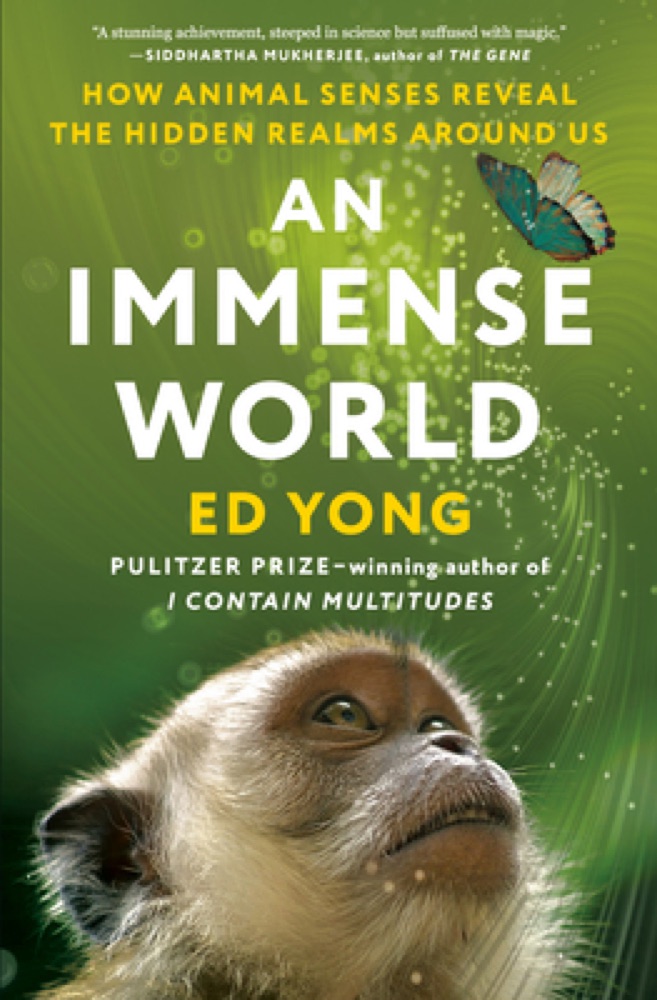 An Immense World: How Animal Senses Reveal the Hidden Realms Around Us
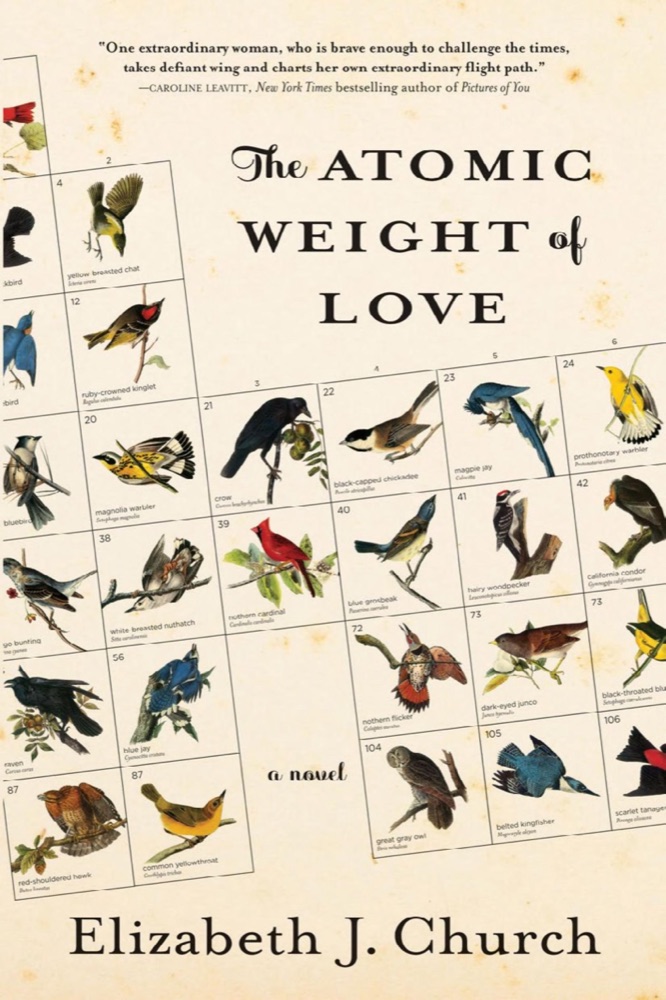 The Atomic Weight of Love
 Blindsight
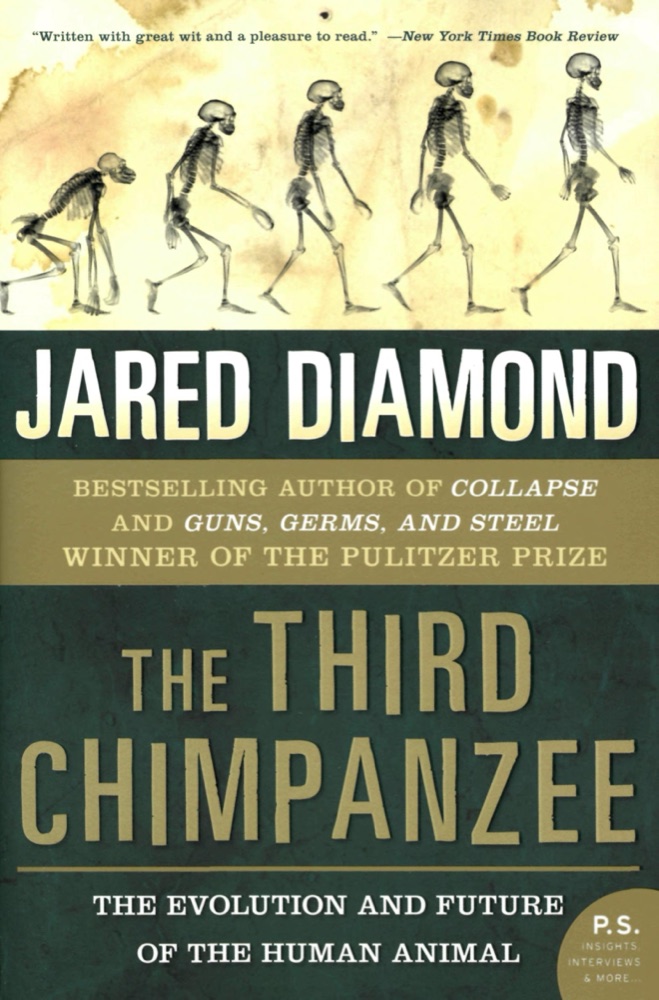 The Third Chimpanzee: The Evolution and Future of the Human Animal
 Why We Run: A Natural History
 The Ancestor's Tale: A Pilgrimage to the Dawn of Evolution
 The Mountain in the Sea
 The Fifth Science
 Gathering Moss: A Natural and Cultural History of Mosses
 The Moral Animal: Why We Are the Way We Are - The New Science of Evolutionary Psychology
 Galápagos
 Darwin's Dangerous Idea: Evolution and the Meanings of Life
 The Code Breaker: Jennifer Doudna, Gene Editing, and the Future of the Human Race
 Oryx and Crake
 H is for Hawk
 The Song of the Cell: An Exploration of Medicine and the New Human
 The Violinist's Thumb: And Other Lost Tales of Love, War, and Genius, as Written by Our Genetic Code
 Drive Your Plow Over the Bones of the Dead
 The Unexpected Truth About Animals: A Menagerie of the Misunderstood
 The Salmon of Doubt
 Silent Spring