
 Packing for Mars: The Curious Science of Life in the Void
Quotes from the Book
We are irrational in our species-specific devotions. I know a man who won’t eat octopus because of its intelligence. Yet he eats pork and buys glue traps for rats, though rats and pigs are highly intelligent, likely more intelligent—I’m guessing, for I have not seen the SAT scores—than octopuses. Why, for that matter, is intelligence the scale by which we decide whom to spare? Or size? Have the simple and the small less right to live?
10
Snowplows kill twice as many Canadians as grizzly bears do.
8
The black bear is a ridiculously lovable species. There's a reason kids have teddy bears, not teddy goats or teddy eels.
5
Californians are like, 'Lions are everywhere now!'" What's on the rise are home security cameras. Doorbell cameras are the mammograms of wildlife biology.
4
If the present rate of decline continues, the yellow-eyed penguin will likely be gone from the planet in ten or twenty years. It is difficult to be here watching them and not feel somewhat slammed by this information. What a thing to lose! Go look them up. The candy red beak, the pink go-go boots, the yellow mask angling back from the eyes. They’re the Flash, they’re 1970s Bowie! I don’t mean to imply that adorable, showy species are of more value or somehow deserving of more concern. It’s just … damn.
4
So she looks in her rearview mirror,” one is saying, “and there’s a bear in the back seat, eating popcorn.” When wildlife officers gather at a conference, the shop talk is outstanding. Last night I stepped onto the elevator as a man was saying, “Ever tase an elk?
4
For most of the past century, your odds of being killed by a cougar were about the same as your odds of being killed by a filing cabinet. Snowplows kill twice as many Canadians as grizzly bears do.
3
Gulls would eat the world but leave the plants.
2
(Pitkin County bears consistently prefer premium brands. “They will not touch Western Family ice cream,” Tina White reports.)
2
Is there something uniquely dangerous about beans? I posed this question to plant scientist Ann Filmer, recently retired from the University of California, Davis. In her reply, she included a link for a website she had put together on poisonous garden plants. I was taken aback to note that nine of the 112 plants in Category 1 (Major Toxicity: “may cause serious illness or death”) were currently, or had recently been, growing in our yard: oleander, lantana, night-blooming jasmine, lobelia, rhododendron, azalea, toyon, pittosporum, and hellebore. Another, the houseplant croton, was growing in an orange ceramic pot in my office. In other words, it’s not beans. It’s plants, period. If you can’t flee or maul or fire a gun, evolution may help you out with other, quieter ways to avoid being eaten. Over the millennia, natural selection favors eaters who turn up their proboscis at you, and eventually they all steer clear.
2
Of all the animals we have ever kept, these Albatross are the ones to which I have become most attached. I really love them and respect their independence and jaunty ways. This marks the end of a period of acquaintance with real aristocrats of life.
2
Because people like me want to have their hamburgers. Only once or twice a year, I want to say. But I know that’s a lame defense. It’s not the quantity that matters, it’s the statement you make or don’t make. When you tell people you don’t eat beef — or would never use a glue trap — you make the alternative a little less comfortable for them. You keep it from being a thing they give no thought to.
2
Albert Ken-rich Fisher’s 1900 “Summary of the Contents of 255 Stomachs of the Screech Owl” made me feel tired and sad, though also vaguely festive, owing to the author’s “Twelve Days of Christmas”–style presentation: “91 stomachs contained mice … 100 stomachs contained insects … 9 stomachs contained crawfish … 2 stomachs contained scorpions …” Droppings provided a kinder, less taxing alternative.
2
I would take delight in the optical non sequitur of a bear standing in front of a Louis Vuitton boutique. This poor goober with the burrata on its snout, innocent and utterly unaware of its likely fate, makes me want to cry.
2
And he said, ‘I don’t have the right to decide whose life is more important, the person or the bear.
1
Possum merino is a heavenly soft wool blend. When I first arrived in New Zealand, I bought a pair of wonderful green possum merino gloves. I imagined peaceful possum flocks being sheared like sheep. Then Warburton explained that possum pile is too short to shear and is typically sliped instead. Sliping involves some kind of postmortem chemical depilatory. I still wear the gloves, though with diminished happiness.
1
Like most birds, gulls mate by aligning their cloacal openings. The ornithological term for this is “the cloacal kiss.” Which makes bird sex sound sweet and demure, until you remember that they also excrete through their cloaca.
1
New Zealand says it like it is. On the brink of a cliff above the surf at Pancake Rocks is a sign warning tourists not to climb over the fence. It closes with “Don’t be an idiot.
1
I can’t judge. We all have emotional connections to certain branches of the tree of life, and for some that branch is trees. We are irrational in our species-specific devotions. I know a man who won’t eat octopus because of its intelligence. Yet he eats pork and buys glue traps for rats, though rats and pigs are highly intelligent, likely more intelligent—I’m guessing, for I have not seen the SAT scores—than octopuses. Why, for that matter, is intelligence the scale by which we decide whom to spare? Or size? Have the simple and the small less right to live?
1
Exasperated, the navy turned to science for help. On October 2, 1957, Hubert Frings, a Pennsylvania State University professor of zoology, got a call from Washington. Would he be willing to come to Midway Atoll for the December/January nesting season? In other words, would Frings make the supreme sacrifice of spending his between-semester break on a tropical island in lieu of hanging around Altoona, Pennsylvania? You bet. Accompanying him would be his wife, Mable, a librarian and bioacoustician with a special interest in cricket and grasshopper “chirp sequences.
1
Research on jaywalking pedestrians tells a similar story. Most of our decision-making is based on how far off a car is. We’re not so good at factoring in the speed. Experimental evidence suggests that full looming sensitivity doesn’t develop until adulthood. A young child on the side of the road and a car traveling faster than 20 mph combine to encourage, quoting a team of European psychologists, “injudicious road crossing.” Hence the need for injudiciously punctuated slow children signs. It’s not just that kids aren’t looking when they cross; they’re also not seeing.
1
Let us here lay to rest the myth that birds’ innards will burst if they scavenge the rice thrown at weddings. Over the years, this enduring bit of misinformation migrated as far as Ann Landers’s column and the Connecticut state legislature. In 1985, Representative Mae Schmidle proposed “An Act Prohibiting the Use of Uncooked Rice at Nuptial Affairs.” The Audubon Society called hooey, pointing out that migrating birds feed on fields of rice. Some churches ban the practice anyway, not because it’s perilous for birds but because it’s perilous for guests, who could slip on the hard, round grains and fall and then fly off to a personal injury lawyer.
1
A technique favored by Mussolini’s squadristi thugs. Political foes were force-fed large quantities of castor oil—up to a quart, according to The Straight Dope. Who does that? Moreover, why? To kill by dehydration? To humiliate? I could find no satisfying answer, not even from the International Castor Oil Association, which, despite large quantities of emails, had no comment.
1
The words appear that way on a Utah food-handler testing and certification site. The threat they refer to is not jequirity beans or castor beans. (The castor bean isn’t actually a legume. It’s a spurge.) The threats are kidney beans, red or white, broad beans, and lima beans. Fail to boil these common edibles for at least ten minutes, and you may find yourself in significant gastrointestinal distress. As did a thousand-plus viewers of a Japanese TV show that recommended grinding white kidney beans in a coffee mill, toasting for three minutes, and sprinkling on rice. According to the journal article “The ‘White Kidney Bean Incident’ in Japan,” a hundred people were hospitalized.
1
While Cutler was tinkering with his castor oil, his roommate began feeling ill. Fearing it might be ricin poisoning, the roommate went to the emergency room. It was just flu, but at the mention of ricin, medical personnel called in a potential terrorist situation and a Phoenix SWAT team descended upon the apartment. Cutler served three years for, essentially, possession of a laxative with criminal intent.
1
We practiced the diamond-shaped sweep earlier. Four people move along back to back to back to back, weapons ready. It’s a human octopus with guns. Each person scans the quadrant in front of her (named for hours on a clock face: 12, 3, 6, and 9) and calls “Clear” if she sees no danger. Whereupon the person to her right calls “Clear.” Et cetera, around and around. Not only can the surroundings be monitored in all directions, but it’s safe in that no one can inadvertently point a weapon at anyone else. Should someone spot a threat, she calls it out, whereupon the people on either side move into position beside her. Now three rifles are aimed and ready, while one person watches the rear. When we practiced this earlier, Joel played the dangerous animal. I had hoped for some pantomime, maybe even a costume, but he’d just step in front of us and say, “I’m a bear.
1
So I’m curious, how far does the Pope think we should go in the direction of respecting and correcting the natural world and it’s wild inhabitants. Before I arrived the PIL media manager sent me a copy of Francis’s rather beautiful and cyclical ‘On Care For Our Common Home’. “Each creature has its own purpose” he writes “none is superfluous." He describes how Saint Francis would burst into song when he gazed at the sun, the moon or the smallest of animals. I read these passages to Father Carlo. He listens, nodding. “Saint Francis began a new relationship between nature and humanity. If you read his poems you find the expressions ‘Sister Water’, ‘Brother Sun’, ‘Sister Moon’.” “Would Saint Francis include brother rat?” I ask “Sister Boll Weevil, Uncle Blackbird who devours 2% of the North Dakota sunflower crop?”. Father Carlo says "Yes, Yes he would. He includes even death” he says.“Did saint Francis say anything specifically about rodents?”I hear myself say. “No, he didn’t. but the point is, brotherhood is not a simple relationship. with your brothers and sisters, normally you fight. You cannot think that there is an idillic way of being in a relationship with someone. Every relationship among humans and the earth is not only connotated with positive aspects. At the same time you also have negative aspects. The point is how do you deal with those aspects?” He’s good, this guy. “Yes” I say, “and how should we deal? It’s well and good to say these things, but how do we act in a way that serves both human and animal fairly? Let’s take the example of Canada Geese on gold courses. What is their crime? Befouling the turf, littering. For this should we be allowed to call someone in to round them up and gas them? Do they deserve to die because a few well-heeled humans want to hit a ball into hole and they need an obsessively tidy playing surface the size of the holy sea? Think of all the Sister Water that gets wasted watering the greens. Maybe it’s time to eliminate golf, not geese.” Father Carlos collects his thoughts. Among them, surely, ‘who let her in?’.
1
someone who knows a little more than diddly. I’m scheduled to meet with the Center’s wildlife genetics staff, upstairs in the Long Speak Room, which is an amusingly apt name for a government conference room (except that it isn’t—a realization that will dawn when I take note of the plaque by the door, which reads: Longs Peak Room).
1
Watch on YouTube
About Mary Roach
We have collected 198 quotes from 7 books by Mary Roach on BookQuoters.
More about the author →More by Mary Roach
Packing for Mars: The Curious Science of Life in the Void
 Stiff: The Curious Lives of Human Cadavers
 Bonk: The Curious Coupling of Science and Sex
 Gulp: Adventures on the Alimentary Canal
About the book
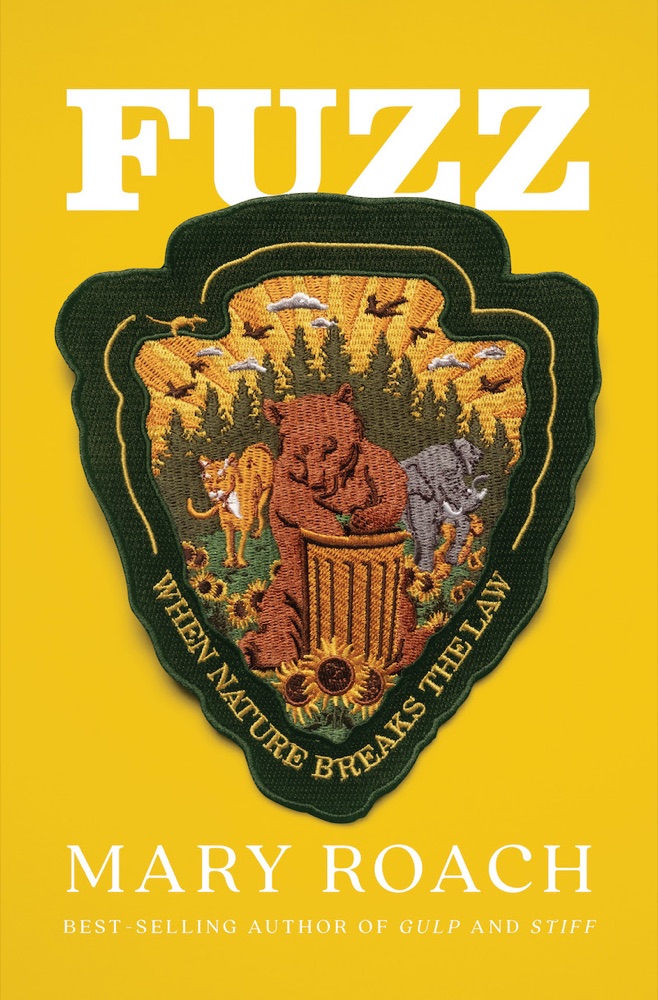
Come comportarsi quando un alce ci attraversa la strada? Quando sorprendiamo un orso entrare in casa? O ci troviamo di fronte a un albero “pericoloso”? Non siamo mai stati troppo bravi, come specie, a condividere il Pianeta... Nell’antichità, quando gli animali “infrangevano la legge” venivano affidati ad avvocati e portati a processo. Esemplare il caso dei bruchi che nel 1659 furono denunciati per aver sconfinato, rubando dai frutteti della gente (ai bruchi fu ordinato di comparire in tribunale in un giorno prestabilito, dove sarebbe stata assegnata loro la rappresentanza legale. Ovviamente nessun bruco si presentò, ma il caso andò avanti lo stesso...); o del maiale processato per omicidio; o del giudice che nel XVI secolo concesse clemenza a una famiglia di talpe con prole a carico. In passato, le specie “criminali” venivano semplicemente sterminate attraverso sanguinose e arroganti ca
Book details
- First published
- 2021
- Author
- Mary Roach
- Genre
- Nonfiction
- Goodreads rating
- 3.84 (31k ratings)
The buzz
- The New York TimesReview in The New York Timesprofessional review (via Book Marks)
- The Washington PostReview in The Washington Postprofessional review (via Book Marks)
- The Wall Street JournalReview in The Wall Street Journalprofessional review (via Book Marks)
- Kirkus ReviewsReview in Kirkus Reviewsprofessional review (via Book Marks)
- Publishers WeeklyReview in Publishers Weeklyprofessional review (via Book Marks)
- BooklistReview in Booklistprofessional review (via Book Marks)
Keep reading
 Last Chance to See
 Vanishing Treasures: A Bestiary of Extraordinary Endangered Creatures
 Pocket Apocalypse
 Wild Ones: A Sometimes Dismaying, Weirdly Reassuring Story About Looking at People Looking at Animals in America
 Eating Animals
 The Hangman's Replacement: Sprout of Disruption
 Fluke: Or, I Know Why the Winged Whale Sings
 The Further Adventures of An Idiot Abroad
 The Log from the Sea of Cortez
 Parasite
 NGLND XPX
 Tricked
 Friday
 Beyond Words: What Animals Think and Feel
 The Gone-Away World
 Memoirs of a Polar Bear
 Grunt: The Curious Science of Humans at War
 Holy Cow
 Eeeee Eee Eeee
 Horse Latitudes
 Martin Marten
 The Book of General Ignorance
 The Genius of Birds
 Thunder Bay
 Freddy and Fredericka
 The Dreadful Lemon Sky
 Discount Armageddon
 The Fourth Bear
 The Sheep Look Up
 Steve & Me
 An Idiot Abroad: The Travel Diaries of Karl Pilkington
 The Midwich Cuckoos
 Fifteen Dogs
 This Book Is Full of Spiders
 Heaven's River
 Maelstrom
 Folks, This Ain't Normal: A Farmer's Advice for Happier Hens, Healthier People, and a Better World
 When Will Jesus Bring the Pork Chops?
 I Am America
 The Tokyo-Montana Express
 Sometimes a Great Notion
 Sweep in Peace
Gulp: Adventures on the Alimentary Canal
Sweep in Peace
Gulp: Adventures on the Alimentary Canal
 Skinny Legs and All
 Roadside Picnic
 In a Sunburned Country
 A Cook's Tour: Global Adventures in Extreme Cuisines
 Hemlock & Silver
 The Nature of Jade
 Beat the Reaper
 A Language Older Than Words
 The Plague Dogs
 Pigeon English
 Wesley the Owl: The Remarkable Love Story of an Owl and His Girl
 Hunted
 Oryx and Crake
 Medium Raw: A Bloody Valentine to the World of Food and the People Who Cook
 A Children's Bible
 The Nasty Bits: Collected Varietal Cuts, Usable Trim, Scraps, and Bones
 The Salmon of Doubt