
 The Arcades Project
Quotes from the Book
Our world, like a charnel-house, is strewn with the detritus of dead epochs.
16
The house is a machine for living in.
8
A house is a machine for living in. Baths, sun, hot-water, cold-water, warmth at will, conservation of food, hygiene, beauty in the sense of good proportion. An armchair is a machine for sitting in and so on. Our
7
Truth to tell, the modern man is bored to tears in his home; so he goes to his club. The modern woman is bored outside her boudoir; she goes to tea-parties. The modern man and woman are bored at home; they go to night-clubs. But lesser folk who have no clubs gather together in the evening under the chandelier and hardly dare to walk through the labyrinth of their furniture which takes up the whole room and is all their fortune and their pride.
3
A ceux qui, absorbés maintenant dans le problème de "la machine à habiter", déclaraient que "l'architecture c'est servir", nous avons répondu: "L'architecture c'est émouvoir". Et nous avons été taxé de "poète", avec dédain
2
An object placed in the center of a room often spoils the room, for it hinders you from standing in the middle
1
The problem of the house is a problem of the epoch. The equilibrium of society today depends upon it. Architecture has for its first duty, in this period of renewal, that of bringing about a revision of values, a revision of the constituent elements of the house.
1
The primordial instinct of every human being is to assure himself of a shelter. The various classes of workers in society to-day no long have dwellings adapted to their needs; neither the artizan nor the intellectual. It is a question of building which is at the root of the social unrest of to-day: architecture or revolution.
Contour and profile ['modinature'] are the touchstone of the architect. Here he reveals himself as artist or mere engineer. Contour is free of all restraint.
Now, the plan is the generator, “the plan is the determination of everything; it is an austere abstraction, an algebrization, and cold of aspect.” It is a plan of battle. The battle follows and that is the great moment.
ROME AND OURSELVES Rome is a bazaar in full swing, and a picturesque one. There you find every sort of horror (see the four reproductions here given) and the bad taste of the Roman Renaissance. We have to judge this Renaissance by our modern taste, which separates us from it by four great centuries of effort, the 17th, 18th, 19th, and 20th. We reap the benefit of this endeavour; we judge hardly, but with a warrantable severity. These four centuries are lacking at Rome, which fell asleep after Michael Angelo. Setting foot once again in Paris, we recover our ability to judge. The lesson of Rome is for wise men, for those who know and can appreciate, who can resist and can verify. Rome is the damnation of the half-educated. To send architectural students to Rome is to cripple them for life. The Grand Prix de Rome and the Villa Medici are the cancer of French architecture.
Watch on YouTube
About Le Corbusier
We have collected 11 quotes from 1 book by Le Corbusier on BookQuoters.
More about the author →About the book
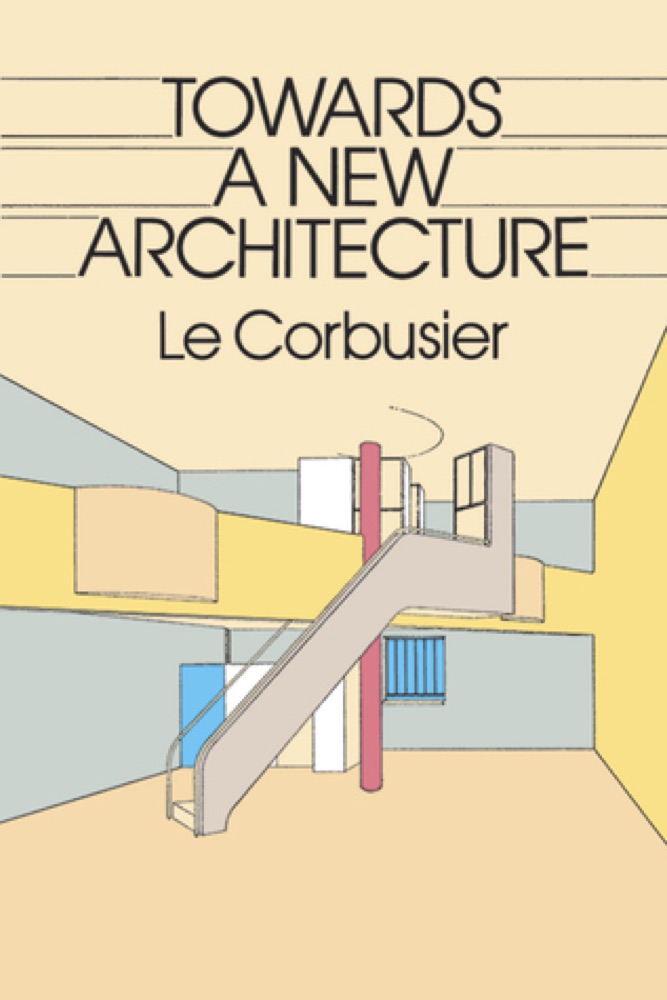
For the Swiss-born architect and city planner Le Corbusier (Charles-Édouard Jeanneret, 1887–1965), architecture constituted a noble art, an exalted calling in which the architect combined plastic invention, intellectual speculation, and higher mathematics to go beyond mere utilitarian needs, beyond "style," to achieve a pure creation of the spirit which established "emotional relationships by means of raw materials."
The first major exposition of his ideas appeared in Vers une Architecture (1923), a compilation of articles originally written by Le Corbusier for his own avant-garde magazine, L'Esprit Nouveau. The present volume is an unabridged English translation of the 13th French edition of that historic manifesto, in which Le Corbusier expounded his technical and aesthetic theories, views on industry, economics, relation of form to function, the "mass-production spirit," and much e
Book details
- First published
- 1923
- Author
- Le Corbusier
- Genre
- Nonfiction
- Goodreads rating
- 3.93 (5k ratings)
Keep reading
The Arcades Project
 The Architecture of Happiness
 The Poetics of Space
 The Medium is the Massage
 The Shock of the New
 Understanding Media: The Extensions of Man
 The Beauty of Everyday Things
 From Dawn to Decadence: 500 Years of Western Cultural Life, 1500 to the Present
 A Place of My Own: The Education of an Amateur Builder
 The London Scene: Six Essays on London Life
 The Futurological Congress: From the Memoirs of Ijon Tichy
 The Age of Absurdity: Why Modern Life makes it Hard to be Happy
 What's Wrong with the World
 One Way Street And Other Writings
 In Praise of Shadows
 The Practice of Everyday Life
 Bicycle Diaries
 Irrational Man: A Study in Existential Philosophy
 Blue Mars
 2312
2312
 Seeing Like a State: How Certain Schemes to Improve the Human Condition Have Failed
 Life A User's Manual
 Illuminations: Essays and Reflections
 The Pleasures and Sorrows of Work
 The Art of the Novel
 Anti-Oedipus: Capitalism and Schizophrenia
 The Death and Life of Great American Cities
 The Art of the Commonplace: The Agrarian Essays
 Primeval and Other Times
 The Big Green Tent
 Selections from the Prison Notebooks
 America
 Erewhon
 The Hare With Amber Eyes: A Family's Century of Art and Loss
 Distrust That Particular Flavor
 The Essays of Ralph Waldo Emerson
 At Home: A Short History of Private Life
 Another Roadside Attraction
 The Coming Insurrection
 Shop Class as Soulcraft: An Inquiry Into the Value of Work
 Skinny Legs and All
 Permutation City
 Flights
 Walden Two
 V.
V.
 News from Nowhere
 The Fifth Science
 Twilight of the Idols/The Anti-Christ
 Ghosts of My Life: Writings on Depression, Hauntology and Lost Futures
 Essays of E.B. White
 Wanderlust: A History of Walking
 The Home and the World
 Moravagine
 Angle of Repose
 Zen and the Art of Motorcycle Maintenance
 The Doors of Perception & Heaven and Hell
 Saving Time: Discovering a Life Beyond the Clock
 In Praise of Idleness and Other Essays
 The Order of Things: An Archaeology of the Human Sciences
 The Crisis of the Modern World