 Headscarves and Hymens: Why the Middle East Needs a Sexual Revolution
Quotes from the Book
I believe the role of the writer is to tell society what it pretends it does not know.
12
When a woman is ‘too much’, she is essentially uncontrollable and unashamed. That makes her dangerous.
6
I have engaged in enough women’s rights activism to know that the belief “sons are better than daughters'' is a huge problem in some parts of the world. For those who have little knowledge of Islam, there is the impression that women’s oppression stems from islamic teachings. This is simply not the case. In fact, muslim imams preach about the value of daughters often siting that a daughter opens the gates of paradise for their father. Indeed, the person the most beloved to the Prophet Mohammed, peace be upon him, was his youngest daughter, Fatima. Islamic teachings are clear that a father has to fulfill his duty to raise and care for his daughters, and that the obligations go beyond providing financial support. He must provide a safe, peaceful, and loving home environment that is conducive to his daughter’s overall spiritual and moral development.
5
We are not asking for permission any more. We are taking up space. We've listened to a lot of people talking about who Muslim women are without actually hearing Muslim women. So now, we are speaking. And now, it's your turn to listen.
3
Mine is a single person's lived experiences. An experience full of contradictions, imperfections and incongruities, but my lived experience nonetheless. Part of the journey, for me, is owning the inconsistencies in myself and my stories- we cannot change past perceptions, but we can certainly reflect on them, own them, and commit to growing from them. We must cultivate compassion for our past selves, trusting that we did the best we could at the time, while simultaneously striving to do better
3
We are the ones we have been waiting for.
3
Women are supposed to be ‘less than’, not ‘too much’. Women are meant to be quiet, modest, humble, polite, nice, well behaved, aware of the red lines. They are supposed to tread softly and within their limits.
2
Revolutions 'go too far': if your community is ready for you, then you are too late. You must challenge your community. You must throw down the gauntlet of freedom to your community and dare it to accept. Revolutions are by nature uncomfortable. They are meant to discombobulate. How else would the status quo be overthrown? Revolutions rattle the privileged and discomfort the complacent. They are never about the comfortable majority. Rather, it is always the minority, especially those who are caught by the intersection of multiple oppressions, who instigate and inspire.
2
things were a lot easier when I wasn’t woke. Or perhaps they were easier because I wasn’t woke.
2
You think all your memories are yours alone, but often they are given by others: versions of events repeated by family, scenes stolen from a movie watched half-sleeping, dreams willed into existence.
1
Profanity – especially delivered by women – is a powerful way to transgress the red lines of politeness and niceness that the patriarchy – shared by the rock and the hard place – demands of us as women. I say fuck because I am not supposed to. I say fuck because I believe that the crimes of racism, bigotry and misogyny – enabled and protected by patriarchy – are more profane than swear words. I say fuck because there is nothing civil about racists, Islamophobes and misogynists arguing over my body as if I did not exist.
1
Patriarchy demands that of all women, but the more women fall within intersections of oppression, the more they are expected to live by those demands, and Muslim women are especially vulnerable to what I call a trifecta of oppressions: misogyny (faced by all women), racism (faced by women of colour) and Islamophobia (faced by Muslims).
1
Dissecting the rishta sites quickly becomes me and Fiz's favorite pastime. 'Look at this one, Fiz, look at this one. "i am looking for simple, obedient girl." Vom!' 'Why doesn't he just advertise for a chief chapati maker and be done with it.' 'I know, right! This guy says "only virgin!", "no party girls!" He also loves exclamation marks.' 'Translation: I can't be with a woman who has met other men because then she'll know how rubbish I am.
1
In early Islam in seventh century Arabia, Muslim women were feisty and unafraid to fight for their rights. With the passing of the centuries, their dramatic progress stagnated and stalled, causing them to regress. Women need to reclaim their rightful legacy by educating themselves, as is a duty under Islam.
1
Writing is dangerous because we are afraid of what the writing reveals: the fears, the angers, the strengths of a woman under a triple or quadruple oppression. Yet in that very act lies our survival because a woman who writes has power. And a woman with power is feared.
1
As they like to say: you can fool yourself but you can’t fool God.
Once you have begun the journey of awakening, there is no turning back.
I would accept nothing less than substantive, transformative and unconditional equality, for myself and for others.
What is the point of being represented if it is only our image that is invited to the table?
It was overwhelmingly white men held the keys to the doors that I needed to get through.
I will forever be the enemy of patriarchy, whichever language it speaks or God it worships.
Never, ever let people make you feel ashamed for who you are. You know what is right and wrong in your heart, and it is your heart that Allah sees, that I see, and that you have to see every day when you look in the mirror. No one has the right to judge you.
Too often, ‘community’ is synonymous with men, and too often those self-appointed male leaders are the ones who determine what is ‘too far’. In fact, the word and concept ‘community’ is much like the word and concept ‘culture’: for example, a popular way to rein in people – read ‘women’ – is to tell them that they must not oppose a behaviour or way of being because it is part of the ‘culture’ or what the ‘community’ wants.
Watch on YouTube
About Mariam Khan
About the book
When was the last time you heard a Muslim woman speak for herself without a filter?
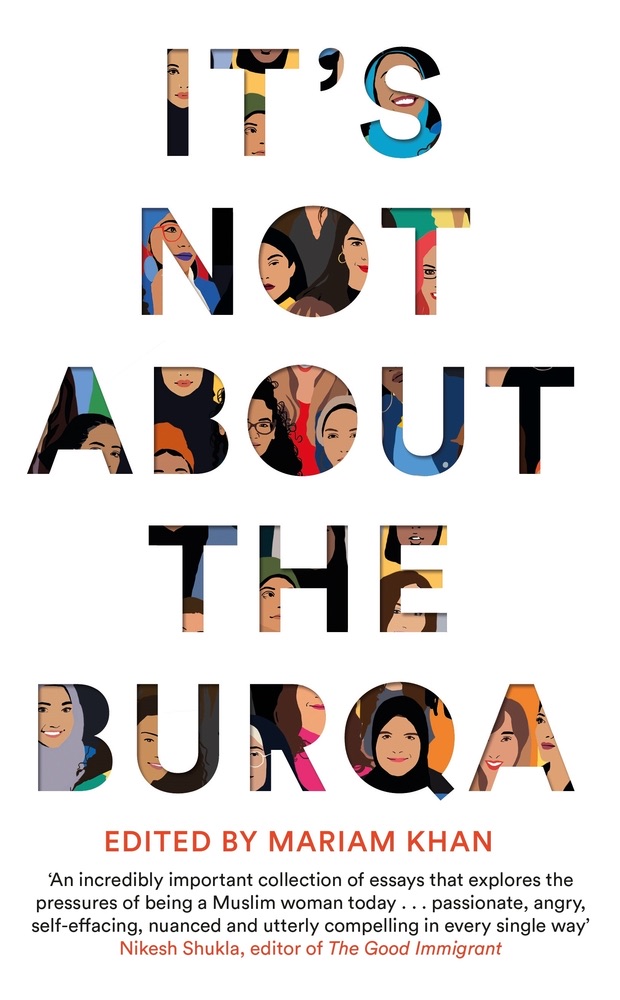
In 2016, Mariam Khan read that David Cameron had linked the radicalization of Muslim men to the ‘traditional submissiveness’ of Muslim women. Mariam felt pretty sure she didn’t know a single Muslim woman who would describe herself that way. Why was she hearing about Muslim women from people who were neither Muslim, nor female?
Years later the state of the national discourse has deteriorated even further, and Muslim women’s voices are still pushed to the fringes – the figures leading the discussion are white and male.
Taking one of the most politicized and misused words associated with Muslim women and Islamophobia, It’s Not About the Burqa is poised to change all that. Here are voices you won’t see represented in the national news headlines: seventeen Muslim women speaking frankly about the hija
Book details
- First published
- 2019
- Author
- Mariam Khan
- Genre
- Nonfiction
- Goodreads rating
- 4.18 (8k ratings)
Keep reading
Headscarves and Hymens: Why the Middle East Needs a Sexual Revolution
 Infidel
 Men Explain Things to Me
 This Bridge Called My Back: Writings by Radical Women of Color
 The Truth Will Set You Free, But First It Will Piss You Off!: Thoughts on Life, Love, and Rebellion
 Sister Outsider: Essays and Speeches
 Unspeakable Things: Sex, Lies and Revolution
 Girl, Woman, Other
 Why I Am Not a Feminist: A Feminist Manifesto
 The Soul of a Woman
 Cunt: A Declaration of Independence
 The Mother of All Questions
 Feminists Don't Wear Pink (And Other Lies): Amazing Women on What the F-Word Means to Them
 A Woman's Worth
 Not That Bad: Dispatches from Rape Culture
 The Women's Room
 Things I've Been Silent About
 The Witches Are Coming
 The Geek Feminist Revolution
 On Our Best Behavior: The Seven Deadly Sins and the Price Women Pay to Be Good
 Shrill: Notes from a Loud Woman
 Women Talking
 My Life on the Road
 Bad Feminist
 Brave
Brave
 Nomad: From Islam to America: A Personal Journey Through the Clash of Civilizations
 How to Be a Woman
 The Underground Girls of Kabul: In Search of a Hidden Resistance in Afghanistan
 The Master's Tools Will Never Dismantle the Master's House
 Redefining Realness: My Path to Womanhood, Identity, Love & So Much More
 The Moment of Lift: How Empowering Women Changes the World
 Trick Mirror: Reflections on Self-Delusion
 What Happened
 Becoming
 Sex Object: A Memoir
 Princess: A True Story of Life Behind the Veil in Saudi Arabia
 Whose Story Is This? Old Conflicts, New Chapters
 The Female Eunuch
 Pure: Inside the Evangelical Movement That Shamed a Generation of Young Women and How I Broke Free
 My Body
 The Favorite Sister
 Outrageous Acts and Everyday Rebellions
 Boys Will Be Boys: Power, Patriarchy and the Toxic Bonds of Mateship
 The Argonauts
 The Change
 Nine Parts of Desire: The Hidden World of Islamic Women
 Untamed
 Opinions: A Decade of Arguments, Criticism, and Minding Other People’s Business
 A Year of Biblical Womanhood
 Princess Sultana's Daughters
 Trainwreck: The Women We Love to Hate, Mock, and Fear... and Why
 The Surface Breaks
 The Dialectic of Sex: The Case for Feminist Revolution
 Unprotected: A Memoir
 How to Suppress Women's Writing
 The Power
 A Girl Is a Body of Water
 Cassandra Speaks: When Women Are the Storytellers, the Human Story Changes
 Too Fat, Too Slutty, Too Loud: The Rise and Reign of the Unruly Woman
 We Should All Be Feminists