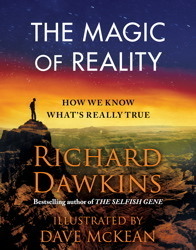

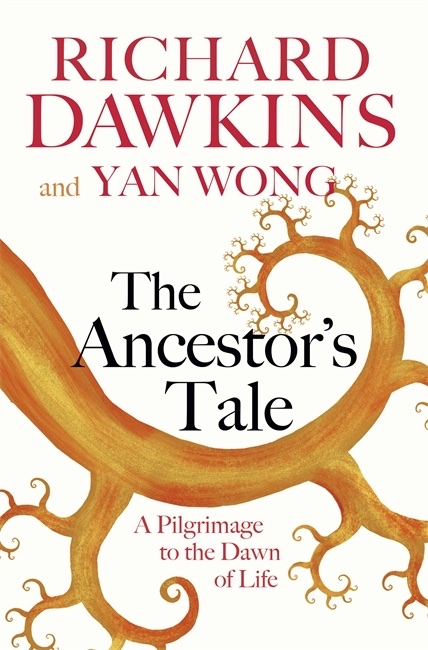
 The Ancestor's Tale: A Pilgrimage to the Dawn of Evolution
Quotes from the Book
bad things, like good things don't happen any more often than they ought to by chance. the universe has no mind, no feelings, and no personality, so it doesn't do things in order to either hurt or please you. bad things happen because things happen.
The truth is more magical - in the best and most exciting sense of the word - than any myth or made-up mystery or miracle. Science has its own magic: the magic of reality.
unlike, say, the sun, or the rainbow, or earthquakes, the fascinating world of the very small never came to the notice of primitive peoples. if you think about this for a minute, it's not really surprising.. they had no way of even knowing it was there, and so of course they didn't invent any myths to explain it. it wasn't until the microscope was invented in the sixteenth century that people discovered that ponds and lakes, soil and dust, even our body, teem with tiny living creatures, too small to see, yet too complicated and, in their own way, beautiful, or perhaps frightening, depending on how you think about them. the whole world is made of incredibly tiny things, much too small to be visible to the naked eye - and yet none of the myths or so-called holy books that some people, even now, think were given to us by an all knowing god, mentions them at all. in fact, when you look at those myths and stories, you can see that they don't contain any of the knowledge that science has patiently worked out. they don't tell us how big or how old the universe is; they don't tell us how to treat cancer; they don't explain gravity or the internal combustion engine; they don't tell us about germs, or nuclear fusion, or electricity, or anaesthetics. in fact, unsurprisingly, the stories in holy books don't contain any more information about the world than was known to the primitive people who first started telling them. if these 'holly books' really were written, or dictated, or inspired, by all knowing gods, don't you think it's odd that those gods said nothing about any of these important and useful things?
The good ended happily, and the bad unhappily. That is what fiction means.
We should always be open-minded, but the only good reason to believe that something exists is if there is real evidence that it does.
To say that something happened supernaturally is not just to say ‘We don’t understand it’ but to say ‘We will never understand it, so don’t even try.
We are in one galaxy called the Milky Way. When you look at the Milky Way’s next-door neighbour, the Andromeda galaxy, your telescope is a time machine taking you back two and a half million years. There’s a cluster of five galaxies called Stephan’s Quintet, which we see through the Hubble telescope spectacularly colliding with each other. But we see them colliding 280 million years ago. If there are aliens in one of those colliding galaxies with a telescope powerful enough to see us, what they are seeing on Earth, at this very moment, here and now, is the early ancestors of the dinosaurs. Are
No testimony is sufficient to establish a miracle, unless the testimony be of such a kind, that its falsehood would be more miraculous than the fact which it endeavours to establish.
Next to the true beauty and magic of the real world, supernatural spells and stage tricks seem cheap and tawdry by comparison. The magic of reality is neither supernatural nor a trick, but – quite simply – wonderful. Wonderful, and real. Wonderful because real.
Your family tree includes not just obvious cousins like chimpanzees and monkeys but also mice, buffaloes, iguanas, wallabies, snails, dandelions, golden eagles, mushrooms, whales, wombats and bacteria. All are our cousins. Every last one of them. Isn’t that a far more wonderful thought than any myth?
There is absolutely no reason to believe that those things for which science does not yet have natural explanations will turn out to be of supernatural origin, any more than volcanoes or earthquakes or diseases turn out to be caused by angry deities, as people once believed they were. Of
Even the orbit of Pluto, however, is nothing like as eccentric as that of a comet. The most famous one, Halley’s Comet, becomes visible to us only near perihelion, when it is closest to the sun and reflects the sun’s light. Its elliptical orbit takes it far, far away, and it returns to our neighbourhood only every 75 to 76 years. I saw it in 1986 and showed it to my baby daughter Juliet. I whispered in her ear (of course she couldn’t understand what I was saying, but I obstinately whispered it anyway) that I would never see it again, but that she would have another chance when it returned in 2061.
If something were to happen that went against our current understanding of reality, scientists would see that as a challenge to our present model, requiring us to abandon or at least change it. It is through such adjustments and subsequent testing that we approach closer and closer to what is true.
Indeed, to claim a supernatural explanation of something is not to explain it at all and, even worse, to rule out any possibility of its ever being explained.
As for the next nearest star, Proxima Centauri, if you look at it in 2012, what you are seeing is happening in 2008.
We needn't bother with exactly what 'electric charge' means here.
the only good reason to believe that something exists is if there is real evidence that it does.
anything that suggests that complicated life forms appeared suddenly, in one go (rather than evolving gradually step by step), is just a lazy story – no better than the fictional magic of a fairy godmother’s wand. As
The ‘tail’ of a comet, by the way, is a train of dust, but it is not streaming out behind the head of the comet as we might think. Instead, it is ‘blown’ by a stream of particles coming from the sun, which we call the solar wind. So the tail of the comet always points away from the sun, no matter which way the comet is travelling. There’s an exciting proposal, once confined to science fiction stories but now being implemented by Japanese space engineers, to use the solar wind to propel spacecraft equipped with gigantic ‘sails’. Like sailing yachts on the sea using real wind, solar wind space-yachts would theoretically provide a very economical way to travel to distant worlds.
There’s a cluster of five galaxies called Stephan’s Quintet, which we see through the Hubble telescope spectacularly colliding with each other. But we see them colliding 280 million years ago. If there are aliens in one of those colliding galaxies with a telescope powerful enough to see us, what they are seeing on Earth, at this very moment, here and now, is the early ancestors of the dinosaurs.
The Hopi tribe of North America had a goddess called Spider Woman. In their creation myth she teamed up with Tawa the sun god, and they sang the First Magic Song as a duet. This song brought the Earth, and life, into being. Spider Woman then took the threads of Tawa’s thoughts and wove them into solid form, creating fish, birds, and all other animals.
Watch on YouTube
About Richard Dawkins
We have collected 220 quotes from 11 books by Richard Dawkins on BookQuoters.
More about the author →More by Richard Dawkins
The Ancestor's Tale: A Pilgrimage to the Dawn of Evolution
 The Blind Watchmaker: Why the Evidence of Evolution Reveals a Universe Without Design
 The Selfish Gene
 The God Delusion
Book details
- Author
- Richard Dawkins
- Genre
- Philosophy
- Goodreads rating
- 4.05 (28k ratings) →
Keep reading
 A Universe from Nothing: Why There Is Something Rather Than Nothing
 The Grand Design
 The Demon-Haunted World: Science as a Candle in the Dark
 The Big Picture: On the Origins of Life, Meaning, and the Universe Itself
 Existential Physics: A Scientist's Guide to Life's Biggest Questions
 Astrophysics for People in a Hurry
 The Varieties of Scientific Experience: A Personal View of the Search for God
 Death by Black Hole: And Other Cosmic Quandaries
 The Three-Body Problem
 The Meaning of It All: Thoughts of a Citizen-Scientist
 Real Magic: Ancient Wisdom, Modern Science, and a Guide to the Secret Power of the Universe
 A Brief History of Time
 Miracles: What They Are, Why They Happen, and How They Can Change Your Life
 Why Does the World Exist?: An Existential Detective Story
The Blind Watchmaker: Why the Evidence of Evolution Reveals a Universe Without Design
Why Does the World Exist?: An Existential Detective Story
The Blind Watchmaker: Why the Evidence of Evolution Reveals a Universe Without Design
 13 Things That Don't Make Sense: The Most Baffling Scientific Mysteries of Our Time
 The Case for a Creator: A Journalist Investigates Scientific Evidence That Points Toward God
 The Cosmic Serpent: DNA and the Origins of Knowledge
 A Short History of Nearly Everything
 Outgrowing God: A Beginner’s Guide to Atheism
 The Case Against Reality: Why Evolution Hid the Truth from Our Eyes
 From Eternity to Here: The Quest for the Ultimate Theory of Time
 Spook: Science Tackles the Afterlife
 Our Mathematical Universe: My Quest for the Ultimate Nature of Reality
 God's Debris: A Thought Experiment
 Unweaving the Rainbow: Science, Delusion and the Appetite for Wonder
 The End of Everything
 Arcadia
 Travels
 Living with a Wild God: A Nonbeliever's Search for the Truth about Everything
 The Accidental Universe: The World You Thought You Knew
 Black Holes and Baby Universes and Other Essays
 Genome
 Helgoland: Making Sense of the Quantum Revolution
 21 Lessons for the 21st Century
 The Rose Field
 The Fifth Science
 A Briefer History of Time
 Echopraxia
 Darwin's Dangerous Idea: Evolution and the Meanings of Life
 Death's End
 Eating the Dinosaur
 The Power of Myth
 Why There Is No God: Simple Responses to 20 Common Arguments for the Existence of God
 Jurassic Park
 Chariots of The Gods
 Metaphysics
 The Fabric of the Cosmos: Space, Time, and the Texture of Reality
 Parallel Worlds: A Journey Through Creation, Higher Dimensions, and the Future of the Cosmos
 Songs of Distant Earth
 Myths to Live By
 Undeniable: Evolution and the Science of Creation
 There Is a God: How the World's Most Notorious Atheist Changed His Mind
 The Gospel of the Flying Spaghetti Monster
 The Tell-Tale Brain: A Neuroscientist's Quest for What Makes Us Human
 Origins: Fourteen Billion Years of Cosmic Evolution
 For Small Creatures Such as We: Rituals for Finding Meaning in Our Unlikely World
 Rationality: From AI to Zombies
 The Occult
 Experimental Film