
 Salt: A World History
Quotes from the Book
Man wants to see nature and evolution as separate from human activities. There is a natural world, and there is man. But man also belongs to the natural world. If he is a ferocious predator, that too is part of evolution. If cod and haddock and other species cannot survive because man kills them, something more adaptable will take their place. Nature, the ultimate pragmatist, doggedly searches for something that works. But as the cockroach demonstrates, what works best in nature does not always appeal to us.
30
To the glee of the British press, a letter has recently been discovered. The letter had been sent to Christopher Columbus, a decade after the Croft affair in Bristol, while Columbus was taking bows for his discovery of America. The letter, from Bristol merchants, alleged that he knew perfectly well that they had been to America already. It is not known if Columbus ever replied. He didn’t need to. Fishermen were keeping their secrets, while explorers were telling the world. Columbus had claimed the entire new world for Spain.
4
The technology never reverses itself. It creates new technology to confront new sets of problems.
3
The town of Lunenburg was built on a hill running down to a sheltered harbour. On one of the upper streets stands a Presbyterian church with a huge gilded cod on its weather vane. Along the waterfront, the wooden-shingled houses are brick red, a color that originally came from mixing clay with cod-liver oil to protect the wood against the salt of the waterfront. It is the look of Nova Scotia - brick red wood, dark green pine, charcoal sea.
3
Cod meat has virtually no fat (.3 percent) and is more than 18 percent protein, which is unusually high even for fish. And when cod is dried, the more than 80 percent of its flesh that is water having evaporated, it becomes concentrated protein - almost 80 percent protein.
3
When the Basque whalers applied to cod the salting techniques they were using on whale, they discovered a particularly good marriage because the cod is virtually without fat, and so if salted and dried well, would rarely spoil. It would outlast whale, which is red meat, and it would outlast herring, a fatty fish that became a popular salted item of the northern countries in the Middle Ages.
3
Antoine-Auguste Parmentier was an eighteenth-century officer who popularized the potato in the French Army, and his name has ever since meant "with potatoes".
2
Nature, the ultimate pragmatist, doggedly searches for something that works. But as the cockroach demonstrates, what works best in nature does not always appeal to us.
2
Newfoundlanders debated over when "the cod was coming back". Few dared ask if. Or what happens to the ocean if they don't come back?
2
PARTY CHOWDER Take a cod of ten pounds, well cleaned, leaving on the skin. Cut into pieces one and a half pounds thick, preserving the head whole. Take one and a half pounds of clear, fat salt pork, cut in thin slices. Do the same with twelve potatoes. Take the largest pot you have. Try out the pork first, then take out the pieces of pork, leaving in the drippings. Add to that three parts of water, a layer of fish, so as to cover the bottom of the pot; next a layer of potatoes, then two tablespoons of salt, I teaspoon of pepper, then the pork, another layer of fish, and the remainder of the potatoes. Fill the pot with water to cover the ingredients. Put over a good fire. Let the chowder boil twenty-five minutes. When this is done have a quart of boiling milk ready, and ten hard crackers split and dipped in cold water. Add milk and crackers. Let the whole boil five minutes. The chowder is then ready to be first-rate if you have followed the directions. An onion may be added if you like the flavor. This chowder is suitable for a large fishing
1
Then, in 1497, five years after Columbus first stumbled across the Caribbean while searching for a westward route to the spice-producing lands of Asia, Giovanni Caboto sailed from Bristol, not in search of the Bristol secret but in the hopes of finding the route to Asia that Columbus had missed. Caboto was a Genovese who is remembered by the English name John Cabot, because he undertook this voyage for Henry VII of England. The English, being in the North, were far from the spice route and so paid exceptionally high prices for spices. Cabot reasoned correctly that the British Crown and the Bristol merchants would be willing to finance a search for a northern spice route. In June, after only thirty-five days at sea, Cabot found land, though it wasn’t Asia. It was a vast, rocky coastline that was ideal for salting and drying fish, by a sea that was teeming with cod. Cabot reported on the cod as evidence of the wealth of this new land,
1
Where there are Norwegian communities, there are cod clubs.
1
People who know fresh cod - from the great restaurants of France, to British working-class fish shops, to the St. John's waterfront - all agree on three things: It should be cooked quickly and gently, it should be prepared simply, and, above all, it must be a thick piece. Only a large piece can be properly cooked.
1
The most highly developed salt cod cuisine in the world is that of the Spanish Basque provinces. Until the nineteenth century, salt cod was exclusively food for the poor, usually broken up in stews.
1
There is a big difference between living in a society that hunts whales and living in one that views them. Nature is being reduced to precious demonstrations for entertainment and education, something far less natural than hunting. Are we headed for a world where nothing is left of nature but parks?
1
Newlyn does not look like the Cornish towns on either side: Penzance and Mousehole. Those are resort towns where British vacationers practice that peculiarly British pastime of strolling the beaches and walkways, bundled in sweaters and mufflers. But Newlyn is a fishing town - or, increasingly, an out-of-work fishing town.
1
Politics and nationalism often play far greater roles than conservation in the decision-making process.
1
Salt cod, morue, had slowly made its way up from peasant food in the south to become an honored French tradition. But not fresh cod.
1
gastronomically, a wild salmon and a farmed salmon have as much in common as a side of wild boar has with pork chops.
1
By the time the war ended, Iceland was a changed country. Not least among the changes, in 1944 it had negotiated full independence from Denmark. Now it was free to negotiate its own relations with the rest of the world. Because of cod, it had moved in one generation from a fifteenth-century colonial society to a modern postwar nation.
1
Since the industrial revolution, Great Britain had been developing an ever-increasing market for groundfish - especially cod, haddock, and plaice - because fried fish, later fish-and-chips, became the favorite dish of the urban working class.
1
Massachusetts had elevated cod from commodity to fetish.
1
Typical of Iberia, both the Basques and the Catalans claim the word comes from their own languages, and the rest of Spain disagrees. Catalans have a myth that cod was the proud king of fish and was always speaking boastfully, which was an offence to God. "Va callar!" (Will you be quiet!), God told the cod in Catalan. Whatever the word's origin, in Spain lo que corta el bacalao, the person who cuts the salt cod, is a colloquialism for the person in charge.
1
In Middle English, cod meant "a bag or a sack", or by inference, "a scrotum", which is why the outrageous purse that sixteenth-century men wore at their crotch to give the appearance of enormous and decorative genitals was called a codpiece.
1
The word cod is of unknown origin. For something that began as food for good Catholics on the days they were to abstain from sex, it is not clear why, in several languages, the words for salt cod have come to have sexual connotations. In the English-speaking West Indies, saltfish is the common name for salt cod. In slang, saltfish means "a woman's genitals", and while Caribbeans do love their salt cod, it is this other meaning that is responsible for the frequent appearance of the word saltfish in Caribbean songs such as the Mighty Sparrow's "Saltfish".
1
Cod became almost a religious icon - a mythological crusader for Christian observance.
1
Watch on YouTube
About Mark Kurlansky
We have collected 66 quotes from 3 books by Mark Kurlansky on BookQuoters.
More about the author →More by Mark Kurlansky
Salt: A World History
 1968: The Year that Rocked the World
About the book
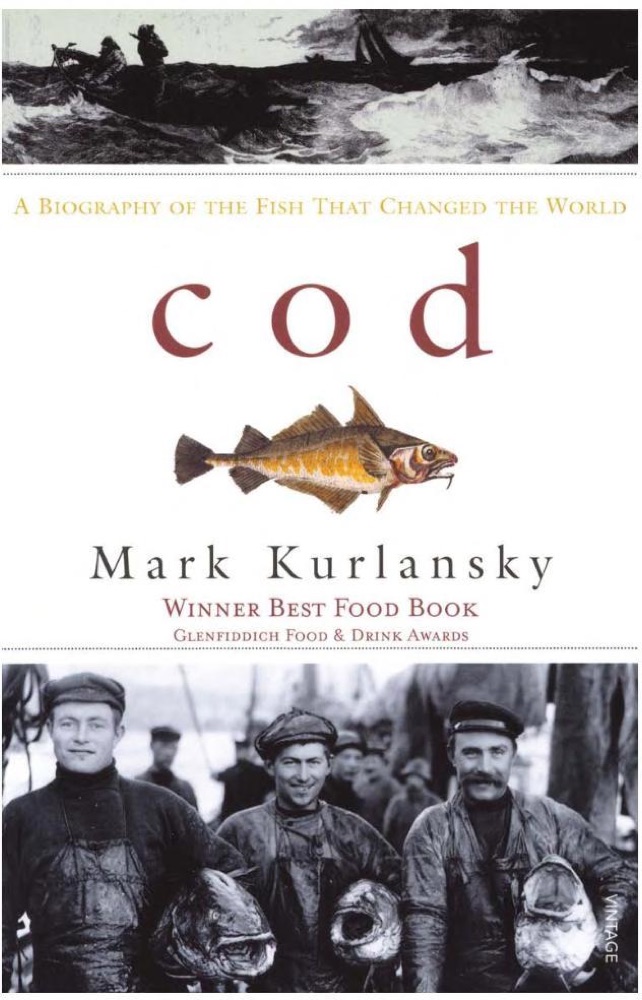
The Cod. Wars have been fought over it, revolutions have been triggered by it, national diets have been based on it, economies and livelihoods have depended on it. To the millions it has sustained, it has been a treasure more precious that gold. This book spans 1,000 years and four continents. From the Vikings to Clarence Birdseye, Mark Kurlansky introduces the explorers, merchants, writers, chefs and fisherman, whose lives have been interwoven with this prolific fish. He chronicles the cod wars of the 16th and 20th centuries. He blends in recipes and lore from the Middle Ages to the present. In a story that brings world history and human passions into captivating focus, he shows how the most profitable fish in history is today faced with extinction.
Book details
- First published
- 1997
- Author
- Mark Kurlansky
- Genre
- History
- Goodreads rating
- 3.92 (26k ratings)
Keep reading
Salt: A World History
 Four Fish: The Future of the Last Wild Food
 Made in America: An Informal History of the English Language in the United States
 The Third Plate: Field Notes on the Future of Food
 At Home: A Short History of Private Life
 The Book of General Ignorance
 1491: New Revelations of the Americas Before Columbus
 The Log from the Sea of Cortez
 Ripple
 Kon-Tiki
 Fuzz: When Nature Breaks the Law
 A Cook's Tour: Global Adventures in Extreme Cuisines
 In the Heart of the Sea: The Tragedy of the Whaleship Essex
 The Etymologicon: A Circular Stroll through the Hidden Connections of the English Language
 Catching Fire: How Cooking Made Us Human
 An Everlasting Meal: Cooking with Economy and Grace
 Into the Drowning Deep
 Nathaniel's Nutmeg: How One Man's Courage Changed the Course of History
 Sea People: The Puzzle of Polynesia
 Madhouse at the End of the Earth: The Belgica's Journey into the Dark Antarctic Night
 Trilobite: Eyewitness to Evolution
 Animal, Vegetable, Miracle: A Year of Food Life
 Guns, Germs, and Steel: The Fates of Human Societies
 A History of the World in 100 Objects
 Cooked: A Natural History of Transformation
 Collapse: How Societies Choose to Fail or Succeed
 The Sex Lives of Cannibals: Adrift in the Equatorial Pacific
 Boomerang: Travels in the New Third World
 Twenty Thousand Leagues Under the Sea
 Gulp: Adventures on the Alimentary Canal
 Cannibalism: A Perfectly Natural History
 Following the Equator: A Journey Around the World
 Cannery Row
 Billions & Billions: Thoughts on Life and Death at the Brink of the Millennium
 Feral: Rewilding the Land, the Sea and Human Life
 The Omnivore's Dilemma: A Natural History of Four Meals
 Chesapeake
 Europe: A History
 A History of the World in 6 Glasses
 Folks, This Ain't Normal: A Farmer's Advice for Happier Hens, Healthier People, and a Better World
 Cinnamon and Gunpowder
 Scattered All Over the Earth
 The Art of Eating
 Children of Ash and Elm: A History of the Vikings
 Notes from a Small Island
 The Fresco
 Life on the Mississippi
 Under a White Sky: The Nature of the Future
 Last Chance to See
 Wilding
 Captains Courageous
 Ireland
 The Nasty Bits: Collected Varietal Cuts, Usable Trim, Scraps, and Bones
 The Wager: A Tale of Shipwreck, Mutiny and Murder
 438 Days: An Extraordinary True Story of Survival at Sea
 Fast Food Nation: The Dark Side of the All-American Meal
 Maelstrom
 The Last Continent
 The Wizard and the Prophet: Two Remarkable Scientists and Their Dueling Visions to Shape Tomorrow's World
 Upheaval: Turning Points for Nations in Crisis