
 Songs of Distant Earth
Quotes from the Book
Pearls rarely turn up in oysters served to you on a plate; you have to dive for them.
16
SOME PEOPLE BELIEVE IN FATE, OTHERS DON’T. I DO, and I don’t. It may seem at times as if invisible fingers move us about like puppets on strings. But for sure, we are not born to be dragged along. We can grab the strings ourselves and adjust our course at every crossroad, or take off at any little trail into the unknown.
15
Otherwise he was glad we had missed our landing, for he still had three books to read.
11
The Kon-Tiki expedition opened my eyes to what the ocean really is. It is a conveyor and not an isolator.
8
Agreement and acceptance rarely stimulate experiments and progress.
7
The sea contains many surprises for him who has his floor on a level with the surface and drifts along slowly and noiselessly. A sportsman who breaks his way through the woods may come back and say that no wild life is to be seen. Another may sit down on a stump and wait, and often rustlings and cracklings will begin and curious eyes peer out. So it is on the sea, too. We usually plow across it with roaring engines and piston strokes, with the water foaming round our bow. Then we come back and say that there is nothing to see far out on the ocean.
5
The task of science is investigation pure and simple,” he said quietly. “Not to try to prove this or that.” He
5
dissidence and controversy are what bring science forward. Agreement and acceptance rarely stimulate experiments and progress.
5
But you can’t navigate a raft,” he added. “It goes sideways and backward and round as the wind takes it.
4
It was a great moment on board when two large boobies were spotted above the horizon to westward
4
Then we heard, rather faintly, in the receiver: “If all’s well, why worry?
2
The dolphin (dorado), which is a brilliantly colored tropical fish, must not be confused with the creature, also called dolphin, which is a small, toothed whale.
2
No tempest at sea is harder on a man than to stand alone encircled by a firing squad of international authorities. A firm conviction of being in the right becomes your only armor against the barrage of assaults that can often be both personal and unfair. Yet dissidence and controversy are what bring science forward. Agreement and acceptance rarely stimulate experiments and progress.
1
They’re specialists, the whole lot of them, and they don’t believe in a method of work which cuts into every field of science from botany to archaeology. They limit their own scope in order to be able to dig in the depths with more concentration for details. Modern research demands that every special branch shall dig in its own hole. It’s not usual for anyone to sort out what comes up out of the holes and try to put it all together.
1
Order number one, which came first and last, was: Hold on to the raft! Whatever happened, we must hang on tight on board and let the nine great logs take the pressure from the reef. We ourselves had more than enough to do to withstand the weight of the water. If we jumped overboard, we should become helpless victims of the suction which would fling us in and out over the sharp corals. The rubber raft would capsize in the steep seas or, heavily loaded with us in it, it would be torn to ribbons against the reef. But the wooden logs would sooner or later be cast ashore, and we with them, if we only managed to hold fast.
1
Purgatory was a bit damp,’ said Bengt, ‘but heaven was more or less as I’d imagined it.
1
When the day of our departure was approaching, we went to the regular passport control office to get permission to leave the country. Bengt stood first in the line as interpreter. “What is your name?” asked a ceremonious little clerk, looking suspiciously over his spectacles at Bengt’s huge beard. “Bengt Emmerik Danielsson,” Bengt answered respectfully. The man put a long form into his typewriter. “By what boat did you come to Peru?” “Well, you see,” Bengt explained, bending over the mild little man, “I didn’t come by boat. I came to Peru by canoe.” The man looked at Bengt dumb with astonishment and tapped out “canoe” in an open space on the form. “And by what boat are you leaving Peru?” “Well, you see, again,” said Bengt politely, “I’m not leaving Peru by boat. I’m leaving by raft.” “A likely story!” the clerk cried angrily and tore the paper out of the machine. “Will you please answer my questions properly?
1
I definitely smelled a delicious odor of steak and onions. But it turned out to be only a dirty shirt.
1
Sometimes, too, we went out in the rubber boat to look at ourselves by night. Coal-black seas towered up on all sides, and a glittering myriad of tropical stars drew a faint reflection from plankton in the water. The world was simple—stars in the darkness. Whether it was 1947 B.C. or A.D. suddenly became of no significance. We lived, and that we felt with alert intensity. We realized that life had been full for men before the technical age also—in fact, fuller and richer in many ways than the life of modern man. Time and evolution somehow ceased to exist; all that was real and that mattered were the same today as they had always been and would always be. We were swallowed up in the absolute common measure of history—endless unbroken darkness under a swarm of stars.
ONCE IN A WHILE YOU FIND YOURSELF IN AN odd situation. You get into it by degrees and in the most natural way but
Scientific medals do not make headlines, but stimulate aggression among those who never get any.
We lived, and that we felt with alert intensity.
Watch on YouTube
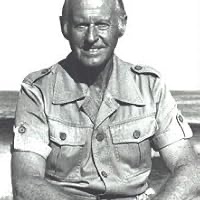
About Thor Heyerdahl
We have collected 22 quotes from 1 book by Thor Heyerdahl on BookQuoters.
More about the author →About the book
Kon-Tiki is the record of an astonishing adventure - a journey of 4,300 nautical miles across the Pacific Ocean by raft. Intrigued by Polynesian folklore, biologist Thor Heyerdahl suspected that the South Sea Islands had been settled by an ancient race from thousands of miles to the east, led by a mythical hero, Kon-Tiki. He decided to prove his theory by duplicating the legendary voyage.
On April 28, 1947, Heyerdahl and five other adventurers sailed from Peru on a balsa log raft. After three months on the open sea, encountering raging storms, whales, and sharks, they sighted land - the Polynesian island of Puka Puka.
Translated into over sixty languages, Kon-Tiki is a classic, inspiring tale of daring and courage - a magnificent saga of men against the sea.
Book details
- First published
- 1948
- Author
- Thor Heyerdahl
- Genre
- Nonfiction
- Goodreads rating
- 4.16 (26k ratings)
Keep reading
Songs of Distant Earth
 Antarctica
 A Bend in the River
 Nation
 2010: Odyssey Two
 The Mysterious Island
 Journey to the Center of the Earth
 Rendezvous with Rama
 Adrift: Seventy-Six Days Lost at Sea
 The Cat's Table
 The Sex Lives of Cannibals: Adrift in the Equatorial Pacific
 West with the Night
 Flight Behavior
 The Log from the Sea of Cortez
 Endurance: Shackleton's Incredible Voyage
 State of Wonder
 A Fire Upon the Deep
 Ripple
 Into the Drowning Deep
 Quicksilver
 Sometimes a Great Notion
 Twenty Thousand Leagues Under the Sea
 Last Chance to See
 The Farthest Shore
 Following the Equator: A Journey Around the World
 Caliban’s War
 The Shipping News
 Remarkable Creatures
 Out of the Silent Planet
 The Bedlam Stacks
 A Passage to India
 Small Wonder
 The Worst Journey in the World
 The Dark Forest
 The Long Earth
 Arctic Dreams
 Authority
 Alas, Babylon
 The Path Between the Seas: The Creation of the Panama Canal, 1870-1914
 The Long Dark Tea-Time of the Soul
 Island of the Sequined Love Nun
 Roughing It
 We, the Drowned
 Where the Wind Leads: A Refugee Family's Miraculous Story of Loss, Rescue, and Redemption
 Voyage of the Beagle
 The Sailor Who Fell from Grace with the Sea
 Leviathan Wakes
 Babylon's Ashes
 The Shape of Water
 Maelstrom
 The Plover
 Death's End
 Blue Remembered Earth
 Red Mars
 Billions & Billions: Thoughts on Life and Death at the Brink of the Millennium
 Dirk Gently's Holistic Detective Agency
 South: The Story of Shackleton's Last Expedition 1914-1917
 Earth Abides
 The Star Diaries
 The Quiet Game