
 Cooked: A Natural History of Transformation
Quotes from the Book
There is great value in being able to say "yes" when people ask if there is anything they can do. By letting people pick herbs or slice bread instead of bringing a salad, you make your kitchen a universe in which you can give completely and ask for help. The more environments with that atmospheric makeup we can find or create, the better.
24
All ingredients need salt. The noodle or tender spring pea would be narcissistic to imagine it already contained within its cell walls all the perfection it would ever need. We seem, too, to fear that we are failures at being tender and springy if we need to be seasoned. It’s not so: it doesn’t reflect badly on pea or person that either needs help to be most itself.
19
Great meals rarely start at points that all look like beginnings. They usually pick up where something else leaves off. This is how most of the best things are made - imagine if the world had to begin from scratch each dawn: a tree would never grow, nor would we ever get to see the etchings of gentle rings on a clamshell... Meals' ingredients must be allowed to topple into one another like dominos. Broccoli stems, their florets perfectly boiled in salty water, must be simmered with olive oil and eaten with shaved Parmesan on toast; their leftover cooking liquid kept for the base for soup, studded with other vegetables, drizzled with good olive oil, with the rind of the Parmesan added for heartiness. This continuity is the heart and soul of cooking.
18
If we were taught to cook as we are taught to walk, encouraged first to feel for pebbles with our toes, then to wobble forward and fall, then had our hands firmly tugged on so we would try again, we would learn that being good at it relies on something deeply rooted, akin to walking, to get good at which we need only guidance, senses, and a little faith. We aren't often taught to cook like that, so when we watch people cook naturally, in what looks like an agreement between cook and cooked, we think that they were born with an ability to simply know that an egg is done, that the fish needs flipping, and that the soup needs salt. Instinct, whether on the ground or in the kitchen, is not a destination but a path.
9
But cooking is best approached from wherever you find yourself when you are hungry, and should extend long past the end of the page. There should be serving, and also eating, and storing away what's left; there should be looking at meals' remainders with interest and imagining all the good things they will become.
5
So you must simply pay attention, trust yourself, and decide.
4
Though plucking artichoke leaves doesn't mend all cracked spirits as firmly as pea shelling, it has its own curative power. There is a Dutch saying: “Bitter in the mouth cures the heart.” If you happen to have a friend shaken by heartache, hand over a bag of raw artichokes. Once she has relieved them of their leaves, encourage one brave bite. Between the meditative peeling and the bitter taste, she should be completely healed. If there are no artichokes around, raw dandelion greens are a good substitute.
4
The word instinct comes from a combination of in meaning “toward,” and stinguere meaning “to prick.” It doesn’t mean knowing anything, but pricking your way toward the answer.
3
The bones and shells and peels of things are where a lot of their goodness resides. It's no more or less lamb for being meat or bone; it's no more or less pea for being pea or pod. Grappa is made from the spent skins and stems and seeds of wine grapes; marmalade from the peels of oranges. The wine behind grappa is great, but there are moments when only grappa will do; the fruit of the orange is delicious, but it cannot be satisfactorily spread. “The skins of onions, green tops from leeks, stems from herbs must all be swept directly into a pot instead of the garbage. Along with the bones from a chicken, raw or cooked, they are what it takes to make chicken stock, which you need never buy, once you decide to keep its ingredients instead of throwing them away. If you have bones from fish, it's fish stock. If there are bones from pork or lamb, you will have pork or lamb stock.
3
Food is what I love, and how I communicate love, and how I calm myself.
3
t smells in. Let the smell of hot tarmac in the summer remind you of a meal you ate the first time you landed in a hot place, when the ground smelled like it was melting. Let the smell of salt remind you of a paper basket of fried clams you ate once, squeezing them with lemon as you walked on a boardwalk. Let it reach your deeper interest. When you smell the sea, and remember the basket of hot fried clams, and the sound of skee-balls knocking against each other, let it help you love what food can do, which is to tie this moment to that one. Then something about the wind off the sea will have settled in your mind, and carried the fried clams and squeeze of a lemon with it.
3
Good meat only seems so expensive because we eat meat like children taking bites out of the middles of sandwiches and throwing the rest away.
2
Or dispense with any heating and combining and buy a few dark chocolate bars. Break them into big squares and serve them in a tumble on a plate, with a glass of Scotch per person, which will make each appetite feel listened to, and provide a tiny anesthetic to the pain of letting go.
2
Substitute any vegetable that grows with its leafy head aboveground for another: a flower for a flower, a root for a root, shoot for shoot, stem for stem, tuber for tuber. (No rules apply to beets.
2
The managed grazing of pastured animals is as good for land as factory farming is bad for it.
1
There are certain stormy days when a sensible meal of chickpea soup won't do. That is when I turn to a secret cache of cans I keep, even though they are frivolous, for the strange weather that needs them. [...] It is as wise to be prepared for an impractical meal as for a practical one. If something so good or so bad has happened that only buttered toast and cuttlefish, or delicately whipped liver or goose neck, or pâté are appropriate, as long as you keep your pantry stocked with a few lovely, uncommon things, you can open it and be as well set up to celebrate as to survive.
1
Luckily we don’t have far to go. Great meals rarely start at points that all look like beginnings. They usually pick up where something else leaves off. This is how most of the best things are made—imagine if the world had to begin from scratch each dawn: a tree would never grow, nor would we ever get to see the etchings of gentle rings on a clamshell.
1
You, of course, are not I, and it must be from someplace in you, not me, that you serve. If you like symmetry, you must line things up. If you feel most satisfied composing plates away from your table, do it happily, for it will be genuine and full of what is yours to offer. Only remember what is plainly and always true: the act of serving fulfills itself.
When not fully cooked, any vegetable seems starchy and indifferent: it hasn’t retained the virtues of being recently picked nor benefited from the development of sugars that comes with time and heat. There’s not much I dislike more than biting into a perfectly lovely vegetable and hearing it squeak.
Omelets, which provide the gracious foil of soft, simple egg, are especially good at making less dramatic meals from restaurant leftovers, which are usually so strongly seasoned that eating them untransformed the next day can feel like meeting someone at the breakfast table in full makeup.
Unless you are an aspiring laser beam, your microwave won’t teach you anything. Use yours as a bookshelf, or to store gadgets you don’t use.
1 shallot, finely chopped 1/2 teaspoon salt red or white wine vinegar 1 bunch parsley, leaves picked from stems and roughly chopped 1/2 clove garlic, chopped and pounded to a paste with a tiny bit of salt in a mortar with a pestle or on a cutting board 1 anchovy fillet, finely chopped 1 teaspoon capers, finely chopped 1/2 cup olive oil Put the shallot in a small mixing bowl. Add the salt and then enough vinegar to cover. Let it sit for 10 to 15 minutes. Drain the shallot of its vinegar, reserving it for a future vinaigrette. Mix the shallot and the rest of the ingredients together.
First, an egg is not an egg is not an egg. I don't know what to call the things that are produced by hens crowded into dirty cages, their beaks snipped, tricked into laying constantly. Whatever they are, they are only edible in the sense that we can cram anything down if we need to; their secrets merit airing, but not eating.
Watch on YouTube
About Tamar Adler
We have collected 23 quotes from 1 book by Tamar Adler on BookQuoters.
More about the author →About the book
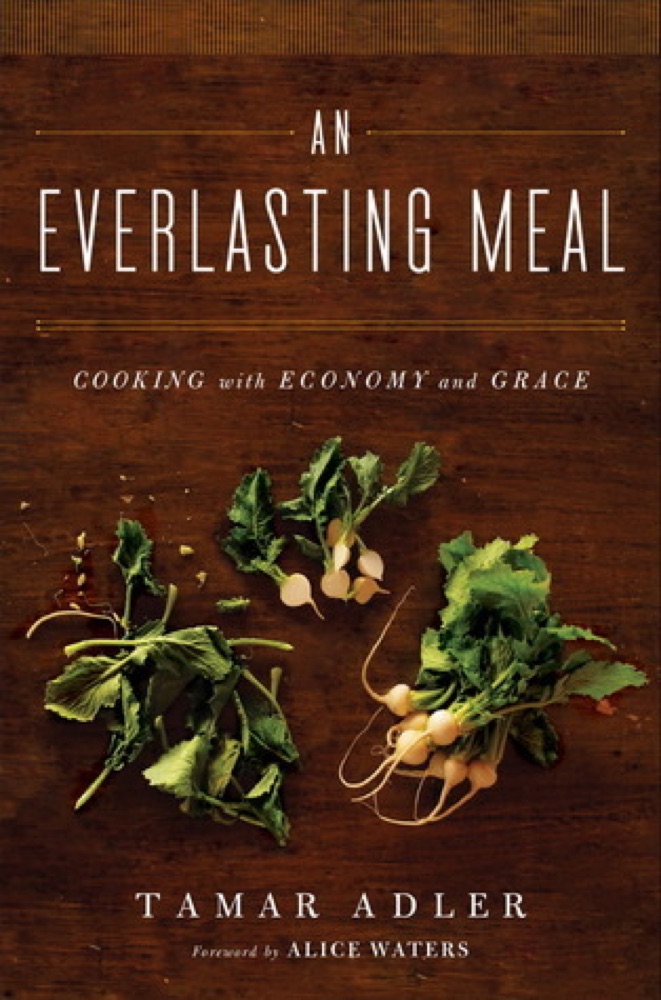
Reviving the inspiring message of M. F. K. Fisher’s How to Cook a Wolf — written in 1942 during wartime shortages— An Everlasting Meal shows that cooking is the path to better eating.
Through the insightful essays in An Everlasting Meal, Tamar Adler issues a rallying cry to home cooks.
In chapters about boiling water, cooking eggs and beans, and summoning respectable meals from empty cupboards, Tamar weaves philosophy and instruction into approachable lessons on instinctive cooking. Tamar shows how to make the most of everything you buy, demonstrating what the world’s great chefs that great meals rely on the bones and peels and ends of meals before them.
She explains how to smarten up simple food and gives advice for fixing dishes gone awry. She recommends turning to neglected onions, celery, and potatoes for inexpensive meals that taste full of fresh vegetables, and cooking meat and
Book details
- First published
- 2011
- Author
- Tamar Adler
- Genre
- Nonfiction
- Goodreads rating
- 4.20 (8k ratings)
Keep reading
Cooked: A Natural History of Transformation
 The Art of Eating
 When in Doubt, Add Butter
 Animal, Vegetable, Miracle: A Year of Food Life
 The Supper of the Lamb: A Culinary Reflection
 Buttermilk Graffiti: A Chef’s Journey to Discover America’s New Melting-Pot Cuisine
 Midnight Chicken: & Other Recipes Worth Living For
 First Bite: How We Learn to Eat
 A Cook's Tour: Global Adventures in Extreme Cuisines
 Food: A Love Story
 The 4-Hour Chef: The Simple Path to Cooking Like a Pro, Learning Anything, and Living the Good Life
 The Devil in the Kitchen: Sex, Pain, Madness and the Making of a Great Chef
 In Defense of Food: An Eater's Manifesto
 The Omnivore's Dilemma: A Natural History of Four Meals
 The 80/10/10 Diet: Balancing Your Health, Your Weight, and Your Life, One Luscious Bite at a Time
 The Third Plate: Field Notes on the Future of Food
 Medium Raw: A Bloody Valentine to the World of Food and the People Who Cook
 The School of Essential Ingredients
 Kitchen Confidential: Adventures in the Culinary Underbelly
 Blood, Bones, and Butter: The Inadvertent Education of a Reluctant Chef
 Eating Animals
 Women, Food and God: An Unexpected Path to Almost Everything
 The Sharper Your Knife, the Less You Cry: Love, Laughter, and Tears at the World's Most Famous Cooking School
 Woman, Eating
 Folks, This Ain't Normal: A Farmer's Advice for Happier Hens, Healthier People, and a Better World
 Recipes for Love and Murder
 Cinnamon and Gunpowder
 The 4-Hour Body: An Uncommon Guide to Rapid Fat-Loss, Incredible Sex, and Becoming Superhuman
 If You Can't Take the Heat: Tales of Food, Feminism, and Fury
 Recipe for Second Chances
 Catching Fire: How Cooking Made Us Human
 My Life in France
 Land of Milk and Honey
 Gulp: Adventures on the Alimentary Canal
 French Women Don't Get Fat: The Secret of Eating for Pleasure
 The World Peace Diet
 The Book of Unholy Mischief
 Paddle Your Own Canoe: One Man's Fundamentals for Delicious Living
 Intuitive Eating: A Revolutionary Program That Works
 Shattered
 The Kindred Spirits Supper Club
 Eat to Live: The Revolutionary Formula for Fast and Sustained Weight Loss
 Heartburn
 Julie and Julia: 365 Days, 524 Recipes, 1 Tiny Apartment Kitchen: How One Girl Risked Her Marriage, Her Job, and Her Sanity to Master the Art of Living
 I Feel Bad about My Neck: And Other Thoughts on Being a Woman
 Whole: Rethinking the Science of Nutrition
 The One-Straw Revolution
 32 Yolks: From My Mother's Table to Working the Line
 Lunch in Paris: A Love Story, with Recipes
 My Fine Fellow
 Moranifesto
 A Woman Makes a Plan: Advice for a Lifetime of Adventure, Beauty, and Success
 Gourmet Rhapsody
 The Dirty Life: On Farming, Food, and Love
 Gut: The Inside Story of Our Body's Most Underrated Organ
 The Food of Love
 Relish: My Life in the Kitchen
 The Coincidence of Coconut Cake
 The Girl Who Soared Over Fairyland and Cut the Moon in Two
 The Strawberry Thief