 Why Religion? A Personal Story
Quotes from the Book
When John accuses "evildoers" of leading gullible people into sin, what troubles him is what troubled the Essenes: whether—or how much—to accommodate pagan culture. And when we see Jesus' earliest followers, including Peter, James, and Paul, not as we usually see them, as early Christians, but as they saw themselves—as Jews who had found God's messiah—we can see that they struggled with the same question. For when John charges that certain prophets and teachers are encouraging God's people to eat "unclean" food and engage in "unclean" sex, he is taking up arguments that had broken out between Paul and followers of James and Peter about forty years earlier—an argument that John of Patmos continues with a second generation of Paul's followers. For when we ask, who are the "evildoers" against whom John warns? we may be surprised by the answer. Those whom John says Jesus "hates" look very much like the Gentile followers of Jesus converted through Paul's teaching. Many commentators have pointed out that when we step back from John's angry rhetoric, we can see that the very practices John denounces are those that Paul had recommended.
10
characterizing Christians as criminally minded people whose meetings were covers for secret rituals involving “people of both sexes, and all ages,” including children, in group orgies:
When John accuses 'evildoers' of leading gullible people into sin, what troubles him is what troubled the Essenes: whether - or how much - to accommodate pagan culture. And when we see Jesus' earliest followers, including Peter, James, and Paul, not as we usually see them, as early Christians, but as they saw themselves - as Jews who had found God's messiah - we can see that they struggled with the same question. For when John charges that certain prophets and teachers are encouraging God's people to eat 'unclean' food and engage in 'unclean' sex, he is taking up arguments that had broken out between Paul and followers of James and Peter about forty years earlier - an argument that John of Patmos continues with a second generation of Paul's followers. For when we ask, who are the 'evildoers' against whom John warns? we may be surprised at the answer. Those whom John says Jesus 'hates' look very much like Gentile followers of Jesus converted through Paul's teaching. Many commentators have pointed out that when we step back from John's angry rhetoric, we can see that the very practices John denounces are those that Paul had recommended.
Those whom John says Jesus “hates” look very much like Gentile followers of Jesus converted through Paul’s teaching. Many commentators have pointed out that when we step back from John’s angry rhetoric, we can see that the very practices John denounces are those that Paul had recommended.
Although John’s prophecies are in the New Testament, we do not actually know whether he saw himself as a Christian. There is no doubt that John was a devoted follower of Jesus Christ, but he never actually uses the term “Christian”—probably because what we call Christianity had not yet become entirely separate from Judaism. Instead, like Peter, Paul, and other early followers of Jesus, John clearly saw himself as a Jew who had found the messiah.
John’s visions of such monsters, then, are modeled on creation stories even older than those in Genesis.
A close reader of the Hebrew Scriptures would see that John was invoking prophetic images to interpret the conflicts of his own time, just as the prophets Isaiah and Jeremiah had interpreted the Babylonian War around six hundred years earlier.
Revering the ruler was less a matter of worshipping a human being than of showing respect for the gods who had placed him there, and so shaped the destiny of nations.
Just as the poet Marianne Moore says that poems are “imaginary gardens with real toads in them,” John’s visions and monsters are meant to embody actual beings and events.
What John did in the Book of Revelation, among other things, was create anti-Roman propaganda that drew its imagery from Israel’s prophetic traditions—above all, the writings of Isaiah, Jeremiah, Ezekiel, and Daniel.
Watch on YouTube
About Elaine Pagels
We have collected 66 quotes from 3 books by Elaine Pagels on BookQuoters.
More about the author →More by Elaine Pagels
Why Religion? A Personal Story
 The Gnostic Gospels
About the book
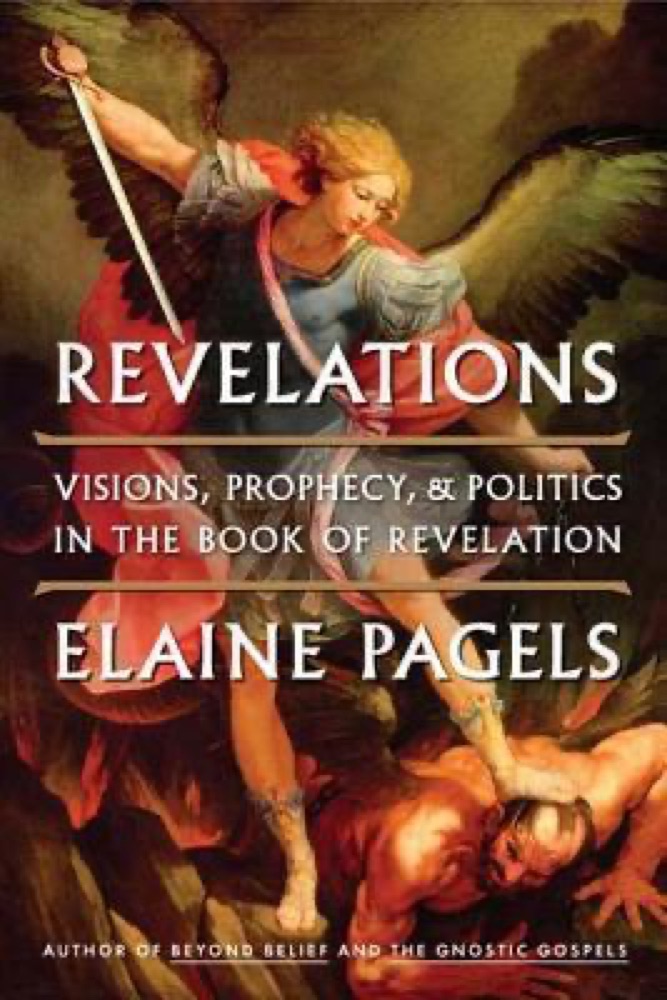
A startling exploration of the history of the most controversial book of the Bible, by the bestselling author of Beyond Belief. Through the bestselling books of Elaine Pagels, thousands of readers have come to know and treasure the suppressed biblical texts known as the Gnostic Gospels. As one of the world's foremost religion scholars, she has been a pioneer in interpreting these books and illuminating their place in the early history of Christianity. Her new book, however, tackles a text that is firmly, dramatically within the New Testament canon: The Book of Revelation, the surreal apocalyptic vision of the end of the world . . . or is it?
In this startling and timely book, Pagels returns The Book of Revelation to its historical origin, written as its author John of Patmos took aim at the Roman Empire after what is now known as "the Jewish War," in 66 CE. Militant Jews in Jerusalem,
Book details
- First published
- 2012
- Author
- Elaine Pagels
- Genre
- Nonfiction
- Goodreads rating
- 3.84 (3k ratings)
Keep reading
 How Jesus Became God: The Exaltation of a Jewish Preacher from Galilee
 Forged: Writing in the Name of God—Why the Bible's Authors Are Not Who We Think They Are
 Zealot: The Life and Times of Jesus of Nazareth
 The History of the Church: From Christ to Constantine
 Paul: A Biography
 How God Became King: The Forgotten Story of the Gospels
 The Case for Christ
 Godless: How an Evangelical Preacher Became One of America's Leading Atheists
 Sinners in the Hands of a Loving God: The Scandalous Truth of the Very Good News
 The Challenge of Jesus: Rediscovering Who Jesus Was & Is
 Jesus of Nazareth: The Infancy Narratives
 Jesus for President: Politics for Ordinary Radicals
 The Bible Tells Me So: Why Defending Scripture Has Made Us Unable to Read It
 The Politics of Jesus
 The Order
 The Messiah Matrix
 Inspired: Slaying Giants, Walking on Water, and Loving the Bible Again
The Gnostic Gospels
Inspired: Slaying Giants, Walking on Water, and Loving the Bible Again
The Gnostic Gospels
 No God but One: Allah or Jesus?: A Former Muslim Investigates the Evidence for Islam and Christianity
 A History of God: The 4,000-Year Quest of Judaism, Christianity, and Islam
 Jesus and the Disinherited
 Separation of Church and Hate: A Sane Person's Guide to Taking Back the Bible from Fundamentalists, Fascists, and Flock-Fleecing Frauds
 Killing Jesus: A History
 Systematic Theology: An Introduction to Biblical Doctrine
 The Prophetic Imagination
 The Case for God
 Bad Religion: How We Became a Nation of Heretics
 The Darkening Age: The Christian Destruction of the Classical World
 Life of Christ
 The Apostle : A Life of Paul
 The Prodigal God: Recovering the Heart of the Christian Faith
 The Gospel of Judas
 Amazing Grace: A Vocabulary of Faith
 The Age of Reason
 The Immortality Key: Uncovering the Secret History of the Religion with No Name
 Sitting at the Feet of Rabbi Jesus: How the Jewishness of Jesus Can Transform Your Faith
 What Is the Bible?: How an Ancient Library of Poems, Letters, and Stories Can Transform the Way You Think and Feel About Everything
 The Gospel in a Pluralist Society
 King's Cross: The Story of the World in the Life of Jesus
 Studies in the Sermon on the Mount
 Under the Banner of Heaven: A Story of Violent Faith
 On the Incarnation
 The Jesus I Never Knew
 Some Danger Involved
 The Divine Conspiracy: Rediscovering Our Hidden Life in God
 Jesus the Christ
 The Reason for God: Belief in an Age of Skepticism
 Who Wrote the Bible?
 Seeking Allah, Finding Jesus: A Devout Muslim Encounters Christianity
 Evangelism & the Sovereignty of God
 Speaking of Jesus: The Art of Not-Evangelism
 The Kabbalistic Murder Code
 Adopted for Life: The Priority of Adoption for Christian Families & Churches
 Girl Meets God
 Foxe's Book of Martyrs
 Jesus Feminist: An Invitation to Revisit the Bible's View of Women
 The New Oxford Annotated Bible: New Revised Standard Version
 The Prophets