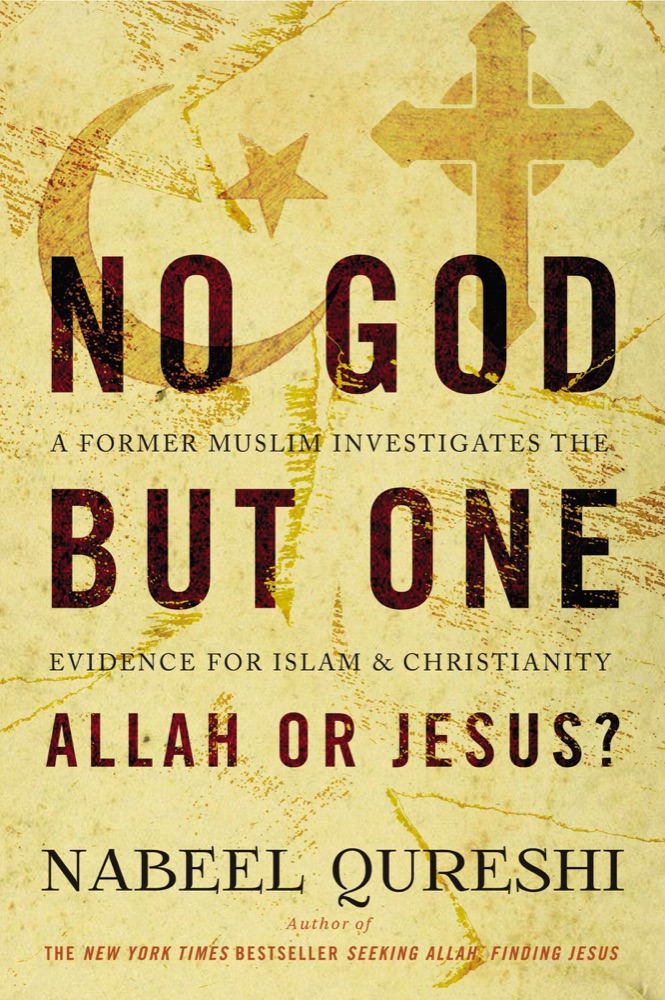

 Seeking Allah, Finding Jesus: A Devout Muslim Encounters Christianity
Quotes from the Book
The gospel is not just an answer that works; it is the only answer that will work.
7
it is the life of Muhammad to which Islamists appeal in order to justify their terrorism.
2
the Crusades were launched in defense of the Byzantine Empire after two-thirds of the Christian world had been conquered by centuries of Muslim attacks. Muslims
2
Islam diagnoses the world with ignorance and offers the remedy of sharia, a law to follow. Christianity diagnoses the world with brokenness and offers the remedy of God himself, a relationship with him that leads to heart transformation.
1
Islam requires us to believe that Jesus was so incompetent as a teacher and prophet that he was not able to instill this most simple fact in his followers’ minds: that he was merely a human. Given that Islam’s central proclamation is tawhid, this means Jesus was an abject failure. In fact, he was worse than a total failure, since he left his disciples believing the exact opposite of tawhid.
1
As a Muslim, I had been taught from childhood that the doctrine of the Trinity was not possible because it was too complex and even self-contradictory. But the more mankind probes the universe, the more we discover its dazzling complexity. As my eyes opened to the deeper truths of the world, I accepted that complexity does not somehow invalidate the Trinity. Why must we assume the Creator is any simpler, any easier to understand, than his creation?
The only option that accounted for the historical evidence was that the disciples simply got the facts wrong; but upon consideration, this posed a serious problem for my Islamic belief. If Allah saved Jesus from the cross while making it look like Jesus died, as most Muslims believe, then Allah is responsible for the disciples’ proclamation of Jesus’ death and resurrection. Therefore, Allah started Christianity, a false religion that has kept billions away from Islam. Worse, Christians believe Jesus is God because of their faith in his resurrection, yet the Quran tells us that people who believe Jesus is God will go to hell (5.72). Could I really believe that, just to save Jesus from the cross, God deceived the disciples, letting them proclaim that Jesus is the risen Lord and thereby sending billions of people to hell?
After studying the historical origins of the Christian faith, I came to these conclusions: that Jesus died on the cross is as certain as anything historical can be; that he rose from the dead is by far the best explanation of the events surrounding his death; and that Jesus claimed to be God is the best explanation for the immediate Christian proclamation of Jesus’ deity.
Jesus is worthy of the honor due to God (5:23); he asks people to have faith in him as they have faith in God (14:1); he claims to be the enabler of salvation (5:21) and the earthly manifestation of God (14:8); he is the king of another world (18:36–37); he assumes dominion over all things (3:35); and he claims to be able to do whatever people ask in his name after he is gone, more or less implying that he has omniscience, omnipotence, and omnipresence (14:13).
But the importance of the resurrection is perhaps stated most clearly by Paul, who says in 1 Corinthians 15:14, “And if Christ has not been raised, our preaching is useless and so is your faith” (NIV). Christian preaching and Christian faith are useless if Jesus remains dead and was not raised. If he did not overcome death, neither will we.
probable; it is the obvious explanation. Regarding the biblical verses cited as subtle traces of God’s divine plan, it needs to be pointed out that these verses occur in the context of four Gospels that repeatedly proclaim Jesus prophesied his death and that he did die. To extract verses from their context and say they assert the exact opposite of their context is a poor handling of texts, unless there is good reason to do so. In this case, not only is there no good reason to do so, but also there is a good reason not to: The verses prophesying and proclaiming Jesus’ death are abundant and clear, whereas these “subtle traces” are often solitary and require an unlikely interpretation. One of the basic rules of proper hermeneutics, whether Quranic or biblical or secular, is to interpret unclear statements in light of clear ones, not the other way around. To ignore the clear statements of Jesus’ death, and to point to these verses as hints that God saved him, is a poor method of investigation.
that defending victims with violence is a natural reflex. But throughout the Gospels, Jesus teaches us to forsake our natural inclinations for his otherworldly teachings.
When Jesus says he has come to bring a sword, he tells us exactly what he means by that statement: His advent will divide families.
And that is the power of God’s Word—it traverses the ages and resonates with all his people.
If you, being a human, love your daughter so much that you are willing to lay aside your dignity to save her, how much more can we expect God, if he is our perfectly loving Father, to lay aside his majesty to save us?
Unless one believes in a transcendent basis for altruism, one’s desire to care for people is unanchored and ephemeral, little more than a whim. According to this amoral worldview, nothing behooves a person to be kind. Even though someone might wish to be altruistic, in the next moment it would be entirely consistent with their worldview if they chose to be selfish.
Mankind seems incapable of saving itself. In our natural selves, we perpetuate cycles of destruction.
obedience under the shadow of threat is hardly obedience at all, but compulsion. Christian obedience, devoid of threat and rooted in love, is what God truly wants.
Regarding the nature of God, we need to remember that he loves us absolutely. Just as a perfect father would love his child no matter what the child does, so our heavenly Father loves us no matter what we have done. As an example, a father would love his son even if he were a thief. He might even turn his son over to the authorities to face the consequences of his crime, but it would be out of love and desire for ultimate rehabilitation. In the same way, God loves his children despite their sins, though he does allow them to endure the consequences of their actions on earth so that they might repent and change their ways. In all this he always loves us, because he is our perfect Father, and he is love.
When we realize the depravity of our sins and the depths of our rebellion against God, it exceeds the mind’s capacity to grasp this grace. What could we do to deserve such forgiveness? Nothing at all! He engulfs us with his infinite love and absolute mercy, though we cannot earn it.
It is into that overwhelming flood of grace that our hearts release their poison. When we have been forgiven so much, how can we hold our fellow man accountable for so little?
The way of the Messiah is purer than the way of the Messenger, and there is a great difference between them!
Both Islam and Christianity are monotheistic, believing there is “no God but one,” but they differ fundamentally on who that God is: Allah or Jesus.
few Muslims realize that only one hundred years before, there were about eighty different readings of the Quran in the Muslim world, and that there are significant differences in Qurans even today.
Allah, having predestined the universe, made mankind with the express purpose of worshiping him (Quran 51.56). To
It was not until Christians were a thousand years removed from Jesus that they believed holy war could purge sin, whereas Muhammad himself taught Muslims that fighting in jihad can forgive sin, and indeed is the best thing in the world.
The Muslims looked back on the Crusades with indifference and complacency. In their eyes, they had been the outright winners .
Watch on YouTube
About Nabeel Qureshi
We have collected 55 quotes from 2 books by Nabeel Qureshi on BookQuoters.
More about the author →More by Nabeel Qureshi
Seeking Allah, Finding Jesus: A Devout Muslim Encounters Christianity
About the book
Having shared his journey of faith in the New York Times bestselling Seeking Allah, Finding Jesus, Nabeel Qureshi now examines Islam and Christianity in detail, exploring areas of crucial conflict and unpacking the relevant evidence.In this anticipated follow-up book, Nabeel reveals what he discovered in the decade following his conversion, providing a thorough and careful comparison of the evidence for Islam and Christianity--evidence that wrenched his heart and transformed his life.In Seeking Allah, Finding Jesus, Nabeel Qureshi recounted his dramatic journey, describing his departure from Islam and his decision to follow Christ. In the years that followed, he realized that the world’s two largest religions are far more different than they initially appeared.No God but One: Allah or Jesus? addresses the most important questions at the interface of Islam and Christianity: How do the two
Book details
- First published
- 2016
- Author
- Nabeel Qureshi
- Genre
- Nonfiction
- Goodreads rating
- 4.61 (4k ratings)
Keep reading
Seeking Allah, Finding Jesus: A Devout Muslim Encounters Christianity
 Jesus Among Other Gods: The Absolute Claims of the Christian Message
 Encounters with Jesus: Unexpected Answers to Life's Biggest Questions
 Life of Christ
 The Reason for God: Belief in an Age of Skepticism
 Jesus of Nazareth: The Infancy Narratives
 Sinners in the Hands of a Loving God: The Scandalous Truth of the Very Good News
 A History of God: The 4,000-Year Quest of Judaism, Christianity, and Islam
 No god but God: The Origins, Evolution and Future of Islam
 The Case for Faith: A Journalist Investigates the Toughest Objections to Christianity
 The Holiness of God
 King's Cross: The Story of the World in the Life of Jesus
 The Hope of Glory: Reflections on the Last Words of Jesus from the Cross
 Godless: How an Evangelical Preacher Became One of America's Leading Atheists
 Simply Christian
 Studies in the Sermon on the Mount
 The Cross of Christ
 The Divine Conspiracy: Rediscovering Our Hidden Life in God
 The Jesus I Never Knew
 The Case for Christ
 How God Became King: The Forgotten Story of the Gospels
 Systematic Theology: An Introduction to Biblical Doctrine
 How Jesus Became God: The Exaltation of a Jewish Preacher from Galilee
 The Challenge of Jesus: Rediscovering Who Jesus Was & Is
 The Explicit Gospel
 Speaking of Jesus: The Art of Not-Evangelism
 The Crucible of Doubt: Reflections On the Quest for Faith
 All of Grace
 Velvet Elvis: Repainting the Christian Faith
 God Is Not One: The Eight Rival Religions That Run the World--and Why Their Differences Matter
 On the Incarnation
 The Attributes of God
 That All Shall Be Saved: Heaven, Hell, and Universal Salvation
 Jesus for President: Politics for Ordinary Radicals
 Forged: Writing in the Name of God—Why the Bible's Authors Are Not Who We Think They Are
 The Orthodox Way
 The Age of Reason
 The Sermon on the Mount: The Key to Success in Life
 The Knowledge of the Holy
 The Bible Jesus Read
 The Kingdom of God Is Within You
 Radical: Taking Back Your Faith from the American Dream
 The Attributes of God: A Journey Into the Father's Heart
 Evangelism & the Sovereignty of God
 Jesus and the Disinherited
 The Great Omission: Reclaiming Jesus's Essential Teachings on Discipleship
 The Cost of Discipleship
 The Furious Longing of God
 The Heavenly Man: The Remarkable True Story of Chinese Christian Brother Yun
 Erasing Hell: What God Said About Eternity, and the Things We've Made Up
 Reasonable Faith
 He Chose the Nails: What God Did to Win Your Heart
 Love Wins Low Price CD: Love Wins Low Price CD
 To Live Is Christ: Joining Paul's Journey of Faith
 The Grand Weaver: How God Shapes Us through the Events in Our Lives
 The Sovereignty of God
 The Politics of Jesus
 Life Together: The Classic Exploration of Christian Community