
 The Quotidian Mysteries: Laundry, Liturgy and Women's Work
Quotes from the Book
This is a God who is not identified with the help of a dictionary but through a relationship.
15
At its Greek root, "to believe" simply means "to give one's heart to." Thus, if we can determine what it is we give our heart to, then we will know what it is we believe.
9
But in order to have an adult faith, most of us have to outgrow and unlearn much of what we were taught about religion.
7
I just don’t understand how you can get so much comfort from a religion whose language does so much harm.”…I realized that what troubled me most was her use of the word “comfort,” so in my reply I addressed that first. I said that I didn’t think it was comfort I was seeking, or comfort that I’d found. Look, I said to her, as a rush of words came to me. As far as I’m concerned, this religion has saved my life, my husband’s life, and our marriage. So it’s not comfort that I’m talking about but salvation.
7
When I see teenagers out in public with their families, holding back, refusing to walk with mom and dad, ashamed to be seen as part of a family, I have to admit that I have acted that way myself, at times, with regard to my Christian inheritance. A hapless and mortally embarrassed adolescent lurked behind the sophisticated mask I wrote in my twenties: faith was something for little kids and grandmas, not me.
6
For Christians, the Trinity is the primary symbol of a community that holds together by containing diversity within itself. Another symbol of a unity that is not uniform might be the Bible itself, with its two creation accounts in the Book of Genesis, and four gospels, each with a strikingly different approach to telling the story of Jesus and his ministry. Church historians such as Margaret Miles point out that “Christianity is, and historically has been, pluralistic in beliefs, creeds, and liturgical and devotional practices in different geographical settings as well as over the 2,000 years of its existence.” The wonder is that this flexibility and diversity has often been considered more of an embarrassment than celebrated as one of the religion’s strengths.
2
Conversion is seeing ourselves, and the ordinary people in our families, our classrooms, and on the job, in a new light. Can it be that these very people—even the difficult, unbearable ones—are the ones God has given us, so that together we might find salvation?
2
My book might be seen as a search for lower consciousness, an attempt to remove the patina of abstraction or glassy-eyed piety from religious words, by telling stories about them, by grounding them in the world we live in as mortal and often comically fallible human beings.
2
I had begun to comprehend that the Bible’s story is about the relationship of God to human beings, and of human beings to one another, and that this meant that it is our friendships, marriages, families, and even church congregations that best reveal what kind of theology we have, who our God is. Or, as Thomas Merton once put it, “because we love, God is present.” That is the story.
2
Faith is not discussed as an abstraction in the gospels. Jesus does not talk about it so much as respond to it in other people, for example, saying to a woman who has sought him for a healing, “thy faith hath made thee whole” (Matt. 9:22, KJV). And faith is not presented as a sure thing. Among Jesus’ disciples Peter is the one whose faith is most evident, always eager. Then, in the crisis of Jesus’ arrest and trial, Peter is the disciple who denies him three times. I do not know the man, he says, and weeps. The relentlessly cheerful and positive language about faith that I associate with the strong-arm tactics of evangelism fails to take this biblical ambiguity into account. I appreciate much more the wisdom of novelist Doris Betts’s assertion that faith is “not synonymous with certainty ... [but] is the decision to keep your eyes open.
1
The word “righteous” used to grate on my ear; for years I was able to hear it only in its negative mode, as self-righteous, as judgmental. Gradually, as I became more acquainted with the word in its biblical context, I found that it does not mean self-righteous at all, but righteous in the sight of God. And this righteousness is consistently defined by the prophets, and in the psalms and gospels, as a willingness to care for the most vulnerable people in a culture, characterized in ancient Israel as orphans, widows, resident aliens, and the poor.
1
I began to appreciate religious belief as a relationship, like a deep friendship, or a marriage, something that I could plunge into, not knowing exactly what I was doing or what would be demanded of me in the long run.
1
I often see it in people who have attained what the monastic tradition terms “detachment,” an ability to live at peace with the reality of whatever happens. Such people do not have a closed-off air, nor a boastful demeanor. In them, it is clear, their wounds have opened the way to compassion for others. And compassion is the strength and soul of a religion.
1
I find it understandable that people who have been destroying themselves in a drastic way might turn to a drastic cure, and adopt a harsh version of Christianity, every bit as rigid as the physical addiction that formerly held them in thrall. But they also reveal a basic and valuable truth about conversion - that we do not suddenly change in essence, magically become new people, with all our old faults left behind. What happens is more subtle, and to my mind, more revealing of God's great mercy. In the process of conversion, the detestable parts of our selves do not vanish so much as become transformed. We can't run from who we are, with our short tempers, our vanity, our sharp tongues, our talents for self-aggrandizement, self-delusion, or despair. But we can convert, in its root meaning of turn around, so that we are forced to face ourselves as we really are. We can pray that God will take our faults and use them for the good.
1
conversion is no more spectacular than learning to love the people we live with and work among.
1
It seems clear, from reading the daily news if nothing else, that there will always be some in this world who want their holy wars, who will discriminate, vilify, and even kill in the name of God. They have narrowed down the concept of neighbor to include only those like themselves, in terms of creed, caste, race, sex, or sexual orientation. But there is also much evidence that there are many who know that a neighbor might be anyone at all, and are willing to act on that assumption.
1
Listening to all words--the silent words of nature, the words of friends and enemies, and the words of scripture--can become an exercise in human yearning and divine response, flowing in and out of one's life like a river current.
1
From him I have learned that prayer is not asking for what you think you want but asking to be changed in ways you can't imagine. To be more grateful, more able to see the good in what you have been given instead of always grieving for what might have been.
1
Perfection....it functions as a form of myopia, a preoccupation with self-image that can stunt emotional growth.
Adult infallibility, which seems to me to be an oxymoron, is a regrettable condition, a type of regression, a hardening of the arteries around the heart of ignorance. It frequently manifests itself in an irrational irascibility that is directed at an unspecified “they,” who upon examination turn out to be politicians, professionals, or scientists who have challenged our comfortable assumptions about the world.
My favorite definition of heaven comes from a Benedictine sister, who told me that as her mother lay dying in a hospital bed she had ventured to reassure her by saying, “In heaven, everyone we love is there.” The older woman had replied, “No, in heaven I will love everyone who’s there.
In many ways, airplane travel mimics the asceticism of the early desert monks: a limited and uncomfortable physical space in which to sit, limited availability of water, food that is less than appetizing, small chance of getting much sleep.
Since the earliest days of the Christian church, there has been a curious tension between Semitic storytelling, which admits a remarkable diversity of voices, perspectives, and experience into the canon, and Greek philosophy, which seeks to define, distinguish, pare down. It is the latter most people think of when they hear the word “theology,” because at least in the Christian West, it is that tendency that has prevailed.
Prayer is often stereotyped in our culture as a form of pietism, a lamentable privatization of religion. Even many Christians seem to regard prayer as a grocery list we hand to God, and when we don’t get what we want, we assume that the prayers didn’t “work.” This is privatization at its worst, and a cosmic selfishness.
I began to wonder about my own church, which has its godly share of hospitable, big-hearted people. But Presbyterian worship, even in small towns such as mine, presumes a high degree of literacy; each Sunday’s bulletin contains new and often lengthy prayers to be read aloud. I wondered if many of these people would feel welcome there, as reading is such a struggle for them. And as I looked around that room I kept thinking: Kathleen, these are the people Jesus says will be first in the kingdom. And I had a kind of vision of all of us coming together, bearing our different wounds, offering differing gifts. The preachers, prophets, healers, and discerners of spirits. Those who can describe the faith and those who can only live it. Those who speak in tongues, and those who interpret. Those who write, and those who sing. Those who have knowledge, and those who are wise only in the sight of God. Each of us poor and in need of love, yet rich in spirit. Each of us speaking in the language we know, and being understood. Pentecost, indeed.
Unfortunately, the marvelous understanding celebrated at the original Pentecost has faded into the background, and now the word “Pentecostal” often signifies not Christian unity but sectarian differences. Many Pentecostals are conservative Christians who disdain those of a more liberal persuasion. And mainstream Christians often dismiss Pentecostals as looney tunes; anti-intellectual in their theology, overemotional in their worship.
When people speak in the same tone of voice about a “personal deodorant,” a “personal trainer,” and a “personal Savior,” I suspect that what they really mean is “private.” I’ve got mine; too bad about you. But Christianity, like its ancestor Judaism, is inescapably communal.
I have long been intrigued by the fact that the concept of a particular section of hell as reserved for the punishment of sinners did not enter the Hebrew scriptures until after Israel had experienced the trauma of exile in Babylon. Before that time, the word “sheol” had conveyed the general abode of all the dead, as did images of the abyss or the pit. This tells me that how human beings treat one another has everything to do with our concept of hell. People who have endured the pain of exile and enslavement are likely to take refuge in the thought that there is punishment for their tormentors, if not in this world then in the next.
I came back to church in fits and starts, and if I was missing in action for a while, they did not send an “Outreach Committee” to my door. Maybe some of them wondered what was going on, while others knew that I was engaged in studying with the pastors. But no one pressured me. And I am most grateful. The people in the congregation did evangelize in another sense, by saying and doing things they probably don’t remember. Most likely they didn’t think of it as “evangelizing”—the name of Jesus, for example, may not have come up—but little things they said or did revealed their faith in healthy and appealing ways. Something about the way they lived their faith—or even failed to live it, failings I could recognize in myself—convinced me to throw in my lot with them and join the church.
The church is still a sinful institution,” a Benedictine monk wrote to me when I was struggling over whether or not to join a church. “How could it be otherwise?” he asked, and I was startled into a recognition of simple truth. The church is like the Incarnation itself, a shaky proposition. It is a human institution, full of ordinary people, sinners like me, who say and do cruel, stupid things. But it is also a divinely inspired institution, full of good purpose, which partakes of a unity far greater than the sum of its parts. That is why it is called the body of Christ.
Watch on YouTube
About Kathleen Norris
We have collected 76 quotes from 3 books by Kathleen Norris on BookQuoters.
More about the author →More by Kathleen Norris
The Quotidian Mysteries: Laundry, Liturgy and Women's Work
 The Cloister Walk
About the book
Struggling with her return to the Christian church after many years away, Kathleen Norris found it was the language of Christianity that most distanced her from faith. Words like "judgment," "faith," "dogma," "salvation," "sinner"—even "Christ"—formed what she called her "scary vocabulary," words that had become so codified or abstract that their meanings were all but impenetrable. She found she had to wrestle with them and make them her own before they could confer their blessings and their grace. Blending history, theology, storytelling, etymology, and memoir, Norris uses these words as a starting point for reflection, and offers a moving account of her own gradual conversion. She evokes a rich spirituality rooted firmly in the chaos of everyday life—and offers believers and doubters alike an illuminating perspective on how we can embrace ancient traditions and find faith in the contem
Book details
- First published
- 1998
- Author
- Kathleen Norris
- Genre
- Nonfiction
- Goodreads rating
- 4.08 (6k ratings)
Keep reading
 Leaving Church: A Memoir of Faith
 Shameless: A Case for Not Feeling Bad About Feeling Good
 The Reason for God: Belief in an Age of Skepticism
 Holy Envy: Finding God in the Faith of Others
 The Crucible of Doubt: Reflections On the Quest for Faith
 Girl Meets God
 Finding God in the Waves: How I Lost My Faith and Found It Again Through Science
 Searching for God Knows What
 What We Talk about When We Talk about God
 A Long Obedience in the Same Direction: Discipleship in an Instant Society
 Out of Sorts: Making Peace with an Evolving Faith
 Searching for Sunday: Loving, Leaving, and Finding the Church
 Velvet Elvis: Repainting the Christian Faith
 Pastrix: The Cranky, Beautiful Faith of a Sinner & Saint
 The Secret Thoughts of an Unlikely Convert: An English Professor's Journey Into Christian Faith
 Studies in the Sermon on the Mount
 Take This Bread: A Radical Conversion
 The Prodigal God: Recovering the Heart of the Christian Faith
 Simply Christian
 The Explicit Gospel
 My Bright Abyss: Meditation of a Modern Believer
The Cloister Walk
My Bright Abyss: Meditation of a Modern Believer
The Cloister Walk
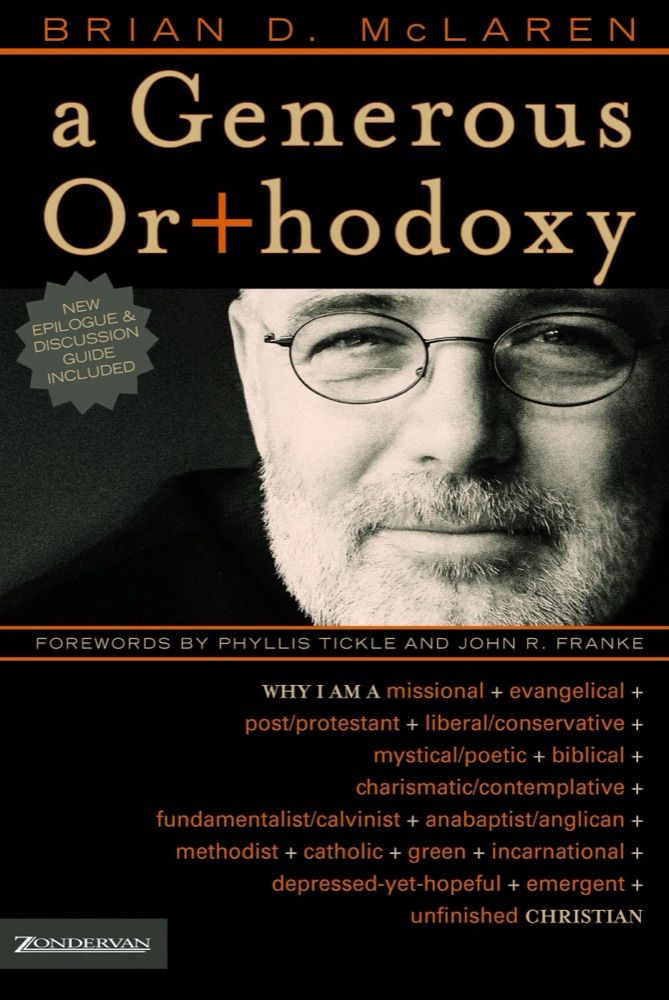 A Generous Orthodoxy
 The Bible Jesus Read
 The Holy Longing: The Search for a Christian Spirituality
 The Divine Conspiracy: Rediscovering Our Hidden Life in God
 Life Together: The Classic Exploration of Christian Community
 How People Change
 Wholehearted Faith
 What's So Amazing About Grace?
 Jesus > Religion: Why He Is So Much Better Than Trying Harder, Doing More, and Being Good Enough
 Total Truth: Liberating Christianity from its Cultural Captivity
 Inspired: Slaying Giants, Walking on Water, and Loving the Bible Again
 The Life You've Always Wanted: Spiritual Disciplines for Ordinary People
 Jesus Among Other Gods: The Absolute Claims of the Christian Message
 Prayer in the Night: For Those Who Work or Watch or Weep
 Seeking Allah, Finding Jesus: A Devout Muslim Encounters Christianity
 The Furious Longing of God
 The Irresistible Revolution: Living as an Ordinary Radical
 Gay Girl, Good God: The Story of Who I Was and Who God Has Always Been
 Christ Plays in Ten Thousand Places: A Conversation in Spiritual Theology
 It's Not What You Think: Why Christianity is About So Much More Than Going to Heaven When You Die
 Still: Notes on a Mid-Faith Crisis
 The Holiness of God
 The Ragamuffin Gospel
 Resident Aliens: Life in the Christian Colony
 The Case for Faith: A Journalist Investigates the Toughest Objections to Christianity
 Christless Christianity: The Alternative Gospel of the American Church
 Blessed Are the Misfits: Great News for Believers who are Introverts, Spiritual Strugglers, or Just Feel Like They're Missing Something
 Letters to Malcolm: Chiefly on Prayer
 Miracles and Other Reasonable Things: A Story of Unlearning and Relearning God
 What Is the Bible?: How an Ancient Library of Poems, Letters, and Stories Can Transform the Way You Think and Feel About Everything
 The Great Omission: Reclaiming Jesus's Essential Teachings on Discipleship
 The Normal Christian Life
 The Sin of Certainty: Why God Desires Our Trust More Than Our "Correct" Beliefs
 Encounters with Jesus: Unexpected Answers to Life's Biggest Questions
 The Grand Weaver: How God Shapes Us through the Events in Our Lives
 Renovation of the Heart: Putting On the Character of Christ
 40 Days of Decrease: A Different Kind of Hunger. A Different Kind of Fast.
 The Benedict Option: A Strategy for Christians in a Post-Christian Nation