
 Liar's Poker
Quotes from the Book
The pleasure of rooting for Goliath is that you can expect to win. The pleasure of rooting for David is that, while you don’t know what to expect, you stand at least a chance of being inspired.
141
Managers tend to pick a strategy that is the least likely to fail, rather then to pick a strategy that is most efficient," Said Palmer. " The pain of looking bad is worse than the gain of making the best move.
83
Every form of strength is also a form of weakness,” he once wrote. “Pretty girls tend to become insufferable because, being pretty, their faults are too much tolerated. Possessions entrap men, and wealth paralyzes them. I learned to write because I am one of those people who somehow cannot manage the common communications of smiles and gestures, but must use words to get across things that other people would never need to say.
53
The inability to envision a certain kind of person doing a certain kind of thing because you've never seen someone who looks like him do it before is not just a vice. It's a luxury. What begins as a failure of the imagination ends as a market inefficiency: when you rule out an entire class of people from doing a job simply by their appearance, you are less likely to find the best person for the job.
36
If you challenge conventional wisdom, you will find ways to do things much better than they are currently done. Bill James
27
People in both fields operate with beliefs and biases. To the extent you can eliminate both and replace them with data, you gain a clear advantage.
27
The sheer quantity of brain power that hurled itself voluntarily and quixotically into the search for new baseball knowledge was either exhilarating or depressing, depending on how you felt about baseball. The same intellectual resources might have cured the common cold, or put a man on Pluto.
20
That's what happens when you're thirty-seven years old: you do the things you always did but the result is somehow different.
18
No matter how successful you are, change is always good. There can never be a status quo. When you have no money you can’t afford long-term solutions, only short-term ones. You have to always be upgrading. Otherwise you’re fucked.
15
There was but one question he left unasked, and it vibrated between his lines: if gross miscalculations of a person's value could occur on a baseball field, before a live audience of thirty thousand, and a television audience of millions more, what did that say about the measurement of performance in other lines of work? If professional baseball players could be over- or under valued, who couldn't?
14
Years later he would say that when he'd decided to become a professional baseball player, it was the only time he'd done something just for the money, and that he'd never do something just for the money ever again. He would never again let the market dictate the direction of his life.
13
What happens when we acknowledge the sovereignty and power of God without trusting in His goodness and faithfulness? A pitcher who saw God's power behind his extremely unlikely rise to the big leagues wondered if, at any difficulty he encountered there, God might be taking his ability away.
11
Every form of strength covers one weakness and creates another, and therefore every form of strength is also a form of weakness and every weakness a strength.
10
Every form of strength is also a weakness. Pretty girls tend to become insufferable because, being pretty, their faults are too much tolerated. Possessions entrap men, and wealth paralyzes them.
9
If you’ve got a dozen pitchers, you need to speak 12 different languages.
9
It is the nature of being the general manager of a baseball team that you have to remain on familiar terms with people you are continually trying to screw.
7
Baseball is a soap opera that lends itself to probabilistic thinking. [Dick Cramer]
7
That’s all right,” says Billy. “We’re blending what we see but we aren’t allowing ourselves to be victimized by what we see.
6
if you challenge the conventional wisdom, you will find ways to do things much better than they are currently done.
6
One absolutely cannot tell, by watching, the difference between a .300 hitter and a .275 hitter. The difference is one hit every two weeks.
6
It was hard to know which of Billy's qualities was most important to his team's success: his energy, his resourcefulness, his intelligence, or his ability to scare the living shit out of even very large professional baseball players.
6
Anti-intellectual resentment is common in all of American life and it has many diverse expressions. Refusing to draft college players might have been one of them. Bill James
6
Baseball has so much history and tradition. You can respect it, or you can exploit it for profit, but it's still being made all over the place, all the time.
6
What baseball managers did do, on occasion, beginning in the early 1980s, was hire some guy who knew how to switch on the computer. But they did this less with honest curiosity than in the spirit of a beleaguered visitor to Morocco hiring a tour guide: pay off one so that the seventy-five others will stop trying to trade you their camels for your wife. Which one you pay off is largely irrelevant.
6
First base was a far richer social opportunity. First base made catching feeling like a bad dinner party - what with the ump hanging on your shoulder and all the fans and cameras staring at you. At first base you could really talk.
5
The great thing about baseball players, from the point of view of personal hygiene, is how seldom they break a sweat.
4
For a lot of the players it was their first exposure to the Southern female - the most flagrant cheater in the mutual disarmament pact known as feminism. Lipstick! Hairdos! Submissiveness!
4
The author refers to a player's affected nonchalance and comments he is, "too young to realize you are what you pretend to be.
4
Did you know?
- The Oakland Athletics' payroll was roughly one-third that of the New York Yankees at the time the book describes.
- The book popularized sabermetrics, the statistical analysis of baseball pioneered by writer Bill James.
- Lewis later noted the book's success may have eroded Oakland's competitive edge by spreading its methods across the league.
- The 2011 film adaptation starred Brad Pitt as Billy Beane and received six Academy Award nominations, including Best Picture.
- Critics argued the book gave too little credit to Oakland's star pitchers acquired through traditional scouting.
About Michael Lewis
Michael Lewis is an American author and financial journalist known for narrative nonfiction including "Liar's Poker," "The Big Short," and "Flash Boys." A former bond salesman, he writes about finance, sports, and human behavior.
More about the author →More by Michael Lewis
Liar's Poker
 The Big Short: Inside the Doomsday Machine
 Boomerang: Travels in the New Third World
 Flash Boys: A Wall Street Revolt
About the book
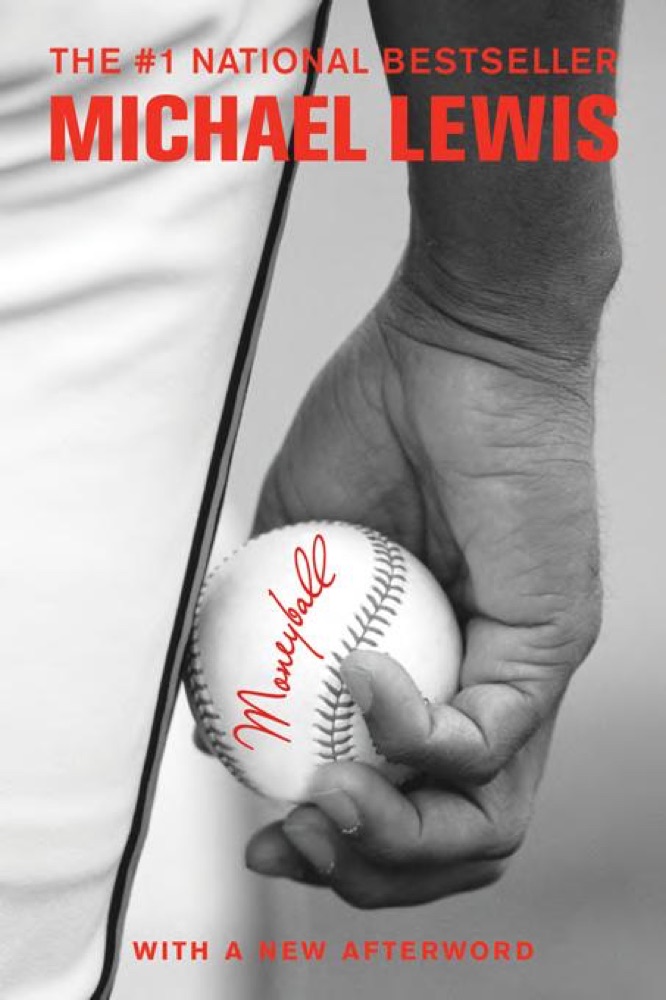
"Moneyball: The Art of Winning an Unfair Game" is Michael Lewis's account of how the Oakland Athletics, one of Major League Baseball's poorest franchises, competed against far wealthier teams during the early 2000s. With a payroll a fraction of the New York Yankees', general manager Billy Beane and his front office relied on rigorous statistical analysis—sabermetrics—to identify undervalued players whose true contributions were overlooked by traditional scouting.
At its core the book is an argument about how markets misprice value and how received wisdom can be wrong. Lewis traces ideas back to the writer and analyst Bill James and shows how metrics such as on-base percentage revealed players that conventional baseball judgment ignored. The narrative becomes a broader study of decision-making, the clash between intuition and evidence, and the difficulty of changing an entrenched culture.
The book was a commercial and critical success and reshaped how baseball front offices operate, with many teams subsequently hiring statistical analysts and the word "Moneyball" entering common usage. It also drew criticism from those who argued it underplayed Oakland's elite, traditionally scouted pitching. It was adapted into an acclaimed 2011 film starring Brad Pitt.
Book details
- First published
- 2003
- Length
- 288 pages
- Reading time
- 5 hours
- Author
- Michael Lewis
- Genre
- Nonfiction
- Goodreads rating
- 4.27 (148k ratings) →
Critical reception
- Economists Richard Thaler and Cass Sunstein praised the book as a sensation and lauded Lewis's storytelling.
- Some baseball analysts criticized it for overlooking the contributions of traditionally scouted pitchers such as Tim Hudson, Mark Mulder, and Barry Zito.
- The book is widely credited with transforming front-office strategy across Major League Baseball.
Movie & TV adaptations
- IMDb
If you liked this, read…
- 1The Big ShortAnother Michael Lewis story of contrarians who saw value the market missed.
- 2The Undoing ProjectLewis on the psychology of judgment and decision-making behind data-driven thinking.
Keep reading
 Moneyball
 Ball Four
 The Art of Fielding
 Mind Gym: An Athlete's Guide to Inner Excellence
 Sum It Up: 1,098 Victories, a Couple of Irrelevant Losses, and a Life in Perspective
 The Snowball: Warren Buffett and the Business of Life
 Trump: The Art of the Deal
 Wooden: A Lifetime of Observations and Reflections On and Off the Court
 Wherever I Wind Up: My Quest for Truth, Authenticity and the Perfect Knuckleball
 Barking Up the Wrong Tree: The Surprising Science Behind Why Everything You Know About Success Is (Mostly) Wrong
 Leading: Learning from Life and My Years at Manchester United
 What the Dog Saw and Other Adventures
Liar's Poker
What the Dog Saw and Other Adventures
Liar's Poker
 David and Goliath: Underdogs, Misfits, and the Art of Battling Giants
 Dodger
 Think Like a Freak
 The Art of Thinking Clearly
 Shoe Dog: A Memoir by the Creator of NIKE
 Fooled by Randomness: The Hidden Role of Chance in Life and in the Markets
 The Undoing Project: A Friendship That Changed Our Minds
 Blockade Billy
 Freakonomics: A Rogue Economist Explores the Hidden Side of Everything
 The Score Takes Care of Itself: My Philosophy of Leadership
 Eleven Rings: The Soul of Success
 Tools of Titans: The Tactics, Routines, and Habits of Billionaires, Icons, and World-Class Performers
 Same as Ever: A Guide to What Never Changes
 How to Fail at Almost Everything and Still Win Big: Kind of the Story of My Life
 Skin in the Game: The Hidden Asymmetries in Daily Life
 The Player of Games
 Predictably Irrational: The Hidden Forces That Shape Our Decisions
 Chinaman: The Legend of Pradeep Mathew
 The Game: Penetrating the Secret Society of Pickup Artists
 Give and Take: A Revolutionary Approach to Success
 What I Learned Losing a Million Dollars
 Confidence Men: Wall Street, Washington, and the Education of a President
 Winning
 Chaos Monkeys: Obscene Fortune and Random Failure in Silicon Valley
 Disclosure
 EntreLeadership: 20 Years of Practical Business Wisdom from the Trenches
 Friday Night Lights: A Town, a Team, and a Dream
 Letters from a Self-Made Merchant to His Son
 Good to Great: Why Some Companies Make the Leap... and Others Don't
 The Algebra of Wealth: A Simple Formula for Financial Security
 Hackers & Painters: Big Ideas from the Computer Age
 Pour Your Heart Into It: How Starbucks Built a Company One Cup at a Time
 Talent is Overrated: What Really Separates World-Class Performers from Everybody Else
 Adapt: Why Success Always Starts with Failure
 A Very Punchable Face
 The Lay of the Land
 The Black Swan: The Impact of the Highly Improbable
 Boy Toy
 The Art of Impossible: A Peak Performance Primer
 Influence: The Psychology of Persuasion
 The Affair
 How to Win Friends & Influence People
 The Leader Who Had No Title: A Modern Fable on Real Success in Business and in Life
 Hocus Pocus
 Bluebeard
 Summerland