
 How to Read the Bible for All Its Worth
Quotes from the Book
A puritan is such a one as loves God with all his soul, but hates his neighbor with all his heart.
13
t's [King James Bible] subject is majesty, not tyranny, and it's political purpose was unifying and enfolding, to elide the kingliness of God with the godliness of kings, to make royal power and divine glory into one invisible garment which could be wrapped around the nation as a whole.
3
The language of the King James Bible is the language of patriarchy, of an instructed order, of richness as a form of beauty, of authority as a form of good; the New English Bible is motivated by the opposite, an anxiety not to bore or intimidate. It is driven, in other words, by the desire to please and, in that way, is a form of language which has died.
3
Very occasionally, a simplified form of communion and of adult baptism for new members of the church would be enacted but no Separatist was ever married in church, because there is no hint of a marriage ceremony in scripture and the primitive church had not considered marriage a sacrament before AD 537.
2
The flattening of language is a flattening of meaning. Language which is not taut with a sense of its own significance, which is apologetic in its desire to be acceptable to a modern consciousness, language in other words which submits to its audience, rather than instructing, informing, moving, challenging and even entertaining them, is no longer a language which can carry the freight the Bible requires. It has, in short, lost all authority.
1
One of the King James Bible’s most consistent driving forces is the idea of majesty. Its method and its voice are far more regal than demotic. Its archaic formulations, its consistent attention to a grand and heavily musical rhythm are the vehicles by which that majesty is infused into the body of the text. Its qualities are those of grace, stateliness, scale, power. There is no desire to please here; only a belief in the enormous and overwhelming divine authority, of which royal authority, ‘the powers that be’ as they translated the words of St Paul, was an adjunct and extension
1
The modern world had lost the thing which informs every act and gesture of Hatfield, of the King James Bible, and of that incomparable age: a sense of encompassing richness which stretches unbroken from the divine to the sculptural, from theology to cushions, from a sense of the beauty of the created world to the extraordinary capabilities of language to embody it. This is about more than mere sonority or the beeswaxed heritage-appeal of antique vocabulary and grammar. The flattening of language is a flattening of meaning. Language which is not taut with a sense of its own significance, which is apologetic in its desire to be acceptable to a modern consciousness, language in other words which submits to its audience, rather than instructing, informing, moving, challenging and even entertaining them, is no longer a language which can carry the freight the Bible requires. It has, in short, lost all authority. The language of the King James Bible is the language of Hatfield, of patriarchy, of an instructed order, of richness as a form of beauty, of authority as a form of good; the New English Bible is motivated by the opposite, an anxiety not to bore or intimidate. It is driven, in other words, by the desire to please and, in that way, is a form of language which has died.
1
It is one of the strangest of historical paradoxes that the King James Bible, whose whole purpose had been nation-building in the service of a ceremonial and episcopal state church, should become the guiding text of Puritan America. But the translation’s lifeblood had been inclusiveness, it was drenched with the splendour of a divinely sanctioned authority, and by the end of the seventeenth century it had come to be treasured by Americans as much as by the British as one of their national texts.
1
language in other words which submits to its audience, rather than instructing, informing, moving, challenging and even entertaining them, is no longer a language which can carry the freight the Bible requires. It has, in short, lost all authority. The language of the King James Bible is the language of Hatfield, of patriarchy, of an instructed order, of richness as a form of beauty, of authority as a form of good; the New English Bible is motivated by the opposite, an anxiety not to bore or intimidate. It is driven, in other words, by the desire to please and, in that way, is a form of language which has died.
1
That shifting, layered sensibility is also, in part, the world into which the King James Bible was born. The king’s instructions were perfectly explicit: they were to use ‘circumlocution’, in other words language in which meaning was to be ‘sett forth gorgeously’. There was no terror of richness in this. Richness, as King David had known when he decorated the temple for God, was one of the attributes of God. Majesty, honour and power were gorgeous in themselves and the Jacobean sense of the beautiful loved both pearls and diamonds, both openness and ceremony. Miles Smith referred in his Preface to ‘the Sun of righteousness, the Son of God’, and it was the beams of that sun which the King James Translators would bring to the people. But the sense of clarity and directness was sewn and fused to those other Jacobean virtues: a pattern of order and authority; the majestic substance, the ‘meat’ of the word of God; the great ceremonial atmosphere of its long, carefully organised, musical rhythms, a ceremony of the word; an atmosphere both godly and kingly; both rich and pure, both multiplicitous and plain. This Bible, in other words, would absorb the full aesthetics of the age. You only have to read the Translators at full flood, feeling behind them the sense of unstoppable divine authority, to hear the immense, gilded majesty of the translation. In describing God’s assembling of the armies of a vengeful justice, they reached their apogee:
1
The flat, overall illumination of Protestant ideology was all very well but for these sophisticates, pure, simple plainness was not enough. Francis Bacon, corrupt, brilliant and unlikeable, builder of his own great pair of houses, now disappeared, not far away at St Albans, famous for the pale-faced catamites he kept to warm his bed, the inventor of the English essay, later to be Lord Chancellor, and, later still, accused of corruption, to be thrown to parliament as a sop to their demands, defined in his essay ‘On Truth’ the subtle and shifting Jacobean relationship to light and beauty, to plainness and richness, to clarity and sparkle. ‘This same Truth’, he wrote,
1
It is, in other words, the King James Bible’s exact contemporary, the product of precisely the same cultural moment, produced from precisely the same court culture, with precisely the same intention of celebrating and in a certain sense ‘housing’ James I and his dream of majesty. Can Hatfield House, then, be read as a companion to the Bible whose genesis is so close to its own?
1
Inspiration was an established part of literary and theological thought. And wild, inspired Blakean prophets of course appear in the Bible itself, writing down, as a phrase in the apocryphal book of Esdras unforgettably describes it, ‘the wonderfull visions of the night, that were told, which they knew not’.
In 1768 a Dr Edward Harwood, a Bristol Presbyterian, published a version of the New Testament which aimed, he said, ‘to clothe the idea of the Apostles with propriety and perspicuity’, replacing the ‘bald and barbarous language of the old vulgar version with the elegance of modern English’. Take, for example, the Nunc Dimittis, the words of Simeon on seeing the child Jesus, which in the King James Bible had run as follows: Lord now lettest thou thy seruant depart in peace, according to thy word. For mine eyes haue seene thy saluation, Which thou hast prepared before the face of all people; A light to lighten the Gentiles, and the glory of thy people Israel. Harwood wrote: ‘O God, thy promise to me is amply fulfilled. I now quit the post of human life with satisfaction and joy, since thou hast indulged mine eyes with so divine a spectacle as the great Messiah.’ It should come as no surprise that Dr Harwood is never more at a loss than at moments of greatest spiritual intensity. At the Transfiguration, when the divinity of Jesus is revealed to the apostles, his clothes and face glowing and shining in front of them, Peter stood amazed, scarcely able to speak. Tyndale had translated his stumbling words as the slightly odd, ‘Master here is good beinge for us’, which was perhaps a mistake, perhaps an attempt to convey Peter’s confusion. The King James Translators had him say simply, ‘Lord, it is good for vs to be here.’ Harwood, reaching high for propriety and perspicuity, managed to turn the apostle into a frock-coated, bewigged and slightly obsequious 1760s estate agent, exclaiming ‘Oh, sir! what a delectable residence we might establish here!
Once the king had decided it should happen; once Bancroft had disseminated the Rules; and once the Translators had been chosen, almost the entire process drops from view.
At moments of intensity and crisis, the natural direction a man’s thoughts took would not be, as it now might, towards the inarticulate, drowning in the struggle to express the extremities of experience in a language that seems scarcely adequate or sufficient for the task, but to the words of scripture from which they had all drawn their sense of reality, their sense of how the world was, for their entire conscious lives. In a sense that almost no one now understands, the words of the Bible were the ultimate and encompassing truth itself. That depth of belief in the sufficiency of language is also one of the shaping forces of the King James Bible.
The words of the King James Bible are just as much English pushed towards the condition of a foreign language as a foreign language translated into English. It was, in other words, more important to make English godly than to make the words of God into the sort of prose that any Englishmen would have written, and that secretarial relationship to the original languages of the scriptures shaped the translation.
The great speeches of twentieth-century America, including J. F. Kennedy’s inaugural address and the series of speeches made by Martin Luther King in the eighteen months leading up to his death, are descendants in a direct line from the words and the evaluating minds, and ears, of the divines who gathered in the wainscoted rooms in Westminster, Cambridge, Oxford and the City of London 400 years ago.
Secretaryship is one of the great shaping forces behind the King James Bible. There is no authorship involved here. Authorship is egotistical, an assumption that you might have something new worth saying. You don’t. Every iota of the Bible counts but without it you count for nothing.
To survive in this net of hostility, James had been forced to compromise and dissemble, to become cunning and to lie. His favourite tag was from Tacitus: ‘Those who know not how to dissimulate, know not how to rule.
Few moments in English history have been more hungry for the future, its mercurial possibilities and its hope of richness, than the spring of 1603.
These scholars were not pulling the language of the scriptures into the English they knew and used at home. The words of the King James Bible are just as much English pushed towards the condition of a foreign language as a foreign language translated into English. It was, in their words, more important to make English godly than to make the words of God into the sort of prose that any Englishmen would have written, and that secretarial relationship to the original languages of the scriptures shaped the translation. Of course, individual English words and phrases are held up to and examined to the point of a knife.
In 1524 the New Testament appeared in Swyzerdeutsch, followed in 1526 by the first complete Bible in Dutch, and in 1530 in French (although a translation of the Vulgate, not from the original tongues). In the same year a New Testament was published ‘tradotto in lingua toscana’. An Icelandic New Testament appeared in 1540, the first complete Swedish Bible in 1541, a Finnish New Testament in 1548 and a complete Danish Bible in 1550. The first Bible in Spanish was published only in 1569, printed in Basle and later distributed from Frankfurt. Spain itself remained implacably hostile to the vernacular. Further east, a Slovene New Testament was published in 1557– 60, a Croat New Testament in 1563, a Polish Bible (Catholic, from the Vulgate) in 1561, a Hungarian Bible in 1590.
At the Transfiguration, when the divinity of Jesus is revealed to the apostles, his clothes and face glowing and shining in front of them, Peter stood amazed, scarcely able to speak. Tyndale had translated his stumbling words as the slightly odd, ‘Master here is good beinge for us’, which was perhaps a mistake, perhaps an attempt to convey Peter’s confusion. The King James Translators had him say simply, ‘Lord, it is good for vs to be here.’ Harwood, reaching high for propriety and perspicuity, managed to turn the apostle into a frock-coated, bewigged and slightly obsequious 1760s estate agent, exclaiming ‘Oh, sir! what a delectable residence we might establish here!
And there are some parts of the King James Bible, particularly in the dense and difficult passages of Paul’s Epistles, that are now, and to some extent were then, virtually unintelligible. A famous example is 2 Corinthians 6:11–13: O yee Corinthians, our mouth is open vnto you, our heart is enlarged. Yee are not straitened in vs, but yee are straitened in your owne bowels. Nowe for a recompense in the same, (I speake as vnto my children) be ye also inlarged.
Laurence Chaderton, the moderate Puritan leader, once paused after two hours of a Cambridge sermon. The entire congregation stood up and shouted, ‘For God’s sake go on!’ He gave them another hour.
John Smyth, originally from Gainsborough, but by 1608 pastor of the Brethren of the Separation of the Second English Church at Amsterdam, its congregation made up of Lincolnshire farmers, decided that they needed to hear the scriptures in the original. One can only imagine the effect on the poor exiles from Gainsborough: hour on hour of Smyth reading out passages of Hebrew and Greek of which they had not the faintest understanding, desperately looking for the sanctity in this.
As if on cue, in 1608, golf was introduced from Scotland for the first time, played around a 5-hole course on Blackheath, south of London. The leather balls, stuffed with feathers, lasted no more than one game each, particularly if it rained. At 5 shillings a time, it was a ruinously expensive but a strangely consoling pursuit, fitted to a country replete with contentment.
Watch on YouTube
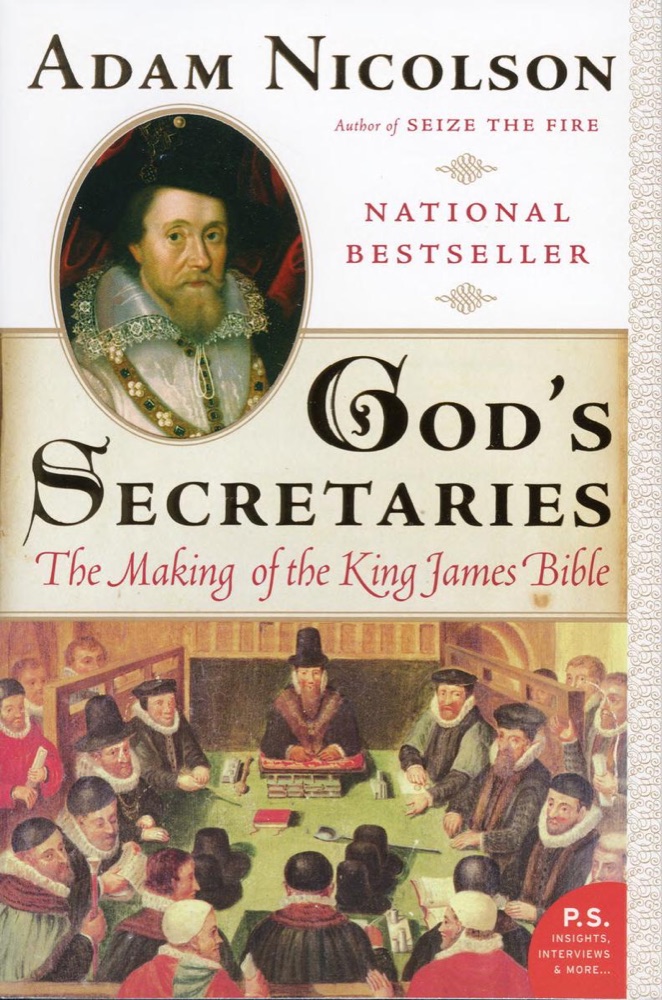
About Adam Nicolson
We have collected 28 quotes from 1 book by Adam Nicolson on BookQuoters.
More about the author →About the book
A network of complex currents flowed across Jacobean England. This was the England of Shakespeare, Jonson, and Bacon; the era of the Gunpowder Plot and the worst outbreak of the plague. Jacobean England was both more godly and less godly than the country had ever been, and the entire culture was drawn taut between these polarities. This was the world that created the King James Bible. It is the greatest work of English prose ever written, and it is no coincidence that the translation was made at the moment "Englishness," specifically the English language itself, had come into its first passionate maturity. The English of Jacobean England has a more encompassing idea of its own scope than any form of the language before or since. It drips with potency and sensitivity. The age, with all its conflicts, explains the book.
This P.S. edition features an extra 16 pages of insights into the b
Book details
- First published
- 2003
- Author
- Adam Nicolson
- Genre
- History
- Goodreads rating
- 3.78 (2k ratings)
Keep reading
How to Read the Bible for All Its Worth
 Forged: Writing in the Name of God—Why the Bible's Authors Are Not Who We Think They Are
 The Bible Tells Me So: Why Defending Scripture Has Made Us Unable to Read It
 Paul: A Biography
 How God Became King: The Forgotten Story of the Gospels
 Systematic Theology: An Introduction to Biblical Doctrine
 The History of the Church: From Christ to Constantine
 Reflections on the Psalms
 Inspired: Slaying Giants, Walking on Water, and Loving the Bible Again
 The Mind of the Maker: Dorothy L. Sayers' Witty Classic on the Trinity, Christianity, and Human Creativity
 The Age of Reason
 On the Incarnation
 Simply Christian
 The Bible Jesus Read
 Taking God At His Word: Why the Bible Is Knowable, Necessary, and Enough, and What That Means for You and Me
 The Case for Christ
 On Christian Doctrine
 Studies in the Sermon on the Mount
 Zealot: The Life and Times of Jesus of Nazareth
 The Case for God
 Jesus of Nazareth: The Infancy Narratives
 The Gospel in a Pluralist Society
 The Everlasting Man
 The Professor and the Madman: A Tale of Murder, Insanity and the Making of the Oxford English Dictionary
 What Is the Bible?: How an Ancient Library of Poems, Letters, and Stories Can Transform the Way You Think and Feel About Everything
 Misquoting Jesus: The Story Behind Who Changed the Bible and Why
 Lord of the World
 A History of God: The 4,000-Year Quest of Judaism, Christianity, and Islam
 The World's Last Night: And Other Essays
 A History of the World in 100 Objects
 The Letters of J.R.R. Tolkien
 Jesus for President: Politics for Ordinary Radicals
 Letters from the Earth: Uncensored Writings
 The Crucible of Doubt: Reflections On the Quest for Faith
 Amazing Grace: A Vocabulary of Faith
 People of the Book
 Escape from Reason
 Lectures to My Students
 Of Plymouth Plantation, 1620-1647
 The Sovereignty of God
 Under the Glacier
 A Little History of Religion
 The Divine Conspiracy: Rediscovering Our Hidden Life in God
 Some Danger Involved
 Godless: How an Evangelical Preacher Became One of America's Leading Atheists
 The Darkening Age: The Christian Destruction of the Classical World
 The New Oxford Annotated Bible: New Revised Standard Version
 Bad Religion: How We Became a Nation of Heretics
 When I Was a Child I Read Books
 Letters and Papers from Prison
 The Orthodox Study Bible
 The Prophetic Imagination
 Life of Christ
 Misreading Scripture with Western Eyes: Removing Cultural Blinders to Better Understand the Bible
 Sinners in the Hands of a Loving God: The Scandalous Truth of the Very Good News
 The Discarded Image: An Introduction to Medieval and Renaissance Literature
 Exegetical Fallacies
 Saint Thomas Aquinas