 The Stone Diaries
Quotes from the Book
This is a female text, composed by folding someone else's clothes. My mind holds it close, and it grows, tender and slow, while my hands perform innumerable chores. This is a female text, born of guilt and desire, stitched to a soundtrack of nursery rhymes.
16
Literature composed by women was stored not in books but in female bodies, living repositories of poetry and song. I have come across a line of argument in my reading, which posits that, due to the inherent fallibility of memory and the imperfect human vessels that held it, the Caoineadh cannot be considered a work of single authorship. Rather, the theory goes, it must be considered collage, or, perhaps, a folky reworking of older keens. This, to me --- in the brazen audacity of one positioned far from the tall walls of the university --- feels like a male assertion pressed upon a female text. After all, the etymology of the word ‘text’ lies in the Latin verb ‘texere’: to weave, to fuse, to braid. The Caoineadh form belongs to a literary genre worked and woven by women, entwining strands of female voices that were carried in female bodies, a phenomenon that seems to me cause for wonder and admiration, rather than suspicion of authorship.
13
As everyone else dreamed, my eyes were open in the dark.
10
Remember this lesson: in every page there are undrawn women, each waiting in her own particular silence.
8
In choosing to carry a pregnancy, a woman gives of her body with a selflessness so ordinary that it goes unnoticed, even by herself.
7
We cannot know from whose mouths the echoes of our lives will chime.
6
I keep a list as close as my phone, and draw a deep sense of satisfaction each time I strike a task from it. In such erasure lies joy. No matter how much I give of myself to household chores, each of the rooms under my control swiftly unravels itself again in my aftermath, as though a shadow hand were already beginning the unwritten lists of my tomorrows…
4
Everything repeated and repeated again. My family had lived within these hills for centuries. I knew that there had been many other girls who had made their homes on this ground before me, girls who were grown now and gone into the ground themselves, their babies - my great-grandmothers - grown and gone the same way. Nothing I knew was ever truly new; every path I followed had been written by the bodies of others, the course of every track sculpted by the footfall of those who came before us. For-ev-er. For-ev-er. To the well. To the haggart. To the shed. To the hill. Along these ways, grassed hummed their old tunes, blackthorns pointed their warnings, and every well held the memory of whispered human desire. Maybe I was a strange child, feeling the constant hum of the past just beyond me, real as a bee, or maybe every child shares that feeling. All I knew was that I felt safe there, in the echo of their company.
3
I don’t know what it’s all for, but I keep going anyway, in the misguided hope that if I can simply exhaust my obsession it might come to bore me, eventually. It’s a foolish approach that only makes things worse, because the more I read, the sharper my rage grows.
3
Swift, the twist from ordinary to catastrophe.
3
In rocking her, maybe I was rocking my own old aching self. Maybe there was some equivalence embedded in that moment, some weird reciprocity. In whispering to a stranger that everything would be OK, maybe I was casting a spell over all of us in our sorrow and pain,...
2
I find myself thinking of the imperceptible beat in which a word exists, between the articulation and the hearing.
2
Never in this quest have I found a simple answer; every lead is always a prelude to more questions.
2
Instead, I'll think of new words, and then I'll follow them.
2
Perhaps the compulsion to lay a woman’s life before me and slowly explore each layer started in the dissection room; so many of our most steadfast patterns are begun in those years between childhood and adulthood.
2
Perhaps it was never as clear as I imagined; perhaps we are each capable of choosing a different direction, depending on the road on which we find ourselves. Perhaps the kaleidoscopic versions of ourselves that inhabit our days and nights are capable, in fact, of anything.
1
The past never ends. Or, worse, the past tells us how it ends. Over, it says, over and over again.
1
The scratch of nib to paper, the liquid birth and loop of the letters, each connected to the next, word following word, and all the small spaces that exist between them.
1
How mysterious, our instincts, those sudden engines that roar up to steer us towards new ends.
1
As I clean, my labour makes of itself an invisibility. If each day is a cluttered page, then I spend my hours scrubbing its letters. In this, my work is a deletion of a presence.
1
All our omens hold the mystery of some grave human consequence, now forgotten, leaving only the gleaming symbol in its aftermath. In attempting to comprehend a turn of ill-fortune, we may search for an omen as prelude, for to find such a sign imposes meaning on the chaotic. In seeking an omen, we frequently seek a bird.
1
All the while, I keep one ye on Eibhlín Dubh and one on my daughter in her car seat. She grows in that rear-view mirror. Soon, her eyes are open as I turn towards home. Soon, her gurgles can almost be translated into words. Soon, she is tugging at the straps in which I have bound her. Soon, she is smiling back at me. This is how years pass in that mirror: soon, too soon.
1
In my anger, I begin to sense some project that might answer the nurse's query. Perhaps I'd always known what it was all for. Perhaps I'd stumbled upon my true work. Perhaps the years I'd spent sifting the scattered pieces of this jigsaw were not in vain; perhaps they were a preparation. Perhaps I could honour Eibhlín Dubh's life by building a truer image of her days, gathering every fact we hold to create a kaleidoscope, a spill of distinct moments, fractured but vivid. Once this thought comes to me, my heart grows quick. I could donate my days to finding hers, I tell myself, I could do that, and I will.
1
I drop the towel, and document my body with curiosity: my milk-bottle thighs split by turquoise seams; my breasts, lopsided and glorious; the holy door of my quadruple caesarean scar, my sag- stomach, stretch-marked with ripples like a strand at low tide. My bellybutton grimaces there, the invisible cord that will always connect me to my mother, just as hers connects her to her mother, and on , and on, and on. I study this body of mine, just one more in a long line, and feel no revulsion, only pride. This is a female text, I think. My body replies in its dialect of scars. Ta-dah! it seems to say, Ta-dah!
Sometimes a female body serves another by effecting a theft upon itself.
In addition to this crude notion of karma, and my sympathy for imagined babies and their imagined families, there also lurks something else: an illusion of control. There is so much in my life that I cannot hope to control. I can't control all my nights of broken sleep. I can't control the terrors that my mind chooses to review just as I close my eyes - the repetitive carousel of meningitis, comas, cars swept into oceans, house fires, or paedophiles. I can't control out landlord's whims, whether - or when - his voracity might lead to us moving house again. I can't control my children's chances of securing a place in the local primary school, whose enrollment policy (like most Irish schools) is predicated upon membership of the Catholic Church. I can, however, control the ritual of milk production: the sterilisation of the bottles, the components of the pump slotted in their correct order, the painstaking necessity of record-keeping, every procedure that I choose to perform carefully and correctly.
A convex seer, this rear-view mirror lets me peer into the landscape unwinding behind me, but it cannot show what is ahead, nor how I should turn next.
Perhaps revenge might be considered the opposite of altruism. Whereas the latter leaves a human interaction lopsided, vengeance demands a strict balancing of the equation. An eye for an eye. A tooth for a tooth.
Watch on YouTube
About Doireann Ní Ghríofa
We have collected 28 quotes from 1 book by Doireann Ní Ghríofa on BookQuoters.
More about the author →About the book
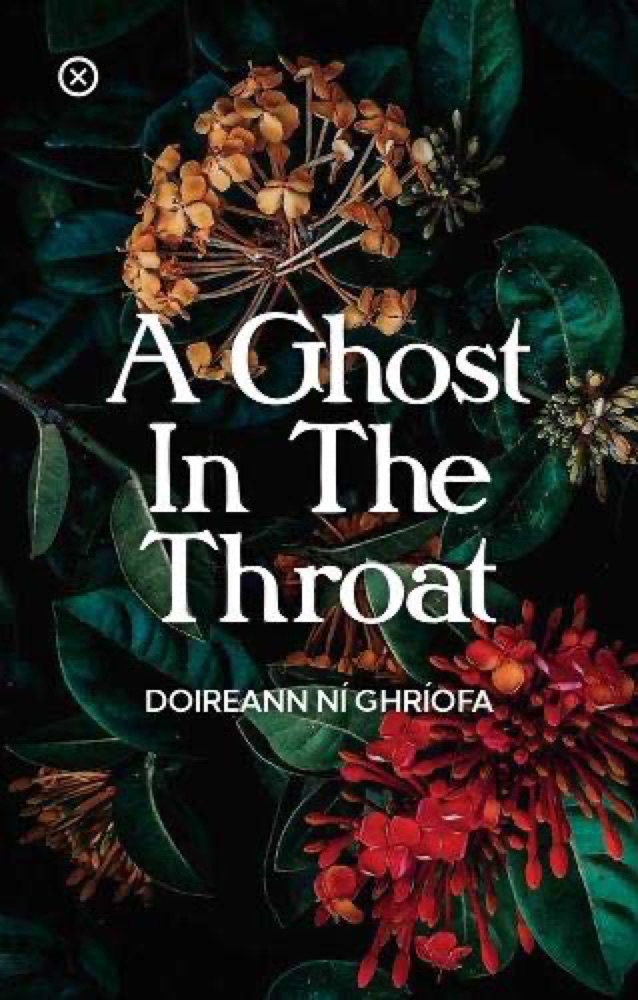
A true original. In this stunningly unusual prose debut, Doireann Ni Ghriofa sculpts essay and autofiction to explore inner life and the deep connection felt between two writers centuries apart. In the 1700s, an Irish noblewoman, on discovering her husband has been murdered, drinks handfuls of his blood and composes an extraordinary poem. In the present day, a young mother narrowly avoids tragedy. On encountering the poem, she becomes obsessed with its parallels with her own life, and sets out to track down the rest of the story. A devastating and timeless tale about one woman freeing her voice by reaching into the past and finding another's.
Book details
- First published
- 2020
- Author
- Doireann Ní Ghríofa
- Genre
- Literature
- Goodreads rating
- 4.00 (11k ratings)
The buzz
- The New York TimesReview in The New York Timesprofessional review (via Book Marks)
- The GuardianReview in The Guardianprofessional review (via Book Marks)
- The TimesReview in The Timesprofessional review (via Book Marks)
- Kirkus ReviewsReview in Kirkus Reviewsprofessional review (via Book Marks)
- New StatesmanReview in New Statesmanprofessional review (via Book Marks)
- The SpectatorReview in The Spectatorprofessional review (via Book Marks)
Keep reading
The Stone Diaries
 Housekeeping
 Devotion
 Trigger Warning: Short Fictions and Disturbances
 Her Body and Other Parties
 Sexing the Cherry
 The Chimes
 Hot Milk
 The Hidden Girl and Other Stories
 Glass, Irony and God
 Near to the Wild Heart
 Possession
 Palimpsest
 In the Heart of the Heart of the Country and Other Stories
 Warlight
 Moon Tiger
 Fugitive Pieces
 The Summer Without Men
 The Notebooks of Malte Laurids Brigge
 The Blind Assassin
 The White Book
 Memorial Drive: A Daughter's Memoir
 A Great and Terrible Beauty
 Mr. Splitfoot
 Killing Commendatore
 The Folded Clock: A Diary
 The Story of the Lost Child
 Swann's Way
 Checkout 19
 The Secret History
 The Raw Shark Texts
 Old Babes in the Wood: Stories
 A Lesson in Vengeance
 The Dream of Perpetual Motion
 The Chronology of Water
 The Blazing World
 Jane Steele
 Burnt Sugar
 Flights
 Speak, Memory
 The Reader
 Year of the Monkey
 House of Leaves
 Girl in the Dark
 Blueberries: Essays Concerning Understanding
 When Women Were Birds: Fifty-Four Variations on Voice
 Winter Hours: Prose, Prose Poems, and Poems
 Inheritance: A Memoir of Genealogy, Paternity, and Love
 The Last House on Needless Street
 The Woman Destroyed
 Divisadero
 The Story of a New Name
 Mother Mary Comes to Me
 Dearly
 Life on Mars: Poems
 Thrust
 The Shock of the Fall
 Daniel Deronda
 Devotion
 The Carrying