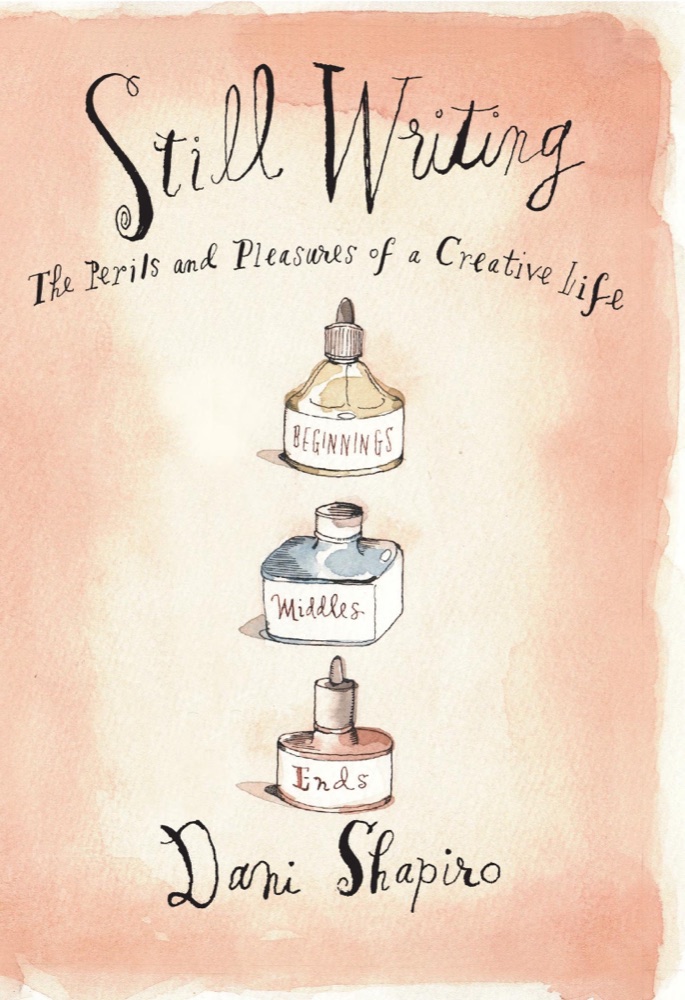
 Still Writing: The Perils and Pleasures of a Creative Life
Quotes from the Book
It wasn't getting easier because it isn't supposed to get easier. Midlife was a bitch, and my educated guess was that the climb only got steeper from here. Carl Jung put it perfectly: "Thoroughly unprepared we take the step into the afternoon of life," he wrote. "Worse still, we take this step with the false assumption that our truths and ideals will serve us as hitherto. But we cannot live the afternoon of life according to the program of life's morning; for what was great in the morning will be little at evening, and what in the morning was true will by evening have become a lie." ... I was writing a new program for the afternoon of life. The scales tipped away from suffering and toward openheartedness and love. [p. 182]
21
This sadness wasn't a huge part of me--I wasn't remotely depressed--but still, it was like a stone I carried in my pocket. I always knew it was there. [p. 179]
21
According to ayurveda, we become what we surround ourselves with. And so it stands to reason that we have to be discerning about what we surround ourselves with." Steve Cope [p. 85]
17
I was longing for the moment I was in, even as I was in it.
12
This is in the natural order of things--the time of life we've now entered. The afternoon, as Jung called it. Thoroughly unprepared we take the step into the afternoon of life. Are we unprepared simply because preparation is not possible? ... We learn--if we are lucky we learn--as we go. ... we are in the center of the stream. Much has already happened, and has formed the shape of our lives as surely as water shapes rock. Much lies ahead of us. We can't see what's coming. We can't know it. All we have is our hope that all will be well, and our knowledge that it won't always be so. We live in the space between this hope and this knowledge. ... Life keeps coming at us. Fleeing it is pointless, as is fighting. What I have begun to learn is that there is value in simply standing there--this too--whether the sun is shining, or the wind whipping all around. [pp.239-240]
11
Rather than feeling vindicated, I felt guilty. It seemed cruel, and all my fault, somehow. My relationship with my mother had always brought into question any sense I had of myself as a good and decent person. [p. 128]
10
In the country, I stopped being a person who, in the words of Sylvia Boorstein, startles easily. I grew calmer, but beneath that calm was a deep well of loneliness I hadn't known was there. ... Anxiety was my fuel. When I stopped, it was all waiting for me: fear, anger, grief, despair, and that terrible, terrible loneliness. What was it about? I was hardly alone. I loved my husband and son. I had great friends, colleagues, students. In the quiet, in the extra hours, I was forced to ask the question, and to listen carefully to the answer: I was lonely for myself. [p. 123]
10
I had spent my childhood and the better part of my early adulthood trying to understand my mother. She had been an extraordinarily difficult person, spiteful and full of rage, with a temper that could flare, seemingly out of nowhere, scorching everything and everyone who got in its way. [pp. 40-41]
10
I believe that there is something connecting us ... Something that was here before we got here and will still be here after we're gone. I've begun to believe that all of our consciousnesses are bound up in that greater consciousness. ... An animating presence .... [pp. 205-206]
7
Gone was the reflexive need to see the worst in things. Before the tumors took her life, they gave her a few moments of grace.
6
It wasn't so much that I was in search of answers. In fact, I was wary of the whole idea of answers. I wanted to climb all the way inside of the questions and see what was there.
5
I had no illusions that now, in some final and dramatic flash of revelation, we would understand one another. We were done. It was a fact of my life--intractable and sad--that our relationship had been a failure. Still, with her prognosis came one last chance to be her daughter. [p. 163]
5
Every once in a while, the darkness was too much. It had been quite some time since I had woken up in the middle of the night and into an abyss of terror. But here I was. ... I couldn't soothe myself. ... But if that person had been accessible to me, I wouldn't have been in the state I was in to begin with. [pp. 195-196]
4
Jung defined midlife as over the age of thirty-five. I know people who don’t consider themselves middle-aged at fifty. It doesn’t really matter, except in this regard: however we think of ourselves, we are in the center of the stream. Much has already happened, and has formed the shape of our lives as surely as water shapes rock. Much lies ahead of us. We can’t see what’s coming. We can’t know it. All we have is our hope that all will be well, and our knowledge that it won’t always be so. We live in the space between this hope and this knowledge.
1
ritual that allows me to enter a contemplative place—a place in which I might come upon something wordless and profound. Maybe the rituals are a doorway to prayer. But I spent most of my life confusing them with prayer itself.
1
There is no permanent forgetting. Though the world of things is persuasive and distracting, the stories always come back, circled in neon. They are all the more alive for having been hidden.
1
What was cluttering my mind when I wasn’t noticing? Sometimes, particularly while driving, I would realize with a jolt that I had covered many miles in my car without the slightest bit of awareness. The outside world was a blur. Where was I? I had no idea. Instead, I was lost in some story—usually a story that hadn’t even happened. What was the use of that? Over time, I began to wonder whether these stories had anything in common. I knew that neural pathways in the brain deepen over time: anxiety creates more anxiety, depression more depression. Maybe these stories also created their own pathways. They seemed to be variations on a theme. But what was the theme?
It was a private bargain I had struck—but with whom? I was always compiling lists in my mind: what had gone wrong, what could go wrong. I hadn’t figured how to live with my heightened awareness of exactly how fragile it all is. And so the lists grew and grew. I was trying to control the universe—and it’s hard work to try to control the universe. I thought that maybe by naming each potential disaster, I could prevent it. Michael could have a heart attack shoveling snow. Lightning could hit our house.
Just a few months ago, Michael and Jacob had been driving home late at night from a baseball game when someone threw a glass bottle of salad dressing off an embankment. The bottle hit the roof of our car and shattered. One fraction of a second earlier, and it would have hit the windshield. Salad dressing, I thought to myself, when Michael told me what had happened. I never considered salad dressing.
I was always compiling lists in my mind: what had gone wrong, what could go wrong. I hadn’t figured how to live with my heightened awareness of exactly how fragile it all is. And so the lists grew and grew. I was trying to control the universe—and it’s hard work to try to control the universe. I thought that maybe by naming each potential disaster, I could prevent it. Michael could have a heart attack shoveling snow.
morning was true will by evening have become a lie.
About Dani Shapiro
We have collected 108 quotes from 4 books by Dani Shapiro on BookQuoters.
More about the author →More by Dani Shapiro
Still Writing: The Perils and Pleasures of a Creative Life
 Inheritance: A Memoir of Genealogy, Paternity, and Love
 Hourglass: Time, Memory, Marriage
About the book
Dani Shapiro, the acclaimed author of the novel Black and White and the bestselling memoir Slow Motion, is back with a searching and timeless new memoir that examines the fundamental questions that wake women in the middle of the night, and grapples with the ways faith, prayer, and devotion affect everyday life. Devotion is sure to appeal to all those dealing with the trials and tribulations of what Carl Jung called “the afternoon of life.”
Book details
- First published
- 2010
- Author
- Dani Shapiro
- Genre
- Biography
- Goodreads rating
- 3.90 (4k ratings) →
Keep reading
 The Reader
 The Year of Magical Thinking
 Anthropology of an American Girl
 Managing Expectations: A Memoir in Essays – A Poignant Collection of Personal Stories on Acting, Failure, and Motherhood's Joy
 Imagine Me Gone
 I Am, I Am, I Am: Seventeen Brushes with Death
 Now Is the Time to Open Your Heart
Hourglass: Time, Memory, Marriage
Now Is the Time to Open Your Heart
Hourglass: Time, Memory, Marriage
 Journal of a Solitude
 Burnt Sugar
 Whereabouts
 Moments of Being: A Collection of Autobiographical Writing
 Great House
 Somebody's Daughter
Inheritance: A Memoir of Genealogy, Paternity, and Love
Somebody's Daughter
Inheritance: A Memoir of Genealogy, Paternity, and Love
 The Pisces
 A Small Indiscretion
 Blue Nights
 Hot Milk
 The Marvelous Misadventures of Ingrid Winter
 All the Lovers in the Night
 Make It Scream, Make It Burn
 The Collected Stories of Lydia Davis
 Killing Commendatore
 On Being Human: A Memoir of Waking Up, Living Real, and Listening Hard
 Trigger Warning: Short Fictions and Disturbances
 Life After God
 My Inner Sky: On Embracing Day, Night, and All the Times in Between
 The Wind-Up Bird Chronicle
 To Shake the Sleeping Self: A Journey from Oregon to Patagonia, and a Quest for a Life with No Regret
 All Fours
 The Chronology of Water
 The Book of Tomorrow
 Cold Enough for Snow
 Ghost Music
 The Rules Do Not Apply
 Enchantment: Awakening Wonder in an Anxious Age
 Swimming in the Dark
 A Three Dog Life
 The Likeness
 Wild Game: My Mother, Her Lover, and Me
 What I Loved
 The Tell: A Memoir
 Grief Is for People
 Belong to Me
 Milk Fed
 The Sweet Hereafter
 These Precious Days: Essays
 What Is the What
 Like Streams to the Ocean: Notes on Ego, Love, and the Things That Make Us Who We Are
 The Folded Clock: A Diary
 The Stone Diaries
 Mother Mary Comes to Me
 A Line Made By Walking
 I Miss You When I Blink: Essays
 Blueberries: Essays Concerning Understanding
 The Red Parts
 Ongoingness: The End of a Diary
 Em and The Big Hoom