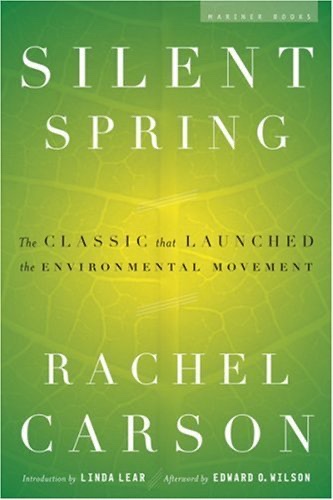
 Silent Spring
Quotes from the Book
Those who contemplate the beauty of the earth find reserves of strength that will endure as long as life lasts.
244
A child’s world is fresh and new and beautiful, full of wonder and excitement. It is our misfortune that for most of us that clear-eyed vision, that true instinct for what is beautiful and awe-inspiring, is dimmed and even lost before we reach adulthood. If I had influence with the good fairy who is supposed to preside over the christening of all children, I should ask that her gift to each child in the world be a sense of wonder so indestructible that it would last throughout life, as an unfailing antidote against the boredom and disenchantment of later years … the alienation from the sources of our strength.
161
It is a wholesome and necessary thing for us to turn again to the earth and in the contemplation of her beauties to know the sense of wonder and humility.
120
There is symbolic as well as actual beauty in the migration of the birds, the ebb and flow of the tides, the folded bud ready for the spring. There is something infinitely healing in the repeated refrains of nature - the assurance that dawn comes after night, and spring after the winter.
39
There is something infinitely healing in the repeated refrains of nature - the assurance that dawn comes after night, and spring after winter.
37
it is not half so important to know as to feel
21
For most of us, knowledge of our world comes largely through sight, yet we look about with such unseeing eyes that we are partially blind. One way to open your eyes to unnoticed beauty is to ask yourself, "What if I had never seen this before? What if I knew I would never see it again?
19
...drink in the beauty and wonder at the meaning of what you see.
14
Many children... delight in the small and inconspicuous.
13
I sincerely believe that for the child, and for the parent seeking to guide him, it is not half so important to know as to feel. If facts are the seeds that later produce knowledge and wisdom, then the emotions and the impressions of the senses are the fertile soil in which the seeds must grow. The years of early childhood are the time to prepare the soil. Once the emotions have been aroused - a sense of the beautiful, the excitement of the new and unknown, a feeling of sympathy, pity, admiration or love - then we wish for knowledge about the object of our emotional response. Once found, it has lasting meaning. It is more important to pave the way for the child to want to know than to put him on a diet of facts he is not ready to assimilate.
12
The lasting pleasures of contact with the natural world are not reserved for scientists but are available to anyone who will place himself under the influence of earth, sea, and sky and their amazing life.
10
It is more important to pave the way for the child to want to know than to put him on a diet of facts he is not ready to assimilate.
9
If I had influence with the good fairy who is supposed to preside over the christening of all children, I should ask that her gift to each child in the world be a sense of wonder so indestructible that it would last throughout life, as an unfailing antidote against the boredom and disenchantments of later years, the sterile preoccupation with things that are artificial, the alienation from the sources of our strength.
7
Whatever the vexations or concerns of their personal lives, their thoughts can find paths that lead to inner contentment and to renewed excitement in living. Those who contemplate the beauty of the earth find reserves of strength that will endure as long as life lasts. There is symbolic as well as actual beauty in the migration of the birds, the ebb and flow of the tides, the folded bud ready for the spring.
6
What if I had never seen this before? What if I knew I would never see it again?
5
facts are the seeds that later produce knowledge and wisdom, then the emotions and the impressions of the senses are the fertile soil in which the seeds must grow. The years of early childhood are the time to prepare the soil.
2
I remember a summer night when such a thought came to me strongly. It was a clear night without a moon. With a friend, I went out on a flat headland that is almost a tiny island, being all but surrounded by the waters of the bay. There the horizons are remote and distant rims on the edge of space. We lay and looked up at the sky and the millions of stars that blazed in darkness. The night was so still that we could hear the buoy on the ledges out beyond the mouth of the bay. Once or twice a word spoken by someone on the far shore was carried across on the clear air. A few lights burned in cottages. Otherwise there was no reminder of other human life; my companion and I were alone with the stars. I have never seen them more beautiful: the misty river of the Milky Way flowing across the sky, the patterns of the constellations standing out bright and clear, a blazing planet low on the horizon. Once or twice a meteor burned its way into the earth's atmosphere. It occurred to me that if this were a sight that could be seen only once in a century or even once in a human generation, this little headland would be thronged with spectators. But it can be seen many scores of nights in any year, and so the lights burned in the cottages and the inhabitants probably gave not a thought to the beauty overhead; and because they could see it almost any night perhaps they will never see it. An experience like that, when one's thoughts are released to roam through the lonely spaces of the universe, can be shared with a child even if you don't know the name of a single star. You can still drink in the beauty, and think and wonder at the meaning of what you see.
Watch on YouTube
About Rachel Carson
We have collected 46 quotes from 2 books by Rachel Carson on BookQuoters.
More about the author →More by Rachel Carson
Silent Spring
About the book
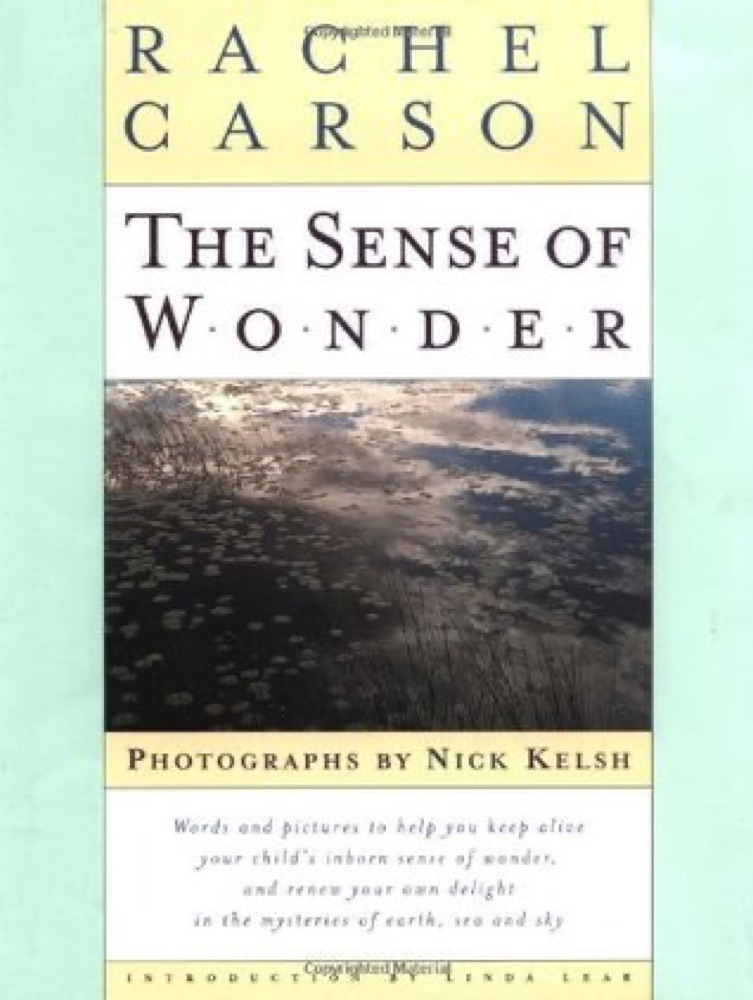
First published more than three decades ago, this reissue of Rachel Carson's award-winning classic brings her unique vision to a new generation of readers. Stunning new photographs by Nick Kelsh beautifully complement Carson's intimate account of adventures with her young nephew, Roger, as they enjoy walks along the rocky coast of Maine and through dense forests and open fields, observing wildlife, strange plants, moonlight and storm clouds, and listening to the "living music" of insects in the underbrush. "If a child is to keep alive his inborn sense of wonder." Writes Carson, "he needs the companionship of at least one adult who can share it, rediscovering with him the joy, excitement and mystery of the world we live in." The Sense of Wonder is a refreshing antidote to indifference and a guide to capturing the simple power of discovery that Carson views as essential to life.
In her
Book details
- First published
- 1965
- Author
- Rachel Carson
- Genre
- Nonfiction
- Goodreads rating
- 4.40 (4k ratings)
The buzz
- The New York TimesReview in The New York Timesprofessional review (via Book Marks)
- The Washington PostReview in The Washington Postprofessional review (via Book Marks)
- Kirkus ReviewsReview in Kirkus Reviewsprofessional review (via Book Marks)
- Publishers WeeklyReview in Publishers Weeklyprofessional review (via Book Marks)
- LA Review of BooksReview in LA Review of Booksprofessional review (via Book Marks)
- The Boston GlobeReview in The Boston Globeprofessional review (via Book Marks)
Keep reading
 Upstream: Selected Essays
 World of Wonders: In Praise of Fireflies, Whale Sharks, and Other Astonishments
 A Natural History of the Senses
 Autumn
 Pilgrim at Tinker Creek
 Evidence: Poems
 Arctic Dreams
 Phosphorescence: On Awe, Wonder and Things That Sustain You When the World Goes Dark
 Unweaving the Rainbow: Science, Delusion and the Appetite for Wonder
 Vesper Flights
 Why Fish Don’t Exist: A Story of Loss, Love, and the Hidden Order of Life
 To The Bright Edge of the World
 Small Wonder
 The Outermost House: A Year of Life on the Great Beach of Cape Cod
 For Small Creatures Such as We: Rituals for Finding Meaning in Our Unlikely World
 Winter Hours: Prose, Prose Poems, and Poems
 The Abundance
 Nature and Selected Essays
 The Snow Leopard
 The Elegance of the Hedgehog
 Art as Therapy
 West with the Night
 Lyrical Ballads
 Deep Creek: Finding Hope in the High Country
 Selected Stories
 A Circle of Quiet
 In Search of Lost Time
 The Story of My Life
 The Covenant of Water
 A Book of Simple Living
 Teaching a Stone to Talk: Expeditions and Encounters
 Gathering Moss: A Natural and Cultural History of Mosses
 Winter
 North of Beautiful
 Down Among the Sticks and Bones
 Becoming Wise: An Inquiry into the Mystery and Art of Living
 The Well-Gardened Mind: The Restorative Power of Nature
 There Are Rivers in the Sky
 The Museum of Innocence
 Swann's Way
 The Anthropocene Reviewed: Essays on a Human-Centered Planet
 Gift from the Sea
 High Tide in Tucson
 The Art of Hearing Heartbeats
 Somewhere Towards the End
 Gilead
 Surprised by Joy: The Shape of My Early Life
 The Blood of Flowers
 The Art of Travel
 The Letters of Vincent van Gogh
 The Girl Who Drank the Moon
 The House at Riverton
 Jitterbug Perfume
 Year of Wonders
 The Island of the Day Before
 Brida
Brida
 The Sea Keeper's Daughters
 The Old Curiosity Shop