
 A Room Called Earth
Quotes from the Book
No matter what the universe has in store, it cannot take away from the fact that you were born. You’ll have some joy and some pain, and all the other experiences that make up what it’s like to be a tiny part of a grand cosmos. No matter what happens next, you were here. And even when any record of our individual lives is lost to the ages, that won’t detract from the fact that we were. We lived. We were part of the enormity. All the great and terrible parts of being alive, the shocking sublime beauty and heartbreak, the monotony, the interior thoughts, the shared pain and pleasure. It really happened. All of it. On this little world that orbits a yellow star out in the great vastness. And that alone is cause for celebration.
32
My parents taught me that the provable, tangible, verifiable things were sacred, that sometimes the most astonishing ideas are clearly profound, but when they get labeled as "facts", we lose sight of their beauty. It doesn't have to be this way. Science is the source of so much insight worthy of ecstatic celebration.
11
Days and weeks go by and the regularity of existing eclipses the miraculousness of it. But there are certain moments when we manage to be viscerally aware of being alive. Sometimes those are terrifying moments, like narrowly avoiding a car accident. Sometimes they are beautiful, like holding your newborn in your arms. And then there are the quiet moments in between when all the joy and sorrow seem profound only to you.
9
I believe our cruelty toward one another, not sex or love of knowledge, is our original sin. It’s that for which we must really atone. In small instances as well as large ones.
8
There is one more way I time travel back to my father. When I was little he told me that air particles stay in our atmosphere for such a long time that we breathe the same air as the people who lived thousands of years ago. I think about that often now. I can take a deep breath and know that some fraction of those particles were once breathed by my dad. What an intimate thing it is to breathe the air of someone you loved.
7
What an astonishing thing a book is. It’s a flat object made from a tree with flexible parts on which are imprinted lots of funny dark squiggles. But one glance at it and you’re inside the mind of another person, maybe somebody dead for thousands of years. Across the millennia, an author is speaking clearly and silently inside your head, directly to you. Writing is perhaps the greatest of human inventions, binding together people who never knew each other, citizens of distant epochs. Books break the shackles of time. A book is proof that humans are capable of working magic.
6
Ritual purification, both spiritual and physical, is common to many religions. It often comes from the idea that human bodies are dirty, innately flawed in their functionality and earthliness. I don’t see it that way. I think the parts of us that bleed and orgasm and eat and sweat are sacred too. It’s all part of the astounding, intricate machinery of being alive.
6
Every single one of us appears seemingly from nowhere and then, eventually, returns to nowhere. We are conceived, we grow, and we die, but what happens beyond that is a great, haunting mystery. We grapple with it by marking how and when things change here on Earth, both cyclically and permanently.
6
We needn’t resort to myth to get that spine-chilling thrill of being part of something grander than ourselves. Our vast universe provides us with enough profound and beautiful truths to live a spiritually fulfilling life.
5
It’s dangerous to believe things just because you want them to be true.
5
Nature is full of patterns and we humans love finding them, creating them, repeating them. This is the core of language, math, music, and even ritual, which is the repetition of words or actions deemed worthy of representing something bigger than ourselves. My view is that all over the world and across time, these are all a form of art, an elaborate performance or a secret poem, all vital in their ability to help us face the nature of time and change, life and death, and everything else we cannot control.
4
for small creatures such as we, the vastness is bearable only through love.
3
Growing up in our home, there was no conflict between science and spirituality. My parents taught me that nature as revealed by science was a source of great, stirring pleasure. Logic, evidence, and proof did not detract from the feeling that something was transcendent—quite the opposite. It was the source of its magnificence.
3
Every loss you withstand in your life reopens all the others.
2
I don't believe ignorance is bliss. I think understanding is bliss, but to get to the joyful part, sometimes you have to face the terror head on. Once I could admit to myself how truly tiny we are, how short our time is, and still love life, I felt like a woman.
2
I have always thought of our love as a kind of religion. Not supernatural or preordained but something to trust in, something to honour, something to cherish - and not take for granted. Like any religion, our love has its hallowed origin story (the steamy August night our friendship finally turned romantic) and annual holidays (the anniversaries of that first night, of the day we decided to be exclusive, of our wedding) and those occasional, rapturous moments of transcendence. But we'd been missing another crucial element: a weekly sacrament, a regular affirmation of the devotion and joy at the core of what we'd built together. The thing you are obliged to do regularly, at an appointed time, to remind you of your values even when you are grouchy, busy, or annoyed. Even when you really don't feel like it.
2
An old tradition is not intrinsically better than a new one. Especially when it is such a joy to make new ones up—ones that reflect exactly what you believe, ones that make sense of your life as you experience it, ones that bring the world a little closer to the way you wish it could be.
1
My parents taught me that there has never been any correlation between how true something was and how fervently it was believed.
1
At our Thanks Givings my mother raises a glass and says, “you don’t need to know who to thank to be thankful.
1
Rituals are, among other things, tools that help us process change. There is so much change in this universe, so many entrances and exits, and ways to mark them...each one astonishing in its own way.
1
I do agree with the premise that there is something wrong with us, something we must work to overcome. It’s our xenophobia, authoritarianism, and violence. When we lived in small bands of only a few dozen people there might have been some selective advantage to these terrible qualities. But now we live in a tribe of seven billion. We are, more than ever, all in it together. Science and technology have allowed us to see one another’s lives, to speak one another’s languages, to learn one another’s customs. They’ve also given us a view of our small world in the vastness. This should breed kindness. As my dad once said, “If a human disagrees with you, let him live. In a hundred billion galaxies, you will not find another.” I believe our cruelty toward one another, not sex or love of knowledge, is our original sin. It’s that for which we must really atone. In small instances as well as large ones.
1
But this is not a singularly Jewish issue. Lots of people don’t, for instance, consider Jesus Christ their Lord and Savior but still take pleasure in Christmas. It doesn’t even have to be about religious identity.
But, safe in New York, my great-grandfather looked up and smiled at his son and said the immortal words: “The only sin would be to pretend.
And they taught me that, as they once wrote, “for small creatures such as we, the vastness is bearable only through love.
But even in its secular incarnation, Thanksgiving is built on lore that does not jibe with the historical facts. The idea of a peaceful breaking of bread where the Pilgrims had nothing but good intentions toward their Native American hosts is a national mythology, not a religious one. Whatever took place between the Wampanoag and the European settlers in Plymouth, it was not the inclusive dinner party we’re told about in school. There’s no evidence a single Native American was present. The only certainty is that it was a prelude to massacres of entire villages and the obliteration of whole societies. So what do we do with this kind of ritual? How do
As with love, it's our vulnerability that opens us up to something deeper. Our willingness to be wrong, to let go of our predictions and preconceptions, clears the way to more than we could have otherwise imagined.
The way we experience time has so often been entwined with our beliefs. This is evident in another part of our weekly calendar. In English, Monday is a contraction of moon and day. In Spanish, French, and Italian, days share the same basic construction. It might not sound like it in English, but Tuesday is for Mars. The romance languages make it obvious: martes (Spanish), mardi (French), and martedi (Italian). Wednesday, also known as miércoles, mercredi, and mercoledí, is for Mercury. Thursday is for Jupiter, Friday for Venus, Saturday for Saturn.
How astonishing that being bathed in rays of light from a 4.6-billion-year-old mass of hydrogen and helium located 93 million miles away can make us feel happy?
It's beautiful that our brains have evolved to recognize patterns. It is one of our greatest strengths. It's what allows me to communicate ideas to you with these squiggly little symbols you're looking at right now. It's what allows us to understand concepts like mathematics and physics, its how we manage to engineer buildings that don't collapse and planes that stay in the air. So in a way, there is a "grand novelist." It's us. We are the ones writing this epic saga, pulling out the plot points from the scenery.
Watch on YouTube
About Sasha Sagan
We have collected 29 quotes from 1 book by Sasha Sagan on BookQuoters.
More about the author →About the book
"What is the meaning of life? Sagan finds its meaning everywhere--with her family, around the world, and especially among the stars of the cosmos. Read her work; you'll have a deeper appreciation for your every step, every bite, and every breath." --Bill Nye
Sasha Sagan was raised by secular parents, the astronomer Carl Sagan and the writer and producer Ann Druyan. They taught her that the natural world and vast cosmos are full of profound beauty, that science reveals truths more wondrous than any myth or fable.
When Sagan herself became a mother, she began her own hunt for the natural phenomena behind our most treasured occasions--from births to deaths, holidays to weddings, anniversaries, and more--growing these roots into a new set of rituals for her young daughter that honor the joy and significance of each experience without relying on religious framework.
As Sagan shares t
Book details
- First published
- 2019
- Author
- Sasha Sagan
- Genre
- Nonfiction
- Goodreads rating
- 4.10 (5k ratings)
The buzz
- Kirkus ReviewsReview in Kirkus Reviewsprofessional review (via Book Marks)
- Publishers WeeklyReview in Publishers Weeklyprofessional review (via Book Marks)
- LibraryjournalReview in Libraryjournalprofessional review (via Book Marks)
- BooklistReview in Booklistprofessional review (via Book Marks)
- BookPageReview in BookPageprofessional review (via Book Marks)
Keep reading
A Room Called Earth
 Becoming Wise: An Inquiry into the Mystery and Art of Living
 Proof of Heaven: A Neurosurgeon's Journey into the Afterlife
 The Power of Myth
 A Circle of Quiet
 Breaking the Spell: Religion as a Natural Phenomenon
 Kitchen Table Wisdom: Stories that Heal
 These Precious Days: Essays
 Bewilderment
 The Book of Awakening: Having the Life You Want by Being Present to the Life You Have
 When Women Were Dragons
 Myths to Live By
 The Stone Gods
 Stitches: A Handbook on Meaning, Hope, and Repair
 Almost Everything: Notes on Hope
 The Book of Secrets: Unlocking the Hidden Dimensions of Your Life
 Small Wonder
 Stories of Your Life and Others
 The Convoluted Universe, Book 1
 The Book: On the Taboo Against Knowing Who You Are
 Unweaving the Rainbow: Science, Delusion and the Appetite for Wonder
 A Language Older Than Words
 Drive Your Plow Over the Bones of the Dead
 Why Fish Don’t Exist: A Story of Loss, Love, and the Hidden Order of Life
 The Big Picture: On the Origins of Life, Meaning, and the Universe Itself
 The Fifth Science
 Of Mess and Moxie: Wrangling Delight Out of This Wild and Glorious Life
 Surprised by Joy: The Shape of My Early Life
 The God Who Weeps: How Mormonism Makes Sense of Life
 No Death, No Fear: Comforting Wisdom for Life
 The Bassoon King: My Life in Art, Faith, and Idiocy
 Dusk, Night, Dawn: On Revival and Courage
 The Library of Fates
 Jeremy Fink and the Meaning of Life
 Split Tooth
 Deep Creek: Finding Hope in the High Country
 The Color of Everything: A Journey to Quiet the Chaos Within
 The Anthropocene Reviewed: Essays on a Human-Centered Planet
 A History of the World in 10½ Chapters
 A Joseph Campbell Companion: Reflections on the Art of Living
 Two-Part Invention: The Story of a Marriage
 The Mountain Shadow
 Christmas Days: 12 Stories and 12 Feasts for 12 Days
 Origin
 Running from Safety: An Adventure of the Spirit
 Children of the Mind
 Conversations with God: An Uncommon Dialogue, Book 1
 Messages from the Masters: Tapping into the Power of Love
 The Accidental Universe: The World You Thought You Knew
 A Return to Love: Reflections on the Principles of "A Course in Miracles"
 This Here Flesh: Spirituality, Liberation, and the Stories That Make Us
 Blue Like Jazz: Nonreligious Thoughts on Christian Spirituality
 Embers: One Ojibway's Meditations
 Make It Scream, Make It Burn
 Falling Back in Love with Being Human: Letters to Lost Souls
 Island
 The Humans
 Letter to My Daughter
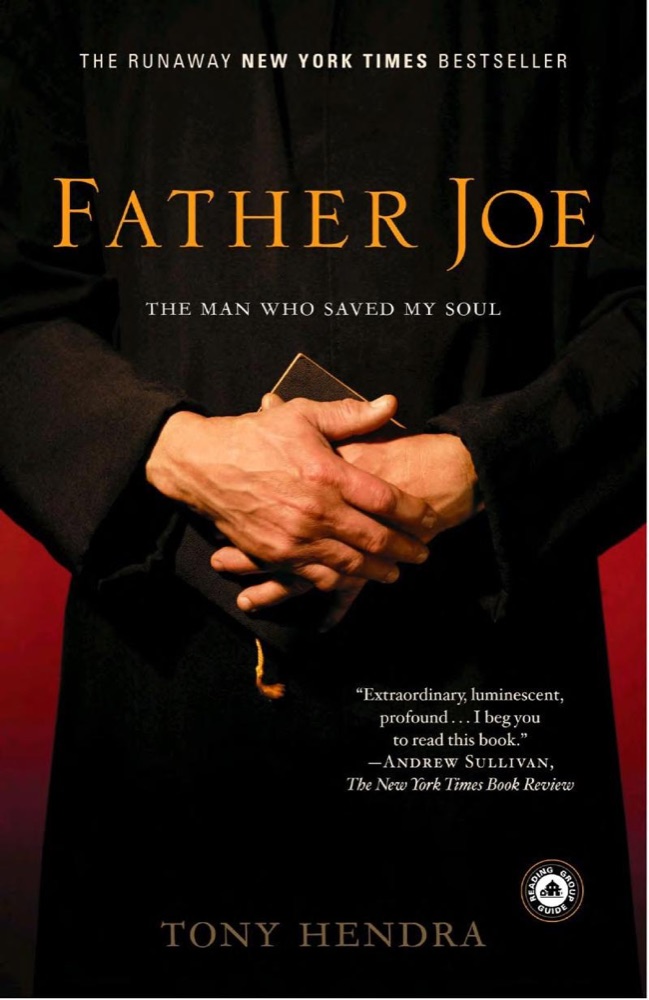 Father Joe: The Man Who Saved My Soul