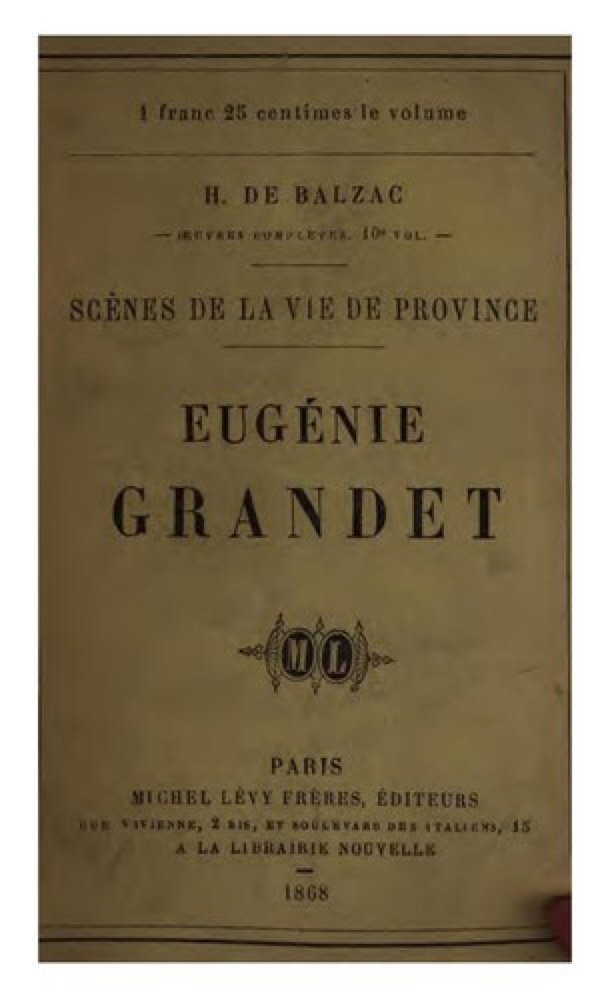
 Eugénie Grandet
Quotes from the Book
It is always assumed by the empty-headed, who chatter about themselves for want of something better, that people who do not discuss their affairs openly must have something to hide.
Women are always true, even in the midst of their greatest falsities, because they are always influenced by some natural feeling.
Some day you will find out that there is far more happiness in another's happiness than in your own.
Ah! What pleasure it must be to a woman to suffer for the one she loves!
I'm a great poet. I don't put my poems on paper: they consist of actions and feelings.
A letter is a soul, so faithful an echo of the speaking voice that to the sensitive it is among the richest treasures of love.
Who is to decide which is the grimmer sight: withered hearts, or empty skulls?
Perhaps it is only human nature to inflict suffering on anything that will endure suffering, whether by reason of its genuine humility, or indifference, or sheer helplessness.
Holding this book in your hand, sinking back in your soft armchair, you will say to yourself: perhaps it will amuse me. And after you have read this story of great misfortunes, you will no doubt dine well, blaming the author for your own insensitivity, accusing him of wild exaggeration and flights of fancy. But rest assured: this tragedy is not a fiction. All is true.
Our heart is a treasury; if you pour out all its wealth at once, you are bankrupt.
However gross a man may be, the minute he expresses a strong and genuine affection, some inner secretion alters his features, animates his gestures, and colors his voice. The stupidest man will often, under the stress of passion, achieve heights of eloquence, in thought if not in language, and seem to move in some luminous sphere. Goriot's voice and gesture had at this moment the power of communication that characterizes the great actor. Are not our finer feelings the poems of the human will?
If the human heart sometimes finds moments of pause as it ascends the slopes of affection, it rarely halts on the way down.
Such is life. It is no cleaner than a kitchen; it reeks like a kitchen; and if you mean to cook your dinner, you must expect to soil your hands; the real art is in getting them clean again, and therein lies the whole morality of our epoch.
You're a fine fastidious young man, as proud as a lion, as gentle as a girl. You'd make a good catch for the devil.
Do you know how a man makes his way here? By brilliant genius or by skilful corruption. You must either cut your way through these masses of men like a cannon ball, or steal among them like a plague.
But also remember: if you have any genuine feelings, hide them like treasure; never let anyone so much as suspect them, or you're lost. Instead of being the executioner, you'll be the victim. And if you ever fall in love, keep that absolutely secret! Never breathe a word until you're completely sure of the person to whom you open your heart. And to protect that love, even before you feel it, learn to despise the world.
Women themselves are so happy, and so beautiful, when they're strong, that they naturally choose powerful men, even if that power's so enermous there's a real risk it could shatter them.
Love is a religion, and its rituals cost more than those of other religions. It goes by quickly and, like a street urchin, it likes to mark its passage by a trail of devastation.
The human heart may find here and there a resting-place short of the highest height of affection, but we seldom stop in the steep, downward slope of hatred.
He hesitated till the last moment, but finally dropped them in the box, saying, "I shall win!"--the cry of a gambler, the cry of the great general, the compulsive cry that has ruined more men than it has ever saved.
We flew back home like swallows. 'Is it happiness that makes us so light?' Agathe asked.
What moralists describe as the mysteries of the human heart are solely the deceiving thoughts, the spontaneous impulses of self-regard. The sudden changes in character, about which so much has been said, are instinctive calculations for the furtherance of our own pleasures. Seeing himself now in his fine clothes, his new gloves and shoes, Eugène de Rastignac forgot his noble resolve. Youth, when it swerves toward wrong, dares not look in the mirror of conscience; maturity has already seen itself there. That is the whole difference between the two phases of life.
Is there any instinct more deeply implanted in the heart of man than the pride of protection, a protection which is constantly exerted for a fragile and defenceless creature?
No one ought even to desert a woman after throwing her a heap of gold in her distress! He ought to love her forever! You are young, only twenty-one, and kind and upright and fine. You'll ask me how a woman can take money from a man. Oh, God, isn't it natural to share everything with the one we owe all our happiness to? When one has given everything, how can one quibble about a mere portion of it? Money is important only when feeling has ceased. Isn't one bound for life? How can you foresee separation when you think someone loves you? When a man swears eternal love--how can there be any separate concerns in that case?
A man who prides himself on going in a straight line through life is an idiot who believes in infallibility.
How did you get back?' asked Vautrin. 'I walked,' replied Eugene. 'I wouldn't like half-pleasures, myself,' observed the tempter. 'I'd want to go there in my own carriage, have my own box, and come back in comfort. All or nothing, that's my motto.' 'And a very good one,' said Madame Vauquer.
If youth were not ignorant and timid, civilization would be impossible.
Watch on YouTube
About Honoré de Balzac
We have collected 104 quotes from 7 books by Honoré de Balzac on BookQuoters.
More about the author →More by Honoré de Balzac
All books by Honoré de Balzac →
Book details
- Author
- Honoré de Balzac
- Genre
- Classics
- Goodreads rating
- 3.85 (69k ratings) →
Keep reading
 The Moon and Sixpence
 Les Liaisons dangereuses
 Uncle Tom's Cabin
 Allan Quatermain
 The Picture of Dorian Gray
 The Heart of the Matter
 The Red and the Black
 Middlemarch
 Of Human Bondage
 The Jewel in the Crown
 The Scarlet Letter
 Don Quixote
 Nicholas Nickleby
 The Interpretation of Murder
 Gaudy Night
 East of Eden
 Adam Bede
 Man and Superman
 The House of the Seven Gables
 The Guermantes Way
 The Sea, the Sea
 The Professor
 La dame aux camélias
 Shantaram
 A Tale of Love and Darkness
 Doctor Zhivago
 Crime and Punishment
 An Ideal Husband
 A Room with a View
 The Way We Live Now
 The Fall
 Journey to the End of the Night
 The Count of Monte Cristo
 Lord Jim
 The Death of the Heart
 The First Circle
 Les Misérables
 The Fall of Babel
 The Lost World
 Silas Marner
 The Volcano Lover: A Romance
 The Hunchback of Notre-Dame
 She
She
 Beyond Good and Evil
 Human, All Too Human
 The Longest Journey
 Dracula
 Vanity Fair
 Herzog
 The Wise Man's Fear
 Cuckold
 Dead Souls
 The Gargoyle
 The Once and Future King
 The Razor's Edge
 The Screwtape Letters
 Humboldt's Gift
 The Woman in White
 The Tsar of Love and Techno
 The Gadfly