
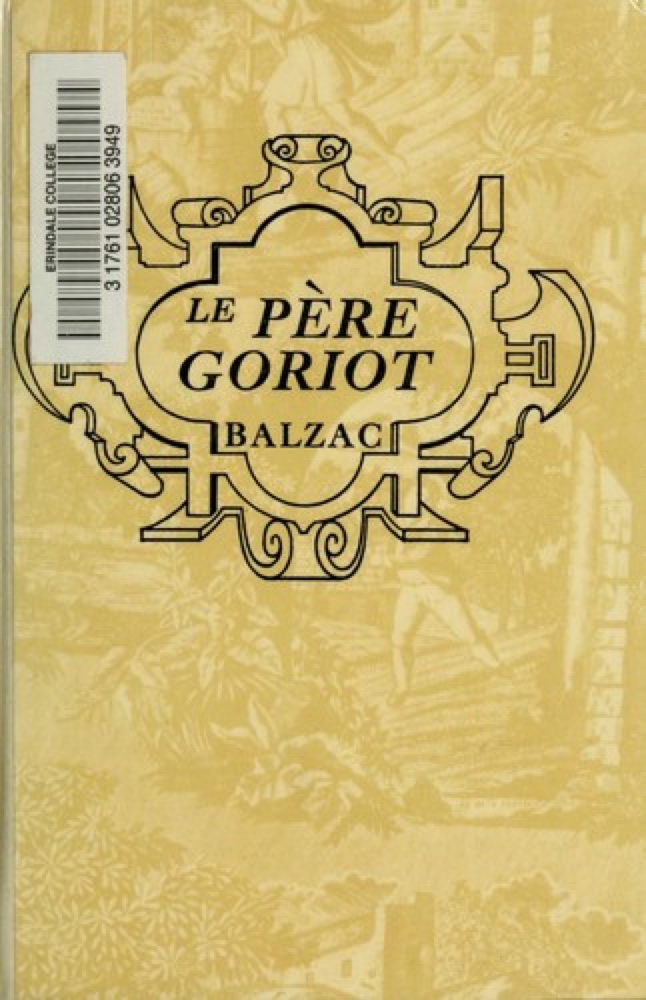
 Père Goriot
Quotes from the Book
There is something noble as well as terrible about suicide. The downfall of many men is not dangerous, for they fall like children, too near the ground to do themselves harm. But when a great man breaks, he has soared up to the heavens, espied some inaccessible paradise, and then fallen from a great height. The forces that make him seek peace from the barrel of a gun cannot be placated. How many young talents confined to an attic room wither and perish for lack of a friend, a consoling wife, alone in the midst of a million fellow humans, while throngs of people weary of gold are bored with their possessions.
Have you ever plunged into the immensity of space and time by reading the geological treatises of Cuvier? Borne away on the wings of his genius, have you hovered over the illimitable abyss of the past as if a magician's hand were holding you aloft? As one penetrates from seam to seam, from stratum to stratum and discovers, under the quarries of Montmartre or in the schists of the Urals, those animals whose fossilized remains belong to antediluvian civilizations, the mind is startled to catch a vista of the milliards of years and the millions of peoples which the feeble memory of man and an indestructible divine tradition have forgotten and whose ashes heaped on the surface of our globe, form the two feet of earth which furnish us with bread and flowers. Is not Cuvier the greatest poet of our century? Certainly Lord Byron has expressed in words some aspects of spiritual turmoil; but our immortal natural historian has reconstructed worlds from bleached bones.
Yes, I can understand that a man might go to gambling table - when he sees that all that lies between himself and death is his last crown
Happy?" asked Aquilina, with dreadful look, and a smile full of pity and terror. "Ah, you do not know what it is to be condemned to a life of pleasure.
Il existe je ne sais quoi de grand et d’épouvantable dans le suicide. Les chutes d’une multitude de gens sont sans danger, comme celles des enfants qui tombent de trop bas pour se blesser; mais quand un grand homme se brise, il doit venir de bien haut, s’être élevé jusqu’aux cieux, avoir entrevu quelque paradis inaccessible. Implacables doivent être les ouragans qui le forcent à demander la paix de l’âme à la bouche d’un pistolet… Chaque suicide est un poème sublime de mélancolie.
He looked like some plant bleached by darkness.
Emile was a journalist who had acquired more reputation by doing nothing than others from a successful productive career. A bold, biting, spirited critic, he possessed all the qualities of his defects. Jovial and outspoken, he would blister a friend to his face with a thousand sarcasms but, behind his back, he would defend him with courage and loyalty. He made fun of everything, his own prospects included. Always short of money, he remained, like all men with a future before them, wallowing in inexpressible idleness, condensing a whole book into one epigram for the benefit of people who were incapable of putting one witticism into a whole book. Lavish of promises that he never kept, he had made his fortune and reputation into a cushion on which he slept, thus running the risk of coming to his senses, as an old man, in an almshouse. With all that, keeping faith with his friends to the point of death, a swaggering cynic and as simple-hearted as a child, he worked only by fits and starts or under the spur of necessity.
Surely a man must be in a parlours state to excite pity, extremely weak to inspire sympathy, or very evil-looking to make a soul tremble in a den like this, where pain must hold its tongue, poverty remain cheerful, and despair retain its self respect.
Existe un algo grande y espantoso en el suicidio. Las caídas de muchas personas no son peligrosas, son como las de los niños, que caen tan a ras del suelo que no se hacen daño; mas cuando un gran hombre se estrella, ha de venir de muy alto, haberse elevado hasta los cielos, haber entrevisto algún paraíso inaccesible. ¡Cuán implacables han de ser los huracanes que le fuerzan a pedir la paz del alma a la boca de una pistola! ¡Cuántos talentos jóvenes encerrados en una buhardilla languidecen y mueren por falta de un amigo, de una mujer consoladora, en el seno de un millón de seres, en presencia de una muchedumbre harta de oro y que se aburre!
Basta a un joven encontrar una mujer que no le ama o que le quiere demasiado para que su vida quede desordenada. La felicidad engulle nuestras fuerzas como el infortunio mata nuestras virtudes.
La vida sencilla y mecánica conduce a una cordura insensata ahogando nuestra inteligencia con el trabajo, en tanto que la vida pasada en el vacío de las abstracciones o en los abismos del mundo moral lleva a una loca cordura. En una palabra: matar los sentimientos para vivir hasta muy viejos o morir jóvenes aceptando el martirio de las pasiones. Esta es nuestra sentencia.
La sociedad, el mundo, nuestras costumbres, vistos de cerca, me han revelado el peligro de mi creencia inocente y la superfluidad de mis fervientes trabajos. Estas provisiones son inútiles al ambicioso. ¡El que persigue la fortuna ha de llevar poco peso en la mochila!
El amor es una fuente ingenua, que sale de su lecho de berros, de flores, de arena, que, arroyo o río, muda de naturaleza y aspecto a cada onda y se arroja a un inconmensurable océano en que los espíritus incompletos ven la monotonía, en que las almas grandes se entregan a contemplaciones perpetuas. ¡Cómo osar describir esas tintas transitorias del sentimiento, esas naderías que tanto precio tienen, esas palabras cuyo acento agota los tesoros del lenguaje, esas miradas más fecundas que los más bellos poemas!
Ver a tu amante dormida, risueña en su sueño apacible bajo tu protección, amándote hasta en sueños, en el momento en que la criatura parece dejar de ser, y ofreciéndote todavía una boca muda que en el sueño te habla del último beso; ver una mujer confiada, medio desnuda, aunque envuelta en su amor como en un manto, y casta en el seno del desorden; admirar sus vestidos esparcidos, una media de seda, quitada rápidamente la noche anterior para complacerte, un ceñidor desabrochado que te confiesa una fe infinita, ¿no es un gozo sin nombre? Ese ceñidor es un poema entero, la mujer a la que defendía ya no existe, es tuya, se ha hecho tú. Si le eres infiel en lo sucesivo, te hieres a ti mismo.
Si alguna ave de las que se hallan en el corral está enferma o lastimada, las otras la acometen a picotazos, la despluman y la matan. Fiel a esta ley fundamental del egoísmo, el mundo prodiga sus rigores a las miserias bastante osadas para venir a arrostrar sus fiestas, para entristecer sus placeres. El que sufre en el cuerpo o el alma, carece de dinero o de poder, es un paria. ¡Que se quede en su desierto! Si traspasa sus límites, encuentra en todas partes el invierno; miradas, modales, palabras, corazones fríos. ¡Dichoso si no recibe insultos en donde debía hallar consuelo! ¡Moribundos, quédense en sus lechos abandonados!
Watch on YouTube
About Honoré de Balzac
We have collected 104 quotes from 7 books by Honoré de Balzac on BookQuoters.
More about the author →More by Honoré de Balzac
All books by Honoré de Balzac →
Book details
- Author
- Honoré de Balzac
- Genre
- Classics
- Goodreads rating
- 3.67 (12k ratings) →
Keep reading
 Paris Spleen
 Lost Illusions
 Stories
 Doctor Glas
 The House of the Spirits
 So Much for That
 The Charioteer
 Dancing Girls and Other Stories
 Distant Star
 The Mystery of Edwin Drood
 Brodeck
 Zorro
Zorro
 The Yellow Eyes of Crocodiles
 Without Feathers
 Beauty and Sadness
 Socrates In Love
 The Little Virtues
 The Labyrinth of Solitude and Other Writings
 The Ingredients of Love
 Phaedo
 Ordesa
 Firmin: Adventures of a Metropolitan Lowlife
 A Sunny Place for Shady People
 Gomorrah
 Of Love and Shadows
 My Last Sigh
 Instrumental: A Memoir of Madness, Medication and Music
 The Lost Steps
 Like Water for Chocolate
 Rita Hayworth and Shawshank Redemption
 Upside Down: A Primer for the Looking-Glass World
 Nadja
Nadja
 Memoirs
 Ficciones
 The Time of the Hero
 Hopscotch
 La reina del sur
 The Autumn of the Patriarch
 Cujo
Cujo
 The Dwarf
 My Childhood
 Don Quixote de La Mancha, Vol. 1
 The Narrow Road Between Desires
 Blow-Up and Other Stories
 A Season in Hell
 Brodie's Report
 The Analyst
 Brave New World / Brave New World Revisited
 On Heroes and Tombs
 Before Night Falls
 Soul Mountain
 A General Theory of Oblivion
 The Invention of Morel
 Things We Lost in the Fire
 Liliana's Invincible Summer: A Sister's Search for Justice
 Dear Theo
 Aunt Julia and the Scriptwriter
 Emma in the Night
 Think of a Number