 Les Misérables
Quotes from the Book
Love is like a tree: it grows by itself, roots itself deeply in our being and continues to flourish over a heart in ruin. The inexplicable fact is that the blinder it is, the more tenacious it is. It is never stronger than when it is completely unreasonable.
Nothing makes a man so adventurous as an empty pocket.
I wanted to see you again, touch you, know who you were, see if I would find you identical with the ideal image of you which had remained with me and perhaps shatter my dream with the aid of reality. -Claude Frollo
When you get an idea into your head you find it in everything.
Do you know what friendship is?' he asked. 'Yes,' replied the gypsy; 'it is to be brother and sister; two souls which touch without mingling, two fingers on one hand.' 'And love?' pursued Gringoire. 'Oh! love!' said she, and her voice trembled, and her eye beamed. 'That is to be two and to be but one. A man and a woman mingled into one angel. It is heaven.
...mothers are often fondest of the child which has caused them the greatest pain.
A one-eyed man is much more incomplete than a blind man, for he knows what it is that's lacking.
He reached for his pocket, and found there, only reality
"Dost thou understand? I love thee!" he cried again."What love!" said the unhappy girl with a shudder.He resumed,--"The love of a damned soul.
One drop of wine is enough to redden a whole glass of water.
You would have imagined her at one moment a maniac, at another a queen.
He left her. She was dissatisfied with him. He had preferred to incur her anger rather than cause her pain. He had kept all the pain for himself.
He therefore turned to mankind only with regret. His cathedral was enough for him. It was peopled with marble figures of kings, saints and bishops who at least did not laugh in his face and looked at him with only tranquillity and benevolence. The other statues, those of monsters and demons, had no hatred for him – he resembled them too closely for that. It was rather the rest of mankind that they jeered at. The saints were his friends and blessed him; the monsters were his friends and kept watch over him. He would sometimes spend whole hours crouched before one of the statues in solitary conversation with it. If anyone came upon him then he would run away like a lover surprised during a serenade.
The saints were his friends, and blessed him; the monsters were his friends, and guarded him.
Love is like a tree: it shoots of itself; it strikes it's roots deeply into our whole being, and frequently continues to put forth green leaves over a heart in ruins. And there is this unaccountable circumstance attending it, that the blinder the passion the more tenacious it is. Never is it stronger than when it is most unreasonable.
To a gargoyle on the ramparts of Notre Dame as Esmeralda rides off with Gringoire Quasimodo says. "Why was I not made of stone like thee?
His judgement demonstrates that one can be a genius and understand nothing of an art that is not one's own.
At the moment when her eyes closed, when all feeling vanished in her, she thought that she felt a touch of fire imprinted on her lips, a kiss more burning than the red-hot iron of the executioner.
If he had had all Peru in his pocket, he would certainly have given it to this dancer; but Gringoire had not Peru in his pocket; and besides, America was not yet discovered. (p. 66)
The owl goes not into the nest of the lark.
Large, heavy, ragged black clouds hung like crape hammocks beneath the starry cope of the night. You would have said that they were the cobwebs of the firmament.
But alas, if I have not maintained my victory, it is God's fault for not making man and the devil of equal strength.
The greatest products of architecture are less the works of individuals than of society; rather the offspring of a nation's effort, than the inspired flash of a man of genius...
...in better company, they found among all those hideous carcasses two skeletons, one of which held the other in its embrace. One of these skeletons, which was that of a woman, still had a few strips of a garment which had once been white, and around her neck was to be seen a string of adrezarach beads with a little silk bag ornamented with green glass, which was open and empty. These objects were of so little value that the executioner had probably not cared for them. The other, which held this one in a close embrace, was the skeleton of a man. It was noticed that his spinal column was crooked, his head seated on his shoulder blades, and that one leg was shorter than the other. Moreover, there was no fracture of the vertebrae at the nape of the neck, and it was evident that he had not been hanged. Hence, the man to whom it had belonged had come thither and had died there. When they tried to detach the skeleton which he held in his embrace, he fell to dust.
by making himself a priest made himself a demon.
And if you wish to receive of the ancient city an impression with which the modern one can no longer furnish you, climb--on the morning of some grand festival, beneath the rising sun of Easter or of Pentecost--climb upon some elevated point, whence you command the entire capital; and be present at the wakening of the chimes. Behold, at a signal given from heaven, for it is the sun which gives it, all those churches quiver simultaneously. First come scattered strokes, running from one church to another, as when musicians give warning that they are about to begin. Then, all at once, behold!--for it seems at times, as though the ear also possessed a sight of its own,--behold, rising from each bell tower, something like a column of sound, a cloud of harmony. First, the vibration of each bell mounts straight upwards, pure and, so to speak, isolated from the others, into the splendid morning sky; then, little by little, as they swell they melt together, mingle, are lost in each other, and amalgamate in a magnificent concert. It is no longer anything but a mass of sonorous vibrations incessantly sent forth from the numerous belfries; floats, undulates, bounds, whirls over the city, and prolongs far beyond the horizon the deafening circle of its oscillations. Nevertheless, this sea of harmony is not a chaos; great and profound as it is, it has not lost its transparency; you behold the windings of each group of notes which escapes from the belfries.
Admirable, however, as the Paris of the present day appears to you, build up and put together again in imagination the Paris of the fifteenth century; look at the light through that surprising host of steeples, towers, and belfries; pour forth amid the immense city, break against the points of its islands, compress within the arches of the bridges, the current of the Seine, with its large patches of green and yellow, more changeable than a serpent's skin; define clearly the Gothic profile of this old Paris upon an horizon of azure, make its contour float in a wintry fog which clings to its innumerable chimneys; drown it in deep night, and observe the extraordinary play of darkness and light in this sombre labyrinth of buildings; throw into it a ray of moonlight, which shall show its faint outline and cause the huge heads of the towers to stand forth from amid the mist; or revert to that dark picture, touch up with shade the thousand acute angles of the spires and gables, and make them stand out, more jagged than a shark's jaw, upon the copper-coloured sky of evening. Now compare the two.
There are plenty who regard a wall behind which something is happening as a very curious thing.
When a man understands the art of seeing, he can trace the spirit of an age and the features of a king even in the knocker on a door.
Did you know?
- The novel was originally published in French under the title Notre-Dame de Paris, which centers the cathedral rather than the hunchback.
- Facing a contractual deadline, Hugo is said to have finished the manuscript on 15 January 1831, weeks before it was due.
- The book helped inspire the 19th-century Gothic revival and the restoration of Notre-Dame led by Eugene Viollet-le-Duc.
- The story is set in Paris in 1482 during the reign of King Louis XI.
- The first edition sold out quickly, requiring additional printings within the same year.
About Victor Hugo
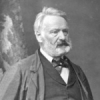
Victor Hugo (1802-1885) was a French Romantic writer and one of the towering figures of French literature, celebrated for novels including Notre-Dame de Paris and Les Miserables as well as his poetry and drama.
More about the author →More by Victor Hugo
All books by Victor Hugo →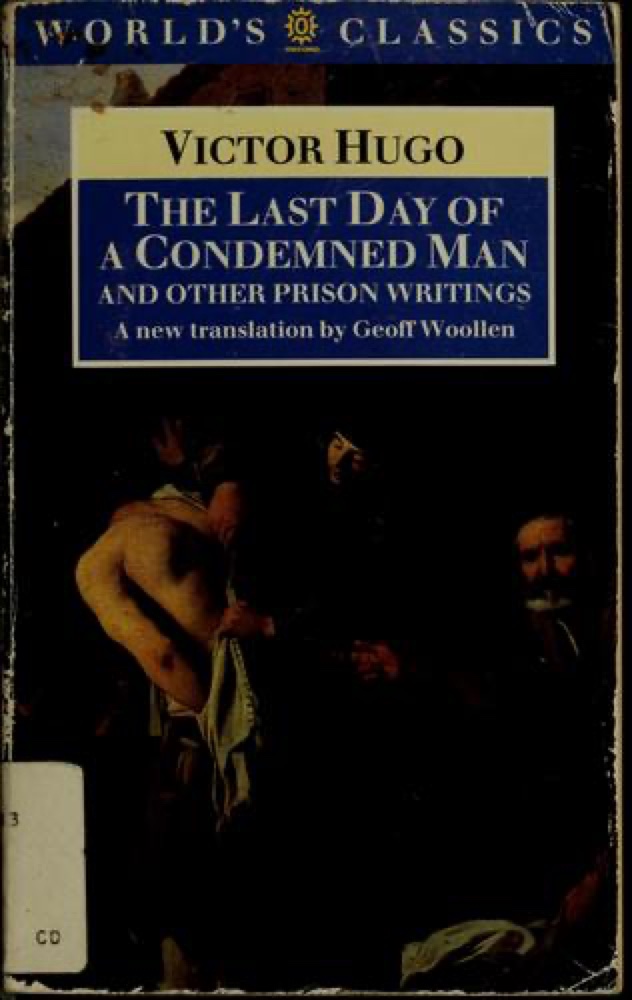
About the book
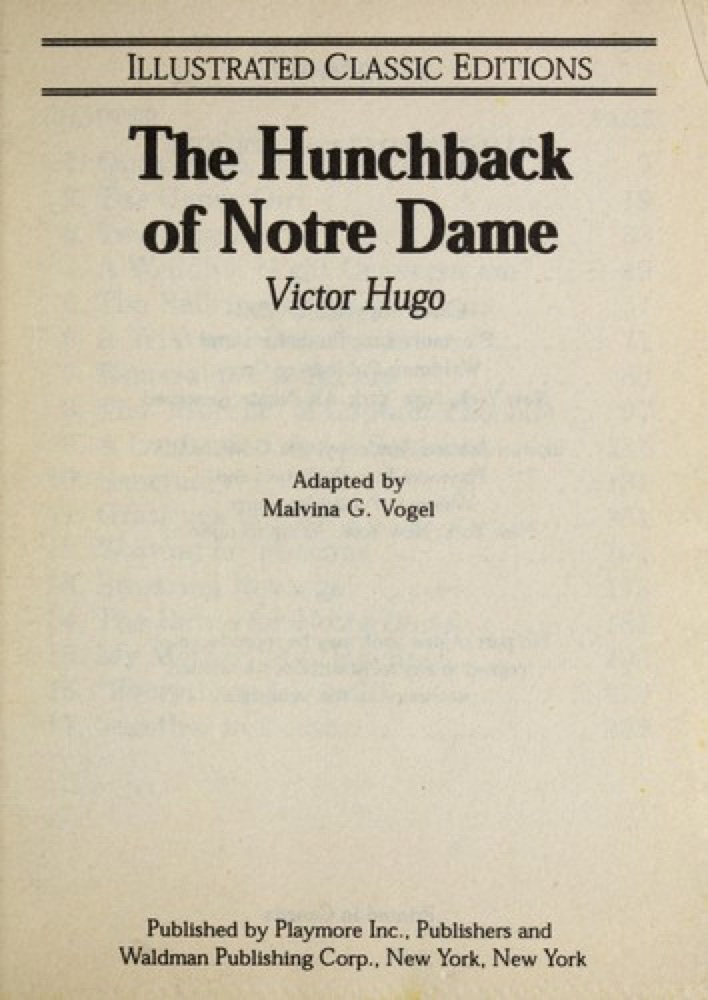
First published in French as Notre-Dame de Paris on 16 March 1831, Victor Hugo's novel unfolds in 1482 Paris during the reign of Louis XI, with the great Gothic cathedral itself at the heart of the story. Its intersecting lives revolve around Esmeralda, a young Romani street dancer, and the men drawn to her: the deformed bell-ringer Quasimodo, the tormented archdeacon Claude Frollo, the vain Captain Phoebus, and the struggling poet Pierre Gringoire. Frollo's obsessive jealousy sets a tragic chain of events in motion around the towers and squares of Notre-Dame.
Beyond its melodrama, the book is a sustained meditation on Gothic architecture, fate, and social exclusion. Hugo lamented the neglect and 'restoration' that were disfiguring France's medieval buildings, and he framed the cathedral as a work of collective genius worth preserving. Themes of determinism, outsider status, and the cruelty of a crowd run through the narrative, with Quasimodo and Esmeralda standing as figures scorned or condemned by the society around them.
The novel became a classic of French literature and a landmark of Romanticism. It helped spark the 19th-century Gothic revival and the historic-preservation movement, contributing to the major restoration of Notre-Dame led by Eugene Viollet-le-Duc, and it cemented the cathedral as a French national icon. Widely translated and adapted for film, stage, and ballet, the story has remained a durable part of popular culture.
Key characters
- QuasimodoThe deformed, half-deaf bell-ringer of Notre-Dame, raised by Frollo
- EsmeraldaA compassionate young Romani street dancer beloved by several men
- Claude FrolloThe archdeacon whose obsessive desire for Esmeralda drives the tragedy
- Captain Phoebus de ChateaupersA vain, handsome King's Archer who betrays Esmeralda
- Pierre GringoireA struggling poet who becomes Esmeralda's husband in name only
Book details
- First published
- 1831
- Author
- Victor Hugo
- Genre
- Classics
- Goodreads rating
- 4.02 (223k ratings) →
- First line
- “Three hundred and forty-eight years, six months, and nineteen days ago to-day, the Parisians awoke to the sound of all the bells in the triple circuit of the city, the university, and the town ringing a full peal.”
Movie & TV adaptations
- IMDb
- IMDb
- IMDb
If you liked this, read…
- 1Les MiserablesHugo's other epic novel of social injustice in France
- 2The Phantom of the OperaA tragic outsider haunting a great Parisian landmark
- 3The Count of Monte CristoSweeping French Romantic-era storytelling of fate and injustice
Keep reading
 The Pillars of the Earth
 The Enchantress of Florence
Les Misérables
The Enchantress of Florence
Les Misérables
 The Arabian Nights
 The Magician's Nephew
 Père Goriot
 Victory
 Phantastes
 The Red and the Black
 Nicholas Nickleby
 The Pearl
 The Luminaries
 Allan Quatermain
 The Scarlet Letter
 The Scarlet Pimpernel
 Dreams and Shadows
 Justine
 Don Quixote
 She
She
 The Drawing of the Three
 Shadow & Claw
 The House of the Seven Gables
 Look Homeward, Angel
 Oscar and Lucinda
 The Damnation Game
 Under the Volcano
 Bel-Ami
 The Thousandfold Thought
 Lord Jim
 The Agony and the Ecstasy
 Of Human Bondage
 Purgatorio
 The Complete Stories and Poems
 Autobiography of Red
 Juliet
 Melmoth the Wanderer
 The Man Who Laughs
 The Return of the Native
 The Etched City
 Orlando
 Mythology
 Ben-Hur: A Tale of the Christ
 A Trick of the Light
 Miss Lonelyhearts
 Black Lamb and Grey Falcon
 The Volcano Lover: A Romance
 The Real Life of Sebastian Knight
 Shirley
 The Stories of Vladimir Nabokov
 Ragtime
 Stardust
 The Scapegoat
 A Room with a View
 A Portrait of the Artist as a Young Man
 Swann's Way
 Narcissus and Goldmund
 A Dance to the Music of Time: 1st Movement
 Uncle Tom's Cabin
 Lud-in-the-Mist
 Dead Souls