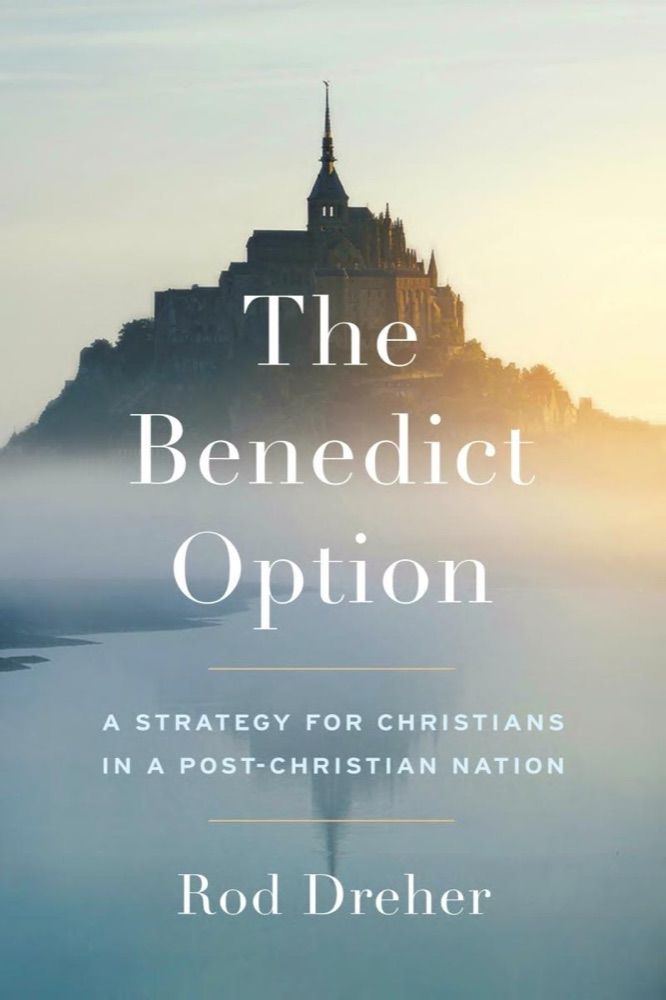
 The Benedict Option: A Strategy for Christians in a Post-Christian Nation
Quotes from the Book
And this is the thing about soft totalitarianism: It seduces those – even Christians – who have lost the capacity to love enduringly, for better or for worse. They think love, but they merely desire. They think they follow Jesus, but in fact, they merely admire him. Each of us thinks we wouldn’t be like that. But if we have accepted the lie of our therapeutic culture, which tells us that personal happiness is the greatest good of all, then we will surrender at the first sign of trouble.
13
They stood up for truth and justice not out of an expectation of achievable victory in their lifetimes, but because it was the right thing to do.
10
It masks its hatred of dissenters from its utopian ideology in the guise of helping and healing.
7
Not all of us are called to die a martyr’s death,” he wrote, “but all of us are called to have the same spirit of self-sacrifice and love to the very end as these martyrs had.
6
If you are not rock solid in your commitment to traditional Christianity, then the world will break you. But if you are, then this is the solid rock upon which that world will be broken. And if those solid rocks are joined together, they form a wall of solidarity that is very hard for the enemy to breach.
4
In the coming soft totalitarianism, Christians will have to regard family life in a much more focused, serious way. The traditional Christian family is not merely a good idea—it is also a survival strategy for the faith in a time of persecution. Christians should stop taking family life for granted, instead approaching it in a more thoughtful, disciplined way. We cannot simply live as all other families live, except that we go to church on Sunday. Holding the correct theological beliefs and having the right intentions will not be enough. Christian parents must be intentionally countercultural in their approach to family dynamics. The days of living like everybody else and hoping our children turn out for the best are over.
4
It is up to us today to take up this challenge, to live not by lies and to speak the truth that defeats evil. How do we do this in a society built on lies? By accepting a life outside the mainstream, courageously defending the truth, and being willing to endure the consequences.
4
Relatively few contemporary Christians are prepared to suffer for the faith, because the therapeutic society that has formed them denies the purpose of suffering in the first place, and the idea of bearing pain for the sake of truth seems ridiculous.
3
The longer we remain isolated in a period of liberty, the harder it will be to find one another in a time of persecution.
3
Propaganda helps change the world by creating a false impression of the way the world is.
3
Maybe they will just try to steer users into buying certain products and not others. But what happens when the products are politicians or ideologies? And how will people know when they are being manipulated?
2
No Christian has the power to avoid suffering entirely. It is the human condition. What we do control is how we act in the face of it. Will we run from it and betray our Lord? Or will we accept it as a severe mercy? The choices we will make when put to the ultimate test depend on the choices we make today, in a time of peace.
2
The kind of Christians we will be in the time of testing depends on the kind of Christians we are today.
2
The testimony of anti-communist dissidents is clear: Only in solidarity with others can we find the spiritual and communal strength to resist. The longer we remain isolated in a period of liberty, the harder it will be to find one another in a time of persecution. We must see in our brothers and sisters not a burden of obligation but the blessing of our own freedom from loneliness, suspicion, and defeat.
2
The Benda family model requires parents to exercise discernment. For example, the Bendas didn’t opt out of popular culture but rather chose intelligently which parts of it they wanted their children to absorb. To visit the Benda family home is not to step into a Spartan barracks but rather into a place filled with books and art and life. The Benda family judged that they could be open to the good things in the world around them because of the disciplined moral, intellectual, and spiritual lives they lived within the family.
2
It’s no accident that every dictatorship always tries to break down the family, because it’s in the family that you get the strength to be able to fight,
2
Once you perceive how the system runs on lies, stand as firmly as you can on what you know to be true and real when confronted by those lies. Refuse to let the media and institutions propagandize your children. Teach them how to identify lies and to refuse them. Do your best not be party to the lie—not for the sake of professional advantage, personal status, or any other reason. Sometimes you will have to act openly to confront the lie directly. Other times you will fight it by remaining silent and withholding the approval authorities request. You might have to raise your voice to defend someone who is being slandered by propagandists.
2
The Baptists stood alone, but stand they did. If you have been discipled in a faith that takes seriously the Apostle Paul’s words that to suffer for Christ is gain and are prepared, as the Orthodox Kaleda family was, to live with reduced expectations of worldly success, it becomes easier to stand for the truth.
2
Faithful Christians must work for social justice, but can only do so in the context of fidelity to the full Christian moral and theological vision through which we understand the meaning of justice. Any social justice campaign that implies that the God of the Bible is an enemy of man and his happiness is fraudulent and must be rejected.
2
Nineteen Eighty-Four is not the novel that previews what’s coming; it’s rather Aldous Huxley’s Brave New World. The contemporary social critic James Poulos calls this the “Pink Police State”: an informal arrangement in which people will surrender political rights in exchange for guarantees of personal pleasure.
2
We cannot hope to resist the coming soft totalitarianism if we do not have our spiritual lives in order. This is the message of Aleksandr Solzhenitsyn, the great anti-communist dissident, Nobel laureate, and Orthodox Christian. He believed the core of the crisis that created and sustained communism was not political but spiritual.
2
What did it mean to live by lies? It meant, Solzhenitsyn writes, accepting without protest all the falsehoods and propaganda that the state compelled its citizens to affirm—or at least not to oppose—to get along peaceably under totalitarianism. Everybody says that they have no choice but to conform, says Solzhenitsyn, and to accept powerlessness. But that is the lie that gives all the other lies their malign force. The ordinary man may not be able to overturn the kingdom of lies, but he can at least say that he is not going to be its loyal subject.
2
How did people keep hold of reality under communist conditions? How do they know not only what to remember but how to remember it? The answer was to create distinct small communities—especially families and religious fellowships—in which it was possible both to speak truthfully and to embody truth.
2
But truth cannot be separated from tears. To live in truth requires accepting suffering.
1
The essence of modernity is to deny that there are any transcendent stories, structures, habits, or beliefs to which individuals must submit and that should bind our conduct. To be modern is to be free to choose. What is chosen does not matter; the meaning is in the choice itself. There is no sacred order, no other world, no fixed virtues and permanent truths. There is only here and now and the eternal flame of human desire. Volo ergo sum—I want, therefore I am.
1
The more totalitarian a regime’s nature, the more it will try to force people to forget their cultural memories. In Nineteen Eighty-Four, the role of Winston Smith within the Ministry of Information is to erase all newspaper records of past events to reflect the current political priorities of the Party. This, said the ex-communist Polish intellectual Leszek Kołakowski, reflects “the great ambition of totalitarianism—the total possession and control of human memory.
1
If a corporation with access to private data decides that progress requires suppressing dissenting opinions, it will be easy to identify the dissidents, even if they have said not one word publicly.
1
One of contemporary progressivism’s commonly used phrases—the personal is political—captures the totalitarian spirit, which seeks to infuse all aspects of life with political consciousness. Indeed, the Left pushes its ideology ever deeper into the personal realm, leaving fewer and fewer areas of daily life uncontested. This, warned Arendt, is a sign that a society is ripening for totalitarianism, because that is what totalitarianism essentially is: the politicization of everything.
1
According to Hannah Arendt, the foremost scholar of totalitarianism, a totalitarian society is one in which an ideology seeks to displace all prior traditions and institutions, with the goal of bringing all aspects of society under control of that ideology. A totalitarian state is one that aspires to nothing less than defining and controlling reality. Truth is whatever the rulers decide it is.
1
In Chapter 77, you had people of totally different worldviews and ideas joined together,” says Patrik. “You had, for example, democratic socialists on the one side and fervent Catholics on the other side. It was totally normal for me that as a small child, I was being raised in a community of people with very different opinions. So it shattered the bubble around me.” The lesson of valuing diversity within a broader unity of shared goals is something that Christians today need to embrace. “When we look at what’s happening in America today, we see that you are building walls and creating gaps between people,” he says. “For us, we are always willing to speak, to talk with the other side to avoid building walls between people. You know, it is much easier to indoctrinate someone who is enclosed within a set of walls.
1
Watch on YouTube
About Rod Dreher
We have collected 60 quotes from 2 books by Rod Dreher on BookQuoters.
More about the author →More by Rod Dreher
The Benedict Option: A Strategy for Christians in a Post-Christian Nation
About the book
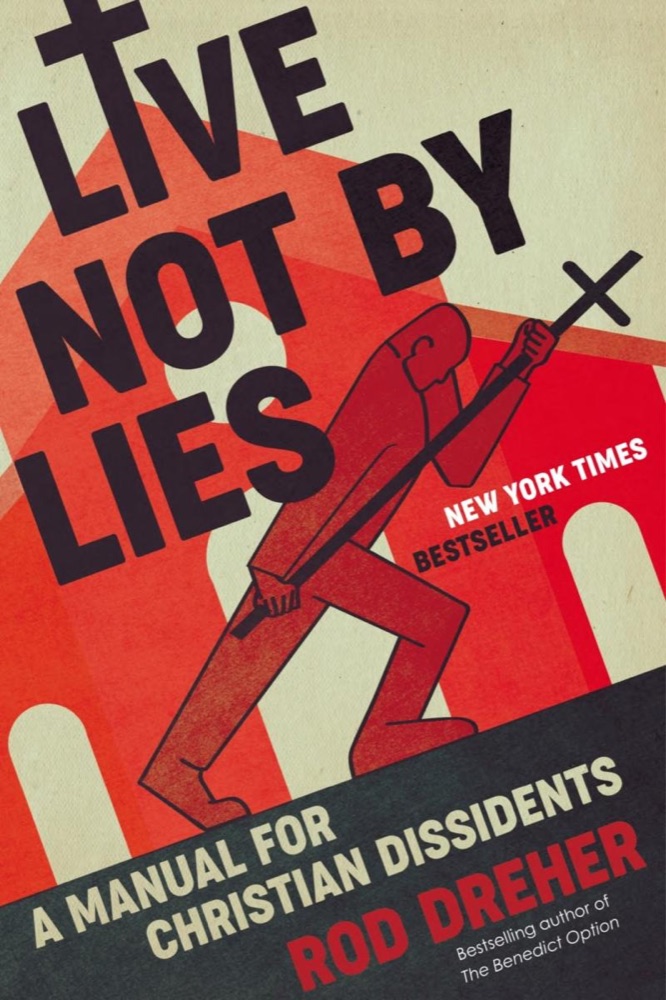
The New York Times bestselling author of The Benedict Option draws on the wisdom of Christian survivors of Soviet persecution to warn American Christians of approaching dangers.
For years, émigrés from the former Soviet bloc have been telling Rod Dreher they see telltale signs of "soft" totalitarianism cropping up in America—something more Brave New World than Nineteen Eighty-Four. Identity politics are beginning to encroach on every aspect of life. Civil liberties are increasingly seen as a threat to "safety". Progressives marginalize conservative, traditional Christians, and other dissenters. Technology and consumerism hasten the possibility of a corporate surveillance state. And the pandemic, having put millions out of work, leaves our country especially vulnerable to demagogic manipulation.
In Live Not By Lies, Dreher amplifies the alarm sounded by the brave men and women who f
Book details
- First published
- 2020
- Author
- Rod Dreher
- Genre
- Nonfiction
- Goodreads rating
- 4.34 (7k ratings)
Keep reading
 Resident Aliens: Life in the Christian Colony
 A Theology of Liberation
The Benedict Option: A Strategy for Christians in a Post-Christian Nation
A Theology of Liberation
The Benedict Option: A Strategy for Christians in a Post-Christian Nation
 Let Us Dream: The Path to a Better Future
 How Should We Then Live? The Rise and Decline of Western Thought and Culture
 The Gospel in a Pluralist Society
 Compassion (&) Conviction: The AND Campaign's Guide to Faithful Civic Engagement
 The Biggest Secret: The Book That Will Change the World
 On Tyranny: Twenty Lessons from the Twentieth Century
 Ethics
 Across That Bridge: A Vision for Change and the Future of America
 Jesus and the Disinherited
 The Kingdom of God Is Within You
 Where Do We Go from Here: Chaos or Community?
 Letters and Papers from Prison
 The Better Angels of Our Nature: Why Violence Has Declined
 Witness
 Rules for Radicals: A Pragmatic Primer for Realistic Radicals
 Tactics: A Game Plan for Discussing Your Christian Convictions
 The Irresistible Revolution: Living as an Ordinary Radical
 The Story of My Experiments With Truth
 The Rage Against God: How Atheism Led Me to Faith
 You Can't Be Neutral on a Moving Train: A Personal History of Our Times
 Total Truth: Liberating Christianity from its Cultural Captivity
 The Fire Next Time
 Letter from the Birmingham Jail
 The Spirit of the Disciplines: Understanding How God Changes Lives
 Pedagogy of the Oppressed
 Daybreak: Thoughts on the Prejudices of Morality
 The Source of Self-Regard: Selected Essays, Speeches, and Meditations
 Arguably: Selected Essays
 The True Believer: Thoughts on the Nature of Mass Movements
 The Road to Serfdom
 Brave New World Revisited
 Revolution
 The Audacity of Hope: Thoughts on Reclaiming the American Dream
 The Message
 Resistance, Rebellion and Death: Essays
 Children of Dune
 Endgame, Vol. 1: The Problem of Civilization
 Walden Two
 Creation Lake
 Escape from Freedom
 Strength to Love
 Secondhand Time: The Last of the Soviets
 The Anti-Christ
 The Closing of the American Mind
 The Sign
 No Name in the Street
 One Day, Everyone Will Have Always Been Against This
 United: Thoughts on Finding Common Ground and Advancing the Common Good
 The Essential Chomsky
 Tortured for Christ
 Heretics
 The Power of the Powerless
 Jesus for President: Politics for Ordinary Radicals
 Bonhoeffer: Pastor, Martyr, Prophet, Spy
 People of the Lie: The Hope for Healing Human Evil
 The World's Last Night: And Other Essays