
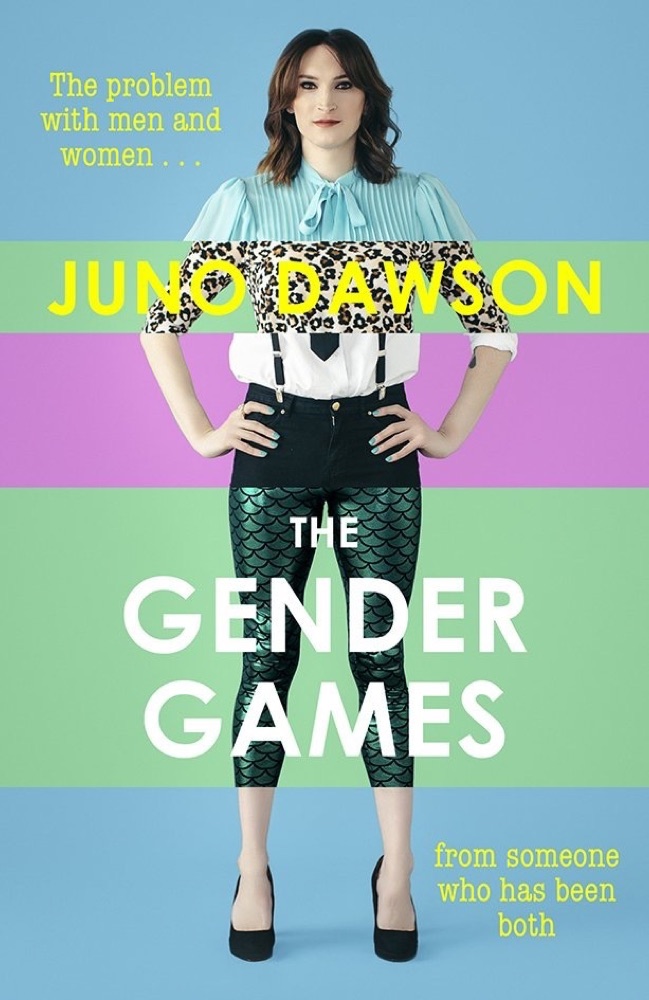
 The Gender Games: The Problem with Men and Women, from Someone Who Has Been Both
Quotes from the Book
I can’t think of any branch of medicine outside of cosmetic surgery where the patient makes the diagnosis and prescribes the treatment. This doesn’t exist.
20
While all this sexual identity politics marches through the front door, a large-scale robbery is taking place: the theft of women's achievement. The more incredible a woman is, the more barriers she busts through, the more "gender nonconforming" she is deemed to be. In this perverse schema, by definition, the more amazing a woman is, the less she counts as a woman.
12
Several studies indicate that nearly 70 percent of kids who experience childhood gender dysphoria—and are not affirmed or socially transitioned—eventually outgrow it.
10
Women feel things deeply. We empathize. For good reason, when asked to identify their best friend, most men name their wives; most women name another woman.
5
For those of you who have ever been an adolescent or attempted the toe-curling, hair-whitening endeavor of raising one—hold your laughter. Resist the urge to squeal out loud at the preposterous notion that a teenager in any sense knows who she is with the level of certainty sufficient to entrust her with life-altering decisions.
5
the new “affirmative-care” standard of mental health professionals is a different matter entirely. It surpasses sympathy and leaps straight to demanding that mental health professionals adopt their patients’ beliefs of being in the “wrong body.” Affirmative therapy compels therapists to endorse a falsehood: not that a teenage girl feels more comfortable presenting as a boy—but that she actually is a boy.
4
Today’s adolescents spend far less time in person with friends—up to an hour less per day—than did members of Gen X.4 And dear God, they are lonely. They report greater loneliness than any generation on record.
3
In fact, they turned out to be unprecedented. In America and across the Western world, adolescents were reporting a sudden spike in gender dysphoria—the medical condition associated with the social designation “transgender.” Between 2016 and 2017 the number of gender surgeries for natal females in the U.S. quadrupled, with biological women suddenly accounting for—as we have seen—70 percent of all gender surgeries.1 In 2018, the UK reported a 4,400 percent rise over the previous decade in teenage girls seeking gender treatments.2 In Canada, Sweden, Finland, and the UK, clinicians and gender therapists began reporting a sudden and dramatic shift in the demographics of those presenting with gender dysphoria—from predominately preschool-aged boys to predominately adolescent girls.
3
Nearly every novel problem teenagers face traces itself back to 2007 and the introduction of Steve Jobs’s iPhone. In fact, the explosion in self-harm can be so precisely pinpointed to the introduction of this one device that researches have little doubt that it is the cause... The statistical explosion of bullying, cutting, anorexia, depression, and the rise of sudden transgender identification is owed to the self-harm instruction, manipulation, abuse, and relentless harassment supplied by a single smartphone.
2
Not even the most prominent members of their profession were safe from the activist mob. Get on board with “affirmative therapy”—or lose your job and maybe your license.
2
Her daughter just didn’t seem like “a boy trapped in a girl’s body.” She seemed like a girl who had had a lot of trouble fitting in with peers, who had been introduced to an explanation and latched onto it.
2
The pro-anorexia sites effectively turned mental illness into a heroic social identity, to which you show your commitment by ever greater self-harm.
2
The Salem witch trials of the seventeenth century are closer to the mark. So are the nervous disorders of the eighteenth century and the neurasthenia epidemic of the nineteenth century.1 Anorexia nervosa,2 repressed memory,3 bulimia, and the cutting contagion in the twentieth.4 One protagonist has led them all, notorious for magnifying and spreading her own psychic pain: the adolescent girl.
1
Robert H. Jackson declared, “If there is any fixed star in our constitutional constellation, it is that no official, high or petty, can prescribe what shall be orthodox in politics, nationalism, religion or other matters of opinion or force citizens to confess by word or act their faith therein.
1
I think the whole area has become politicized,” said psychotherapist Marcus Evans, who resigned from England’s national gender clinic, the Tavistock Foundation, over the lack of careful protocols in its treatment of transgender-identified children. “The drugs, you know, the hormone blockers, first of all, they say it’s a neutral act. What are they talking about? You’re going to powerfully interfere with a person’s biological development,” he said to me over Skype. “I’m not saying you shouldn’t do it…. But you don’t say it’s a neutral act…. They’re not with their peers anymore.
1
The California Board of Education provides, through its virtual libraries, a book intended for kindergarten teachers to read to their students: Who Are You? The Kid’s Guide to Gender Identity by Brook Pessin-Whedbee.19 The author begins with a familiar origin story: “Babies can’t talk, so grown-ups make a guess by looking at their bodies. This is the sex assigned to you at birth, male or female.”20 This author runs the gamut of typical kindergarten gender identity instruction. Who Are You? offers kids a smorgasbord of gender options. (“These are just a few words people use: trans, genderqueer, non-binary, gender fluid, transgender, gender neutral, agender, neutrois, bigender, third gender, two-spirit….”) The way baby boomers once learned to rattle off state capitals, elementary school kids are now taught today’s gender taxonomy often enough to have committed it to memory. And while gender ideologues insist they are merely presenting an objective ontology, it is hard to miss that they seem to hope kids will pick a fun, “gender-creative”21 option for themselves.
1
Psychologists who study peer influence ask what it is about teenage girls that makes them so susceptible to peer contagion and so good at spreading it. Many believe it has something to do with the way girls tend to socialize.35 “When we listen to girls versus boys talk to each other, girls are much more likely to reply with statements that are validating and supportive than questioning,” Amanda Rose, professor of psychology at the University of Missouri, told me. “They’re willing to suspend reality to get into their friends’ worlds more. For this reason, adolescent girls are more likely to take on, for instance, the depression their friends are going through and become depressed themselves.” This female tendency to meet our friends where they are and share in their pain can be a productive and valuable social skill. Co-rumination (excessive discussion of a hardship) “does make the relationship between girls stronger,” Professor Rose told me. But it also leads friends to take on each other’s ailments. Teenage girls spread psychic illness because of features natural to their modes of friendship: co-rumination; excessive reassurance seeking; and negative-feedback seeking, in which someone maintains a feeling of control by angling for confirmation of her low self-concept from others.36 It isn’t hard to see why the 24/7 forum of social media intensifies and increases the incidence of each.
1
We are, all of us, doomed to hurt those we love. Most of us disappoint our parents in some respect; or at least, we're not exactly who our parents would have designed, had they been granted just a little more say. Worse yet, we disappoint ourselves. But then, each day, we awaken to a miracle: another chance to try again. To ask forgiveness. To call our moms. To go just a little easier on ourselves.
1
And Teen Vogue routinely educates girls that gender is a social construct. “The truth is, not all women menstruate and not all people who menstruate are women,” one article blithely informs readers, as if that were factual.
1
Policy makers and the media are doing no favors to the public or the transgendered by treating their confusions as a right in need of defending rather than as a mental disorder that deserves understanding, treatment and prevention,” he wrote in 2014.19 From this statement alone, one might guess that Paul McHugh has won his share of detractors.
1
You know, there’s a kind of progressive language police now and part of the function is to keep people off balance so that they’re always apologizing and never asking questions and also to prevent people from being able to have clear conversations about things,” he says.
1
It is worth asking whether a standard guided less by biology than by political correctness is in the best interest of patients.
1
Suicide rates among the transgender-identified are, indeed, alarmingly high.
1
To see kids turning on their parents… I found that very heartbreaking,” she said. “It’s kind of my worst nightmare.
1
Transgender influencers coach other adolescents on how to wheedle a testosterone prescription from a skeptical clinician.
1
Becoming a woman means losing a body almost indistinguishable from a boy’s in terms of strength and solidity and growing into one that is softer, more sexually inviting, but more vulnerable, too.
A young woman’s unruly emotions in her teenage years—the whirlwind fury and self-doubt of female adolescence—may be a feature, not a flaw. That doesn’t mean a parent shouldn’t set boundaries or punish bad behavior. But absent a serious mental health problem, neither should a parent strive to banish all her daughter’s ups and downs. Your teenage girl may be driving you crazy. Though this be madness, there is method in it. She may just be beta testing. She’s flexing her muscles, discovering the power and extent of an intellectual and emotional prowess that will enable her to be the most compassionate of parents and supportive of friends.
Watch on YouTube
About Abigail Shrier
We have collected 27 quotes from 1 book by Abigail Shrier on BookQuoters.
More about the author →About the book
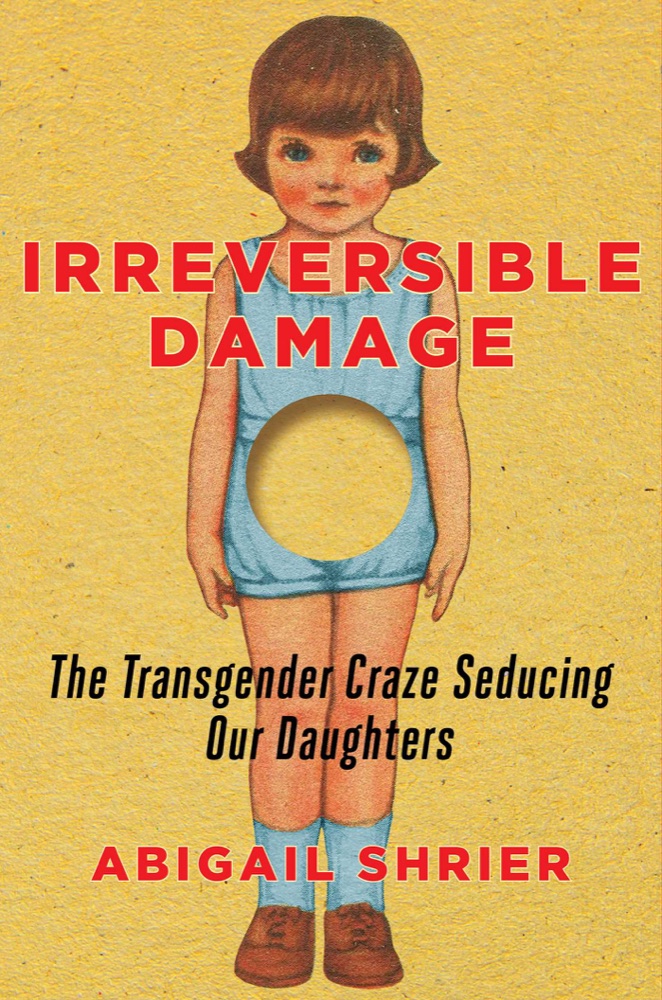
Irreversible Damage is an exploration of a mystery: Why, in the last decade, has the diagnosis "gender dysphoria," transformed from a vanishingly rare affliction, applying almost exclusively to boys and men, to an epidemic among teenage girls? Author Abigail Shrier presents shocking statistics and stories from real families to show that America and the West have become fertile ground for a "transgender craze" that has nothing to do with real gender dysphoria and everything to do with our cultural frailty. Teenage girls are taking courses of testosterone and disfiguring their bodies. Parents are undermined; experts are over-relied upon; dissenters in science and medicine are intimidated; free speech truckles under renewed attack; socialized medicine bears hidden consequences; and an intersectional era has arisen in which the desire to escape a dominant identity encourages individuals to t
Book details
- First published
- 2020
- Author
- Abigail Shrier
- Genre
- Nonfiction
- Goodreads rating
- 4.15 (14k ratings)
Keep reading
The Gender Games: The Problem with Men and Women, from Someone Who Has Been Both
 Detransition, Baby
 Trans: When Ideology Meets Reality
 Sissy: A Coming-of-Gender Story
 Whipping Girl: A Transsexual Woman on Sexism and the Scapegoating of Femininity
 Material Girls: Why Reality Matters for Feminism
 Redefining Realness: My Path to Womanhood, Identity, Love & So Much More
 American Girls: Social Media and the Secret Lives of Teenagers
 Ladyparts
 The 57 Bus
 Far from the Tree: Parents, Children, and the Search for Identity
 Animal: The Autobiography of a Female Body
 Tomorrow Will Be Different: Love, Loss, and the Fight for Trans Equality
 Different, Not Less: A Neurodivergent's Guide to Embracing Your True Self and Finding Your Happily Ever After
 The Mother of All Questions
 Reviving Ophelia: Saving the Selves of Adolescent Girls
 Unspeakable Things: Sex, Lies and Revolution
 Girl, Woman, Other
 Shrill: Notes from a Loud Woman
 Good Morning, Monster: A Therapist Shares Five Heroic Stories of Emotional Recovery
 The Madness of Crowds: Gender, Race and Identity
 What Made Maddy Run: The Secret Struggles and Tragic Death of an All-American Teen
 Trick Mirror: Reflections on Self-Delusion
 A Hunter-Gatherer's Guide to the 21st Century: Evolution and the Challenges of Modern Life
 The Argonauts
 The Anxious Generation: How the Great Rewiring of Childhood Caused an Epidemic of Mental Illness
 Being Jazz
 Cinderella Ate My Daughter: Dispatches from the Frontlines of the New Girlie-Girl Culture
 iGen: Why Today’s Super-Connected Kids Are Growing Up Less Rebellious, More Tolerant, Less Happy--and Completely Unprepared for Adulthood--and What That Means for the Rest of Us
 Her Majesty's Royal Coven
 Pure: Inside the Evangelical Movement That Shamed a Generation of Young Women and How I Broke Free
 The Feminine Mystique
 In The Blood
 Brief Interviews with Hideous Men
 I Heard Her Call My Name: A Memoir of Transition
 Paris: A Memoir for Young Women in the Age of Influencers
 Woman: An Intimate Geography
 Natural Causes: An Epidemic of Wellness, the Certainty of Dying, and Killing Ourselves to Live Longer
 Tomboy: A Graphic Memoir
 Come as You Are: The Surprising New Science that Will Transform Your Sex Life
 You'll Grow Out of It
 Where Am I Now?
 Mad Honey
 All in Her Head: The Truth and Lies Early Medicine Taught Us About Women’s Bodies and Why It Matters Today
 Not That Bad: Dispatches from Rape Culture
 The Age of Magical Overthinking: Notes on Modern Irrationality
 The Geeks Shall Inherit the Earth: Popularity, Quirk Theory and Why Outsiders Thrive After High School
 I Hope We Choose Love: A Trans Girl's Notes from the End of the World
 I'm Afraid of Men.
 All Is Not Forgotten
 The Female Eunuch
 Brazen: Rebel Ladies Who Rocked the World
 Women's Bodies, Women's Wisdom: Creating Physical and Emotional Health and Healing
 The Sleeping Beauties: And Other Stories of Mystery Illness
 Queer Ducks (and Other Animals): The Natural World of Animal Sexuality
 The Women's Room
 Cunt: A Declaration of Independence
 What Fresh Hell Is This?: Perimenopause, Menopause, Other Indignities, and You
 Symptoms of Being Human