
 The Darkness Outside Us
Quotes from the Book
Traditions are just peer pressure from dead people.
12
Say you're a 20-something studying geckos, and the 600 pages of scientific literature that currently exist on geckos, published by giants in the field, don't mention any homosexual behavior. You saw it, though. You could bravely write on that finding, contradicting your immediate advisor and the professors who are in charge of your academic future, and risk established scientists writing to the journal to complain that your upstart study contradicts their own, well-accepted study, or you could decide to publish on some other aspect of gecko behavior. If you want to get a job and pay your bills, wouldn't it be easier to just publish on foraging strategies instead of homosexuality? Everyone loves foraging strategies! No one writes hate mail about foraging strategies. So, you make that reluctant choice. Your queer-erasing article comes out. Now there are 620 pages of scientific literature on geckos that don't mention homosexual behavior. There's even more pressing and discouraging young and unestablished researchers from going against the flow.
Have there been barriers to publishing on sex reversal or same-sex sexual behavior? [Max Lambert] Absolutely. A paper I published in 2019 on sex reversal being very common in frogs, I think I submitted it to nine or ten different journals? We got very positive reviews back, and after every indication it was going to be published, they just went, 'Nah.' The journal is basically saying, 'We don't want to rock the boat.
Gonochoristic' is what's known as a 'retronym,' or a word that's only necessary because a new, opposing concept has been invented. Like how we didn't need the term 'snail mail' until we invented email. We just called it 'mail.' 'Heterosexual' is also a retronym. 'Homosexual' shows up first in the English language, and then everyone had to scramble to find a word to describe people who are attracted to people of the opposite sex. Linguistically speaking, gays came first. So did 'sex-changing animals.' The 'straights' and 'non-sex-changers' came after.
[Beans Velocci] I think of 'trans' much more as a political tool than a classification tool. Because I'm into picking apart classifications in general, and so I don't think there's an inherent way to classify people's gender at all. That said, I still identify as trans because I like to make myself legible as a part of a shared experience, as part of a community, and to articulate a sense of politics.
The females are physcially smaller, but if a male gets aggressive toward any one of them, she can count on a squad of intimate female allies having her back. Over millions of years, male bonobos have learned that the females have too much social support for male violence to succeed.
There's a very good reason you are who you are. It's not just random. How wonderful to be linked into the giant web of life that way.
Up until then, I'd just been 'me.' But now, I was 'gay.
The cattle industry, the most red-blooded of american livelihoods, land of the cowboys and marlboro man, has been relying on same-sex attraction for years and years.
Watch on YouTube
About Eliot Schrefer
We have collected 37 quotes from 2 books by Eliot Schrefer on BookQuoters.
More about the author →More by Eliot Schrefer
The Darkness Outside Us
About the book
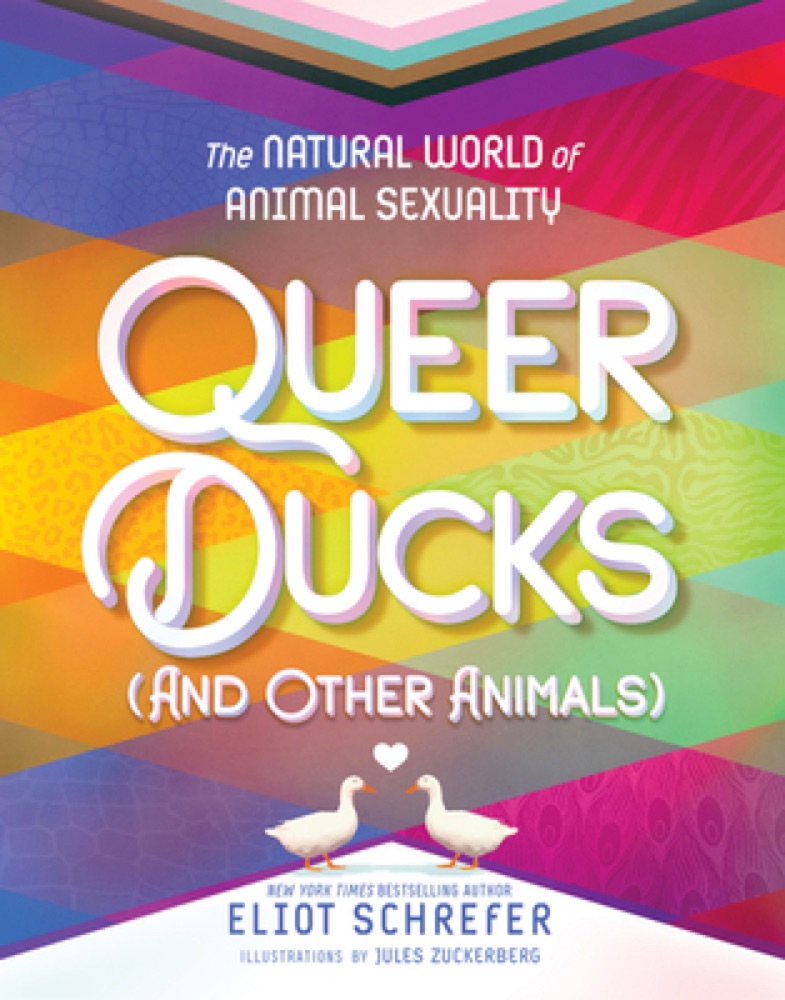
This groundbreaking illustrated YA nonfiction title from two-time National Book Award finalist and New York Times bestselling author Eliot Schrefer is a well-researched and teen-friendly exploration of the gamut of queer behaviors observed in animals.
A quiet revolution has been underway in recent years, with study after study revealing substantial same-sex sexual behavior in animals. Join celebrated author Eliot Schrefer on an exploration of queer behavior in the animal world--from albatrosses to bonobos to clownfish to doodlebugs.
In sharp and witty prose--aided by humorous comics from artist Jules Zuckerberg--Schrefer uses science, history, anthropology, and sociology to illustrate the diversity of sexual behavior in the animal world. Interviews with researchers in the field offer additional insights for readers and aspiring scientists.
Queer behavior in animals is as diverse
Book details
- First published
- 2022
- Author
- Eliot Schrefer
- Genre
- Nonfiction
- Goodreads rating
- 4.33 (2k ratings)
Keep reading
 Sex at Dawn: The Prehistoric Origins of Modern Sexuality
 Sissy: A Coming-of-Gender Story
 Material Girls: Why Reality Matters for Feminism
 The Gender Games: The Problem with Men and Women, from Someone Who Has Been Both
 A Hunter-Gatherer's Guide to the 21st Century: Evolution and the Challenges of Modern Life
 Openly Straight
 Trans: When Ideology Meets Reality
 The Argonauts
 Animal: The Autobiography of a Female Body
 Woman: An Intimate Geography
 Simon vs. the Homo Sapiens Agenda
 The Mating Mind: How Sexual Choice Shaped the Evolution of Human Nature
 Irreversible Damage: The Transgender Craze Seducing Our Daughters
 Binge
Binge
 This Book is Gay
 Becoming a Man: Half a Life Story
 Rubyfruit Jungle
 Self
Self
 The Mother of All Questions
 How Far the Light Reaches: A Life in Ten Sea Creatures
 Whipping Girl: A Transsexual Woman on Sexism and the Scapegoating of Femininity
 The Naked Civil Servant
 Walking Practice
 The Moral Animal: Why We Are the Way We Are - The New Science of Evolutionary Psychology
 Butts: A Backstory
 I Am America
 I Heard Her Call My Name: A Memoir of Transition
 The Madness of Crowds: Gender, Race and Identity
 Redefining Realness: My Path to Womanhood, Identity, Love & So Much More
 The Red Queen: Sex and the Evolution of Human Nature
 The Tragedy of Heterosexuality
 The Descent of Man
 I'm Afraid of Men.
 Detransition, Baby
 I Love Dick
 Some We Love, Some We Hate, Some We Eat: Why It's So Hard to Think Straight About Animals
 Grasshopper Jungle
 Bonk: The Curious Coupling of Science and Sex
 The Female of the Species
 Cunt: A Declaration of Independence
 Our Inner Ape: A Leading Primatologist Explains Why We are Who We Are
 Far from the Tree: Parents, Children, and the Search for Identity
 Creation Lake
 Come as You Are: The Surprising New Science that Will Transform Your Sex Life
 A Certain Hunger
 Symptoms of Being Human
 Amateur: A True Story About What Makes a Man
 Starry Messenger: Cosmic Perspectives on Civilization
 Tomorrow Will Be Different: Love, Loss, and the Fight for Trans Equality
 Blachart
 Opinions: A Decade of Arguments, Criticism, and Minding Other People’s Business
 To Throw Away Unopened
 Demonspawn
 Sex, Drugs, and Cocoa Puffs: A Low Culture Manifesto
 The Hangman's Replacement: Sprout of Disruption
 Mad Honey
 Undeniable: Evolution and the Science of Creation
 The Game: Penetrating the Secret Society of Pickup Artists
 Consider the Lobster and Other Essays
 Believe Me: A Memoir of Love, Death, and Jazz Chickens