
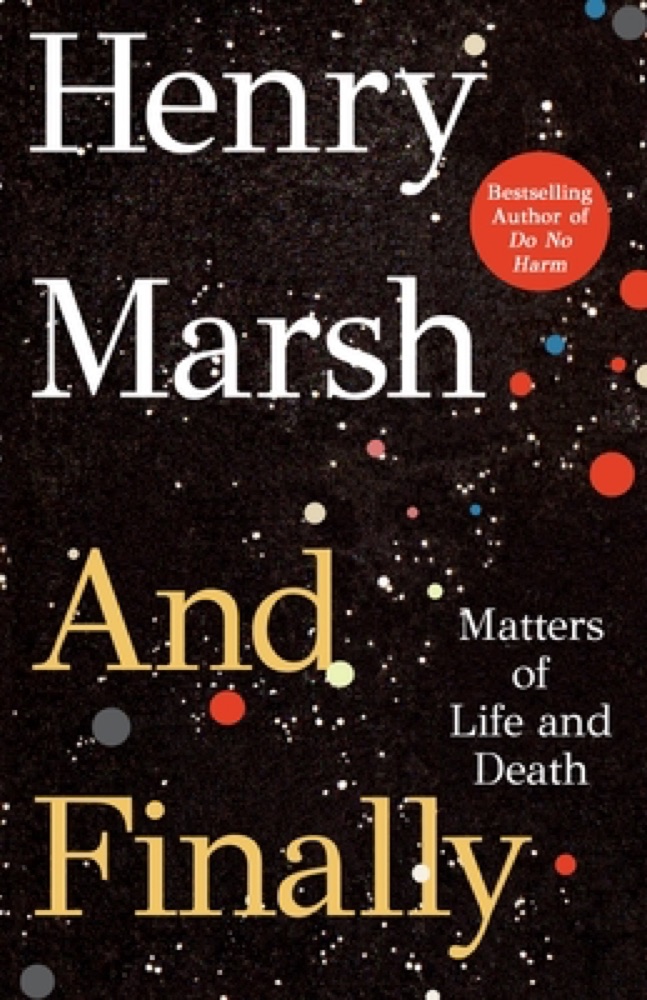
 And Finally: Matters of Life and Death
Quotes from the Book
Life without hope is hopelessly difficult but at the end hope can so easily make fools of us all.
71
Every surgeon carries within himself a small cemetery, where from time to time he goes to pray – a place of bitterness and regret, where he must look for an explanation for his failures.’ René Leriche, La philosophie de la chirurgie, 1951
51
Neuroscience tells us that it is highly improbable that we have souls, as everything we think and feel is no more or no less than the electrochemical chatter of our nerve cells. Our sense of self, our feelings and our thoughts, our love for others, our hopes and ambitions, our hates and fears all die when our brains die. Many people deeply resent this view of things, which not only deprives us of life after death but also seems to downgrade thought to mere electrochemistry and reduces us to mere automata, to machines. Such people are profoundly mistaken, since what it really does is upgrade matter into something infinitely mysterious that we do not understand. There are one hundred billion nerve cells in our brains. Does each one have a fragment of consciousness within it? How many nerve cells do we require to be conscious or to feel pain? Or does consciousness and thought reside in the electrochemical impulses that join these billions of cells together? Is a snail aware? Does it feel pain when you crush it underfoot? Nobody knows.
46
Healthy people, I have concluded, including myself, do not understand how everything changes once you have been diagnosed with a fatal illness. How you cling to hope, however false, however slight, and how reluctant most doctors are to deprive patients of that fragile beam of light in so much darkness. Indeed, many people develop what psychiatrists call ‘dissociation’ and a doctor can find himself talking to two people – they know that they are dying and yet still hope that they will live. I had noticed the same phenomenon with my mother during the last few days of her life. When faced by people who are dying you are no longer dealing with the rational consumers assumed by economic model-builders, if they ever existed in the first place.
29
Anxiety might be contagious, but confidence is also contagious
24
The operating is the easy part, you know,’ he said. ‘By my age you realize that the difficulties are all to do with the decision-making.
22
But death is not always a bad outcome, you know, and a quick death can be better than a slow one.
21
Surgeons must always tell the truth but rarely, if ever, deprive patients of all hope. It can be very difficult to find the balance between optimism and realism.
19
Most medical students go through a brief period when they develop all manner of imaginary illnesses – I myself had leukaemia for at least four days – until they learn, as a matter of self-preservation, that illnesses happen to patients, not to doctors.
17
And now all those brain cells are dead – and my mother – who in a sense was the complex electrochemical interaction of all these millions of neurons – is no more. In neuroscience it is called ‘the binding problem’ – the extraordinary fact, which nobody can even begin to explain, that mere brute matter can give rise to consciousness and sensation. I had such a strong sensation, as she lay dying, that some deeper, ‘real’ person was still there behind the death mask.
17
We have achieved most as surgeons when our patients recover completely and forget us completely. All patients are immensely grateful at first after a successful operation but if the gratitude persists it usually means that they have not been cured of the underlying problem and that they fear that they may need us in the future. They feel that they must placate us, as though we were angry gods or at least the agents of an unpredictable fate.
14
Hope is beyond price and the pharmaceutical companies, which are run by businessmen not altruists, price their products accordingly.
13
Few people outside medicine realize that what tortures doctors most is uncertainty, rather than the fact they often deal with people who are suffering or who are about to die. It is easy enough to let somebody die if one knows beyond doubt that they cannot be saved - if one is a decent doctor one will be sympathetic, but the situation is clear. This is life, and we all have to die sooner or later. It is when I do not know for certain whether I can help or not, or should help or not, that things become so difficult.
11
Angor animi - the sense of being in the act of dying, differing from the fear of death or the desire for death.
10
Psychological research has shown that the most reliable route to personal happiness is to make others happy. I have made many patients very happy with successful operations but there have been many terrible failures and most neurosurgeons’ lives are punctuated by periods of deep despair.
9
We lauhed together for a long time. When we had first met, her eyes were dull with pain-killing drugs and if she tried to talk, her face would controt with agonizing pain. I thought how radiantly beautiful she now looked. She stood up to leave and went to the door but then came back and kissed me. `I hope I never see you again,' she said. `I quite understand,' I replied.
9
You might expect that seeing so much pain and suffering might help you keep your own difficulties in perspective but, alas, it does not.
7
When I tell a patient that I think I should do their operation under local anaesthetic they usually look a little shocked. In fact the brain cannot itself feel pain since pain is a phenomenon produced within the brain.
7
Patients in persistent vegetative state – or PVS as it is called for short – seem to be awake because their eyes are open, yet they show no awareness or responsiveness to the outside world. They are conscious, some would say, but there is no content to their consciousness. They have become an empty shell, there is nobody at home. Yet recent research with functional brain scans shows this is not always the case. Some of these patients, despite being mute and unresponsive, seem to have some kind of activity going on in their brains, and some kind of awareness of the outside world. It is not, however, at all clear what it means. Are they in some kind of perpetual dream state? Are they in heaven, or in hell? Or just dimly aware, with only a fragment of consciousness of which they themselves
7
My sister was wonderful to watch, kindly and gently discussing and explaining everything as she carried out the simple, necessary nursing. We have both seen many people die, after all, and I had worked as a geriatric nurse many years ago too. It felt quite easy and natural for us both, I think, despite our intense emotions. It’s not that we felt anxious – the three of us knew she was dying – I suppose what we felt was simply intense love, a love quite without ulterior motive, quite without the vanity and self-interest of which love is so often the expression.
7
There is no evidence that the complete head shaves we did in the past, which made the patients look like convicts, had any effect on infection rates, which had been the ostensible reason for doing them. I suspect the real – albeit unconscious – reason was that dehumanizing the patients made it easier for the surgeons to operate.
7
We have been most successful, however, when our patients return to their homes and get on with their lives and never need to see us again. They are grateful, no doubt, but happy to put us and the horror of their illness behind them. Perhaps they never quite realized just how dangerous the operation had been and how lucky they were to have recovered so well. Whereas the surgeon, for a while, has known heaven, having come very close to hell.
6
Some of my operations are great triumphs and tremendous. But they're only triumphs because there are also disasters
6
Informed consent’ sounds so easy in principle – the surgeon explains the balance of risks and benefits, and the calm and rational patient decides what he or she wants – just like going to the supermarket and choosing from the vast array of toothbrushes on offer. The reality is very different.
6
I learned a long time ago in the outpatient clinic to make no distinction –as some condescending doctors still do –between ‘real’ or ‘psychological’ pain. All pain is produced in the brain, and the only way pain can vary, other than in its intensity, is how it is best treated, or more particularly in my clinic, whether surgery might help or not.
5
But I then thought of how the value of my work as a doctor is measured solely in the value of other people's lives, and that included the people in front of me in the check-out queue.
5
If patients were thinking rationally they would ask their surgeon how many operations he or she has performed of the sort for which their consent is being sought, but in my experience this scarcely ever happens.
5
It's the professional shame that hurts the most,' I said to him. I wheeled my bike as we walked along Fleet Street. 'Vanity really. As a neurosurgeon you have to come to terms with ruining people's lives and with making mistakes. But one still feels terrible about it and how much it will cost.
4
Anxious and angry relatives are a burden all doctors must bear, but having been one myself was an important part of my medical education.
3
The idea that my sucker is moving through thought itself, through emotion and reason, that memories, dreams and reflections should consist of jelly, is simply too strange to understand.
3
Watch on YouTube
About Henry Marsh
We have collected 35 quotes from 2 books by Henry Marsh on BookQuoters.
More about the author →More by Henry Marsh
And Finally: Matters of Life and Death
About the book
What is it like to be a brain surgeon? How does it feel to hold someone's life in your hands, to cut into the stuff that creates thought, feeling, and reason? How do you live with the consequences of performing a potentially lifesaving operation when it all goes wrong?
In neurosurgery, more than in any other branch of medicine, the doctor's oath to "do no harm" holds a bitter irony. Operations on the brain carry grave risks. Every day, leading neurosurgeon Henry Marsh must make agonizing decisions, often in the face of great urgency and uncertainty.
If you believe that brain surgery is a precise and exquisite craft, practiced by calm and detached doctors, this gripping, brutally honest account will make you think again. With astonishing compassion and candor, Marsh reveals the fierce joy of operating, the profoundly moving triumphs, the harrowing disasters, the haunting regrets, an
Book details
- First published
- 2014
- Author
- Henry Marsh
- Genre
- Nonfiction
- Goodreads rating
- 4.25 (44k ratings)
Keep reading
 In Shock: My Journey from Death to Recovery and the Redemptive Power of Hope
 When the Air Hits Your Brain: Tales of Neurosurgery
 The House of God
 Being Mortal: Medicine and What Matters in the End
 Cancer Ward
 Natural Causes: An Epidemic of Wellness, the Certainty of Dying, and Killing Ourselves to Live Longer
 Just Like Someone Without Mental Illness Only More So
 What Doctors Feel: How Emotions Affect the Practice of Medicine
 Better: A Surgeon's Notes on Performance
 The Invisible Kingdom: Reimagining Chronic Illness
 When Breath Becomes Air
 The Center Cannot Hold: My Journey Through Madness
 Any Ordinary Day
 The Anatomy of Hope: How People Prevail in the Face of Illness
 Mortality
 The Tale of the Dueling Neurosurgeons: The History of the Human Brain as Revealed by True Stories of Trauma, Madness, and Recovery
 Brain on Fire: My Month of Madness
 Suspect
 The Collected Schizophrenias: Essays
 The Gift of Therapy: An Open Letter to a New Generation of Therapists and Their Patients
 The Physician
 If You Meet the Buddha on the Road, Kill Him! The Pilgrimage of Psychotherapy Patients
 Riding the Elephant: A Memoir of Altercations, Humiliations, Hallucinations, and Observations
 Doctors
 In The Blood
 Hello I Want to Die Please Fix Me: Depression in the First Person
 The Sleeping Beauties: And Other Stories of Mystery Illness
 Imagine Me Gone
 Sleepless
 The Resurrectionist: The Lost Work of Dr. Spencer Black
 Regeneration
 The Man Who Mistook His Wife for a Hat and Other Clinical Tales
 The Silent Patient
 Cutting for Stone
 A Thousand Naked Strangers: a Paramedic's Wild Ride to the Edge and Back
 Into the Magic Shop: A Neurosurgeon's Quest to Discover the Mysteries of the Brain and the Secrets of the Heart
 My Grandfather's Blessings : Stories of Strength, Refuge, and Belonging
 Where My Heart Used to Beat
 The Hangman's Replacement: Sprout of Disruption
 Everything Is Tuberculosis: The History and Persistence of Our Deadliest Infection
 Maybe You Should Talk to Someone: A Therapist, Her Therapist, and Our Lives Revealed
 The Schopenhauer Cure
 A Matter of Death and Life
 Burned Out
 Between Two Kingdoms: A Memoir of a Life Interrupted
 All Is Not Forgotten
 Range of Motion
 What It is Like to Go to War
 Ladyparts
 Piercing: A Novel
 Saving Fish from Drowning
 The Girl in the Castle
 Q & A
Q & A
 It's Not about the Bike: My Journey Back to Life
 Underground: The Tokyo Gas Attack and the Japanese Psyche
 The Answer Is…: Reflections on My Life
 Kitchen Table Wisdom: Stories that Heal
 In the Midst of Life
 Stiff: The Curious Lives of Human Cadavers