 The Book of Alchemy: A Creative Practice for an Inspired Life
Quotes from the Book
Grief is a ghost that visits without warning. It comes in the night and rips you from your sleep. It fills your chest with shards of glass. It interrupts you mid-laugh when you're at a party, chastising you that, just for a moment, you've forgotten. It haunts you until it becomes a part of you, shadowing you breath for breath.
6
Some traumas, I learned, refuse to remain in the past, wreaking havoc in the form of triggers and flashbacks, nightmares and fits of rage, until they’ve been processed and given their proper place.
6
Write," instructs Annie Dillard, "as if you were dying." We are all terminal patients on this earth-the mystery is not "if" but "when" death appears in the plotline...To this day, I've never been more prolific. Death can be a great motivator.
6
Then I howled into my pillow—a deep, blood-vessel-popping howl of frustration and envy directed at Will, at my friends, at everyone else who was out there starting jobs, taking trips, discovering new things—all unencumbered by illness. That everyone’s lives were starting while mine was over before it had begun seemed unspeakably unfair. When I’d run out of air, lungs burning, I stood up and walked across my room to the small wooden desk pushed up against the windows and flipped open my journal. The world is moving forward and I am stuck, I wrote.
6
Time was a waiting room—waiting for doctors, waiting for blood transfusions and test results, waiting for better days.
6
Meaning is what’s left when everything else is stripped away.
6
Imagining a future is a frightening exercise when your life has been upended; it requires hope, which feels risky, even dangerous.
6
Suffering can make you selfish, turn you cruel. It can make you feel like there is nothing but you and your anger, the crackle of exam table paper beneath bruised limbs, the way your heart pounds into your mouth when the doctor enters the room with the latest biopsy results. But I wasn’t the only one whose life had been interrupted by illness; my loved ones all faced a rupture that was similar in kind, if not in degree. That I wasn’t the only one in the room meant I was one of the lucky ones, I knew.
5
It was my first indication that cancer is uncomfortable for the people around you, and that when people don’t know what to say, they often say nothing at all.
5
But now, I’m not so sure, because cancer does a weird thing to you. It takes who you are and what you think you know and throws that all in the trash.
5
I’ve spent the past fifteen hundred days working tirelessly toward a single goal—survival. And now that I’ve survived, I’m realizing I don’t know how to live.
5
When we travel, we actually take three trips. There’s the first trip of preparation and anticipation, packing and daydreaming. There’s the trip you’re actually on. And then, there’s the trip you remember. “The key is to try to keep all three as separate as possible,” he says. “The key is to be present wherever you are right now.” This advice, more than any, stays with me.
5
The idea was that if you wanted to connect with someone out in the world, someone far removed from your own life, someone who maybe even seemed unknowable, you didn’t let the distance stop you—you said what the hell, and you wrote.
5
That’s all you can do in the face of these things. Love the people around you. Love the life you have. I can’t think of a more powerful response to life’s sorrows than loving.
4
I want to be released from what won’t let me go. I want uncomplicated joy. But I see now that, without realizing it, I’ve been waiting for permission—from Melissa, from Will, from all the people who have disappeared from my life before a sense of closure could be reached. I want their blessings to fall in love again, to dream a new future, to move forward. I keep waiting for some kind of sign, or reassurance that it’s okay to go entire days without thinking of them—that it’s necessary to forget a little if I am going to live. No matter how many apologies, acts of contrition, or sacrifices I offer up, I’m realizing I need to accept that things may never feel fully resolved—with the living or the dead. —
4
Perhaps the greatest test of love is the way we act in times of need.
4
I think of how the Taj embodies both love and grief. So did my friendship with Melissa. In life, I’m realizing, you don’t get one without the other.
4
I hoped to make a difference. I wanted, in my own way, however small, to contribute something to the world. To leave more than I took.
4
I wouldn’t hear from him for many weeks. It was my first indication that cancer is uncomfortable for the people around you, and that when people don’t know what to say, they often say nothing at all.
4
The logical mind tries to remind itself that sometimes you must suffer in order to feel better. But the body has its own memory: It remembers who hurt it.
4
With mortality in the balance, one of life’s most delicious activities when you’re young—imagining your future—had become a frightening, despair-inducing exercise. The future had once seemed infinite with possibility. Now it was shrouded in doom, a dark space ahead filled only with the promise of more poisonous treatments and terrifying unknowns. Thinking about the past stirred a nostalgia I preferred not to dwell on, a painful reminder of all I had lost, was losing: my friends; my youth; my fertility; my hair; the “milestone necklace” my parents had given me on my first day of chemo, which had gone missing somewhere in transit between the hospital and home; my mind, as the chemo made me cloudy and slow; my faith that I would ever make it to transplant.
4
Love the people around you. Love the life you have. I can’t think of a more powerful response to life’s sorrows than loving.
4
Though the word may suggest otherwise, recovery is not about salvaging the old at all. It’s about accepting that you must forsake a familiar self forever, in favor of one that is being newly born. It is an act of brute, terrifying discovery.
4
Trauma has a way of dividing your view of the world into two camps: those who get it and those who don’t.
3
We were learning that sometimes the only way to endure suffering is to transform it into art. — Melissa
3
To learn to swim in the ocean of not-knowing—this is my constant work.
3
It was my first indication that, no matter how brilliant and compassionate my doctors might be, I would have to be proactive and learn to advocate for myself.
3
Although my twenties have been wrenching, confusing, difficult—to the point of sometimes feeling unendurably painful—they have also been the most formative years of my life, a time imbued with the sweet grace of a second chance, and an inundation of luck, if such a concept can be said to exist at all. The tangling of so much cruelty and beauty has made of my life a strange, discordant landscape. It has left me with an awareness that haunts the edges of my vision—it can all be lost in a moment—but it’s also given me a jeweler’s eye.
3
I don’t know what will come of my relationship with Jon or if I will ever see Max again, but I no longer want to protect my heart. You can’t guarantee that people won’t hurt or betray you—they will, be it a breakup or something as big and blinding as death. But evading heartbreak is how we miss our people, our purpose. I make a pact with myself and send it off into the desert: May I be awake enough to notice when love appears and bold enough to pursue it without knowing where it will lead.
3
But for as long as I’ve known him, Jon has been teaching me that sometimes all you can do is show up. And when things are hard, to keep on showing up.
3
Did you know?
- Jaouad was diagnosed with acute myeloid leukemia at age 22, with doctors giving her about a 35 percent chance of survival.
- The memoir grew out of her Emmy Award-winning New York Times column and video series 'Life, Interrupted.'
- Its title and framing draw on Susan Sontag's idea of dual citizenship in 'the kingdom of the well' and 'the kingdom of the sick.'
- The book's second half recounts a 100-day, roughly 15,000-mile road trip Jaouad took with her rescue dog, Oscar.
- On that trip she visited strangers who had written to her during her hospitalization, including a teenage cancer patient, a grieving teacher, and a death-row inmate.
- The memoir was a New York Times bestseller and earned starred reviews from Booklist, Library Journal, and Publishers Weekly.
About Suleika Jaouad
Suleika Jaouad (born 1988 in New York City) is an American writer, advocate, and speaker who studied at Princeton University and Bennington College. She wrote the Emmy Award-winning New York Times column and video series 'Life, Interrupted' about her experience with leukemia.
More about the author →More by Suleika Jaouad
The Book of Alchemy: A Creative Practice for an Inspired Life
About the book
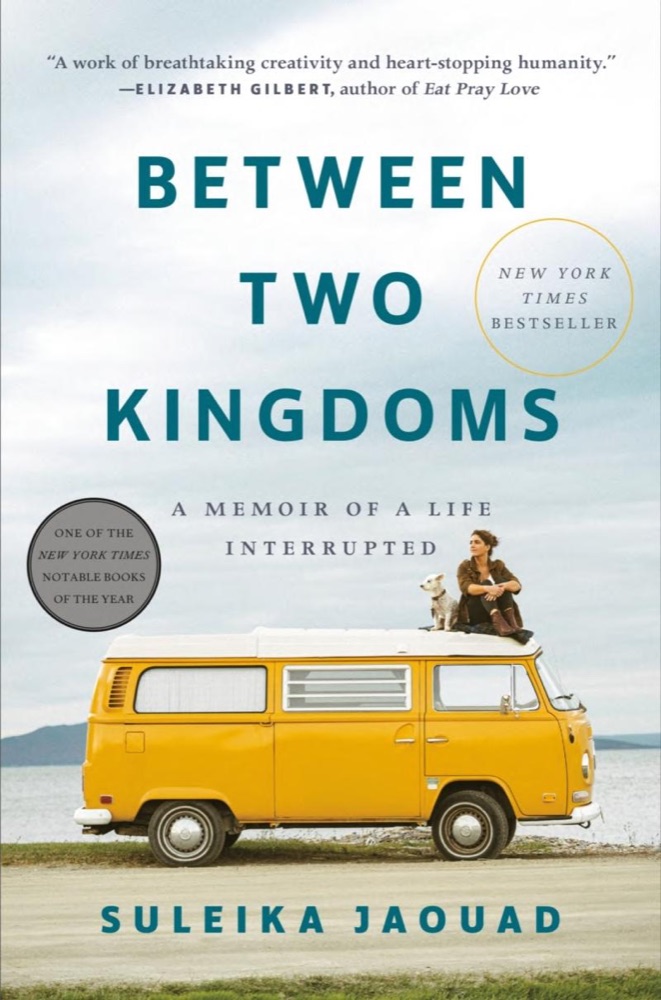
Between Two Kingdoms is Suleika Jaouad's memoir of being diagnosed with acute myeloid leukemia at age twenty-two, just as she was beginning adult life after college. Drawing on the journals she kept, her medical records, and later reflection, she chronicles nearly four years of chemotherapy, a clinical trial, and a bone-marrow transplant, as well as the disorienting question that follows survival: how to live again once treatment ends.
The book takes its structure from the idea, borrowed from Susan Sontag, that everyone holds dual citizenship in the kingdom of the well and the kingdom of the sick. Its second half follows Jaouad on a 100-day, roughly 15,000-mile cross-country road trip with her dog, visiting strangers who had written to her during her illness. Its themes are mortality, identity, isolation, the limits of the survivor narrative, and the difficulty of re-entering ordinary life.
The memoir was a New York Times bestseller and drew widespread critical praise, including starred reviews from Booklist, Library Journal, and Publishers Weekly. It grew out of Jaouad's Emmy Award-winning New York Times column and video series 'Life, Interrupted,' and was named a Booklist Editors' Choice and one of Booklist's Top 10 Memoirs of 2021.
Book details
- First published
- 2021
- Length
- 352 pages
- Reading time
- 9 hours
- Author
- Suleika Jaouad
- Genre
- Biography
- Goodreads rating
- 4.42 (134k ratings)
Critical reception
- Debuted as a New York Times bestseller.
- Received starred reviews from Booklist, Library Journal, and Publishers Weekly.
- Named a Booklist Editors' Choice (2021) and one of Booklist's Top 10 Memoirs of 2021.
- Kirkus Reviews described it as 'memorable, lyrical, and ultimately hopeful.'
If you liked this, read…
- 1When Breath Becomes AirAnother acclaimed memoir confronting mortality after a young terminal diagnosis.
- 2The Bright HourA lyrical memoir of living fully in the shadow of incurable cancer.
- 3WildA grief-driven cross-country journey toward self-reckoning and renewal.
Keep reading
 Let's Take the Long Way Home: A Memoir of Friendship
 Paperweight
 The First Time She Drowned
 A Small Indiscretion
 Am I There Yet? The Loop-de-Loop, Zigzagging Journey to Adulthood
 After the Flood
 Extraordinary Means
 In Shock: My Journey from Death to Recovery and the Redemptive Power of Hope
 Dream Count
 I Keep My Exoskeletons to Myself
 Grief Is for People
 Goodbye Days
 The Dark and Hollow Places
 Range of Motion
 Traveling Mercies: Some Thoughts on Faith
 Men Without Women
 Imagine Me Gone
 What Is the What
 On Being Human: A Memoir of Waking Up, Living Real, and Listening Hard
 Love from A to Z
 When Breath Becomes Air
 Any Ordinary Day
 The Beauty of Living Twice
 Dyscalculia: A Love Story of Epic Miscalculation
 And the Mountains Echoed
 Dreams of Falling
 Heart Berries
 Swimming in the Dark
 The Cancer Journals
 After You
 In the Wild Light
 How High We Go in the Dark
 Change of Heart
 A Thousand Broken Pieces
 Managing Expectations: A Memoir in Essays – A Poignant Collection of Personal Stories on Acting, Failure, and Motherhood's Joy
 The Nobleman's Guide to Scandal and Shipwrecks
 The Bookshop at Water's End
 Anthropology of an American Girl
 We Are Okay
 Legendborn
 The Year of Magical Thinking
 Take Me With You
 Ripe
Ripe
 The Dressmaker's Gift
 The Girl on the Train
 Make It Scream, Make It Burn
 You Better Be Lightning
 Our Wives Under the Sea
 Where the Wildflowers Grow
 Handle with Care
 The Tell: A Memoir
 Chances Are...
 To Shake the Sleeping Self: A Journey from Oregon to Patagonia, and a Quest for a Life with No Regret
 The Shock of the Fall
 You Could Make This Place Beautiful
 Leaving Time
 The Memory of Light
 The Story of the Lost Child