 The Forgotten Highlander: My Incredible Story of Survival During the War in the Far East
Quotes from the Book
As soon as all the passengers had been accounted for, we were on our way. I relived momentarily the sorrows and the joys of my whole evacuation experience, until the barracks faded away into the distance. There was only the desert now. My thoughts shifted from the past to the future.
1
Here I was, alone, with no family responsibilities, and yet fear had chained me to the camp. I thought, "My God! How do they expect those poor people to leave the one place they can call home.
At first it was impossible to drink the water because of the strong taste from the chlorine and the pipes. Thirsty people went to the one well with good water, near the U.S. Engineer’s Office, until this was condemned as contaminated. Some braver souls managed to go into the prohibited area to the Caucasian workers’ canteen.
A group of landscape architects decided to build a lake to beautify the camp. Trees and shrubs were dug up from various places and transplanted in the center field. The size and location of a tree was no hindrance to transplanting it if the tree fitted into the plan. The workmen struggled day after day with limited equipment. For a long time we were kept in wonderment by this activity. Everyone knew the camp was not a permanent one. On August 2, North Lake was formally opened. It had been transformed from a mere wet spot in the Tanforan scenery into a miniature aquatic park, complete with bridge, promenade, and islands. The lake was a great joy to the residents and presented new material for the artists. In the morning sunlight and at sunset it added great beauty to the bleak barracks.
In the women’s the arrangement was the same, except that a half-partition separated the toilets conversationally in pairs.
Because of the injustices and contradictions nothing made much sense, making things comical in spite of the misery. Crazy things were constantly happening in the camp, with close to ten thousand people confined in an area a mile square.
Cameras and photographs were not permitted in the camps, so I recorded everything in sketches, drawings, and paintings.
Watch on YouTube
About Miné Okubo
About the book
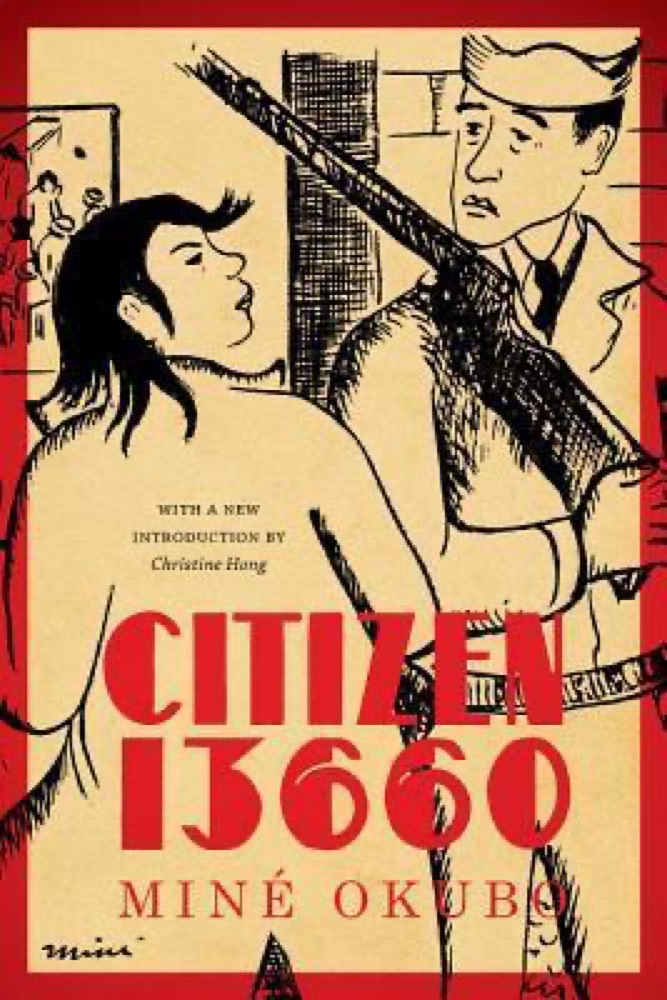
Miné Okubo was one of more than a hundred thousand people of Japanese descent - nearly two-thirds of whom were American citizens - who were forced into "protective custody" shortly after the bombing of Pearl Harbor. Citizen 13660, Okubo's illustrated memoir of life in relocation centers in California and Utah, illuminates this experience with poignant drawings and witty, candid text. This classic in Asian American literature and American history, with a new introduction by Christine Hong, is available for the first time in both a traditional paperback format and an artist's edition, oversize and in hardcover to better illustrate the innovative artwork as originally envisioned by Okubo.
"[Mine Okubo] took her months of life in the concentration camp and made it the material for this amusing, heartbreaking book. . . . The moral is never expressed, but the wry pictures and the scanty wor
Book details
- First published
- 1946
- Author
- Miné Okubo
- Genre
- History
- Goodreads rating
- 4.04 (2k ratings)
Keep reading
The Forgotten Highlander: My Incredible Story of Survival During the War in the Far East
 Prisoner B-3087
 Underground Airlines
 All But My Life: A Memoir
 Ghost Soldiers: The Epic Account of World War II's Greatest Rescue Mission
 What Strange Paradise
 Auschwitz: A Doctor's Eyewitness Account
 Mischling
 A House in the Sky
 South: The Story of Shackleton's Last Expedition 1914-1917
 Dispatches
 Paradise of the Blind
 The Girl Who Smiled Beads: A Story of War and What Comes After
 Travels with Myself and Another
 Girl at War
 The Aquariums of Pyongyang: Ten Years in the North Korean Gulag
 Escape from Camp 14: One Man's Remarkable Odyssey from North Korea to Freedom in the West
 The Girl with Seven Names: A North Korean Defector’s Story
 A Thousand Moons
 Stasiland: Stories from Behind the Berlin Wall
 Without You, There Is No Us: My Time with the Sons of North Korea's Elite
 Things We Couldn't Say
 Minor Detail
 A Bend in the River
 The Old Patagonian Express: By Train Through the Americas
 The Refugees
 Hiroshima
 In Order to Live: A North Korean Girl's Journey to Freedom
 Tisha: The Story of a Young Teacher in the Alaskan Wilderness
 The Gulag Archipelago 1918-1956
 The Road Back
 Life & Times of Michael K
 The Life and Times of the Thunderbolt Kid
 Where Late the Sweet Birds Sang
 The Auschwitz Escape
 World's Fair
 Brick Lane
 Survival in Auschwitz
 The Underground Railroad
 Station Eleven
 A Rumor of War: The Classic Vietnam Memoir
 Surviving the Angel of Death: The True Story of a Mengele Twin in Auschwitz
 The Adventures of China Iron
 The Glass Palace
 The Buddha in the Attic
 The Yellow Birds
 The Brutal Telling
 The Book of My Lives
 The Forgotten Soldier
 Running for My Life: One Lost Boy's Journey from the Killing Fields of Sudan to the Olympic Games
 Still Alive: A Holocaust Girlhood Remembered
 Kolyma Tales
 No-No Boy
 Another Country
 Magenta
 From Beirut to Jerusalem
 The Fortress of Solitude
 Jailbird
 Wolf Willow
 The Wayward Bus