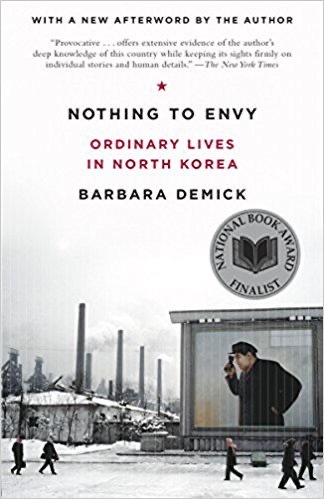
 Nothing to Envy: Ordinary Lives in North Korea
Quotes from the Book
People who are hungry don't have the heart to think about others. Sometimes they can't even care for their own family. Hunger quashes man's will to help his fellow man. I've seen fathers steal food from their own children's lunchboxes. As they scarf down the corn they have only one overpowering desire: to placate, if even for just one moment, that feeling of insufferable need.
12
Hunger quashes man's will to help his fellow man.
6
I remember his last day. He was lying calmly in bed with his eyes closed, when his whole body suddenly went slack. He made a little gesture with his hand, smiling slightly—what I later realized was his final farewell. That’s how he died, without our even realizing it. That scene changed my perception of death. Previously, it always wore a mask of terror; I never imagined it could be so peaceful. Since then, death no longer scares me. My father showed me it could be a moment for smiling.
5
I once believed man was different from other animals, but Yodok showed me that reality doesn't support this opinion. In the camp, there was no difference between man and beast, except maybe that a very hungry human was capable of stealing food from its little ones while an animal, perhaps, was not.
5
At the time, I remained relatively calm before that spectacle of horrors, which is perhaps the most telling indication of just how desensitized I had become. The more I witnessed such atrocities and rubbed shoulders with death, the more I desired to stay alive, no matter the cost.
5
A clear-eyed view of the hell I had landed in certainly would have thrown me deeper into despair. There is nothing like thought to deepen one's gloom.
4
Only around 1983 did I begin to realize that not he but rather Kim Il-sung and his regime were the real causes of my suffering. They were the ones responsible for the camp and for filling it with innocent people. All during my childhood, Kim Il-sung had been like a god to me. A few years in the camp cured me of my faith.
4
We left in the same kind of truck that had brought us to the camp ten years earlier. When it started up, I was taken back to our departure from Pyongyang, and to my mother's tear-lined face as it receded into the distance. The vision struck me with new and unexpected force - for I had all but forgotten my mother.
4
The only lesson I got pounded into me was about man's limitless capacity for vice - that and the fact that social distinctions vanish in a concentration camp. I once believed that man was different from other animals, but Yodok showed me that reality doesn't support this opinion.
4
(P166) That’s the way things usually work in North Korea: money and violence stand in for law and order. We even have a saying for it: “The law is far; the fist is close.” The regime that never tires of denouncing capitalism has birthed a society where money is king— more so than any capitalist society I have visited.
3
What happened? We sent our family and friends letters warning people not to come! Why didn’t your family listen? … You’re not going to build a new life here; your parents will be stripped of all their belongings, then left to die. You’ll soon find out what these North Korean Communists are all about.
1
It was like the city was dead – the strangest atmosphere. The people all looked so shabby and aimless in their wandering. There was a feeling of deep sadness in the air…
1
I have since learned that at other latitudes and at other times, the same Communist powers created similar traps for making people believe and hope in illusions. This led to the misery of countless peoples: in France, in America, in Egypt, and perhaps most notably, in Armenia. Tens of thousands died there in 1947 under the spell of Stalin’s propaganda, which had painted the Soviet Socialist Republic of Armenia as the land of milk and honey. The Soviets… promised that the ancestral culture and religion would be respected and that the newcomers would shortly see a new generation rise and flourish in social justice.
1
Koreans never had an easy time integrating into Japanese life and often were targets of prejudice. The North Korean propaganda thus resonated with many in the diaspora, and thousands responded to Kim Il-Sung’s call to return. Well-to-do Koreans such as my grandparents could be expected to be wooed with an equal measure of ideological arguments and fantastical promises: there were managerial positions awaiting them, they were entitled to a beautiful home, they would have no material worries, and their children would be able to study in Moscow.
1
In June 1949, the Koreans who previously had belonged to the Japanese Communist Party migrated en masse into the newly created Korean Workers’ Party, as the North Korean communist party was called. Like its counterparts all over the world, the KWP showed a formidable knack for creating associations with the allure of democracy and openness to the public. There were women’s associations, movements for the defence of culture and peace, sports clubs, and various other groups which the Party could influence from the shadows. My grandmother was among the Party’s most active organisers and eventually became director for the Kyoto region.
1
It's clear: North Korea is a total sham. Officially, it outlaws private business, but in the shadows it lets it thrive. Since there are hardly any markets, merchants warehouse their Chinese products at home and sell them to their neighbors and acquaintances. This farce is the only thing preventing the bankruptcy of the North Korean state and the pauperization of its citizenry.
1
Watch on YouTube
About Kang Chol-Hwan
We have collected 16 quotes from 1 book by Kang Chol-Hwan on BookQuoters.
More about the author →About the book
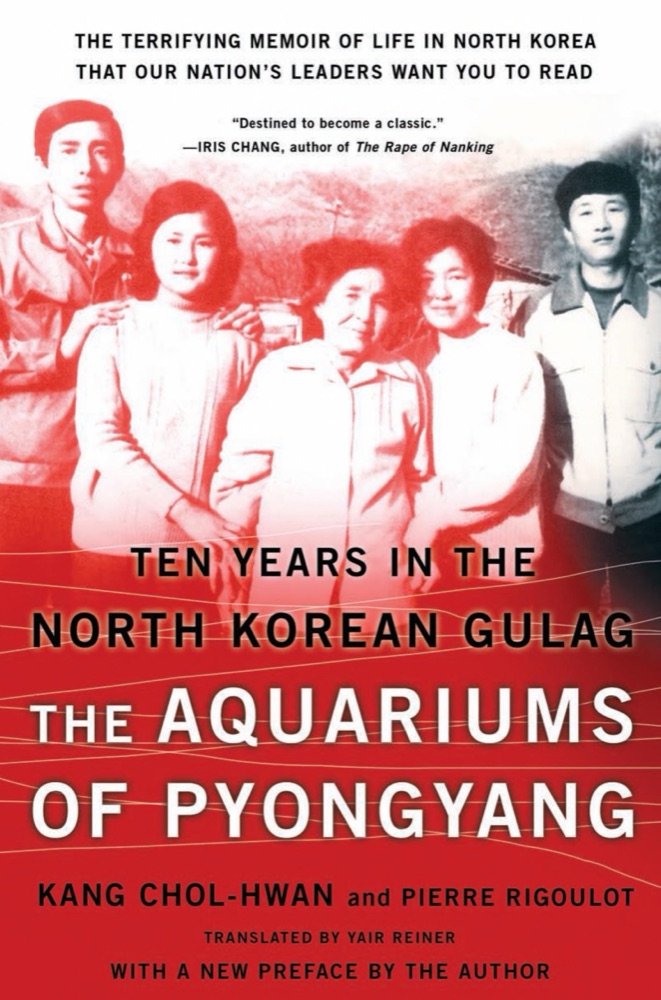
"Destined to become a classic" (Iris Chang, author of The Rape of Nanking ), this harrowing memoir of life inside North Korea was the first account to emerge from the notoriously secretive country -- and it remains one of the most terrifying.
Amid escalating nuclear tensions, Kim Jong-un and North Korea's other leaders have kept a tight grasp on their one-party state, quashing any nascent opposition movements and sending all suspected dissidents to its brutal concentration camps for "re-education."
Kang Chol-Hwan is the first survivor of one of these camps to escape and tell his story to the world, documenting the extreme conditions in these gulags and providing a personal insight into life in North Korea. Sent to the notorious labor camp Yodok when he was nine years old, Kang observed frequent public executions and endured forced labor and near-starvation rations for ten years. In
Book details
- First published
- 2000
- Author
- Kang Chol-Hwan
- Genre
- Nonfiction
- Goodreads rating
- 4.12 (12k ratings)
Keep reading
Nothing to Envy: Ordinary Lives in North Korea
 The Girl with Seven Names: A North Korean Defector’s Story
 Without You, There Is No Us: My Time with the Sons of North Korea's Elite
 Escape from Camp 14: One Man's Remarkable Odyssey from North Korea to Freedom in the West
 In Order to Live: A North Korean Girl's Journey to Freedom
 The Gulag Archipelago 1918-1956
 Life and Death in Shanghai
 Everything Flows
 Pachinko
 Free: A Child and a Country at the End of History
 The Devil of Nanking
 Daughters of Smoke and Fire
 Kolyma Tales
 Where the Wind Leads: A Refugee Family's Miraculous Story of Loss, Rescue, and Redemption
 Red Dust: A Path Through China
 The Girl Who Smiled Beads: A Story of War and What Comes After
 Wild Swans: Three Daughters of China
 Survival in Auschwitz
 Zinky Boys: Soviet Voices from the Afghanistan War
 The Forgotten Highlander: My Incredible Story of Survival During the War in the Far East
 Secondhand Time: The Last of the Soviets
 Radio Free Albemuth
 Imperium
 Koba the Dread: Laughter and the Twenty Million
 Underground: The Tokyo Gas Attack and the Japanese Psyche
 Paradise of the Blind
 In the Miso Soup
 A Woman in Berlin: Eight Weeks in the Conquered City: A Diary
 Night
Night
 American Shaolin: Flying Kicks, Buddhist Monks, and the Legend of Iron Crotch: An Odyssey in the New China
 Stasiland: Stories from Behind the Berlin Wall
 If This Is a Man / The Truce
 Border: A Journey to the Edge of Europe
 Life & Times of Michael K
 All But My Life: A Memoir
 Petals of Blood
 The Teacher of Warsaw
 The Ministry for the Future
 Twenty Fragments of a Ravenous Youth
 Transition
 Riding the Iron Rooster: By Train Through China
 The Aosawa Murders
 Holocaust
 The Silence of Bones
 The Postcard
 Darkness at Noon
 When We Were Orphans
 The Good Son
 The Association of Small Bombs
 Disoriental
 The Road Back
 How Beautiful We Were
 Close to the Knives: A Memoir of Disintegration
 Another Country
 Human Acts
 Emergency Sex (And Other Desperate Measures): True Stories from a War Zone
 The Refugees
 Strange Beasts of China
 The Orphan Master's Son
 Things I've Been Silent About