
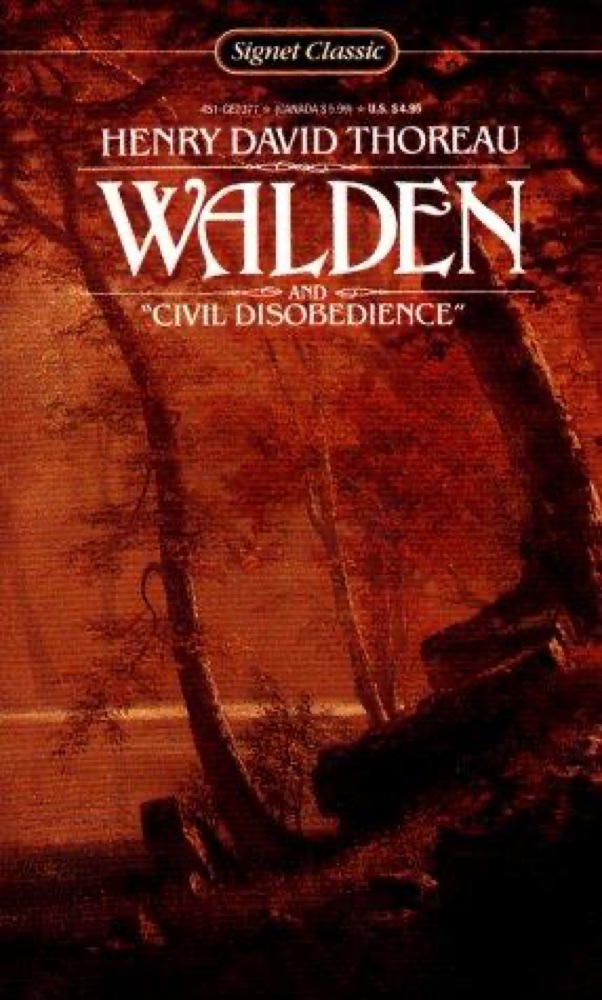
 Walden & Civil Disobedience
Quotes from the Book
Our life is frittered away by detail. Simplify, simplify.
The squirrel that you kill in jest, dies in earnest.
Public opinion is a weak tyrant compared with our own private opinion.
Spending of the best part of one's life earning money in order to enjoy questionable liberty during the least valuable part of it, reminds me of the Englishman who went to India to make a fortune first, in order that he might return to England and live the life of a poet. He should have gone up garret at once.
The greater part of what my neighbors call good I believe in my soul to be bad, and if I repent of anything, it is very likely to be my good behavior. What demon possessed me that I behaved so well?
None can be an impartial or wise observer of human life but from the vantage ground of what we should call voluntary poverty.
Thoreau the “Patron Saint of Swamps” because he enjoyed being in them and writing about them said, “my temple is the swamp… When I would recreate myself, I seek the darkest wood, the thickest and most impenetrable and to the citizen, most dismal, swamp. I enter a swamp as a sacred place, a sanctum sanctorum… I seemed to have reached a new world, so wild a place…far away from human society. What’s the need of visiting far-off mountains and bogs, if a half-hour’s walk will carry me into such wildness and novelty.
We know but few man, a great many coats and breeches.
Knowledge does not come to us by details, but in flashes of light from heaven.
I hear of a convention to be held at Baltimore, or elsewhere, for the selection of a candidate for the Presidency, made up chiefly of editors, and men who are politicians by profession; but I think, what is it to any independent, intellegent, and respectable man what decision they may come to? Shall we not have the advantage of his wisdom and honesty, nevertheless? Can we not count upon some independent votes? Are there not many individuals in the country who do not attend conventions? But no: I find that the respectable man, so called, has immediately drifted from his position, and despairs of his country, when his country has more reason to despair of him. He forthwith adopts one of the candidates thus selected as his only AVAILABLE one, thus proving that he is himself AVAILABLE for any purposes of the demagogue. His vote is of no more worth than that of any unprincipled foreigner or hireling native, who may have been bought.
The childish and savage taste of men and women for new patterns keeps how many shaking and squinting through kaleidoscopes that they may discover the particular figure which this generation requires to-day. The manufacturers have learned that this taste is merely whimsical. Of two patterns which differ only by a few threads more or less of a particular color, the one will be sold readily, the other lie on the shelf, though it frequently happens that after the lapse of a season the latter becomes the most fashionable. Comparatively, tattooing is not the hideous custom which it is called. It is not barbarous merely because the printing is skin-deep and unalterable.
Our statistics are at fault: the population has been returned too large. How many men are there to a square thousand miles in this country? Hardly one.
When I wrote the following pages, or rather the bulk of them, I lived alone, in the woods, a mile from any neighbor, in a house which I had built myself, on the shore of Walden Pond, in Concord, Massachusetts, and earned my living by the labor of my hands only. I lived there two years and two months.
Why should we live with such hurry and waste of life? We are determined to be starved before we are hungry.
I too had woven a kind of basket of a delicate texture, but I had not made it worth any one's while to buy them. Yet not the less, in my case, did I think it worth my while to weave them, and instead of studying how to make it worth men's while to buy my baskets, I studied rather how to avoid the necessity of selling them.
There is on the earth no institution which Friendship has established; it is not taught by any religion; no scripture contains its maxims. It has no temple nor even a solitary column...However, out fates at least are social. Our courses do not diverge; but as the web of destiny is woven it is fulled, and we are cast more and more into the centre. Men naturally, though feebly, seek this alliance, and their actions faintly foretell it. We are inclined to lay the chief stress on likeness and not on difference, and in foreign bodies we admit that there are many degrees of warmth below blood heat, but none of cold above it.
millions are awake enough for physical labor; but only one in a million is awake enough for effective intellectual exertion, only one in a hundred millions to a poetic or divine life. To be awake is to be alive. I have never yet met a man who was quite awake. How could I have looked him in the face?
Let men cultivate the moral affections, lead manly independent lives; let them make riches the means and not the end of existence, and we shall hear no more of the commercial spirit. . . . This curious world which we inhabit is more wonderful than it is convenient; more beautiful than it is useful; it is more to be admired and enjoyed than used.
Shams and delusions are esteemed for soundest truths, while reality is fabulous. If men would steadily observe realities only, and not allow themselves to be deluded, life, to compare it with such things as we know, would be like a fairy tale
I rejoice that there are owls. Let them do the idiotic and maniacal hooting for men. It is a sound admirably suited to swamps and twilight woods which no day illustrates, suggesting a vast and undeveloped nature which men have not recognized.
men have come to such a pass that they frequently starve, not for want of necessaries, but for want of luxuries;
I should not talk so much about myself if there were any body else whom I knew as well.
Did you know?
- The book's central work, "Walden," chronicles the two years, two months, and two days Thoreau spent living in a self-built cabin near Walden Pond.
- Walden was first published in 1854 by the Boston firm Ticknor and Fields under the title "Walden; or, Life in the Woods."
- Thoreau built his cabin on land near Walden Pond that belonged to his friend Ralph Waldo Emerson.
- The essay "Civil Disobedience," often collected alongside Walden, grew out of the night Thoreau spent in the Concord jail for refusing to pay his poll tax.
- Walden is organized into eighteen chapters, beginning with "Economy" and closing with "Conclusion."
- Thoreau was a central figure in the American Transcendentalist movement centered in Concord, Massachusetts.
About Henry David Thoreau
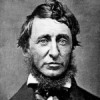
Henry David Thoreau (1817-1862) was an American writer, naturalist, and philosopher who spent nearly his whole life in Concord, Massachusetts. A leading figure in Transcendentalism and a close associate of Ralph Waldo Emerson, he is best known for "Walden" and the essay "Civil Disobedience."
More about the author →More by Henry David Thoreau
All books by Henry David Thoreau →

About the book
"Walden and Other Writings" collects Henry David Thoreau's best-known prose, anchored by "Walden; or, Life in the Woods" (1854). In that central work Thoreau recounts the two years, two months, and two days he spent living alone in a small cabin he built himself on the shore of Walden Pond, a mile from any neighbor, near Concord, Massachusetts. Organized into eighteen chapters such as "Economy," "Where I Lived, and What I Lived For," "Solitude," and "The Pond in Winter," the book is at once a memoir of a self-sufficient experiment and a sustained meditation on how a person ought to live.
Thoreau's overriding theme is deliberate living: stripping life down to its essentials in order to see it clearly. He champions simplicity, self-reliance, and close attention to the natural world, while sharply criticizing materialism, needless labor, and the distractions of conventional society. Collections under this title typically pair Walden with the essay "Civil Disobedience," in which Thoreau argues that individual conscience must take precedence over unjust law, a position rooted in his own refusal to pay a poll tax and the night he spent in the Concord jail.
A product of American Transcendentalism and Thoreau's friendship with Ralph Waldo Emerson, the book became one of the most influential works of American nonfiction. Its call to simplicity and its defense of principled resistance have shaped environmental thought and movements for nonviolent protest, and it continues to be read as a foundational text of self-examination and civil conscience.
Book details
- First published
- 1854
- Author
- Henry David Thoreau
- Genre
- Classics
- Goodreads rating
- 3.77 (207k ratings) →
- First line
- “When I wrote the following pages, or rather the bulk of them, I lived alone, in the woods, a mile from any neighbor, in a house which I had built myself, on the shore of Walden Pond, in Concord, Massachusetts, and earned my living by the labor of my hands only.”
If you liked this, read…
- 1Nature and Selected EssaysEmerson's Transcendentalist essays that directly shaped Thoreau's thought.
- 2A Sand County AlmanacAldo Leopold's nature writing and land ethic in Thoreau's tradition.
- 3Pilgrim at Tinker CreekAnnie Dillard's contemplative, closely observed year in nature.
- 4Desert SolitaireEdward Abbey's solitary meditation on wilderness and simple living.
Keep reading
Walden & Civil Disobedience
 Walden
 Daniel Deronda
 The Essays of Ralph Waldo Emerson
 The Home and the World
 Erewhon
 The Autobiography of Benjamin Franklin
 Human, All Too Human
 The Complete Essays
 Point Counter Point
 One Man's Meat
 Middlemarch
 Surprised by Joy: The Shape of My Early Life
 Life Without Principle
 The Fall of Babel
 West with the Night
 The Gay Science
 The World-Ending Fire: The Essential Wendell Berry
 Heretics
 Man and Superman
 The Adventures of Augie March
 The Essential Writings of Ralph Waldo Emerson
 Big Sur and the Oranges of Hieronymus Bosch
 Humboldt's Gift
 Travels with Charley: In Search of America
 Dust Tracks on a Road
 Notes from Underground
 An Instance of the Fingerpost
 Cat's Cradle
 What's Wrong with the World
 Wampeters, Foma and Granfalloons
 The Magic Mountain
 Brave New World
 The Razor's Edge
 Dead Souls
 The Rebel Angels
 The Wisdom of Life
 Open City
 Twilight of the Idols
 The Fall
 Independent People
 Selected Stories
 Bleak House
 Small Wonder
 When I Was a Child I Read Books
 Nature and Selected Essays
 A Connecticut Yankee in King Arthur's Court
 Villa Incognito
 The Secret Scripture
 The Abundance
 V.
V.
 Allan Quatermain
 The Common Reader
 Lorna Doone
 The Empusium
 American Pastoral
 Flaubert's Parrot
 Another Roadside Attraction
 March
March