
 The Naked and the Dead
Quotes from the Book
not for nothing had Lenin pointed out that there were ten years which passed like an uneventful day, but there was also the revolutionary day which was like ten years.
5
Mediocrities flock to any movement which will indulge their self-pity and their self-righteousness, for without a Movement the mediocrity is on the slide into terminal melancholia.
5
Years ago in 1959 when Dellinger was already an editor on Liberation (then an anarchist-pacifist magazine, of worthy but not very readable articles in more or less vegetarian prose) Mailer had submitted a piece, after some solicitation, on the contrast between real obscenity in advertising, and alleged obscenity in four-letter words. The piece was no irreplaceable work of prose, and in fact was eventually inserted quietly into his book, Advertisements for Myself, but it created difficulty for the editorial board at Liberation, since there was a four-letter word he had used to make his point, the palpable four-letter word which signifies a woman’s most definitive organ: these editorial anarchists were decorous; they were ready to overthrow society and replace it with a communion of pacifistic men free of all laws, but they were not ready to print cunt.
5
His deepest detestation was often reserved for the nicest of liberal academics, as if their lives were his own life but a step escaped. Like the scent of the void which comes off the pages of a Xerox copy, so was he always depressed in such homes by their hint of oversecurity. If the republic was now managing to convert the citizenry to a plastic mass, ready to be attached to any manipulative gung ho, the author was ready to cast much of the blame for such success into the undernourished lap, the overpsychologized loins, of the liberal academic intelligentsia. They were of course politically opposed to the present programs and movements of the republic in Asian foreign policy, but this political difference seemed no more than a quarrel among engineers. Liberal academics had no root of a real war with technology land itself, no, in all likelihood, they were the natural managers of that future air-conditioned vault where the last of human life would still exist.
5
We find, therefore, Lowell and Mailer ostensibly locked in converse. In fact, out of the thousand separate enclaves of their very separate personalities, they sensed quickly that they now shared one enclave to the hilt: their secret detestation of liberal academic parties to accompany worthy causes. Yes, their snobbery was on this mountainous face close to identical—each had a delight in exactly the other kind of party, a posh evil social affair, they even supported a similar vein of vanity (Lowell with considerably more justice) that if they were doomed to be revolutionaries, rebels, dissenters, anarchists, protesters, and general champions of one Left cause or another, they were also, in private, grands conservateurs, and if the truth be told, poor damn émigré princes. They were willing if necessary (probably) to die for the cause—one could hope the cause might finally at the end have an unexpected hint of wit, a touch of the Lord’s last grace—but wit or no, grace or grace failing, it was bitter rue to have to root up one’s occupations of the day, the week, and the weekend and trot down to Washington for idiot mass manifestations which could only drench one in the most ineradicable kind of mucked-up publicity and have for compensation nothing at this party which might be representative of some of the Devil’s better creations. So Robert Lowell and Norman Mailer feigned deep conversation. They turned their heads to one another at the empty table, ignoring the potentially acolytic drinkers at either elbow, they projected their elbows out in fact like flying buttresses or old Republicans, they exuded waves of Interruption Repellent from the posture of their backs, and concentrated on their conversation, for indeed they were the only two men of remotely similar status in the room. (Explanations about the position of Paul Goodman will follow later.)
4
Once History inhabits a crazy house, egotism may be the last tool left to History.
2
Either the century was entrenching itself more deeply into the absurd, or the absurd was delivering evidence that it was possessed of some of the nutritive mysteries of a marrow which would yet feed the armies of the absurd.
2
You, Lowell, beloved poet of many, what do you know of the dirt and the dark deliveries of the necessary? What do you know of dignity hard-achieved, and dignity lost through innocence, and dignity lost by sacrifice for a cause one cannot name. What do you know about getting fat against your will, and turning into a clown of an arriviste baron when you would rather be an eagle or a count, or rarest of all, some natural aristocrat from these damned democratic states.
2
Arrayed against them as hard-core troops: an elite! the Freud-ridden embers of Marxism, good old American anxiety strata—the urban middle-class with their proliferated monumental adenoidal resentments, their secret slavish love for the oncoming hegemony of the computer and the suburb, yes, they and their children, by the sheer ironies, the sheer ineptitude, the kinks of history, were now being compressed into more and more militant stands, their resistance to the war some hopeless melange, somehow firmed, of Pacifism and closet Communism. And their children—on a freak-out from the suburbs to a love-in on the Pentagon wall.
2
Since the American Revolution must climb uphill blindfolded in the long Capitalist night, any thing which was publicity became a walking stick.
1
... se dan en ellos contradicciones explosivas. En teoría han de hacer cumplir la ley, pero tienden a considerarse la ley misma. Tienen más responsabilidades que el hombre de la calle, pero son más infantiles. Están indisociablemente unidos al concepto de honestidad, pero son en grado sumo corruptos. Poseen más valor físico que el ciudadano medio, pero son bravucones sin escrúpulos. Sirven a la verdad, pero son psicópatas de la mentira... Desarrollan una labor autoritaria, pero son escépticos. Y, finalmente, si hay algo profundamente idealista en su corazón, están también henchidos de codicia. No hay personaje humano tan contradictorio, tan categóricamente enigmático como el policía medio...
1
Consciousness, that blunt tool, bucks in the general direction of the truth. Instinct plucks the feather.
1
There was a way, of course, to deal with the papers. If the ears of the reporters were geared to capture accurately the mediocre remarks of mediocre men, then one had to look for simple salient statements, so poetically bare, but so irreducible, that they would stick in the reporter’s mind like a thorn.
1
For guilt was the existential edge of sex. Without guilt, sex was meaningless.
1
One’s own literary work was the only answer to the war in Vietnam.
1
Watch on YouTube
About Norman Mailer
We have collected 73 quotes from 5 books by Norman Mailer on BookQuoters.
More about the author →More by Norman Mailer
About the book
Winner of the Pulitzer Prize and the National Book Award
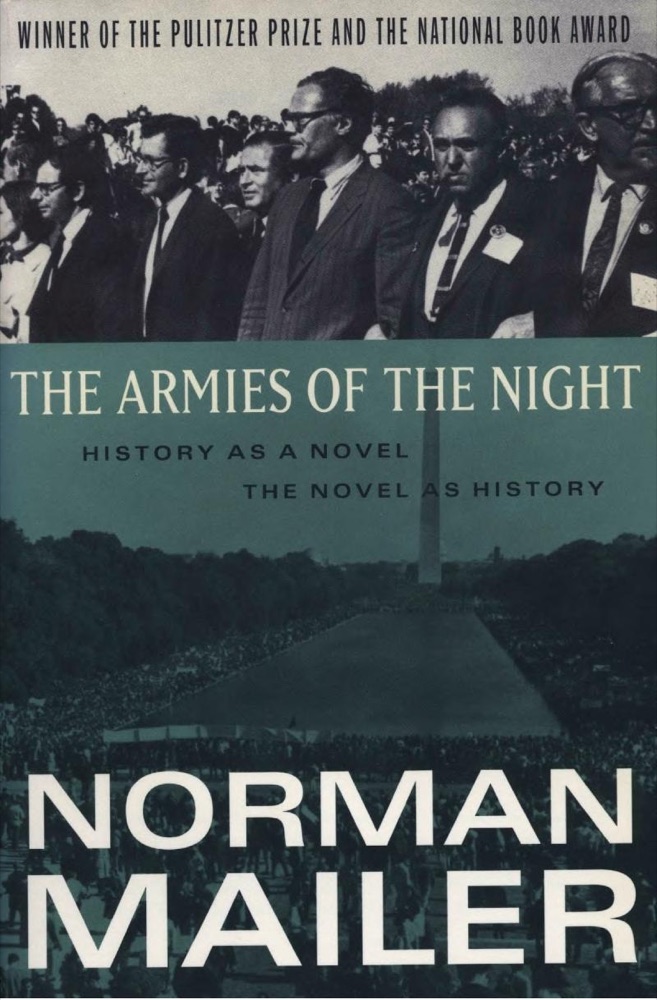
Fifty years after the March on the Pentagon, Norman Mailer’s seminal tour de force remains as urgent and incisive as ever. Winner of America’s two highest literary awards, The Armies of the Night uniquely and unforgettably captures the Sixties’ tidal wave of love and rage at its crest and a towering genius at his peak.
The time is October 21, 1967. The place is Washington, D.C. Depending on the paper you read, 20,000 to 200,000 protestors are marching to end the war in Vietnam, while helicopters hover overhead and federal marshals and soldiers with fixed bayonets await them on the Pentagon steps. Among the marchers is a writer named Norman Mailer. From his own singular participation in the day’s events and his even more extraordinary perceptions comes a classic work that shatters the mold of traditional reportage. Intellectu
Book details
- First published
- 1968
- Author
- Norman Mailer
- Genre
- History
- Goodreads rating
- 3.61 (3k ratings)
Keep reading
 A Collection of Essays
 The Tunnel
 The Secret Agent
 Darkness at Noon
 Sixty Stories
 Arguably: Selected Essays
 The Committed
 Radio Free Albemuth
 Cultural Amnesia: Necessary Memories from History and the Arts
 Essays of E.B. White
 What's Left?
 Call for the Dead
 Eyeless in Gaza
 V.
V.
 The Honourable Schoolboy
 Koba the Dread: Laughter and the Twenty Million
 The Fall of Babel
 The Last Lion: Winston Spencer Churchill: Alone, 1932-40
The Naked and the Dead
The Last Lion: Winston Spencer Churchill: Alone, 1932-40
The Naked and the Dead
 In the Heart of the Heart of the Country and Other Stories
 No Name in the Street
 Anti-Oedipus: Capitalism and Schizophrenia
 Purity
 Hitch-22: A Memoir
 The Golden House
 The Book of My Lives
 The Captive Mind
 The Ides of March
 Private Citizens
 Minima Moralia: Reflections on a Damaged Life
 The Noise of Time
 The Story of the Lost Child
 The Bonfire of the Vanities
 Absolute Friends
 Gravity's Rainbow
 Revolutionary Road
 From Here to Eternity
 Against the Day
 Martin Eden
 Black Lamb and Grey Falcon
 The Atrocity Exhibition
 Ravelstein
 The Proud Highway: Saga of a Desperate Southern Gentleman, 1955-1967
 From Dawn to Decadence: 500 Years of Western Cultural Life, 1500 to the Present
 The Proud Tower: A Portrait of the World Before the War, 1890-1914
 Antic Hay
 Ragtime
 Resistance, Rebellion and Death: Essays
 Speedboat
 The Brooklyn Follies
 It Can't Happen Here
 Every Love Story Is a Ghost Story: A Life of David Foster Wallace
 Fall of Giants
 Hyperion
 Mislaid
 Europe Central
 The Eighth Life
 Mumbo Jumbo
 American Pastoral
 An American Dream