 The Years
Quotes from the Book
It was indescribable what she wanted. She was restless. She wanted to work. She wanted to be thirty people. She wanted to wear a cap of pearls and a coat of bright blue diamonds. To live as nature does, in many ages, in many brains
16
Yet why must grammar be like a prison for the mind? Might not language be as a closet full of gowns? Of a generally similar cut, with a hole for the head and neck to pass, but filled with difference and a variety of trimmings so that we don't grow bored?
14
Yet how hard it is to point to a moment. To say: there, in that moment, I changed.
5
Yet she is happy -- is it happiness she feels? -- as she places her things in the cupboards and drawers. Her quills, stockings, shoes. The room is dotted by porcelain figures. Punctuated, she thinks. She picks one up, puts it down. The former wife's collection? Then opens a window to London bells and that green-silk scent of spring. And she sees now, here in this room, how badly she'd needed to leave.
5
On the fifth night of this solitude, she falls asleep with a candle burning and dreams herself a mermaid with a thick and golden tail, a crown of shimmering conch shells, then awakens with a start. Whether the ship hit something or something hit the ship, another change has come. The ship is dying; she can feel it slipping away. She waits beneath the blanket for icy water to greet her. But instead of the sea, it's a bear that opens the door. A great white bear up on its hind legs steps across the threshold. 'Good morning,' he says, and reaches out a paw.
2
I had rather be a meteor, single, alone.' Plus Paris itself was noisome. Even with its glittering bridges and orangeries, even if the birthplace of ballet. 'I had rather been a meteor, than a star in a crowd.
2
Sixteen, I reflected, biting into a stolen pie. By this time in her life, my sister Mary had been pregnant. Ovid had dedicated his life to poetry. Queen Elizabeth had seen a suitor beheaded. Romeo and Juliet were dead. Whereas I, Margaret Lucas, was nothing if not in health, no single true adventure to my name.
1
As the driver pulled over to attend the injured animal, I sat and watched the sky - an oceanic mass of gray, with islands of steel blue - thinking, yes, certainly, birds must sleep at times while they fly. How ridiculous it was to think otherwise. Yet my brothers' tutor, a man from Oxford with red eyebrows, had informed me the previous morning that no such thing could occur. Such a thing, he'd opined, would be an affront to God, who had blessed birds with the ability to sleep and the ability to fly, but not the ability to sleep while flying or fly while sleeping. Absurd! Moreover, he went on, were it to be case, each morning we would find at our feet heaps of dead birds that had smashed into rooftops or trees in the night. Night after night we would be awakened by this ornithological cacophony, this smashing of beaks against masonry, this violence of feathers and bones. It will not do, he said, to too greatly admire the mysteries of nature. But I remembered that sparrow on the riverbank and secretly held that the world was not so easily explained by a tutor's reason. Indeed, it was then that I first formed the opinion - if childishly, idly - that a person should trust to her own good sense and nature's impenetrable wisdom.
1
Off come her skirts and petticoats, her lace cuffs and collar, her shoes and whalebone stay, until she lies on her side in nothing but a cotton shift and endless strands of pearls. Dust hangs in a crack of light between red velvet drapes, like stars. Her dreams are glimpses, bewildered--celestial charts, oceanic swells, massive, moving bodies of water, the heavens as heavenly liquid, familiar whirlpools, the universe as a ship lost at sea--but the ship she imagines arrived safely, years ago, loaded with their possessions.
1
She was reading Francis Godwin's Man in the Moone--its man was borne into space in a carriage drawn by swans--when she heard the sound of wheels upon the gravel. Two boxes from Martin & Allestyre were set down on the drive. 'My modest closet plays,' she said. She nearly ran down the stairs--for the recovery of her wayward crates that spring and the preparation of her plays for publication had rekindled inside Margaret a flame she'd feared had gone out. ... But now, in turning the pages, she grew concerned and then incensed: 'reins' where she had written 'veins,' 'exterior' when she had clearly meant 'interior.' The sun went down. The room grew dim. ... 'Before the printer ruined it,' she cried, 'my book was good!' 'Could it be,' he asked, soaking his bread in {lamb's} blood, 'that you were yourself the cause of this misfortune?
1
Still, Antwerp, the parties, my husband's talks--all of it fed my mind. I'd hardly set down my quill before I took it up again, writing stories unconnected--of a pimp, a virgin, a rogue--strung up like pearls on a thread. ... 'I am very ambitious, yet 'tis neither for Beauty, Wit, Titles, Wealth, or Power, but as they are steps to raise me to Fames Tower.' O minor victory! O small delight! My star began to rise.
1
Does every river make a music of its own?
1
Long reconciled to childlessness, she worries instead about barrenness of the brain
At the embassy for supper - quail in broth and oysters - Lady Browne remembered my father, whom she'd met at Queen Elizabeth's court. Yet one name only was on the tongue of Sir Richard: William Cavendish, newly made marquess. This gentleman, he reported between oysters, had recently fled to Hamburg after losing badly with a regiment raised near York. A master horseman and fencer, and one of the richest men in England, he wrote plays - oyster - collected viols - oyster - "his particular love in music" - and was by all accounts - oyster - affable and quick.
I found myself in an unknown universe, whirling far into space. African servants, dogs in hats, platonic ideals, sparkling conversation, and ivy-coated quadrangles with womanizing captains, dueling earls, actors. I met Father Cyprien de Gamache, her majesty's wily confessor; William, a poet, who claimed to be Shakespeare's son; and a giggling dwarf called Jeffry, who'd been presented to the queen in a pie. I met the ladies-in-waiting, too, who hardly looked my way, busy as they were, bickering over who went where and when, who wore what and when, who fetched what and why, who said what and to whom, and who gave her the right to say that.
An utter success,' her stepdaughters confided to Margaret as they prepared to take their leave. 'The handsome king! That spoof!' Still the rain persisted, and the bishop had lost his hat. Maids danced in and out. Where was the bishop's hat? Alone at the window, Margaret didn't hear. The reflection of the parlor was yellow and warm. She watched it empty out. Then, an interruption. A voice came at her side: 'What do you look at with such interest, Lady Cavendish?' What did she see in the glass? She saw the Marchioness of Newcastle. She saw the aging wife of an aged marquess, without even any children to dignify her life.
One night, the Duarte girl, sang poems set to music in a voice so clear I felt my soul rise up inside my ear. In a garden of clematis, with servants dressed like Gypsies placing candles in the trees, we assembled on the grass, between a Belgian wood and {the Duchess of Lorraine}'s glassy pond. In a pale orange gown I read two pieces I'd prepared...When the ladies clapped their approval in the dark, everything, to me, was suddenly bright and near.
Watch on YouTube
About Danielle Dutton
We have collected 17 quotes from 1 book by Danielle Dutton on BookQuoters.
More about the author →About the book
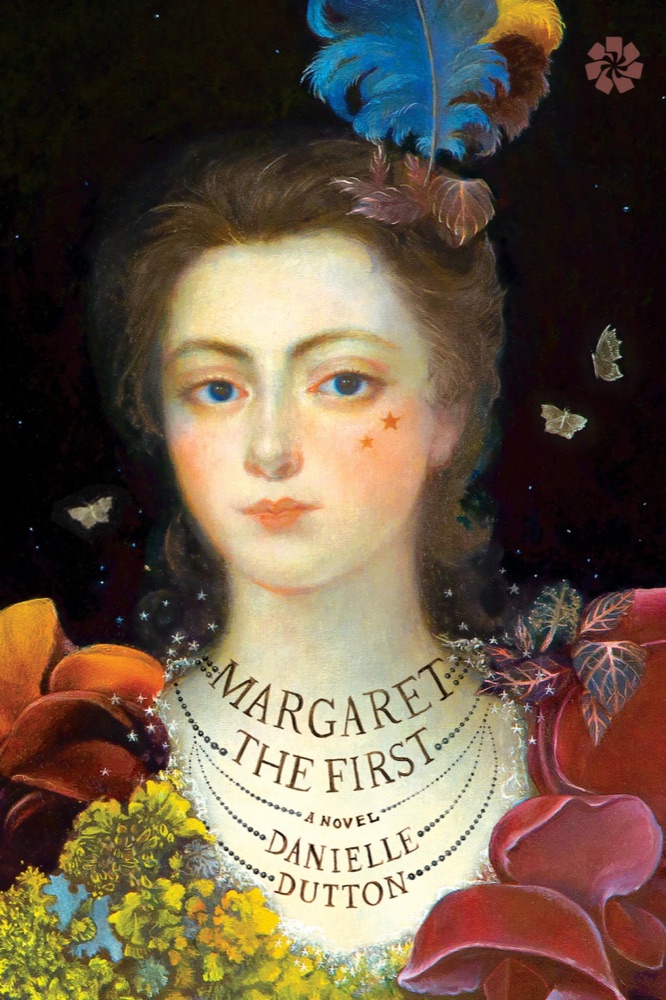
Margaret the First dramatizes the life of Margaret Cavendish, the shy, gifted, and wildly unconventional 17th-century Duchess. The eccentric Margaret wrote and published volumes of poems, philosophy, feminist plays, and utopian science fiction at a time when “being a writer” was not an option open to women. As one of the Queen’s attendants and the daughter of prominent Royalists, she was exiled to France when King Charles I was overthrown. As the English Civil War raged on, Margaret met and married William Cavendish, who encouraged her writing and her desire for a career. After the War, her work earned her both fame and infamy in England: at the dawn of daily newspapers, she was “Mad Madge,” an original tabloid celebrity. Yet Margaret was also the first woman to be invited to the Royal Society of London—a mainstay of the Scientific Revolution—and the last for another two hundred years.Ma
Book details
- First published
- 2016
- Author
- Danielle Dutton
- Genre
- Historical
- Goodreads rating
- 3.51 (4k ratings)
The buzz
- The New York TimesReview in The New York Timesprofessional review (via Book Marks)
- The Wall Street JournalReview in The Wall Street Journalprofessional review (via Book Marks)
- The GuardianReview in The Guardianprofessional review (via Book Marks)
- The TimesReview in The Timesprofessional review (via Book Marks)
- LA Review of BooksReview in LA Review of Booksprofessional review (via Book Marks)
- Star TribuneReview in Star Tribuneprofessional review (via Book Marks)
Keep reading
The Years
 Briefly, A Delicious Life
 Night and Day
 The Garden Party and Other Stories
 Green Dolphin Street
 All Passion Spent
 The Art of Inheriting Secrets
 Lady Jayne Disappears
 The Fraud
 The Jane Austen Book Club
 Johnny Panic and the Bible of Dreams: Short Stories, Prose and Diary Excerpts
 Too Much Happiness: Stories
 Ahab's Wife, or The Star-Gazer
 Between the Acts
 The Paying Guests
 The Awakening and Selected Stories
 Lolly Willowes
 What I Did for a Duke
 In the Heart of the Heart of the Country and Other Stories
 Bitter Greens
 The English Patient
 Singin' and Swingin' and Gettin' Merry Like Christmas
 Devotion
 Madame Bovary
 The Stories of John Cheever
 Dracula in Love
 The Enchanted April
 The Complete Stories and Poems
 Longbourn
 After Sappho
 The Children's Book
 Glass, Irony and God
 The Song of the Lark
 And I Do Not Forgive You: Stories & Other Revenges
 The Muse
 The Return of the Native
 Dubliners
 The Gormenghast Novels
 Burning Your Boats: The Collected Short Stories
 Palimpsest
 The Collected Poems of W.B. Yeats
 Post Captain
 Tipping the Velvet
 Titus Groan
 The World's Wife
 Affinity
 Birds of America
 The Wings of the Dove
 The Short Stories
 Tess of the D'Urbervilles
 The Novel Habits of Happiness
 The Ladies of Grace Adieu and Other Stories
 The Art of Theft
 The Uncommon Appeal of Clouds
 The Witch of Blackbird Pond
 The Last Report on the Miracles at Little No Horse
 The Life of Charlotte Brontë
 Shrines of Gaiety
 Those Who Leave and Those Who Stay
 Mislaid