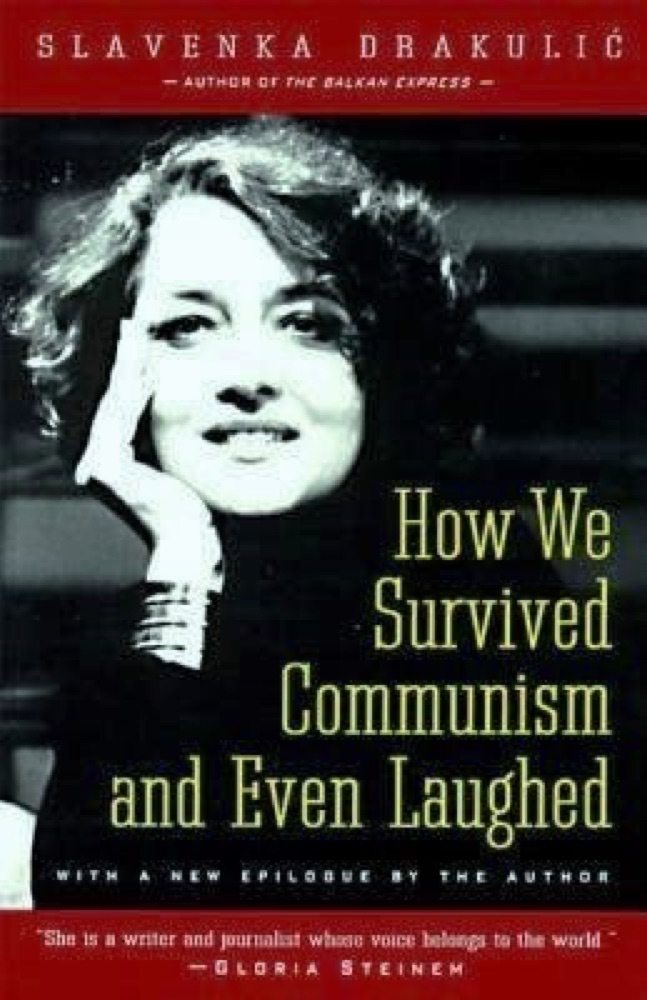

 Café Europa: Life After Communism
Quotes from the Book
I realize that I only have words and that, from time to time, as I hold them in my arms I am less lonely.
30
Why communism failed: it failed because of distrust, because of a fear for the future. Because deep down no body believed in a system that was continuously unable to provide for its life citizen's basic needs for forty years or more.
8
How is a woman to tell the story of her life and not stumble upon men?
6
It's hard to recognize discrimination when you live with it
5
Only when there is no privacy can there be total control
5
Humor is the only way to overcome depression
5
Yes I don’t like to live here,’ she said, more to herself than me. Then she turned toward me: ‘But if I have learned anything from my life, it’s that since I don’t belong anywhere, only the movement matters.
4
Every public space is like a billboard, with messages from the collective subconscious of the nation. There one can read passivity, rage indifference, fear, double standards, subversion, bad economy, a twisted definition of 'public' itself, the whole Weltanschauung - an entire range of emotions and attitudes is exposed.
4
That evening, in her apartment, still in Warsaw, Ana takes down a book from her shelf – a rather thick, ordinary paperback. It looks old, because it's worn out and somehow shabby. But it's not ordinary. I can tell by the way she handles it so carefully, like something unique. 'This is the book I told you about,' she says, holding out the Anthology of Feminist Texts, a collection of early American feminist essays, 'the only feminist book translated into the Polish language,' the only such book to turn to when you are sick and tired of reading about man-eater/man-killer feminists from the West, I think, looking at it, imagining how many women have read this one copy. 'Sometimes I feel like I live on Jupiter, among Jupiterians, and then one day, quite by chance, I discover that I belong to another species. And I discover it in this book. Isn't that wonderful.
3
Category of 'enemy' could spread to the whole nation
2
How could you forget something you never learned or had?!
2
Perhaps to them and their peers their ecological consciousness is a bigger sign of prestige than a fur coat.
1
Growing up in Eastern Europe you learn very youg that politics is not an abstract concept, but a powerful force influencing people's everyday lives.
1
Look now,' Vesna's mother continued, 'what do you know, a civil war might break out any minute: Serbs would fight with Croats, Czechs would fight with Slovaks, Hungarians would fight with Jews. how can you be sure of anything?' 'But, Mother, if this happens, then it will such big trouble that nobody would think about a shortage of pantyhose,' protested Vesna. 'You'd be surprised, my dear, to know that people have to live and survive during wars, too. Besides, how do you think we survived communism?
1
To say it's the poor quality of the paint under socialism is correct, but it is not enough. To say it's soft-coal exploitation and air pollution, bad gasoline and bad cars, or lack of money - that again would be correct. But not the whole story. All these reasons (and probably many more) are not enough to explain the decrepitude. I think the reason is in us. The cities have been killed by our decades of indifference, by our conviction that somebody else - the government, the party, those 'above' - is in charge of it. Not us. How can it be us, if we are not in charge of our own lives?
And even those who would like to believe in egalitarianism must ask themselves why we have to be equal only in poverty.
I know them, the American men (and women) of the left. Talking to them always makes me feel like the worst kind of dissident, a right-wing freak (or a Republican, at best), even if I consider myself an honest social democrat. For every mild criticism of life in the system I have been living under for the last forty years they look at me suspiciously, as if I were a CIA agent... But one can hardly blame them. It is not the knowledge about communism they lack - I am pretty sure they know all about it - it's the experience of living under such conditions. So, while I am speaking from 'within' the system itself, they are explaining it to me from without. I do not want to claim that you have to be a hen to lay an egg, only that a certain disagreement between two starting points is normal. But they don't go for that; they need to be right.
They were forced to vote for communists, as if communists needed voting for.
I wish I could have written to you about something transparent and as light as the feeling that photograph of the empty room gives me, but then I'd be sending you something else -- that would be poetry. I realize that I only have words and that, from time to time, as I hold them in my arms I am less lonely.
I wonder — this feeling of insecurity, of vulnerability, of having the carpet pulled out from under one’s feet, this fear in the face of the desired but unknown — is this the price that we have to pay to reach towards a future that is constantly escaping us?
Watch on YouTube
About Slavenka Drakulić
We have collected 29 quotes from 2 books by Slavenka Drakulić on BookQuoters.
More about the author →More by Slavenka Drakulić
Café Europa: Life After Communism
About the book
Hailed by feminists and scholars as one of the most important contributions to women's studies in recent decades, Slavenka Drakulic’s gripping, beautifully written account—newly reissued in paperback—describes the daily struggles of women under the Marxist regime in the former republic of Yugoslavia.
In this provocative, acutely observed essay collection, renowned journalist, novelist, and non-fiction writer Slavenka Drakulic writes with wit and heart about her experiences under communism—as well as those of other Eastern Europeans, primarily women, who lived and suffered behind the Iron Curtain. A portrayal of the reality behind the rhetoric, her essays also chronicle the consequences of these regimes: The Berlin Wall may have fallen, but ideology cannot be dismantled so quickly, and a lifetime lived in fear cannot be so easily forgotten.Many of the pieces focus on the intense connec
Book details
- First published
- 1991
- Author
- Slavenka Drakulić
- Genre
- Nonfiction
- Goodreads rating
- 4.14 (6k ratings)
Keep reading
 Free: A Child and a Country at the End of History
 Secondhand Time: The Last of the Soviets
 A Woman in Berlin: Eight Weeks in the Conquered City: A Diary
 Old Babes in the Wood: Stories
 Stasiland: Stories from Behind the Berlin Wall
 My Life on the Road
 This Bridge Called My Back: Writings by Radical Women of Color
 Things I've Been Silent About
Café Europa: Life After Communism
Things I've Been Silent About
Café Europa: Life After Communism
 Close to the Knives: A Memoir of Disintegration
 In Search of Our Mothers' Gardens: Womanist Prose
 Dream Count
 The Girl Who Smiled Beads: A Story of War and What Comes After
 Too Much Happiness: Stories
 Skin: Talking About Sex, Class And Literature
 Opinions: A Decade of Arguments, Criticism, and Minding Other People’s Business
 Sister Outsider: Essays and Speeches
 We Have Always Been Here: A Queer Muslim Memoir
 The City in the Middle of the Night
 A Long, Long Time Ago and Essentially True
 The Empusium
 Little Failure: A Memoir
 I Must Betray You
 How Long 'til Black Future Month?
 The Tsar of Love and Techno
 A Woman Is No Man
 Open City
 Sixty Stories
 Underground: The Tokyo Gas Attack and the Japanese Psyche
 The Golden Notebook
 Drive Your Plow Over the Bones of the Dead
 The Source of Self-Regard: Selected Essays, Speeches, and Meditations
 Of Women and Salt
 The Committed
 The House of Hidden Meanings
 Creation Lake
 Notes from No Man's Land
 The Story of the Lost Child
 The Women's Room
 Blackfish City
 In Order to Live: A North Korean Girl's Journey to Freedom
 My Government Means to Kill Me
 How to Stay Sane in an Age of Division
 When Women Were Dragons
 A Promised Land
 Revolution
 The Hearing Trumpet
 Earthlings
 The Handmaid's Tale
 The Lives of Others
 No One Is Talking About This
 Trust
Trust
 Wide Awake
 Out of Oz
 You Can't Be Neutral on a Moving Train: A Personal History of Our Times
 The Fall of Babel
 The Eighth Life
 The Message
 A People's Future of the United States: Speculative Fiction from 25 Extraordinary Writers
 Assata: An Autobiography