
 A Mathematician's Apology
Quotes from the Book
They must be true because, if they were not true, no one would have the imagination to invent them.
15
Sometimes in studying Ramanujan's work, [George Andrews] said at another time, "I have wondered how much Ramanujan could have done if he had had MACSYMA or SCRATCHPAD or some other symbolic algebra package.
8
But what Ramanujan wanted more, more than anything, was simply the freedom to do as he wished, to be left alone to think, to dream, to create, to lose himself in a world of his own making.
6
Plenty of mathematicians, Hardy knew, could follow a step-by-step discursus unflaggingly—yet counted for nothing beside Ramanujan. Years later, he would contrive an informal scale of natural mathematical ability on which he assigned himself a 25 and Littlewood a 30. To David Hilbert, the most eminent mathematician of the day, he assigned an 80. To Ramanujan he gave 100.
5
Don’t be so easy on yourself, it said.
4
His academic failure forced him to develop unconventionally, free of the social straightjacket that might have constrained his progress to well-worn paths.
3
Ramanujan’s refrain was always the same—that his parents had made him marry, that now he needed a job, that he had no degree but that he’d been conducting mathematical researches on his own. And here … well, why didn’t the good sir just examine his notebooks. His notebooks were his sole credential in a society where, even more than in the West, credentials mattered; where academic degrees usually appeared on letterheads and were mentioned as part of any introduction; where, when they were not, you’d take care to slip them into the conversation. “Like regiments we have to carry our drums, and tambourinage is as essential a thing to the march of our careers as it is to the march of soldiers in the West,” Indian novelist and critic Nirad C. Chaudhuri has written of his countrymen’s bent for self-promotion. “In our society, a man is always what his designation makes him.” Ramanujan’s only designations were unemployed, and flunk-out. Without his B.A., one prominent mathematics professor told him straight out, he would simply never amount to anything.
3
In the West, there was an old debate as to whether mathematical reality was made by mathematicians or, existing independently, was merely discovered by them. Ramanujan was squarely in the latter camp; for him, numbers and their mathematical relationships fairly threw off clues to how the universe fit together. Each new theorem was one more piece of the Infinite unfathomed. So he wasn’t being silly, or sly, or cute when later he told a friend, “An equation for me has no meaning unless it expresses a thought of God.
3
Ramanujan was not the first foreigner to retreat into his shell in a new country; indeed, his was the typical response, not the exceptional one. One later study of Asian and African students in Britain observed that a sense of exclusion “from the life of the community … constituted one of the most serious problems with which they were confronted … [and had] a serious psychological effect” upon them. Another study, this time of Indian students in particular, reported that while 83 percent of them saw friends more or less every day back in India, just 17 percent did while in England.
3
A pure mathematician must leave to happier colleagues the great task of alleviating the sufferings of humanity.
2
The Riemann zeta function was a simple enough looking infinite series expressed in terms of a complex variable. Here, “complex” means not difficult or complicated, but refers to a variable of two distinct components, “real” and “imaginary,” which together could be thought to range over a two-dimensional plane. In 1860, Georg Friedrich Bernhard Riemann made six conjectures concerning the zeta function. By Ramanujan’s time, five had been proven. One, enshrined today as the Riemann hypothesis, had not
1
He received no guidance, no stimulation, no money beyond the few rupees he made from tutoring. But for all the economic deadweight he represented, his family apparently discouraged him little- not enough, in any case, to stop him.
Viewed one way, then, for at least five years between 1904 and 1909, Ramanujan floundered- mostly out of school, without a degree, without contact with other mathematicians. And yet, was the cup half-empty or half-full?
Ramanujan had lost all his scholarships. He had failed in school. Even as a tutor of the subject he loved most, he'd been found wanting. He had nothing. And yet, viewed a little differently, he had everything. For now there was nothing to distract him from his notebooks- notebooks, crammed with theorems, that each day, each week, bulged wider.
Then, too, it seems certain, in light of future events, simple racism was a factor; Ramanujan, after all, was a black man.
The cards are stacked, against any original mind, and perhaps properly so.
Watch on YouTube
About Robert Kanigel
We have collected 16 quotes from 1 book by Robert Kanigel on BookQuoters.
More about the author →About the book
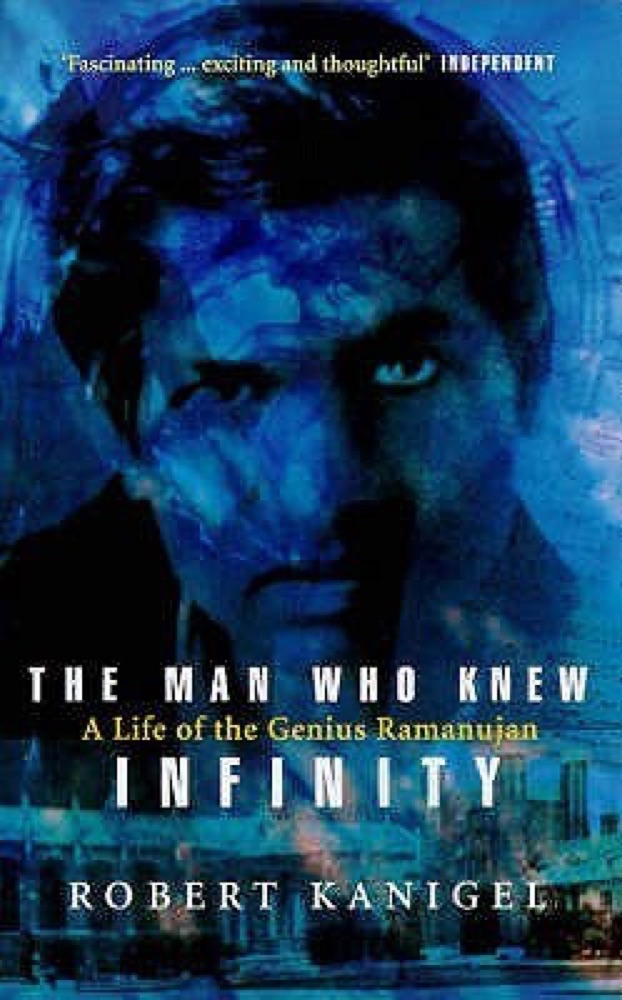
In 1913, a young unschooled Indian clerk wrote a letter to G H Hardy, begging the pre-eminent English mathematician's opinion on several ideas he had about numbers. Realising the letter was the work of a genius, Hardy arranged for Srinivasa Ramanujan to come to England. Thus began one of the most improbable and productive collaborations ever chronicled. With a passion for rich and evocative detail, Robert Kanigel takes us from the temples and slums of Madras to the courts and chapels of Cambridge University, where the devout Hindu Ramanujan, 'the Prince of Intuition,' tested his brilliant theories alongside the sophisticated and eccentric Hardy, 'the Apostle of Proof'. In time, Ramanujan's creative intensity took its he died at the age of thirty-two and left behind a magical and inspired legacy that is still being plumbed for its secrets today.
Book details
- First published
- 1991
- Author
- Robert Kanigel
- Genre
- Biography
- Goodreads rating
- 4.04 (9k ratings)
Keep reading
A Mathematician's Apology
 The Housekeeper and the Professor
 The Education of Henry Adams
 Beneath the Wheel
 A Beautiful Mind
 In the Light of What We Know
 Genius: The Life and Science of Richard Feynman
 The Man Without Qualities
 The Golden Ratio: The Story of Phi, the World's Most Astonishing Number
 Fermat's Enigma: The Epic Quest to Solve the World's Greatest Mathematical Problem
 Second Foundation
 The Man Who Counted: A Collection of Mathematical Adventures
 Hard Times
 The Cyberiad
 A Study in Scarlet
 A Mathematician's Lament: How School Cheats Us Out of Our Most Fascinating and Imaginative Art Form
 The Purloined Letter
 The Essays of Ralph Waldo Emerson
 The Last Samurai
 Solar
Solar
 The Great Mistake
 The Eternal Wonder
 Quicksilver
 A Suitable Boy
 Einstein: His Life and Universe
 Sherlock Holmes
 Walden & Civil Disobedience
 The Blue Flower
 The Watchmaker of Filigree Street
 The Making of the Atomic Bomb
 Songs of Distant Earth
 Rama II
 The Upright Thinkers: The Human Journey from Living in Trees to Understanding the Cosmos
 Prelude to Foundation
 Ragtime
 The Devotion of Suspect X
 Rendezvous with Rama
 The Spinoza Problem
 Meetings With Remarkable Men
 The Ascent of Man
 Call for the Dead
 An Instance of the Fingerpost
 The Short and Tragic Life of Robert Peace: A Brilliant Young Man Who Left Newark for the Ivy League
 Bend Sinister
 The Secret Agent
 4 3 2 1
 J
J
 The Towers of Silence
 American Prometheus: The Triumph and Tragedy of J. Robert Oppenheimer
 A Connecticut Yankee in King Arthur's Court
 Metaphysics
 A History of Western Philosophy
 The Mysterious Mr. Quin
 The Art of Fielding
 36 Arguments for the Existence of God: A Work of Fiction
 The Professor's House
 The Map of Time
 Emile or On Education
 The Geography of Genius: A Search for the World's Most Creative Places from Ancient Athens to Silicon Valley
 The Autobiography of Bertrand Russell