
 Pachinko
Quotes from the Book
There are two kinds of opportunities: one which we chance upon, the other which we create.
14
Japan likewise put her hopes of victory on a different basis from that prevalent in the United States. (...) Even when she was winning, her civilian statesmen, her High Command, and her soldiers repeated that this was no contest between armaments; it was pitting of our faith in things against their faith in spirit.
3
The hero we sympathize with because he is in love or cherishes some personal ambition, they condemn as weak because he has allowed these feelings to come between him and his gimu or his giri.
2
the Japanese love the theme. They play up suicide as Americans play up crime and they have the same vicarious enjoyment of it. They choose to dwell on events of self-destruction instead of on destruction of others.
2
Such men will never know the added love of their culture which comes from a knowledge of other ways of life.
2
Americans gear all their living to a constantly challenging world and are prepared to accept the challenge. Japanese reassurances are based rather on a way of life that is planned and charted beforehand and where the greatest threat comes from the unforeseen. The Japanese, more than any other sovereign nation, have been conditioned to a world where the smallest details of conduct are mapped and status is assigned. During two centuries where law and order were maintained in such a world with an iron hand, the Japanese learned to identify this meticulously plotted hierarchy with safety and security. So long as they stayed within known boundaries and so long as they fulfilled known obligations, they could trust their world. The Japanese point of view is that obeying the law is repayment upon their highest indebtedness. In spite of the fact that Japan is one of the great Buddhist nations in the world, her ethics at this point contrast sharply with the teachings of Gautama Buddha and of the holy books of Buddhism. The Japanese do not condemn self-gratification. They are not Puritans. They consider physical pleasures good and worthy of cultivation. Buddhist teachers and modern nationalistic leaders have written and spoken on this theme: human nature in Japan is naturally good and to be trusted. It does not need to flight and evil half of itself. It needs to cleanse the windows of its soul and act with appropriateness on every different occasion. The Japanese define the supreme task of life as fulfilling one's obligations. They fully accept the fact that repaying "on" means sacrificing one's personal desires and pleasures. The idea that the pursuit of happiness is a serious goal of life is to them an amazing and immoral doctrine. Happiness is a relaxation in which one indulges when one can. Zen seeks only the light man can find in himself. if you do this, if you do that, the adults say to the children, the word will laugh at you. The rules are particularistic and situational and a great many of them concern what we should call etiquette. They require subordinating one's own will to the ever-increasing duties to neighbors, to family and country. The child must restrain himself, he must recognize his indebtedness. Training is explicit for every art and skill. It is the habit that is taught, not just the rules. Adults do not consider that children will "pick up" the proper habits when the time to employ them comes around. Great things can only be achieved through self-restraint. Japanese people often keep their thoughts busy with trivial minutiae in order to stave off awareness of their real feelings. They are mechanical in the performance of a disciplined routine which is fundamentally meaningless to them. Japan's real strength which she can use in remaking herself into a peaceful nation lies in her ability to say to a course of action: "that failed" and then to throw her energies into other channels. The Japanese have an ethic of alternatives.
1
Shame cultures therefore do not provide for confessions, even to the gods. They have ceremonies for good luck rather than for expiation.
1
A moral code was good for the Chinese whose inferior natures required such artificial means of restraint.
1
For in Japan the constant goal is honor. It is necessary to command respect. The means one uses to that end are tools one takes up and then lays aside as circumstances dictate.
1
It would be truer to say that the citizens’ self-respect, in the two countries, is tied up with different attitudes; in our country it depends on his management of his own affairs and in Japan it depends on repaying what he owes to accredited benefactors.
1
The heavier our bodies, the higher our will, our spirit, rises above them.' 'The wearier we are, the more splendid the training.
1
Systemic study of national differences requires a certain generosity as well as tough-mindedness. The study of comparative religions has flourished only when men are secure enough in their own convictions to be unusually generous. They might be Jesuits or Arabic savants or unbelievers, but they could not be zealots. The study of comparative cultures too cannot flourish when men are so defensive about their own way of life that it appears to them to be by definition the sole solution in the world. Such men will never know the added love of their own culture which comes from a knowledge of other ways of life. They cut themselves off from a pleasant and enriching experience.
You owed him absolute obedience because you were Japanese.
The Japanese, she argues, are unusually sensitive to the opinion of others. Shame comes from not living up to social obligations. You can feel guilty about a crime that goes unnoticed. Shame depends on the observation of others.
One can hardly find elsewhere than in Japan techniques of mysticism pursued without the reward of the consummating mystic experience and appropriated by warriors to train them for hand-to-hand combat.
Their suffering is no judgment of God upon them. It shows that they fulfilled their duty at all costs and allowed nothing—not abandonment or sickness or death—to divert them from the true path.
The Japanese have always been extremely explicit in denying that virtue consists in fighting evil.
The typical Japanese swing of mood is from intense dedication to intense boredom,
Watch on YouTube
About Ruth Benedict
We have collected 18 quotes from 1 book by Ruth Benedict on BookQuoters.
More about the author →About the book
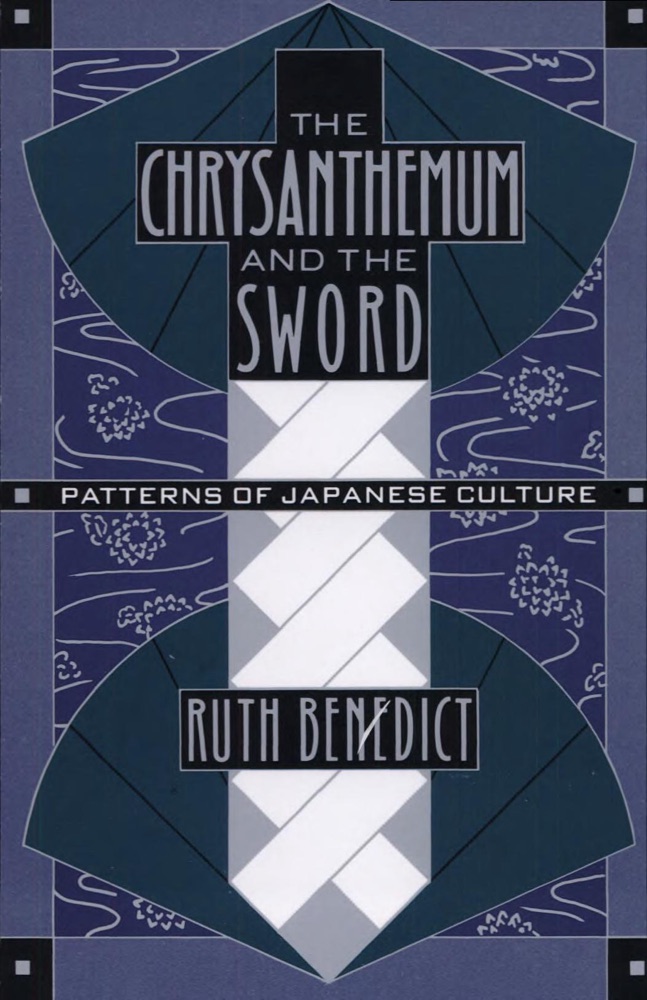
A recognized classic of cultural anthropology, this book explores the political, religious, and economic life of Japan from the seventh century through the mid-twentieth, as well as personal family life.
Book details
- First published
- 1946
- Author
- Ruth Benedict
- Genre
- Nonfiction
- Goodreads rating
- 3.85 (4k ratings)
Keep reading
Pachinko
 Facing the Mountain: A True Story of Japanese American Heroes in World War II
 The Immortals of Meluha
 Hagakure: The Book of the Samurai
 Shibumi
 Persian Letters
 Shōgun
 American Shaolin: Flying Kicks, Buddhist Monks, and the Legend of Iron Crotch: An Odyssey in the New China
 The Wall of Storms
 Cloud of Sparrows
 Musashi
 An Artist of the Floating World
 Our Oriental Heritage
 The Grace of Kings
 The Discovery of India
 Audition
 Human, All Too Human
 Heavenly Tyrant
 From Dawn to Decadence: 500 Years of Western Cultural Life, 1500 to the Present
 Blue Bamboo: Japanese Tales of Fantasy
 The Will to Power
 Sacred Hunger
 The Difficulty of Being Good: On the Subtle Art of Dharma
 History of the Peloponnesian War
 Villa Incognito
 Hawaii
 Civilization and Its Discontents
 Cuckold
 The Story of My Experiments With Truth
 The Jewel in the Crown
 Aphorisms on Love and Hate
 Taiko: An Epic Novel of War and Glory in Feudal Japan
 Dave Barry Does Japan
 Speaking Bones
 River of Smoke
 Upheaval: Turning Points for Nations in Crisis
 Underground: The Tokyo Gas Attack and the Japanese Psyche
 The Fresco
 Anthills of the Savannah
 Noli Me Tángere
 Twelve Steps to a Compassionate Life
 The Shadow of Kyoshi
 The Fire Next Time
 Moribito: Guardian of the Spirit
 The Volcano Lover: A Romance
 The Argumentative Indian: Writings on Indian History, Culture and Identity
 Scion of Ikshvaku
 The Autobiography of Eleanor Roosevelt
 The Buddha in the Attic
 Confessions of a Mask
 The Varieties of Religious Experience
 They Called Us Enemy
 And Then
 A History of the World in 100 Objects
 Shadow of the Hegemon
 Ravelstein
 The Fall of Babel
 The Better Angels of Our Nature: Why Violence Has Declined
 Heretics
 Following the Equator: A Journey Around the World