
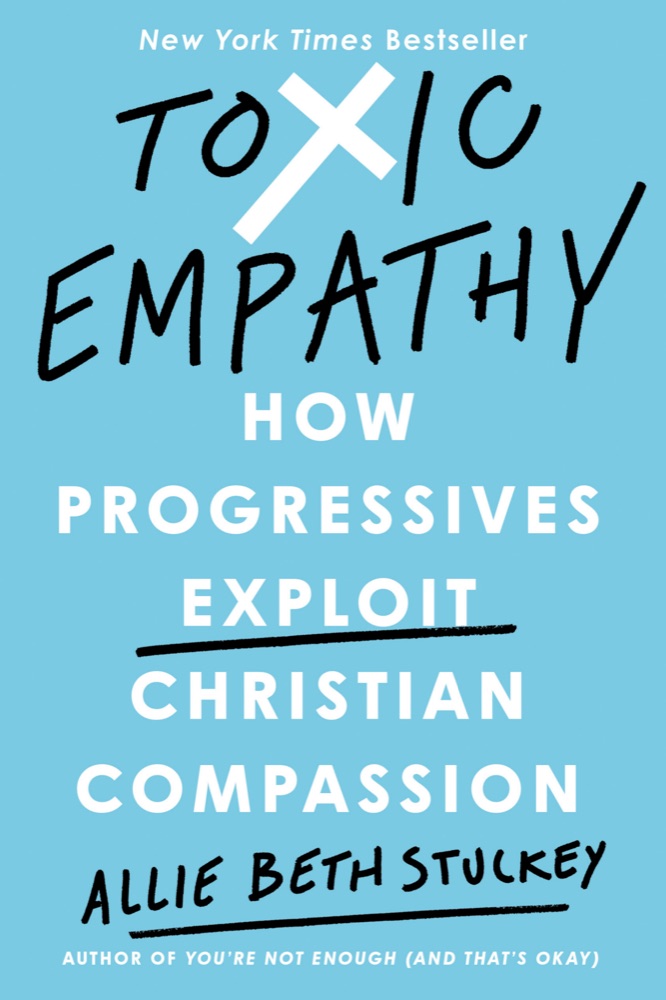
 Toxic Empathy: How Progressives Exploit Christian Compassion
Quotes from the Book
If the self is the source of our depression or despair or insecurity or fear, it can’t also be the source of our ultimate fulfillment.
21
When we follow Christ, we are never at risk of "losing ourselves," because our identity is eternally found in him.
12
Social justice is concerned not with equality of opportunity but equality of outcomes. In order to achieve this, it must hold back those who are ahead and push forward those who are behind. Equality of outcome is NEVER possible without government force." -p. 86
7
But if we were really enough as is, we wouldn’t have to try so hard to convince ourselves it’s true.
7
We’ve spent our lives prioritizing ourselves, our wants, and our happiness, and, guess what. We’re still not happy. So how in the world could it be that self-love is the answer to our problems when there’s no evidence whatsoever that we’ve ever stopped loving ourselves?
4
God instructs us to view them: as a heritage for which we should be grateful rather than obligations we dread (Psalm 127:3). That doesn’t mean we can’t say when it’s hard and ask for help—we should, absolutely. But our prevailing message to the world about motherhood should be one of gratitude, not grumbling. In a culture of self-love that’s convincing women that they need to love themselves before they can love other people, our cheerfulness as moms tells a different story: that there is joy in pouring yourself out, even when you don’t feel filled up. That sacrifice is worth it. That even though we’re not enough, that’s okay because God is.
3
That’s why I think how we talk about motherhood, how we think about motherhood, and how we act as mothers matters. Motherhood is hard, but it is good. It’s a gift that we have the privilege of stewarding. As much as we can, our attitudes should reflect that, especially when we’re talking about being a mom to other people. Avoid toxic online mom culture that calls kids and toddlers brats and burdens. It may be sarcasm, but it has an effect on how people see parenting and family. Let Christian moms be the first ones to say: “No, as hard as this is, my baby is a blessing, not a burden.
3
The culture of self-love tells us life’s too short to stay in a marriage that doesn’t make us happy. As a post on the self-love account @femalecollective argues: “Reminder: relationships are supposed to make you feel good.” That logic makes sense only if the self is the highest priority. But if everyone really thought that way, we’d all end up alone.
3
While self-love depletes, God's love for us doesn't. He showed us His love by sending Jesus to die for our sins so that we could be forgiven and live forever with Him. Self-love is superficial and temporary. God's love is profound and eternal.
3
Maybe we’re unfulfilled, lonely, and purposeless because we love ourselves way too much. Yes, many of us struggle with insecurities and even self-loathing. But these are just other indicators of self-obsession. Even when we don’t like ourselves, our perpetual prioritization of our wants, needs, problems, and dreams above all else proves that we still love ourselves a whole lot.
2
This makes sense in light of what we know about many in our generation, considering how little sacrifice is required by pets in comparison to babies. Not only do they require less supervision, they also demand nothing of us emotionally. We don’t have to let go of our bad habits and hang-ups. We don’t have to mature. We don’t have to learn how to communicate effectively or set a good example for them. If we’re consumed by the culture of self-love and committed to worshipping the god of self, we don’t want to be put off by the demands of a child.
2
The yoke of the god of self is difficult and its burden heavy, but God's yoke is easy and his burden light. What a relief to know we don't have to expend our precious energy serving ourselves. We make terrible, unworthy gods.
2
This is an argument I made in a podcast episode titled "Three Myths Christian Women Believe". The first myth was that you are enough. My counter was this: you're not enough, you'll never be enough, and that's okay, because God is.
2
You—your talents, your goal-reaching abilities, your dreams—still aren’t enough. If your plan is to make your success you identity, you’ll end up empty. Maybe your dreams have nothing to do with a job. Maybe your dream is to be a wife and mom. While these responsibilities matter immensely and will bring you joy, even these can’t fill you completely. No person and no role can replace the longing our Creator alone can meet. God made us for Him, not the other way around.
1
The solutions to our problems and pain aren’t found in self-love, but in God’s love.
1
we were enough, we wouldn’t need Jesus to do these things for us, but we do. Without him we’re hopeless, purposeless, and dead in our sin.
1
A good question to ask when listening to preachers is: Is he providing context and pointing us to Christ, or is he extracting verses to fit a predetermined message and pointing us to ourselves?
1
I never could have guessed that the love we felt the second our baby came into the world would be so all consuming. While our pets are still well cared for, their significance to us doesn’t come within light-years of our love for our daughter. And that’s how it should be. Humans, especially our humans, should be more valuable to us than animals. Not only because people are uniquely made in God’s image, but also because he made us to need human relationships—intimate family relationships—not just companionship with our pets. Christians have an obligation to demonstrate to the world the special value of human beings and specifically of children.
1
The key context of this passage is that at this point in history, Jews and Samaritans hated each other. That means the love demonstrated by the Samaritan isn’t one of admiration, it’s one of determination. It’s the kind of love we would naturally show to ourselves even when we look in the mirror and don’t like what we see. It’s one defined by kindness, protection, and preservation. As C. S. Lewis says, “Love is not an affectionate feeling, but a steady wish for the loved person’s good as far as it can be obtained.
1
In Mere Christianity, C. S. Lewis argues for the existence of a universal moral law that all human beings, regardless of culture, inherently aim to follow. Without it, we have no right to feel outrage toward horrors like slavery or the Holocaust. But we do. That’s because there is a sense of morality embedded in each of us, given to us by a Moral Lawgiver. Without a Moral Lawgiver, there is no moral law. With no transcendent moral law or lawgiver, we are all our own gods, and no one can say who’s right and who’s wrong. This puts our lives into a tailspin of chaos.
1
Most of us have been the centers of our own universe for as long as we can remember. Our most prized possessions all have the letter i in front of their names. We’re the generations of “about me” sections, personal profiles, and selfies. We are well acquainted with instant gratification, and we’ve come to expect the ability to personalize our experiences. We are keenly focused on ourselves and our needs. We spend hours studying our signs and personality types in an effort to gain the self-understanding we hope will bring us guidance and inner peace.
1
When our reason behind our rest is to ensure better service to the Lord and to others, we don’t have to worry whether or not taking needed breaks is self-centered. It’s not.
1
This is the key difference between social justice and actual justice: the former deals in perception; the latter deals in proof." -p. 87
1
The self isn't enough---period. The answer to the purposelessness and hollowness we feel is found not in us but outside of us. The solutions to our problems and pain aren't found in self-love, but in God's love.
1
Because the self can't be both the problem and the solution.
1
Contradicting everything our culture tells us, it turns out the prerequisite for real love is self-forgetfulness, not self-love.
So instead of focusing on what we see, we fix our gaze on what is “unseen,” because “the things that are seen are transient, but the things that are unseen are eternal” (2 Corinthians 4:18).
The only lasting joy we can find in the chaos of parenthood is in the knowledge that even the most mundane, trying moments of motherhood are meant to bring us closer to Christ. When we depend on him for strength in the midst of weakness, for peace in the midst of anxiety, for help in the midst of desperation, when we aim to mimic his unconditional love and self-sacrifice in all that we do for our families, we can rejoice knowing that our effort and exhaustion is never wasted—it’s being used for God’s glory, for our children’s good, and for our sanctification.
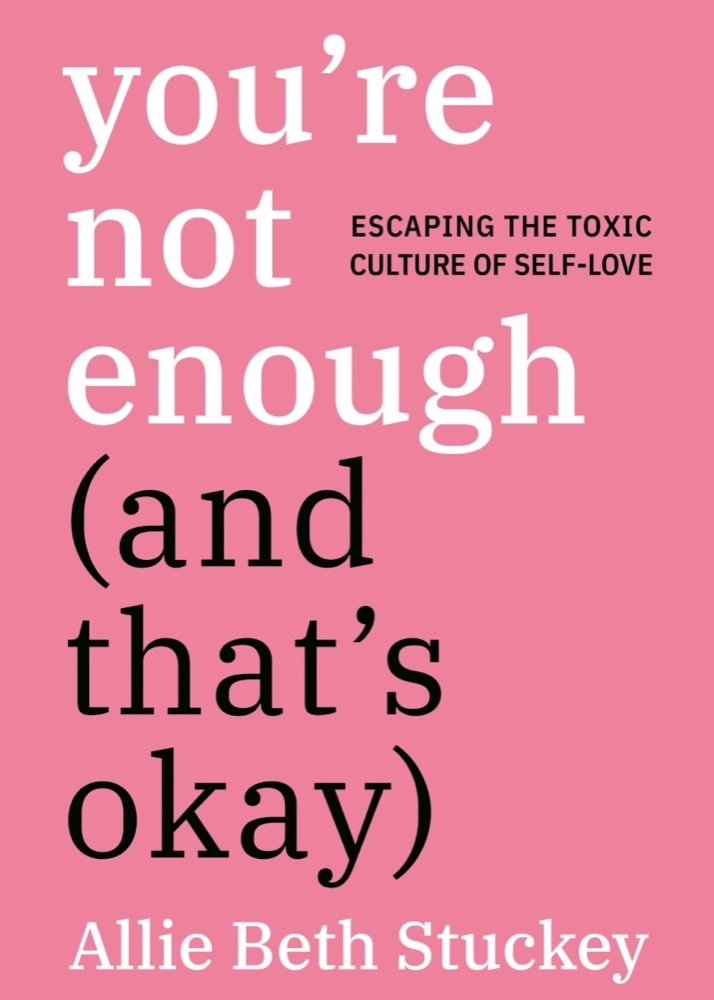
This book is about dismantling the lies the toxic culture of self-love has fed to us and replacing them with God’s truth. We’ll dig into these five myths: 1. You are enough. 2. You determine your truth. 3. You’re perfect the way you are. 4. You’re entitled to your dreams. 5. You can’t love others until you love yourself.
Watch on YouTube
About Allie Beth Stuckey
We have collected 49 quotes from 2 books by Allie Beth Stuckey on BookQuoters.
More about the author →More by Allie Beth Stuckey
Toxic Empathy: How Progressives Exploit Christian Compassion
About the book
Is your quest to love yourself more actually making you miserable?
We're told that the key to happiness is self-love. Instagram influencers, mommy bloggers, self-help gurus, and even Christian teachers promise that if we learn to love ourselves, we'll be successful, secure, and complete. But the promise doesn't deliver. Instead of feeling fulfilled, our pursuit of self-love traps us in an exhausting as we strive for self-acceptance, we become addicted to self-improvement.
The truth is we can't find satisfaction inside ourselves because we are the problem. We struggle with feelings of inadequacy because we are inadequate. Alone, we are not good enough, smart enough, or beautiful enough. We're not enough--period. And that's okay, because God is.
The answer to our insufficiency and insecurity isn't self-love, but God's love. In Jesus, we're offered a way out of our toxic culture of self-
Book details
- First published
- 2020
- Author
- Allie Beth Stuckey
- Genre
- Nonfiction
- Goodreads rating
- 4.16 (11k ratings)
Keep reading
 Jesus Over Everything: Uncomplicating the Daily Struggle to Put Jesus First
 For the Love: Fighting for Grace in a World of Impossible Standards
 Changes That Heal: How to Understand the Past to Ensure a Healthier Future
 A Return to Love: Reflections on the Principles of "A Course in Miracles"
 Of Mess and Moxie: Wrangling Delight Out of This Wild and Glorious Life
 When Strivings Cease: Replacing the Gospel of Self-Improvement with the Gospel of Life-Transforming Grace
 Tattoos on the Heart: The Power of Boundless Compassion
 Becoming Myself: Embracing God's Dream of You
 Emotionally Healthy Spirituality: Unleash A Revolution In Your Life in Christ
 Plan B: Further Thoughts on Faith
 No Man Is an Island
 Grace for the Good Girl: Letting Go of the Try-Hard Life
 Hallelujah Anyway: Rediscovering Mercy
 The Gifts of Imperfection
 Inside Out
 To Hell with the Hustle
 The Me I Want to Be: Becoming God's Best Version of You
 Waking the Dead: The Glory of a Heart Fully Alive
 Discipline: The Glad Surrender
 Humble Roots: How Humility Grounds and Nourishes Your Soul
 Rediscover Catholicism
 Who Are You Following?: Pursuing Jesus in a Social-Media Obsessed World
 The Life You've Always Wanted: Spiritual Disciplines for Ordinary People
 Almost Everything: Notes on Hope
 No Greater Love
 The Purpose Driven Life: What on Earth Am I Here for?
 Becoming More Than a Good Bible Study Girl
 The Secret Thoughts of an Unlikely Convert: An English Professor's Journey Into Christian Faith
 Jesus > Religion: Why He Is So Much Better Than Trying Harder, Doing More, and Being Good Enough
 Kitchen Table Wisdom: Stories that Heal
 Blue Like Jazz: Nonreligious Thoughts on Christian Spirituality
 Present Over Perfect: Leaving Behind Frantic for a Simpler, More Soulful Way of Living
 Carry On, Warrior: Thoughts on Life Unarmed
 Barking to the Choir: The Power of Radical Kinship
 Unglued: Making Wise Choices in the Midst of Raw Emotions
 Searching for God Knows What
 Counterfeit Gods: The Empty Promises of Money, Sex, and Power, and the Only Hope That Matters
 It's Not Supposed to Be This Way: Finding Unexpected Strength When Disappointments Leave You Shattered
 Gay Girl, Good God: The Story of Who I Was and Who God Has Always Been
 This Here Flesh: Spirituality, Liberation, and the Stories That Make Us
 Abba's Child: The Cry of the Heart for Intimate Belonging
 Living Fearless: Exchanging the Lies of the World for the Liberating Truth of God
 I Guess I Haven't Learned That Yet: Discovering New Ways of Living When the Old Ways Stop Working
 Love for Imperfect Things: How to Accept Yourself in a World Striving for Perfection
 A Long Obedience in the Same Direction: Discipleship in an Instant Society
 Shameless: A Case for Not Feeling Bad About Feeling Good
 New Morning Mercies: A Daily Gospel Devotional
 Wholehearted Faith
 Prayer in the Night: For Those Who Work or Watch or Weep
 The Book of Awakening: Having the Life You Want by Being Present to the Life You Have
 What Did You Expect?: Redeeming the Realities of Marriage
 The Mastery of Love: A Practical Guide to the Art of Relationship: A Toltec Wisdom Book
 Christ Plays in Ten Thousand Places: A Conversation in Spiritual Theology
 The Holy Longing: The Search for a Christian Spirituality
 When I Don't Desire God: How to Fight For Joy
 Wild Goose Chase: Reclaim the Adventure of Pursuing God
 When God Writes Your Love Story
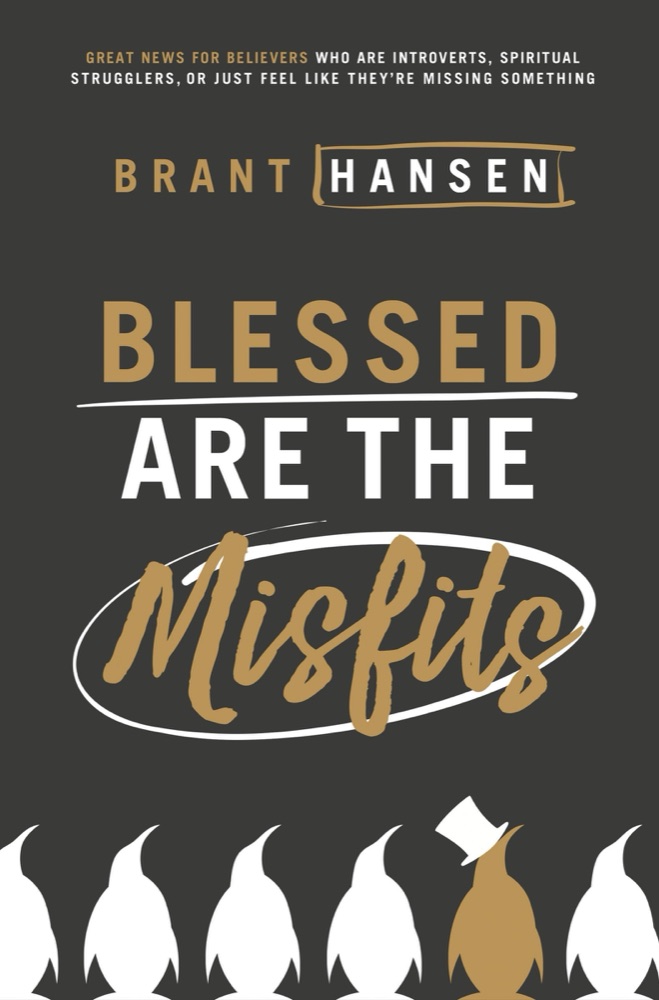 Blessed Are the Misfits: Great News for Believers who are Introverts, Spiritual Strugglers, or Just Feel Like They're Missing Something