
 You're Not Enough (and That's Ok): Escaping the Toxic Culture of Self-Love
Quotes from the Book
The erroneous conflation of love and empathy has convinced the masses that to be loving, we must feel the same way they do. Toxic empathy says we must not only share their feelings, but affirm their feelings and choices as valid, justified, and good. This confusion has not only made us a morally lost people but it’s also harmed the very people empathy-mongers claim they’re trying to help: the truly marginalized and vulnerable.
3
But it’s a toxic empathy that pushes us not only to have compassion for someone’s difficulties but to unquestioningly affirm their feelings, because, if we were in their shoes, we’d want our feelings to be affirmed. But what about when affirmation causes damage to the very people we say we’re loving? The truth is, this toxic empathy is a dangerous guide for our decisions, behavior, and public policy. What someone wants or feels can’t tell us what’s morally right or beneficial, either for the person as an individual or for society as a whole. Feelings are often misaligned with reality and can actually blind us from—rather than lead us to—wisdom.
3
Yes, Scripture does clearly and unequivocally condemn homosexuality as sin, despite baseless claims to the contrary. Leviticus 18:22, 1 Corinthians 6:9, 1 Timothy 1:10, and Romans 1:26–27 all prohibit homosexual relations and condemn them as inherently disordered. But even if these negative verses didn’t exist, the Bible’s positive definition of holy marriage and sexuality would be sufficient in telling us what Christians should believe and how we must live.
3
God’s definition of what is good and loving will almost always contradict the world’s definition, which will inevitably put us at odds with mainstream culture. While this is uncomfortable, the sacrifice is worth it. The truth can change lives.
3
That’s why empathy, even in its best form, isn’t a sufficient determinant of right and wrong, nor is it an adequate driver of policy.
2
One group that God repeatedly commands Christians to honor and uplift is the fatherless. Mistreating fatherless children was forbidden in ancient Israel (Ex. 22:22). God describes Himself as their father and defender (Deut. 10:18; Ps. 68:5). God regards advocating for the fatherless as righteous, and He condemns as wicked exploiting them (Jer. 7:6, Ps. 94:6). Children without fathers are always, without exception, categorized by Scripture as oppressed and in need of special protection.
2
EMOTIONAL LANGUAGE: Manipulative rhetoric lacks substantive, logical arguments and replaces them with demands that you feel a certain way. If you’re really loving, caring, understanding, empathetic, etc., you will buy into a particular position. Often, your rational points will be rebuffed with accusations of callousness instead of thoughtful responses. When they call you hateful, bigoted, racist, or any other epithet, it usually means they don’t know why they believe what they believe, so their insecurity manifests itself in anger.
2
Again: real love—the kind described by the God who created and is love (1 John 4:8)—always includes truth. The two are inextricably intertwined, since true love celebrates truth (1 Cor. 13:6). Christians are called to this kind of love regardless of whether we feel empathy or not. Christians love because Christ first loved us, not because we feel a certain way or have had a particular experience (1 John 4:19). That’s why empathy is different from love and why it also must be submissive to love. Putting yourself in someone’s shoes may help you feel their pain, but their pain isn’t determinative of what’s true or false, right or wrong. A person for whom you feel empathy may, in their pain, believe or demand things that are untrue, unhelpful, and even harmful. We can empathize with the pain of withdrawal for a drug addict, for example, but it would be cruel to give them the heroin they crave.
2
Actually, we’re told it’s not murder at all. It’s “planning parenthood.” It’s “reproductive freedom.” It’s “bodily autonomy.” It’s “women’s rights.” It’s not a baby that’s being killed, it’s “pregnancy termination,” the removal of a “clump of cells.” People on the side of abortion use all kinds of euphemisms, half-truths, and straight-up lies to obscure what the procedure is and does. “Baby murder” simply isn’t good PR, so sterilized, misleading, unscientific terminology is adopted to make what’s always the gruesome killing of an innocent human more palatable to the public.
1
While empathy asks us to understand their desires, toxic empathy demands that we affirm them,
1
That’s what Christians do. We share arrows with our brothers and sisters when they’re in the line of fire.
1
God’s faithfulness is proved not by the elimination of hardships but by carrying us through them. Change is not the absence of struggles; change is the freedom to choose holiness in the midst of our struggles. I realized that the ultimate issue has to be that I yearn after God in total surrender and complete obedience.
1
You are living a lie, and the path you’re on won’t give you the happiness you’re seeking. Your sin, which you think is your friend, is actually killing you. That love, purpose, and identity you’re seeking—it won’t be found in sex, alcohol, your job, your boyfriend, yourself, your gender identity, or any of that. These things can only be found in the God who created you.
1
For the Christian, empathy should never compel us to affirm that which God calls sinful or to advocate for policies that are ineffective at best and deadly at worst.
1
As we’ll see again and again
This is what I mean when I say that social justice isn't justice: justice is about a fair and impartial process, whereas social justice is about equal outcomes. Lady Justice is blind, holding equal weights, but Lady Social Justice would have open eyes, assessing the skin color, socioeconomic status, sexual orientation, and other characteristics of each party and placing her thumb on the scales accordingly, in an attempt to rectify either real or perceived, past or present injustices against one party.
This story isn’t an anomaly. This is what pro-life Christians do. They show up
Abortion isn’t health care. What other form of health care involves killing a human being? Abortion is a vicious practice, no matter when it happens and no matter how much empathy we have for mothers in tough situations.
all, someone who doesn’t follow Christ must first repent of their unbelief before they repent of anything else. That means we get to share with them who God is and what He’s done for us before we have any conversation about sexuality and identity.
like this: “Christ says, ‘Give me All. I don’t want so much of your time and so much of your money and so much of your work: I want You. I have not come to torment your natural self, but to kill it. No half-measures are any good…. Hand over the whole natural self, all the desires which you think innocent as well as the ones you think wicked—the whole outfit. I will give you a new self instead. In fact, I will give you Myself: my own will shall become yours.’
Did you know?
- The book is structured around five statements Stuckey frames as manipulative slogans, covering abortion, gender, sexuality, immigration, and social justice.
- It was published by Sentinel, a conservative-leaning imprint of Penguin Random House, on October 15, 2024.
- It is Allie Beth Stuckey's second book, following "You're Not Enough (And That's Okay)" (2020).
- Stuckey narrated the audiobook edition herself for Penguin Audio.
- The book became a New York Times bestseller and helped popularize the phrase "toxic empathy" in wider political debate.
- Stuckey discussed the book on the New York Times podcast "Interesting Times" with Ross Douthat.
Watch on YouTube
About Allie Beth Stuckey
Allie Beth Stuckey is an American conservative Christian commentator and host of the Blaze Media podcast "Relatable," where she discusses culture, politics, and theology from a conservative, Reformed perspective. A Furman University graduate, she is also the author of "You're Not Enough (And That's Okay)" (2020).
More about the author →More by Allie Beth Stuckey
You're Not Enough (and That's Ok): Escaping the Toxic Culture of Self-Love
About the book
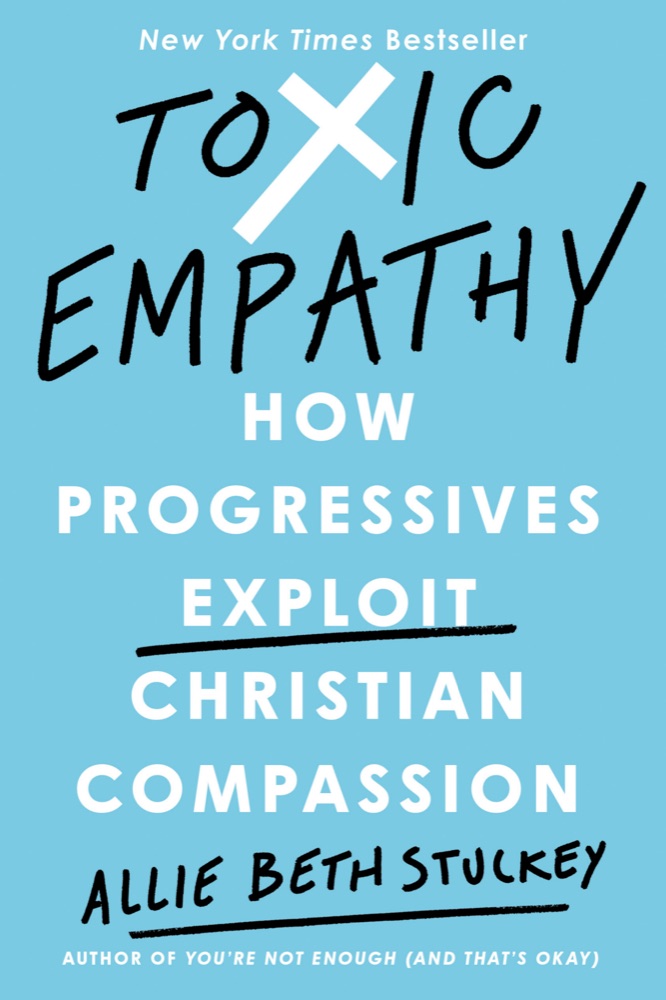
"Toxic Empathy: How Progressives Exploit Christian Compassion" is a conservative Christian polemic by podcaster and commentator Allie Beth Stuckey, published in 2024. Stuckey argues that empathy, while good in itself, can be weaponized by progressive activists to pressure people, especially Christians, into affirming positions she considers immoral or unbiblical. She organizes the book around five statements she treats as manipulative slogans: "abortion is health care," "trans women are women," "love is love," "no human is illegal," and "social justice is justice."
Each chapter typically opens with an emotionally compelling anecdote meant to elicit sympathy, then counters with what Stuckey presents as facts, logic, and Scripture. Her central theme is that Christian compassion should be "submitted to God's definitions of love, goodness, and justice" rather than to feelings alone, and that unchecked emotional appeals can lead well-meaning believers toward conclusions she regards as harmful. The book addresses hot-button cultural issues including abortion, gender identity, sexuality, immigration, and social justice.
The book became a bestseller and a flashpoint in a wider cultural debate about the role of empathy on the political right. It drew sharp criticism from progressive and mainstream commentators, who tied it to figures such as pastor Joe Rigney and public statements by Elon Musk in what several writers dubbed a "war on empathy"; outlets including Salon, The Conversation, and The Revealer engaged the book and its central concept critically. Stuckey also discussed the book in interviews, including a New York Times "Interesting Times" episode with Ross Douthat.
Book details
- First published
- 2024
- Length
- 224 pages
- Reading time
- 1 hour
- Author
- Allie Beth Stuckey
- Genre
- Nonfiction
- Goodreads rating
- 4.32 (7k ratings)
Critical reception
- The book became a New York Times bestseller and was widely discussed as part of a broader debate about empathy on the American right.
- Conservative and Christian reviewers praised it as well-researched and articulate in defending its positions.
- Progressive and mainstream commentators sharply criticized the book, with writers in outlets such as Salon and The Conversation arguing it rationalizes indifference to suffering.
- Its central concept was linked by critics to a wider "war on empathy" involving figures like Joe Rigney and public remarks by Elon Musk.
The buzz
- SalonMAGA's war on empathy was started by a woman2025Amanda Marcotte on how Stuckey packages anti-empathy arguments
- The ConversationMAGA's 'war on empathy' might not be original, but it is dangerous2025Academic critique placing the book in a longer intellectual history
- The RevealerWhat We Can Learn from the Right's Attack On "Toxic Empathy"2025Religion-and-culture essay using the book as its central case study
Keep reading
 Compassion (&) Conviction: The AND Campaign's Guide to Faithful Civic Engagement
 Shameless: A Case for Not Feeling Bad About Feeling Good
 Of Mess and Moxie: Wrangling Delight Out of This Wild and Glorious Life
 The Prodigal God: Recovering the Heart of the Christian Faith
 The Bait Of Satan: Living Free from the Deadly Trap of Offense
 Building a Bridge: How the Catholic Church and the LGBT Community Can Enter into a Relationship of Respect, Compassion, and Sensitivity
 Tattoos on the Heart: The Power of Boundless Compassion
 Jesus Over Everything: Uncomplicating the Daily Struggle to Put Jesus First
 For the Love: Fighting for Grace in a World of Impossible Standards
 The Irresistible Revolution: Living as an Ordinary Radical
 Just Like Jesus: Learning to Have a Heart Like His
 Searching for God Knows What
 The Reason for God: Belief in an Age of Skepticism
 The Secret Thoughts of an Unlikely Convert: An English Professor's Journey Into Christian Faith
 Tactics: A Game Plan for Discussing Your Christian Convictions
 Jesus > Religion: Why He Is So Much Better Than Trying Harder, Doing More, and Being Good Enough
 Pastrix: The Cranky, Beautiful Faith of a Sinner & Saint
 The Case for Faith: A Journalist Investigates the Toughest Objections to Christianity
 The Cross of Christ
 Changes That Heal: How to Understand the Past to Ensure a Healthier Future
 Emotionally Healthy Spirituality: Unleash A Revolution In Your Life in Christ
 King's Cross: The Story of the World in the Life of Jesus
 A Year of Biblical Womanhood
 Barking to the Choir: The Power of Radical Kinship
 Ethics
 Gay Girl, Good God: The Story of Who I Was and Who God Has Always Been
 Discipline: The Glad Surrender
 Fault Lines: The Social Justice Movement and Evangelicalism's Looming Catastrophe
 The Holy Longing: The Search for a Christian Spirituality
 Amazing Grace: A Vocabulary of Faith
 Inside Out
 Love Wins Low Price CD: Love Wins Low Price CD
 Hallelujah Anyway: Rediscovering Mercy
 What Is the Bible?: How an Ancient Library of Poems, Letters, and Stories Can Transform the Way You Think and Feel About Everything
 The Name of God is Mercy
 Waking the Dead: The Glory of a Heart Fully Alive
 Letters and Papers from Prison
 Evil and the Justice of God
 Christ Plays in Ten Thousand Places: A Conversation in Spiritual Theology
 The Crucible of Doubt: Reflections On the Quest for Faith
You're Not Enough (and That's Ok): Escaping the Toxic Culture of Self-Love
The Crucible of Doubt: Reflections On the Quest for Faith
You're Not Enough (and That's Ok): Escaping the Toxic Culture of Self-Love
 Washed and Waiting: Reflections on Christian Faithfulness and Homosexuality
 Sinners in the Hands of a Loving God: The Scandalous Truth of the Very Good News
 What We Talk about When We Talk about God
 The Explicit Gospel
 The Cost of Discipleship
 Life of Christ
 Blessed Are the Misfits: Great News for Believers who are Introverts, Spiritual Strugglers, or Just Feel Like They're Missing Something
 Mere Christianity
 Gentle and Lowly: The Heart of Christ for Sinners and Sufferers
 What's So Amazing About Grace?
 In His Image: 10 Ways God Calls Us to Reflect His Character
 See No Stranger: A Memoir and Manifesto of Revolutionary Love
 Jesus Is: Find a New Way to Be Human
 A Long Obedience in the Same Direction: Discipleship in an Instant Society
 Renovation of the Heart: Putting On the Character of Christ
 Finding God in the Waves: How I Lost My Faith and Found It Again Through Science
 The Ragamuffin Gospel
 Erasing Hell: What God Said About Eternity, and the Things We've Made Up