 Steppenwolf
Quotes from the Book
For me, trees have always been the most penetrating preachers. I revere them when they live in tribes and families, in forests and groves. And even more I revere them when they stand alone. They are like lonely persons. Not like hermits who have stolen away out of some weakness, but like great, solitary men, like Beethoven and Nietzsche. In their highest boughs the world rustles, their roots rest in infinity; but they do not lose themselves there, they struggle with all the force of their lives for one thing only: to fulfil themselves according to their own laws, to build up their own form, to represent themselves. Nothing is holier, nothing is more exemplary than a beautiful, strong tree. When a tree is cut down and reveals its naked death-wound to the sun, one can read its whole history in the luminous, inscribed disk of its trunk: in the rings of its years, its scars, all the struggle, all the suffering, all the sickness, all the happiness and prosperity stand truly written, the narrow years and the luxurious years, the attacks withstood, the storms endured. And every young farmboy knows that the hardest and noblest wood has the narrowest rings, that high on the mountains and in continuing danger the most indestructible, the strongest, the ideal trees grow.
71
Trees are sanctuaries. Whoever knows how to speak to them, whoever knows how to listen to them, can learn the truth. They do not preach learning and precepts, they preach, undeterred by particulars, the ancient law of life.
70
Home is neither here nor there. Home is within you, or home is nowhere at all.
47
Rain Soft rain, summer rain Whispers from bushes, whispers from trees. Oh, how lovely and full of blessing To dream and be satisfied. I was so long in the outer brightness, I am not used to this upheaval: Being at home in my own soul, Never to be led elsewhere. I want nothing, I long for nothing, I hum gently the sounds of childhood, And I reach home astounded In the warm beauty of dreams. Heart, how torn you are, How blessed to plow down blindly, To think nothing, to know nothing, Only to breathe, only to feel.
35
A longing to wander tears my heart when I hear trees rustling in the wind at evening. If one listens to them silently for a long time, the longing reveals its kernel, its meaning. It is not so much a matter of escaping from one's suffering, though it may seem to be so. It is a longing for home, for a memory of the mother, for new metaphors for life. It leads home.
19
Like an attack this melancholy comes from time to time. I don't know at what intervals, and slowly covers my sky with clouds. It begins with an unrest in the heart, with a premonition of anxiety, probably with my dreams at night. People, houses, colors, sounds that otherwise please me become dubious and seem false. Music gives me a headache. All my mail becomes upsetting and contains hidden arrows. At such times, having to converse with people is torture and immediately leads to scenes... Anger, suffering, and complaints are directed at everything, at people, at animals, at the weather, at God, at the paper in the book one is reading, at the material of the very clothing one has on. But anger, impatience, complaints and hatred have no effect on things and are deflected from everything, back to myself.
18
I feel life trembling within me, in my tongue, on the soles of my feet, in my desire or my suffering, I want my soul to be a wandering thing, able to move back into a hundred forms, I want to dream myself into priests and wanderers, female cooks and murderers, children and animals, and, more than anything else, birds and trees; that is necessary, I want it, I need it so I can go on living, and if sometime I were to lose these possibilities and be caught in so-called reality, then I would rather die.
15
What is the world doing? Have new gods been discovered, new laws, new freedoms? Who cares! But up here a primrose is blossoming and bearing silver fuzz on its leaves, and the light sweet wind is singing below me in the poplars, and between my eyes and heaven a dark golden bee is hovering and humming—I care about that. It is humming the song of happiness, humming the song of eternity. Its song is my history of the world.
12
It would be wholly impossible for me to say whether this cloudy, silently disturbed, unraveled sky is mirrored in my soul or the reverse, whether or not I read the image of my own inner life in this sky. Sometimes everything is so completely uncertain! There are days when I am convinced that no man on earth can recognize certain moods of air and cloud, certain tones of color, certain fragrances and movements of moisture as finely, as exactly, and as truly as I can, with my old, nervous sense of poet and wanderer. And then again, as today, it can be doubtful to me whether I have seen, heard, and smelled anything after all, whether everything that I took to be true is not merely an image cast outward, the image of my inner life.
12
Thoughts and sorrows seem to have remained on the other side of the mountains. Between tormented men and hateful deeds, a person has to think and sorrow so much! Back there it is so difficult and so desperately important to find a reason for staying alive. How else should a person go on living? Sheer misery makes one profound.
9
Young woman, fresh face, I don't want to know your name. I don't want to cherish and fatten my love for you. You aren't the end of my love, but its awakening, its beginning.
8
The world has become lovelier. I am alone, and I don’t suffer from my loneliness. I don’t want life to be anything other than what it is
6
The dream of death is only the dark smoke Under which the fires of life are burning.
6
The devil has spit in the soup. Nothing comes out even. Nothing sounds right. Nothing rejoices and warms. Everything is desolate, sad, foul. All strings out of tune. All colors faded.
5
This wind, into which I am climbing, is fragrant of beyonds and distances, of watersheds and foreign languages, of mountains and southern places. It is full of promise.
4
I smile with my soul, with my eyes, with my whole skin, and I offer these countrysides, whose fragrances drift up to me, different senses than those I had before, more delicate, more silent, more finely honed, better practiced, and more grateful. Everything belongs to me more than ever before, it speaks to me more richly and with hundreds of nuances. My yearning no longer paints dreamy colors across the veiled distances, my eyes are satisfied with what exists, because they have learned to see. The world has become lovelier than before. The world has become lovelier. I am alone, and I don’t suffer from my loneliness. I don’t want life to be anything other than what it is. I am ready to let myself be baked in the sun till I am done. I am eager to ripen. I am ready to die, ready to be born again. The world has become lovelier.
2
Watch on YouTube
About Hermann Hesse
We have collected 271 quotes from 12 books by Hermann Hesse on BookQuoters.
More about the author →More by Hermann Hesse
All books by Hermann Hesse →

About the book
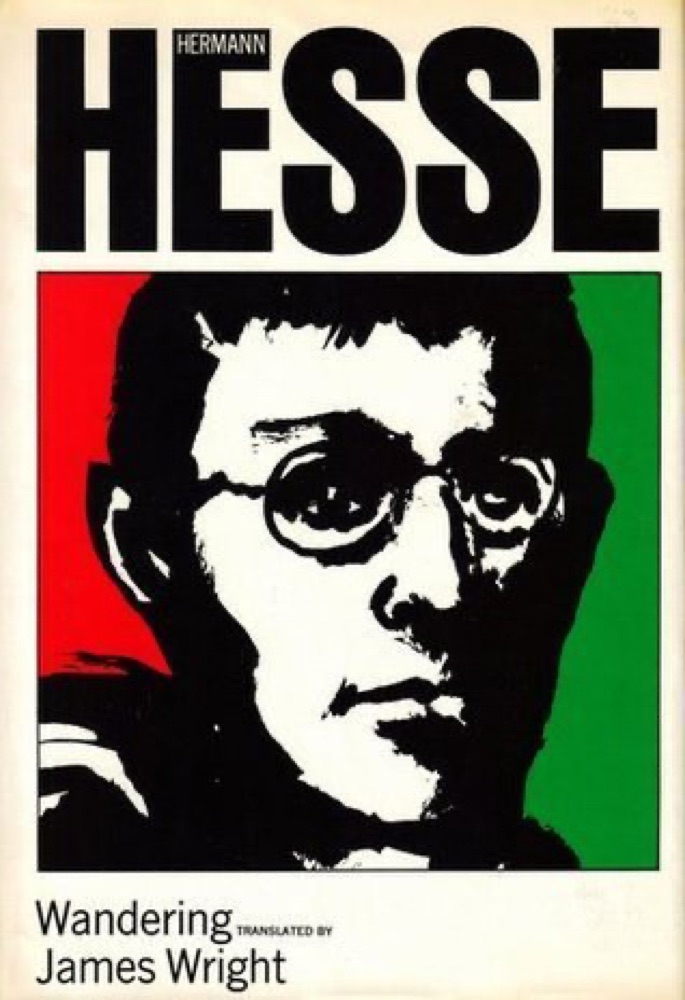
On May 2, 1919, Hesse wrote to Romain Rolland: "I have had to bear a very heavy burden in my personal life in recent years. Now I am about to go to Ticino once again, to live for a while as a hermit in nature and in my work." In 1920, after settling in the Ticino mountain village of Montagnola, he published Wandering, a love letter to this magic-garden world that can be read as a meditation on his attempt to begin a new life. His pure prose, his heartfelt lyricism, and his love for the old earth, for its blessings that renew themselves, all sing in this serene book.
The first German edition of Wandering included facsimiles of fourteen watercolor landscapes. Hesse's painting had blossomed in the southern countryside and he even toyed with the idea "that I might still succeed in escaping literature entirely and making a living at the more appealing trade of painter." Unfortunately, his
Book details
- First published
- 1920
- Author
- Hermann Hesse
- Genre
- Literature
- Goodreads rating
- 4.05 (3k ratings)
Keep reading
 New and Selected Poems, Vol. 2
 Red Bird
 Autumn
 A Thousand Mornings: Poems
 Rilke's Book of Hours: Love Poems to God
 Gitanjali
 The Three-Cornered World
 The Notebooks of Malte Laurids Brigge
 Duino Elegies
 The Soul of Rumi: A New Collection of Ecstatic Poems – Coleman Barks's Sublime Renderings of the 13th-Century Sufi Mystic's Insights into Divine Love and the Human Heart
 The Complete Poems
 Through Painted Deserts: Light, God, and Beauty on the Open Road
 Journal of a Solitude
 Poems, 1962-2012
 Wind, Sand and Stars
 Selected Stories
 The World and Other Places: Stories
 Spring Snow
 The Stream of Life
 Independent People
 Swann's Way
 Plainwater: Essays and Poetry
 You Can't Go Home Again
 The Diary of Anaïs Nin, Vol. 1: 1931-1934
 Crazy Brave
 Pilgrim at Tinker Creek
 Split Tooth
 Either/Or: A Fragment of Life
 Narcissus and Goldmund
 Gertrude
 Tropic of Capricorn
 Diaries, 1910-1923
 View with a Grain of Sand: Selected Poems
 A Breath of Life
 The Story of My Life
 Rose
Rose
 Selected Poems
 Heartwood
 A Book of Simple Living
 The Journals of Sylvia Plath
 Doctor Zhivago
 Refuge: An Unnatural History of Family and Place
 In Search of Lost Time
 How Green Was My Valley
 The Hurting Kind: Poems
 All of Us: The Collected Poems
 The Fairy Tales of Hermann Hesse
 Collected Poems
 The Seagull
 In the Heart of the Heart of the Country and Other Stories
 Light Years
 Deep Creek: Finding Hope in the High Country
 The Complete Poems of Emily Dickinson
 Just Above My Head
 Arch of Triumph
 The Tale of Genji
 Tropic of Cancer
 Killing Commendatore
 Dearly
 Phantastes