
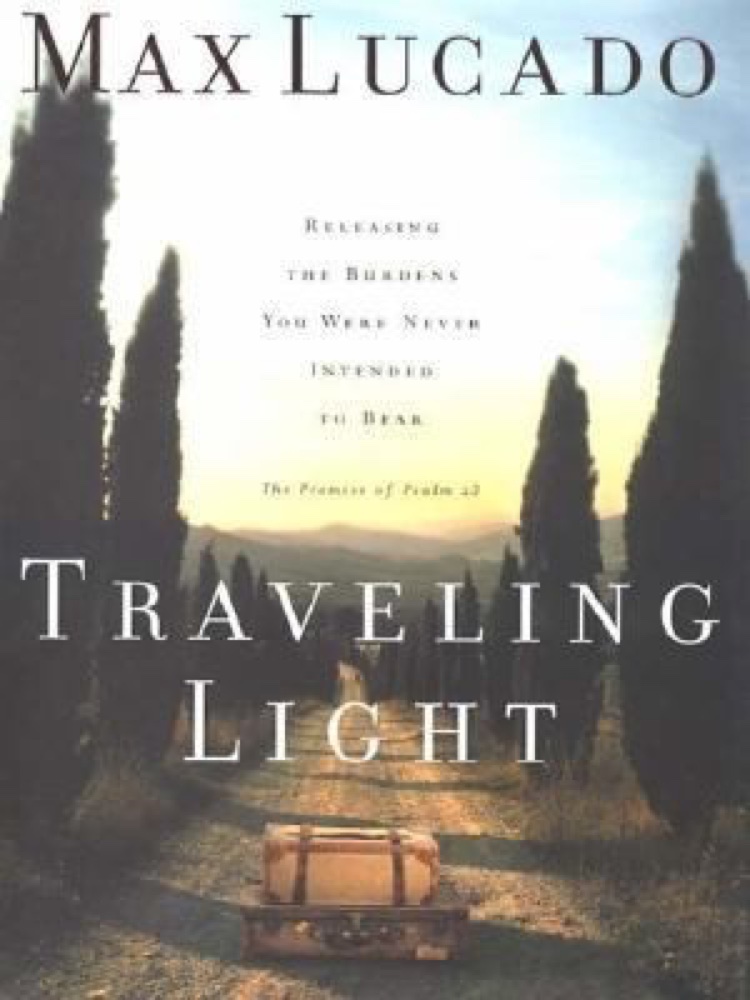
 Traveling Light: Releasing the Burdens You Were Never Intended to Bear
Quotes from the Book
When my daughter was a toddler, I used to take her to a park not far from our apartment. One day as she was playing in a sandbox, an ice-cream salesman approached us. I purchased her a treat, and when I turned to give it to her, I saw her mouth was full of sand. Where I had intended to put a delicacy, she had put dirt. Did I love her with dirt in her mouth? Absolutely. Was she any less of my daughter with dirt in her mouth? Of course not. Was I going to allow her to keep the dirt in her mouth? No way. I loved her right where she was, but I refused to leave her there. I carried her over to the water fountain and washed out her mouth. Why? Because I love her. God does the same for us. He holds us over the fountain. "Spit out the dirt, honey," our Father urges. "I've got something better for you." And so he cleanses us of filth; immorality, dishonesty, prejudice, bitterness, greed. We don't enjoy the cleansing; sometimes we even opt for the dirt over the ice cream. "I can eat dirt if I want to!" we pout and proclaim. Which is true—we can. But if we do, the loss is ours. God has a better offer.
Our Savior kneels down and gazes upon the darkest acts of our lives. But rather than recoil in horror, he reaches out in kindness and says, "I can clean that if you want." And from the basin of his grace, he scoops a palm full of mercy and washes away our sin.
God’s love never ceases. Never. Though we spurn him. Ignore him. Reject him. Despise him. Disobey him. He will not change. Our evil cannot diminish his love. Our goodness cannot increase it. Our faith does not earn it anymore than our stupidity jeopardizes it. God doesn’t love us less if we fail or more if we succeed. God’s love never ceases.1
God never promises to remove us from our struggles. He does promise, however, to change the way we look at them.
But suppose my daughters had approached me as we often approach God. “Hey, Dad, glad you’re home. Here is what I want. More toys. More candy. And can we go to Disneyland this summer?” “Whoa,” I would have wanted to say. “I’m not a waiter, and this isn’t a restaurant. I’m your father, and this is our house. Why don’t you just climb up on Daddy’s lap and let me tell you how much I love you?” Ever thought God might want to do the same with you? Oh, he wouldn’t say that to me. He wouldn’t? Then to whom was he speaking when he said, “I have loved you with an everlasting love” (Jer. 31:3 NIV)? Was he playing games when he said, “Nothing . . . will ever be able to separate us from the love of God that is in Christ” (Rom. 8:39)? Buried in the seldom-quarried mines of the minor prophets is this jewel: The LORD your God is with you; the mighty One will save you. He will rejoice over you. You will rest in his love; he will sing and be joyful about you. (Zeph. 3:17) Don’t move too quickly through that verse. Read it again and prepare yourself for a surprise. The LORD your God is with you; the mighty One will save you. He will rejoice over you. You will rest in his love; he will sing and be joyful about you. (Zeph. 3:17) Note who is active and who is passive. Who is singing, and who is resting? Who is rejoicing over his loved one, and who is being rejoiced over? We tend to think we are the singers and God is the “singee.” Most certainly that is often the case. But apparently there are times when God wishes we would just be still and (what a stunning thought!) let him sing over us. I can see you squirming. You say you aren’t worthy of such affection? Neither was Judas, but Jesus washed his feet. Neither was Peter, but Jesus fixed him breakfast. Neither were the Emmaus-bound disciples, but Jesus took time to sit at their table. Besides, who are we to determine if we are worthy? Our job is simply to be still long enough to let him have us and let him love us.
Our task is not to whitewash nor bloat the truth. Our task is to tell the truth. Period.
God wants to be as close to us as a branch is to a vine. One is an extension of the other. It’s impossible to tell where one starts and the other ends. The branch isn’t connected only at the moment of bearing fruit. The gardener doesn’t keep the branches in a box and then, on the day he wants grapes, glue them to the vine. No, the branch constantly draws nutrition from the vine. Separation means certain death.
The banishing of a leper seems harsh, unnecessary. The Ancient East hasn’t been the only culture to isolate their wounded, however. We may not build colonies or cover our mouths in their presence, but we certainly build walls and duck our eyes. And a person needn’t have leprosy to feel quarantined. One of my sadder memories involves my fourth-grade friend Jerry.1He and a half-dozen of us were an ever-present, inseparable fixture on the playground. One day I called his house to see if we could play. The phone was answered by a cursing, drunken voice telling me Jerry could not come over that day or any day. I told my friends what had happened. One of them explained that Jerry’s father was an alcoholic. I don’t know if I knew what the word meant, but I learned quickly. Jerry, the second baseman; Jerry, the kid with the red bike; Jerry, my friend on the corner was now “Jerry, the son of a drunk.” Kids can be hard, and for some reason we were hard on Jerry. He was infected. Like the leper, he suffered from a condition he didn’t create. Like the leper, he was put outside the village. The divorced know this feeling. So do the handicapped. The unemployed have felt it, as have the less educated. Some shun unmarried moms. We keep our distance from the depressed and avoid the terminally ill. We have neighborhoods for immigrants, convalescent homes for the elderly, schools for the simple, centers for the addicted, and prisons for the criminals. The rest simply try to get away from it all. Only God knows how many Jerrys are in voluntary exile—individuals living quiet, lonely lives infected by their fear of rejection and their memories of the last time they tried. They choose not to be touched at all rather than risk being hurt again.
Jesus offers unconditional grace; we are to offer unconditional grace. The mercy of Christ preceded our mistakes; our mercy must precede the mistakes of others. Those in the circle of Christ had no doubt of his love; those in our circles should have no doubts about ours. What does it mean to have a heart like his? It means to kneel as Jesus knelt, touching the grimy parts of the people we are stuck with and washing away their unkindnesses with kindness. Or as Paul wrote, “Be kind and loving to each other, and forgive each other just as God forgave you in Christ” (Eph. 4:32).
Relationships don’t thrive because the guilty are punished but because the innocent are merciful.
FACING THE MUSIC Many years ago a man conned his way into the orchestra of the emperor of China although he could not play a note. Whenever the group practiced or performed, he would hold his flute against his lips, pretending to play but not making a sound. He received a modest salary and enjoyed a comfortable living. Then one day the emperor requested a solo from each musician. The flutist got nervous. There wasn’t enough time to learn the instrument. He pretended to be sick, but the royal physician wasn’t fooled. On the day of his solo performance, the impostor took poison and killed himself. The explanation of his suicide led to a phrase that found its way into the English language: “He refused to face the music.”2 The cure for deceit is simply this: face the music. Tell the truth. Some of us are living in deceit. Some of us are walking in the shadows. The lies of Ananias and Sapphira resulted in death; so have ours. Some of us have buried a marriage, parts of a conscience, and even parts of our faith—all because we won’t tell the truth. Are you in a dilemma, wondering if you should tell the truth or not? The question to ask in such moments is, Will God bless my deceit? Will he, who hates lies, bless a strategy built on lies? Will the Lord, who loves the truth, bless the business of falsehoods? Will God honor the career of the manipulator? Will God come to the aid of the cheater? Will God bless my dishonesty? I don’t think so either. Examine your heart. Ask yourself some tough questions. Am I being completely honest with my spouse and children? Are my relationships marked by candor? What about my work or school environment? Am I honest in my dealings? Am I a trustworthy student? An honest taxpayer? A reliable witness at work? Do you tell the truth . . . always? If not, start today. Don’t wait until tomorrow. The ripple of today’s lie is tomorrow’s wave and next year’s flood. Start today. Be just like Jesus. Tell the truth, the whole truth, and nothing but the truth.
Identify your strengths, and then—this is important—major in them. Take a few irons out of the fire so this one can get hot. Failing to focus on our strengths may prevent us from accomplishing the unique tasks God has called us to do. A lighthouse keeper who worked on a rocky stretch of coastline received oil once a month to keep his light burning. Not being far from a village, he had frequent guests. One night a woman needed oil to keep her family warm. Another night a father needed oil for his lamp. Then another needed oil to lubricate a wheel. All the requests seemed legitimate, so the lighthouse keeper tried to meet them all. Toward the end of the month, however, he ran out of oil, and his lighthouse went dark, causing several ships to crash on the coastline. The man was reproved by his superiors, “You were given the oil for one reason,” they said, “to keep the light burning.”1 We cannot meet every need in the world. We cannot please every person in the world. We cannot satisfy every request in the world. But some of us try. And in the end, we run out of fuel. Have a sane estimate of your abilities and stick to them.
Imagine considering every moment as a potential time of communion with God. By the time your life is over, you will have spent six months at stoplights, eight months opening junk mail, a year and a half looking for lost stuff (double that number in my case), and a whopping five years standing in various lines.7Why don’t you give these moments to God? By giving God your whispering thoughts, the common becomes uncommon. Simple phrases such as “Thank you, Father,” “Be sovereign in this hour, O Lord,” “You are my resting place, Jesus” can turn a commute into a pilgrimage. You needn’t leave your office or kneel in your kitchen. Just pray where you are. Let the kitchen become a cathedral or the classroom a chapel. Give God your whispering thoughts.
Watch on YouTube
About Max Lucado
We have collected 178 quotes from 11 books by Max Lucado on BookQuoters.
More about the author →More by Max Lucado
Traveling Light: Releasing the Burdens You Were Never Intended to Bear
 Fearless: Imagine Your Life Without Fear
 Facing Your Giants: God Still Does the Impossible
 3:16: The Numbers of Hope
Book details
- Author
- Max Lucado
- Genre
- Nonfiction
- Goodreads rating
- 4.29 (10k ratings) →
Keep reading
 He Chose the Nails: What God Did to Win Your Heart
 Having a Mary Heart in a Martha World: Finding Intimacy with God in the Busyness of Life
 Waking the Dead: The Glory of a Heart Fully Alive
 In His Image: 10 Ways God Calls Us to Reflect His Character
 Jesus Is: Find a New Way to Be Human
 Jesus Over Everything: Uncomplicating the Daily Struggle to Put Jesus First
 The Message Remix
 My Utmost for His Highest
 Hope for the Troubled Heart: Finding God in the Midst of Pain
 Gentle and Lowly: The Heart of Christ for Sinners and Sufferers
 The Name of God is Mercy
 Tattoos on the Heart: The Power of Boundless Compassion
 Erasing Hell: What God Said About Eternity, and the Things We've Made Up
 A Long Obedience in the Same Direction: Discipleship in an Instant Society
 Grace for the Moment: Inspirational Thoughts for Each Day of the Year, Volume 1
 Encounters with Jesus: Unexpected Answers to Life's Biggest Questions
 The Ragamuffin Gospel
 Daring to Hope: Finding God's Goodness in the Broken and the Beautiful
 Moving Mountains: Praying with Passion, Confidence, and Authority
 Seeking Allah, Finding Jesus: A Devout Muslim Encounters Christianity
 The Prodigal God: Recovering the Heart of the Christian Faith
3:16: The Numbers of Hope
The Prodigal God: Recovering the Heart of the Christian Faith
3:16: The Numbers of Hope
 Pastrix: The Cranky, Beautiful Faith of a Sinner & Saint
 To Live Is Christ: Joining Paul's Journey of Faith
 The Bait Of Satan: Living Free from the Deadly Trap of Offense
 Discipline: The Glad Surrender
 The Secret Thoughts of an Unlikely Convert: An English Professor's Journey Into Christian Faith
 The Furious Longing of God
 Because He Loves Me: How Christ Transforms Our Daily Life
 For the Love: Fighting for Grace in a World of Impossible Standards
 Blessed Are the Misfits: Great News for Believers who are Introverts, Spiritual Strugglers, or Just Feel Like They're Missing Something
 I Dare You: Embrace Life with Passion
 The Explicit Gospel
 The Grand Weaver: How God Shapes Us through the Events in Our Lives
 Love Wins Low Price CD: Love Wins Low Price CD
 The Cost of Discipleship
 The Normal Christian Life
 Praying God's Word: Breaking Free From Spiritual Strongholds
 Wholehearted Faith
 40 Days of Decrease: A Different Kind of Hunger. A Different Kind of Fast.
 Praying Like Monks, Living Like Fools: An Invitation to the Wonder and Mystery of Prayer
 Life Together: The Classic Exploration of Christian Community
 What's So Amazing About Grace?
 When God Writes Your Love Story
 Believing God
 King's Cross: The Story of the World in the Life of Jesus
 New Morning Mercies: A Daily Gospel Devotional
 The Peacemaker: A Biblical Guide to Resolving Personal Conflict
 Prayer in the Night: For Those Who Work or Watch or Weep
 The Christian Atheist: Believing in God but Living As If He Doesn't Exist
 Searching for God Knows What
 Passion and Purity: Learning to Bring Your Love Life Under Christ's Control
 When Strivings Cease: Replacing the Gospel of Self-Improvement with the Gospel of Life-Transforming Grace
 The Divine Conspiracy: Rediscovering Our Hidden Life in God
 Girl Meets God
 Emotionally Healthy Spirituality: Unleash A Revolution In Your Life in Christ
 Land of Silence
 The Bible Jesus Read