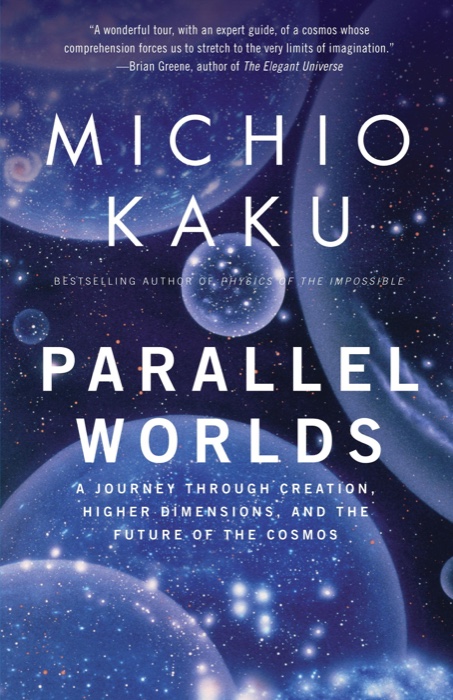
 Parallel Worlds: A Journey Through Creation, Higher Dimensions, and the Future of the Cosmos
Quotes from the Book
When left alone, quantum particles behave as multiple images of themselves (as waves, really), simultaneously moving through all possible paths in space and time. Now, again, why do we not experience this multitude around ourselves? Is it because we are probing things around us all the time? Why do all experiments that involve, say, the position of a particle make the particle suddenly be somewhere rather than everywhere? No one knows. Before you probe it, a particle is a wave of possibilities. After you've probed it, it is somewhere, and subsequently it is somewhere for ever, rather than everywhere again. Strange, that. Nothing, within the laws of quantum physics, allows for such a collapse to happen. It is an experimental mystery and a theoretical one. Quantum physics stipulates that whenever something is there, it can transform into something else, of course, but it cannot disappear. And since quantum physics allows for multiple possibilities simultaneously, these possibilities should then keep existing, even after a measurement is made. But they don't. Every possibility but one vanishes. We do not see any of the others around us. We live in a classical world, where everything is based on quantum laws but nothing resembles the quantum world.
17
A clock that is moving through space at a very fast speed does not tick at the same rate as a slow-moving watch gently attached to your wrist as you stroll on a tropical beach. The idea of a universal time - a godlike clock that could somehow sit outside our universe and measure, in one go, the movement of everything in it, how its evolution unfolds, how old it is and all that - does not exist.
9
The air around you is filled with floating atoms, sliding down the Earth's spacetime curve. Atoms first assembled in the cores of long-dead stars. Atoms within you, everywhere, disintegrating in radioactive decays. Beneath your feet, the floor - whose electrons refuse to let yours pass, thus making you able to stand and walk and run. Earth, your planet, a lump of matter made out of the three quantum fields known to mankind, held together by gravity, the so-called fourth force (even though it isn't a force), floating within and through spacetime.
7
Our image is here and will for ever stay, and there is comfort in knowing that the memory of our lives will always be there, traveling among the stars.
6
Even today, more than eighty years after Oort's bold guess, we still don't have a clue what this dark matter is made of. We know it exists. We know where it is. We have maps of its presence within and around galaxies throughout the universe. We even have stringent constraints on what it is not, but we have no clue what it is. And yes, its presence is overwhelming: for every one kilogram of ordinary matter made out of neutrons and protons and electrons, there are five kilograms of dark matter, made out of who-knows-what.
5
The very small quantum world, it seems, is a mixture of possibilities. The quantum fields to which all particles belong are the sum of these possibilities and, somehow, one possibility is chosen out of all the existing ones just by seeing it, just by the very act of detecting it, whenever one tries to probe a particle's nature. Nobody knows why or how this happens.
5
Quantum particles do not behave like tennis balls, but like the quantum particles they are. To get from one place to another, they take all the possible paths in space and time as long as these paths link their starting point to their end point. The particle [...] literally went everywhere. Simultaneously. To the left and to the right of the post. And through it. And outside the room. And into the future and back - until the moment when it hit a detector on the wall.
4
Mankind has uncovered two extremely efficient theories: one that describes our universe's structure (Einstein's gravity: the theory of general relativity), and one that describes everything our universe contains (quantum field theory), and these two theories won't talk to each other.
3
Everyone should be very grateful radioactivity exists at all. It can kill you, yes, but without it you wouldn't have been born in the first place. On Earth, deep under your feet, our planet happens to contain many atoms that do decay, all the time. Less so now than in the past, but still, Earth's mantle is radioactive. When atoms decay there, the particles they emit bump into their neighbours and generate heat, the very heat that contributes to keeping our planet warm. Without radioactivity, there would be no seismic or volcanic activity. The surface of the Earth would have been dead cold billions of yeras ago. Life as we know it would probably not exist at all.
2
Waking up in the same place in which you dozed off has never happened either to you or to anyone else. Ever. Earth does not stop moving when you sleep. Every hour that passes, Earth travels a little more than 800,000 kilometres around the centre of our galaxy. And so do you. That's the equivalent of about twenty trips around the planet. Every hour. No one minds, though, as long as their bed stays still beneath their body.
2
science, and only science, has given us eyes to see where our bodies are blind.
1
Today, according to NASA's satellite estimates it [the universe] consists of the following: Dark Energy 72%, Dark Matter 23%, the matter we know, including light, 4.6%. The total does not add up to 100% because there are always some uncertainties in the numbers obtained. Everything you've seen so far throughout your journeys correspondes to only 4.6% of the total content of our universe. The rest...is unknown.
1
To appear, particles have to borrow some energy from the quantum fields. And since those fields fill in every place in space and time, particles can literally appear anywhere, and anytime. That is the reason why there is no such thing as true emptiness, anywhere in the universe.
1
Como estás compuesto de masa, no tienes otra alternativa que estar sujeto al paso del tiempo y es imposible hacer nada al respecto. Para ser eterno, tendrías que convertirte en luz, lo cual es imposible, y, aunque lo consiguieras, el tiempo se detendría para ti, así que serías eterno pero no serías consciente de ello.
1
Todos los átomos pesados que componen la Tierra, todos los átomos necesarios para la vida, los átomos mismos que componen tu cuerpo, fueron forjados en lo más profundo de una estrella. Cuando respiras, es lo que inhalas. Cuando tocas tu piel, o la de otra persona, estás tocando polvo de estrellas. Te preguntabas antes por qué las estrellas como el Sol tienen que morir y explotar al final de su existencia, y aquí tienes la respuesta: sin esos finales, solo existiría el hidrógeno y el helio. La materia de la que estamos hechos se encontraría prisionera para siempre en el interior de estrellas eternas.
1
La ciencia no es como la política. A la naturaleza le trae bastante sin cuidado lo que opine la gente, incluso si son mayoría.
sound does not spread in the vacuum of space.
Watch on YouTube
About Christophe Galfard
We have collected 17 quotes from 1 book by Christophe Galfard on BookQuoters.
More about the author →About the book
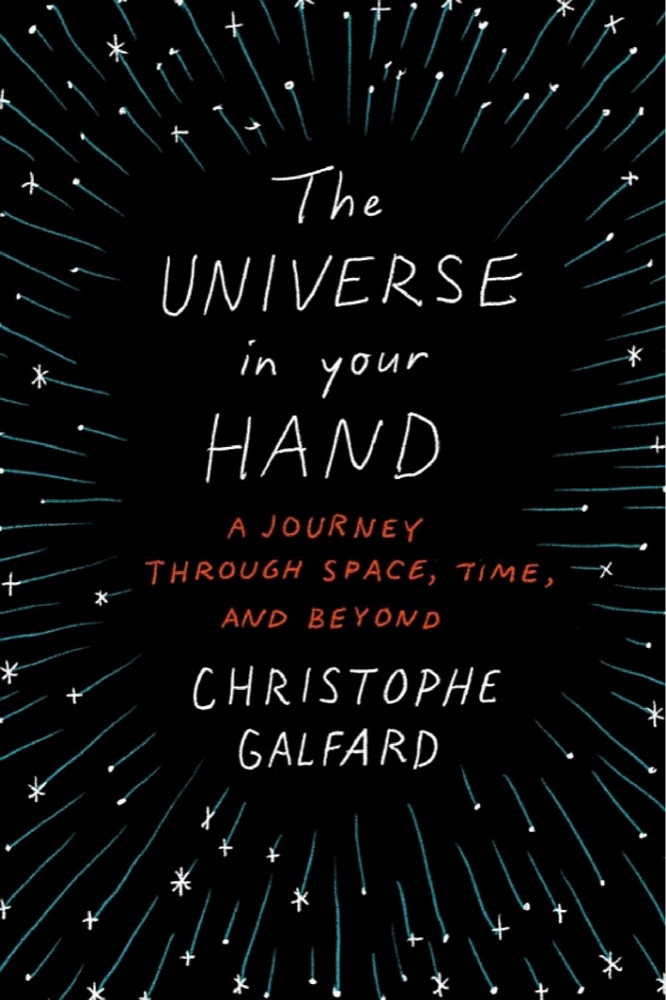
"If Ms. Frizzle were a physics student of Stephen Hawking, she might have written THE UNIVERSE IN YOUR HAND, a wild tour through the reaches of time and space, from the interior of a proton to the Big Bang to the rough suburbs of a black hole. It's friendly, excitable, erudite, and cosmic."—Jordan Ellenberg, New York Times besteselling author of How Not To Be WrongQuantum physics, black holes, string theory, the Big Bang, dark matter, dark energy, parallel even if we are interested in these fundamental concepts of our world, their language is the language of math. Which means that despite our best intentions of finally grasping, say, Einstein's Theory of General Relativity, most of us are quickly brought up short by a snarl of nasty equations or an incomprehensible graph. Christophe Galfard's mission in life is to spread modern scientific ideas to the general public in entertaining ways.
Book details
- First published
- 2015
- Author
- Christophe Galfard
- Genre
- Nonfiction
- Goodreads rating
- 4.39 (7k ratings)
Keep reading
Parallel Worlds: A Journey Through Creation, Higher Dimensions, and the Future of the Cosmos
 Astrophysics for People in a Hurry
 A Briefer History of Time
 Hyperspace
 The Feynman Lectures on Physics
 A Universe from Nothing: Why There Is Something Rather Than Nothing
 The End of Time: The Next Revolution in Our Understanding of the Universe
 Physics of the Impossible: A Scientific Exploration Into the World of Phasers, Force Fields, Teleportation, and Time Travel
 Death by Black Hole: And Other Cosmic Quandaries
 The End of Everything
 The Fabric of the Cosmos: Space, Time, and the Texture of Reality
 A Brief History of Time
 Welcome to the Universe: An Astrophysical Tour
 Helgoland: Making Sense of the Quantum Revolution
 The Elegant Universe: Superstrings, Hidden Dimensions, and the Quest for the Ultimate Theory
 From Eternity to Here: The Quest for the Ultimate Theory of Time
 QED: The Strange Theory of Light and Matter
 The Grand Design
 Our Mathematical Universe: My Quest for the Ultimate Nature of Reality
 The Particle at the End of the Universe: How the Hunt for the Higgs Boson Leads Us to the Edge of a New World
 Six Easy Pieces: Essentials of Physics By Its Most Brilliant Teacher
 Until the End of Time: Mind, Matter, and Our Search for Meaning in an Evolving Universe
 The Accidental Universe: The World You Thought You Knew
 The Character of Physical Law
 The Black Hole War: My Battle with Stephen Hawking to Make the World Safe for Quantum Mechanics
 Three Roads To Quantum Gravity
 Existential Physics: A Scientist's Guide to Life's Biggest Questions
 QED: The Strange Theory of Light and Matter
 Black Holes and Baby Universes and Other Essays
 The Big Picture: On the Origins of Life, Meaning, and the Universe Itself
 The Three-Body Problem
 Life on the Edge: The Coming of Age of Quantum Biology
 The World According to Physics
 A Short History of Nearly Everything
 Cosmos
 Why Does the World Exist?: An Existential Detective Story
 Brief Answers to the Big Questions
 Death's End
 Pale Blue Dot: A Vision of the Human Future in Space
 What Is Real?: The Unfinished Quest for the Meaning of Quantum Physics
 Exhalation
 The Case for a Creator: A Journalist Investigates Scientific Evidence That Points Toward God
 The Order of Time
 The Case Against Reality: Why Evolution Hid the Truth from Our Eyes
 Maya
Maya
 The Blind Watchmaker: Why the Evidence of Evolution Reveals a Universe Without Design
 When We Cease to Understand the World
 The Second Ship
 The Magic of Reality: How We Know What's Really True
 Lost in Math: How Beauty Leads Physics Astray
 God: The Failed Hypothesis: How Science Shows That God Does Not Exist
 The Convoluted Universe, Book 1
 Unweaving the Rainbow: Science, Delusion and the Appetite for Wonder
 Bewilderment
 Chaos: Making a New Science
 The Varieties of Scientific Experience: A Personal View of the Search for God
 The Complete Cosmicomics
 The Lives of a Cell: Notes of a Biology Watcher
 The Fifth Science