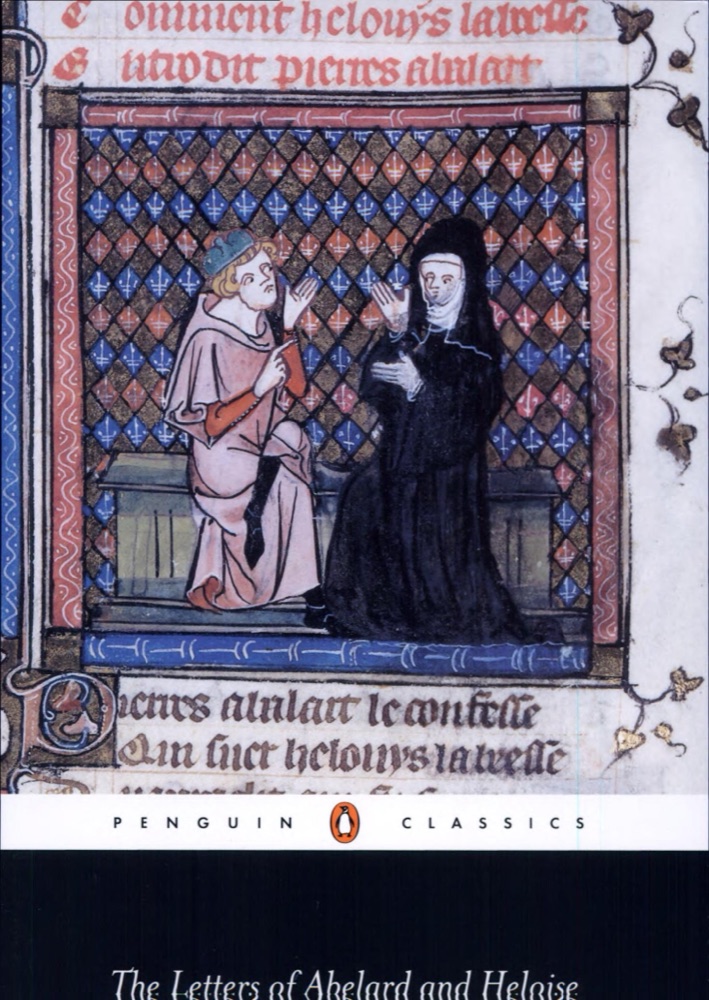
 De Profundis
Quotes from the Book
If the portraits of our absent friends are pleasant to us, which renew our memory of them and relieve our regret for their absence by a false and empty consolation, how much more pleasant are letters which bring us the written characters of the absent friend.
Against the disease of writing one must take special precautions, since it is a dangerous and contagious disease.
Would that thy love, beloved, had less trust in me, that it might be more anxious!
[I]t is not by being richer or more powerful that a man becomes better; one is a matter of fortune, the other of virtue. Nor should she deem herself other than venal who weds a rich man rather than a poor, and desires more things in her husband than himself. Assuredly, whomsoever this concupiscence leads into marriage deserves payment rather than affection.
God knows I never sought anything in you except yourself. I wanted simply you, nothing of yours.
[I]f the name of wife appears more sacred and more valid, sweeter to me is ever the word friend, or, if thou be not ashamed, concubine ... And thou thyself wert not wholly unmindful of that ... [as in the narrative of thy misfortunes] thou hast not disdained to set forth sundry reasons by which I tried to dissuade thee from our marriage, from an ill-starred bed; but wert silent as to many, in which I preferred love to wedlock, freedom to a bond. I call God to witness, if Augustus, ruling over the whole world, were to deem me worthy of the honour of marriage, and to confirm the whole world to me, to be ruled by me forever, dearer to me and of greater dignity would it seem to be called thy concubine than his empress.
Let me have a faithful account of all that concerns you; I would know everything, be it ever so unfortunate. Perhaps by mingling my sighs with yours I may make your sufferings less, for it is said that all sorrows divided are made lighter.
[A]s though mindful of the wife of Lot, who looked back from behind him, thou deliveredst me first to the sacred garments and monastic profession before thou gavest thyself to God. And for that in this one thing thou shouldst have had little trust in me I vehemently grieved and was ashamed. For I (God [knows]) would without hesitation precede or follow thee to the Vulcanian fires according to thy word. For not with me was my heart, but with thee. But now, more than ever, if it be not with thee, it is nowhere. For without thee it cannot anywhere exist.
If there is anything that may properly be called happiness here below, I am persuaded it is the union of two persons who love each other with perfect liberty, who are united by a secret inclination, and satisfied with each other's merits. Their hearts are full and leave no vacancy for any other passion; they enjoy perpetual tranquillity because they enjoy content.
Everyone wishes to be saved, but few will use those means which religion prescribes.
Strive now to unite in yourself all the virtues of these different examples. Have the purity of virgins, the austerity of anchorites, the zeal of pastors and bishops, and the constancy of martyrs.
we are much fonder of the pictures of those we love, when they are at a great distance, than when they are near to us.
It is always some consolation in sorrow to feel that it is shared, and any burden laid on several is carried more lightly or removed.
If there is anything that may properly
Love is incapable of being concealed; a word, a look, nay, silence, speaks it.
16
Tis a thousand times more easy to renounce the world than love.
5
We commonly die to the affections of those we see no more, and they to ours; absence is the tomb of love.
4
No man’s real worth is measured by his property or power: fortune belongs to one category of things and virtue to another. And no woman should think herself any the less for sale if she prefers a rich man to a poor one in marriage and wants what she would get in a husband more than the husband himself. Reward such greed with cash and not devotion, for she is after property alone and is prepared to prostitute herself to an even richer man given the chance.
4
I now lament my lover, and of all my joys have nothing but the painful memory that they are past. Now learn, all you my rivals who once viewed my happiness with jealous eyes, that he you once envied me can never more be mine. I loved him; my love was his crime and the cause of his punishment. My beauty once charmed him; pleased with each other we passed our brightest days in tranquility and happiness. If that were a crime, 'tis a crime I am yet fond of, and I have no other regret save that against my will I must now be innocent.
3
You are called a monastic, but think what that word means. If you are truly alone, then what are you doing among the crowd of men?
3
Perhaps by mingling my sighs with yours I may make your sufferings less, for it is said that all sorrows divided are made lighter.
2
As a city that lieth open and is not compassed with walls, so is a man that cannot restrain his spirit in speech.
2
And, finally, about silence—An idle or unnecessary word is the same thing as excessive speech; hence, Augustine says in the first book of his Retractions, “I cannot call it excessive speech when what is said is needed, no matter how many words are used.” 12 Solomon tells us, “In excessive speech sin shall not be wanting, but he that refraineth his lips is most wise.” 13 Where sin shall not be wanting, we must especially beware and guard against the condition all the more when it is so dangerous and difficult to avoid. This is what Saint Benedict did, saying, “Monks should study silence at all times.” 14 Studying silence is something more than simply keeping silent, for study is the pointed application of the mind to accomplish a given task. We do many things in negligence or even against our will, but we cannot study a thing without acting with purpose and will The apostle James, however, tells us how difficult it is to curb the tongue, but also how beneficial it will be. “We all offend in many things,” he says, but if any man offend not in word, then he is a perfect man. . . . For every nature of beasts and birds and serpents and the rest is tamed, and hath been tamed, by the nature of man, but the tongue no man can tame. . . . The tongue is indeed a small part of the body . . . but see how small a fire can kindle a great wood. . . . It is a world of iniquity . . . , an unquiet evil, full of deadly poison.
2
I have followed the procedure of the ancient painter Zeuxis, who worked in a material temple as I propose to work in a spiritual one. As Cicero tells the story, the people of Croton asked Zeuxis to decorate a temple they held in high esteem with the finest paintings he could devise. He approached the task with care, selecting five of the town’s most beautiful women to sit beside him as he worked and model their beauty for his painting. There were several good reasons for this. Zeuxis, we know, was a master in portraying women’s beauty, which by nature is more elegant and delicate than men’s. But as Cicero makes it a point to explain, he chose several women because he did not think he could find one who was uniformly lovely in all her parts. Nature, he thought, had never conferred such beauty on a single woman that all her parts should have an equal share: nothing composed by nature is complete in all respects, as if, in bestowing all her bounties in one place, nature would have none left to bestow elsewhere. Similarly, in my depiction of the beauty of the soul
2
Come too, my inseparable companion, and join me in thanksgiving, you who were made my partner both in guilt and in grace.
2
I remove to a distance from your person with an intention of avoiding you as an enemy; and yet I incessantly seek for you in my mind; I recall your image in my memory, and in different disquietudes I betray and contradict myself. I hate you! I love you!
1
Till now I thought philosophy made us masters, of all our passions, and that it was a refuge from the storms in which weak mortals are tossed and shipwrecked; but you have destroyed my security, and broken this philosophic courage. I have despised riches; honour and its pageantries could never raise a weak thought in me; beauty alone hath fired my soul.
1
I have made it an observation since our absence, that we are much fonder of the pictures of those we love when they are at a great distance than when they are near us. It seems to me as if the farther they are removed their pictures grow the more finished, and acquire a greater resemblance; or at least our imagination, which perpetually figures them to us by the desire we have of seeing them again, makes us think so. By a peculiar power, love can make that seem life itself which, as soon as the loved object returns, is nothing but a little canvas and flat color. I have your picture in my room; I never pass it without stopping to look at it; and yet when you are present with me I scarce ever cast my eyes on it. If a picture, which is but a mute representation of an object, can give such pleasure, what cannot letters inspire? They have souls; they can speak; they have in them all that force which expresses the transports of the heart; they have all the fire of our passions, they can raise them as much as if the persons themselves were present; they have all the tenderness and the delicacy of speech, and sometimes even a boldness of expression beyond it.
1
Prosperity seldom chooses the side of the virtuous, and fortune is so blind that in a crowd in which there is perhaps but one wise and brave man it is not to be expected that she should single him out.
1
I have long examined things, and have found that death is less dangerous than beauty.
1
Watch on YouTube
About Pierre Abélard
We have collected 30 quotes from 1 book by Pierre Abélard on BookQuoters.
More about the author →Book details
- First published
- 1133
- Author
- Pierre Abélard
- Genre
- Classics
- Goodreads rating
- 3.68 (6k ratings)
Keep reading
De Profundis
 Villette
 Jane Eyre
 Confessions
 The Two Gentlemen of Verona
 The Tenant of Wildfell Hall
 Les Misérables
 The Complete English Poems
 The Letters of Vincent van Gogh
 Purgatorio
 The Well of Loneliness
 Howards End
 Phantastes
 Clarissa, or, the History of a Young Lady
 Les Liaisons dangereuses
 A Room with a View
 Mademoiselle de Maupin
 The Moon and Sixpence
 The Secret Scripture
 Trust: Betrayed
 Persuasion
 The Memoirs of Cleopatra
 Agnes Grey
 Ben-Hur: A Tale of the Christ
 Brideshead Revisited: The Sacred and Profane Memories of Captain Charles Ryder
 Narcissus and Goldmund
 Nicholas Nickleby
 Shirley
 Anna Karenina
 Don Juan
 The Home and the World
 Our Mutual Friend
 Love's Labour's Lost
 The History of Tom Jones, a Foundling
 Gilead
 Père Goriot
 Adam Bede
 The Symposium
 The Tale of Genji
 The Good Soldier
 The Painted Veil
 Daniel Deronda
 The Treasured Writings of Kahlil Gibran
 Doctor Zhivago
 La dame aux camélias
 The Last Man
 The Diary of Adam and Eve
 Sword & Citadel
 Possession
 A Soldier of the Great War
 The Complete Poems of Emily Dickinson
 Arch of Triumph
 The Spanish Tragedy
 Faust
Faust
 Embers
 Under the Udala Trees
 The Scarlet Letter
 The Prophet
 Twelfth Night
 Oblomov