 The Ghost Map: The Story of London's Most Terrifying Epidemic - and How It Changed Science, Cities, and the Modern World
Quotes from the Book
Society cannot function if it is every man for himself. By definition, civilization cannot survive that. Those in authority must retain the public's trust. The way to do that is to distort nothing, to put the best face on nothing, to try to manipulate no one.
25
Influenza killed more people in a year than the Black Death of the Middle Ages killed in a century; it killed more people in twenty-four weeks than AIDS has killed in twenty-four years.
19
You don't manage the truth. You tell the truth.
16
The foundation of morality is to have done, once and for all, with lying.
14
So the final lesson of 1918, a simple one yet one most difficult to execute, is that those who occupy positions of authority must lessen the panic that can alienate all within a society. Society cannot function if it is every man for himself. By definition, civilization cannot survive that. Those in authority must retain the public’s trust. The way to do that is to distort nothing, to put the best face on nothing, to try to manipulate no one. Lincoln said that first, and best. A leader must make whatever horror exists concrete. Only then will people be able to break it apart.
11
In fact, biology is chaos. Biological systems are the product not of logic but of evolution, an inelegant process. Life does not choose the logically best design to meet a new situation. It adapts what already exists...The result, unlike the clean straight lines of logic, is often irregular, messy.
11
Yet institutions are human as well. They reflect the cumulative personalities of those within them, especially their leadership. They tend, unfortunately, to mirror less admirable human traits, developing and protecting self-interest and even ambition. Institutions almost never sacrifice. Since they live by rules, they lack spontaneity. They try to order chaos not in the way an artist or scientist does, through a defining vision that creates structure and discipline, but by closing off and isolating themselves from that which does not fit. They become bureaucratic.
10
The two most important questions in science are “What can I know?” and “How can I know it?
9
As terrifying the disease was, the press made it more so. They terrified by making little of it, for what officials and the press said bore no relationship to what people saw and touched and smelled and endured. People could not trust what they read. Uncertainty follows distrust, fear follow uncertainty, and, under conditions such as these, terror follows fear.
8
The fear, not the disease, threatened to break the society apart.
8
What’s true of all the evils in the world is true of plague as well. It helps men to rise above themselves.
8
Viruses are themselves an enigma that exist on the edges of life. They are not simply small bacteria. Bacteria consist of only one cell, but they are fully alive. Each has a metabolism, requires food, produces waste, and reproduces by division. Viruses do not eat or burn oxygen for energy. They do not engage in any process that could be considered metabolic. They do not produce waste. They do not have sex. They make no side products, by accident or design. They do not even reproduce independently. They are less than a fully living organism but more than an inert collection of chemicals.
7
overstate to make a point—warned, civilization could have disappeared within a few more weeks. So the final lesson of 1918, a simple one yet one most difficult to execute, is that those who occupy positions of authority must lessen the panic that can alienate all within a society. Society cannot function if it is every man for himself. By definition, civilization cannot survive that. Those in authority must retain the public’s trust. The way to do that is to distort nothing, to put the best face on nothing, to try to manipulate no one. Lincoln said that first, and best. A leader must make whatever horror exists concrete. Only then will people be able to break it apart.
6
Sit down before a fact as a little child, be prepared to give up every preconceived notion. Follow humbly wherever and to whatever abysses nature leads, or you shall learn nothing.” He also believed that learning had purpose, stating, “The great end of life is not knowledge but action.
6
Epidemiologists have computed that measles requires an unvaccinated population of at least half a million people living in fairly close contact to continue to exist.
5
Another explanation for the failure of logic and observation alone to advance medicine is that unlike, say, physics, which uses a form of logic - mathematics - as its natural language, biology does not lend itself to logic. Leo Szilard, a prominent physicist, made this point when he complained that after switching from physics to biology he never had a peaceful bath again. As a physicist he would soak in the warmth of a bathtub and contemplate a problem, turn it in his mind, reason his way through it. But once he became a biologist, he constantly had to climb out of the bathtub to look up a fact.
5
Certainty creates strength. Certainty gives one something upon which to lean. Uncertainty creates weakness. Uncertainty makes one tentative if not fearful, and tentative steps, even when in the right direction, may not overcome significant obstacles.
4
He advised, “Whenever you fall, pick up something.
3
No medicine and none of the vaccines developed then could prevent influenza. The masks worn by millions were useless as designed and could not prevent influenza. Only preventing exposure to the virus could. Nothing today can cure influenza, although vaccines can provide significant—but nowhere near complete—protection, and several antiviral drugs can mitigate its severity. Places that isolated themselves—such as Gunnison, Colorado, and a few military installations on islands—escaped. But the closing orders that most cities issued could not prevent exposure; they were not extreme enough. Closing saloons and theaters and churches meant nothing if significant numbers of people continued to climb onto streetcars, continued to go to work, continued to go to the grocer. Even where fear closed down businesses, where both store owners and customers refused to stand face-to-face and left orders on sidewalks, there was still too much interaction to break the chain of infection. The virus was too efficient, too explosive, too good at what it did. In the end the virus did its will around the world.
3
For the influenza pandemic that erupted in 1918 was the first great collision between nature and modern science. It was the first great collision between a natural force and a society that included individuals who refused either to submit to that force or to simply call upon divine intervention to save themselves from it, individuals who instead were determined to confront this force directly, with a developing technology and with their minds.
3
Huxley did not look the warrior. But he had a warrior’s ruthlessness. His dicta included the pronouncement: “The foundation of morality is to have done, once and for all, with lying.
3
Emerson said that an institution is the lengthened shadow of one man,
3
biology is chaos. Biological systems are the product not of logic but of evolution, an inelegant process.
3
One nurse at Great Lakes would later be haunted by nightmares. The wards had forty-two beds; boys lying on the floor on stretchers waited for the boy on the bed to die. Every morning the ambulances arrived and stretcher bearers carried sick sailors in and bodies out. She remembered that at the peak of the epidemic the nurses wrapped more than one living patient in winding sheets and put toe tags on the boys’ left big toe. It saved time, and the nurses were utterly exhausted. The toe tags were shipping tags, listing the sailor’s name, rank, and hometown. She remembered bodies “stacked in the morgue from floor to ceiling like cord wood.” In her nightmares she wondered “what it would feel like to be that boy who was at the bottom of the cord wood in the morgue.
2
Capps did write the JAMA article. He reported finding the masks so successful that after less than three weeks of experimenting he had abandoned testing and simply started using them as “a routine measure.” He also made the more general point that “one of the most vital measures in checking contagion” is eliminating crowding. “Increasing the space between beds in barracks, placing the head of one soldier opposite the feet of his neighbor, stretching tent flags between beds, and suspending a curtain down the center of the mess table, are all of proved value.” To prevent a few arriving individuals from infecting an entire camp, he also repeated Welch’s recommendation to isolate transferred troops.
2
In 1918 fear moved ahead of the virus like the bow wave before a ship. Fear drove the people, and the government and the press could not control it. They could not control it because every true report had been diluted with lies. And the more the officials and newspapers reassured, the more they said, There is no cause for alarm if proper precautions are taken, or Influenza is nothing more or less than old-fashioned grippe, the more people believed themselves cast adrift, adrift with no one to trust, adrift on an ocean of death.
2
It kept people apart. . . . It took away all your community life, you had no community life, you had no school life, you had no church life, you had nothing. . . . It completely destroyed all family and community life. People were afraid to kiss one another, people were afraid to eat with one another, they were afraid to have anything that made contact because that’s how you got the flu. . . . It destroyed those contacts and destroyed the intimacy that existed amongst people. . . . You were constantly afraid, you were afraid because you saw so much death around you, you were surrounded by death. . . . When each day dawned you didn’t know whether you would be there when the sun set that day. It wiped out entire families from the time that the day began in the morning to bedtime at night—entire families were gone completely, there wasn’t any single soul left, and that didn’t happen just intermittently, it happened all the way across the neighborhoods, it was a terrifying experience. It justifiably should be called a plague because that’s what it was. . . . You were quarantined, is what you were, from fear, it was so quick, so sudden. . . . There was an aura of a constant fear that you lived through from getting up in the morning to going to bed at night.
2
relationship with nature, modern humanity has generally been the aggressor, and a daring one at that, altering the flow of rivers, building upon geological faults, and, today, even engineering the genes of existing species. Nature has generally been languid in its response, although contentious once aroused and occasionally displaying a flair for violence. By 1918 humankind was fully modern, and fully scientific, but too busy fighting itself to aggress against nature. Nature, however, chooses its own moments. It chose this moment to aggress against man, and it did not do so prodding languidly. For the first time, modern humanity, a humanity practicing the modern scientific method, would confront nature in its fullest rage.
2
Surgeon General’s Advice to Avoid Influenza Avoid needless crowding. . . . Smother your coughs and sneezes. . . . Your nose not your mouth was made to breathe thru. . . . Remember the 3 Cs, clean mouth, clean skin, and clean clothes. . . . Food will win the war. . . . [H]elp by choosing and chewing your food well. . . . Wash your hands before eating. . . . Don’t let the waste products of digestion accumulate. . . . Avoid tight clothes, tight shoes, tight gloves—seek to make nature your ally not your prisoner. . . . When the air is pure breathe all of it you can—breathe deeply.
2
As Einstein once said, “One of the strongest motives that lead persons to art or science is a flight from the everyday life. . . . With this negative motive goes a positive one. Man seeks to form for himself, in whatever manner is suitable for him, a simplified and lucid image of the world, and so to overcome the world of experience by striving to replace it to some extent by this image. This is what the painter does, and the poet, the speculative philosopher, the natural scientist, each in his own way. Into this image and its formation, he places the center of gravity of his emotional life, in order to attain the peace and serenity that he cannot find within the narrow confines of swirling personal experience.
2
Watch on YouTube
About John M. Barry
We have collected 30 quotes from 1 book by John M. Barry on BookQuoters.
More about the author →About the book
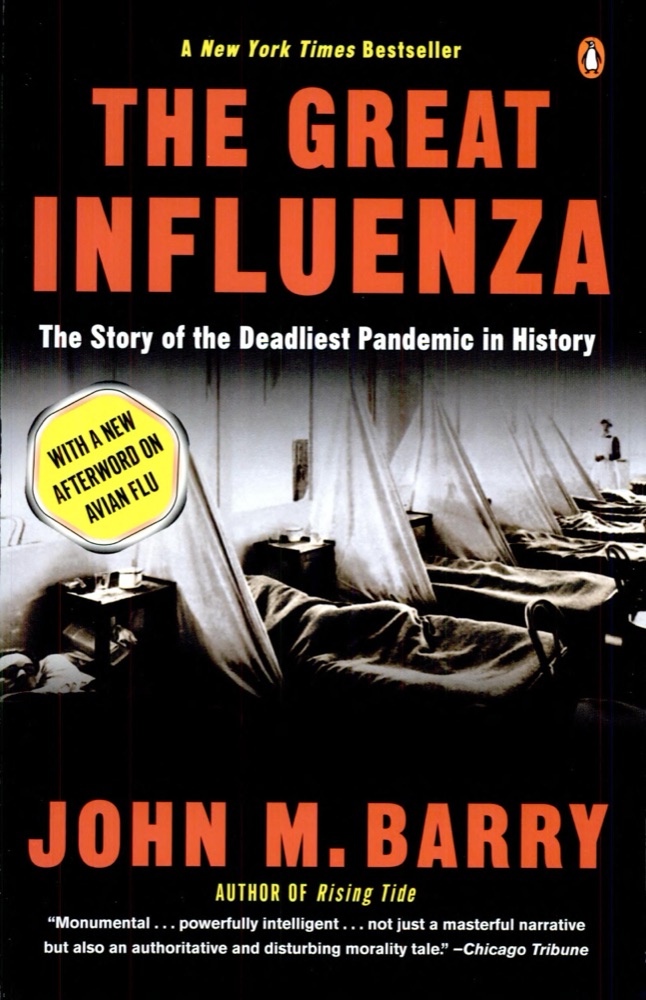
At the height of WWI, history’s most lethal influenza virus erupted in an army camp in Kansas, moved east with American troops, then exploded, killing as many as 100 million people worldwide. It killed more people in twenty-four months than AIDS killed in twenty-four years, more in a year than the Black Death killed in a century. But this was not the Middle Ages, and 1918 marked the first collision of science and epidemic disease. Magisterial in its breadth of perspective and depth of research and now revised to reflect the growing danger of the avian flu, The Great Influenza is ultimately a tale of triumph amid tragedy, which provides us with a precise and sobering model as we confront the epidemics looming on our own horizon. John M. Barry has written a new afterword for this edition that brings us up to speed on the terrible threat of the avian flu and suggest ways in which we might h
Book details
- First published
- 2004
- Author
- John M. Barry
- Genre
- History
- Goodreads rating
- 3.98 (43k ratings)
Keep reading
The Ghost Map: The Story of London's Most Terrifying Epidemic - and How It Changed Science, Cities, and the Modern World
 Get Well Soon: History's Worst Plagues and the Heroes Who Fought Them
 Genome
 Genesis
 Homo Deus: A History of Tomorrow
 The Ministry for the Future
 The Fifth Science
 The Lost City of the Monkey God
 The Gene: An Intimate History
 Billions & Billions: Thoughts on Life and Death at the Brink of the Millennium
 On Call: A Doctor's Journey in Public Service
 Maelstrom
 The Code Breaker: Jennifer Doudna, Gene Editing, and the Future of the Human Race
 The Log from the Sea of Cortez
 Brave New World Revisited
 Endgame, Vol. 1: The Problem of Civilization
 Civilized to Death: What Was Lost on the Way to Modernity
 A Language Older Than Words
 Too Like the Lightning
 The Social Conquest of Earth
 Silent Spring
 World War Z: An Oral History of the Zombie War
 Sapiens: A Brief History of Humankind
 The Lost World
 Humankind: A Hopeful History
 A Short History of Progress
 Illness as Metaphor and AIDS and Its Metaphors
 The Three-Body Problem
 The Song of the Cell: An Exploration of Medicine and the New Human
 Walden Two
 The Atlantis Gene
 The Western Lands
 Friday
 Natural Causes: An Epidemic of Wellness, the Certainty of Dying, and Killing Ourselves to Live Longer
 The Wizard and the Prophet: Two Remarkable Scientists and Their Dueling Visions to Shape Tomorrow's World
 21 Lessons for the 21st Century
 Adulthood Rites
 Wanderers
 Hunters of Dune
 Rationality: From AI to Zombies
 The Story of B: An Adventure of the Mind and Spirit
 Jurassic Park
 The Futurological Congress: From the Memoirs of Ijon Tichy
 Everything Is Tuberculosis: The History and Persistence of Our Deadliest Infection
 A Better World
 Devolution: A Firsthand Account of the Rainier Sasquatch Massacre
 The Better Angels of Our Nature: Why Violence Has Declined
 Revenge of the Tipping Point
 Songs of Distant Earth
 Enlightenment Now: The Case for Reason, Science, Humanism, and Progress
 Ishmael: An Adventure of the Mind and Spirit
 Behold a Pale Horse
 Death's End
 Fall; or, Dodge in Hell
 Tiamat's Wrath
 12 Rules for Life: An Antidote to Chaos
 Green Mars
 Red Mars
 Alien Clay
 Holy Bible: ESV Bible