
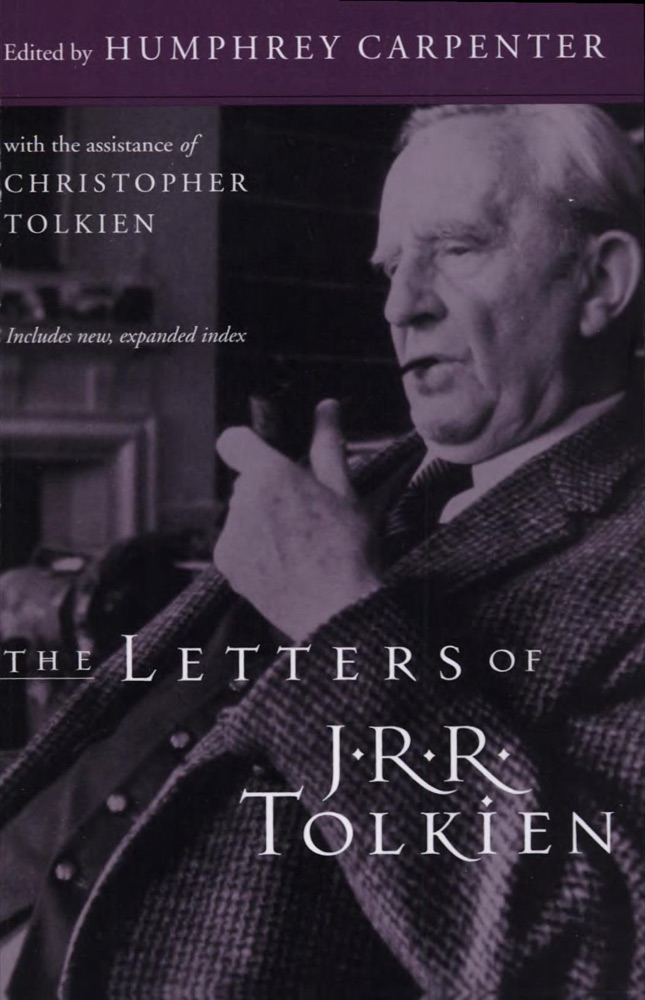
 The Letters of J.R.R. Tolkien
Quotes from the Book
Obedience appears to me more and more the whole business of life, the only road to love and peace.
5
Far from breaking with tradition, they understood the Great War and its aftermath in the light of tradition, believing, as did their literary and spiritual ancestors, that ours is a fallen world yet not a forsaken one.
4
Fidelity in marriage requires self-will and self-denial.
4
A philosophy that cannot be lived is no philosophy at all.
4
Religion in art was a subtle business, best handled indirectly.
4
The teacher-student relationship evaporated, replaced by a rich and lively exchange of equals.
3
J.R.R. Tolkien, said a student, "could turn a lecture room into a mead hall in which he was the bard and we were the feasting, listening guests.
3
A letter Lewis wrote reveals an 18-year-old with the energy of a schoolboy and the tastes of an octogenarian.
3
The unavoidable harshness of life surprised none of them, for they were Christians one and all, believing that they inhabited a fallen world, albeit one filled with God's grace.
3
Tolkien said of himself that “I am in fact a Hobbit (in all but size),” he spoke the truth, not only about his material likes (trees, farms, tobacco, mushrooms, plain English food) and dislikes (cars, French cooking, early rising) but also about the disposition of his soul. He, like a hobbit, was at home in his shire; he, like a hobbit, trusted the cosmos—but not necessarily the powers that held sway on earth.
2
Everyone and everything needed to be raised to its highest level – the teacher must become a mage, the husband a knight errant, the labor a hero in a sacred drama – intensified, rarefied, baptized in the turbulent waters of restlessness, curiosity, and ardor.
2
A Christian's duty, Lewis believed, is not simply to tolerate "X" but to make life with "X" an occasion to work on one's own character flaws.
2
He loved his family, his friends, his writing, his painting; he knew their flaws, but they neither surprised nor embittered him.
2
Christians who like to write might do as a description of the genus. But the actual species shared more precise characteristics, including intellectual vivacity, love of death, conservative politics, memories of war, and a passion for beef, beer, and verbal battle.
2
A Christian atmosphere is no protection against preening egos.
2
J.R.R. Tolkien told a questioning correspondent, life's purpose is to know, praise, and thank God.
2
A translator must, of course, be an interpreter of cultures.
2
Imagination pointed toward truth but could not disclose it directly.
2
Words contain the "souls" or minds of people in the past; as such, they tell the story of consciousness.
2
Words are catch-basins of experience, fingerprints and footprints of the past that the literary detective may scrutinize in order to sleuth out the history of human consciousness.
2
One cannot underestimate boredom as an incentive to write.
2
She had responded to the loss of her husband, to poverty, to disease, and to family cruelty with boldness and ingenuity, by opening herself to others, especially to her children and her Church, pouring into these precious vessels her knowledge, hope, and devotion.
2
The Inklings were comrades who have been touched by war, who view life through the lens of war, yet who look for hope and found it, in fellowship, where so many other modern writers and intellectuals saw only broken narratives, disfigurement, and despair.
2
We must picture Oxford, during World War I, not as the neomedieval paradise it would like to be, but as the military compound it was obliged to become.
2
Oxford in the Inklings' day was not so different in look and smell from the Oxford of today. Then, as now, one was tempted to fantasize one's surroundings as a Camelot of intellectual knight-errantry or an Eden of serene contemplation. Then, as now, there was bound to be disappointment.
2
In a largely autobiographical paper Tolkien wrote in 1931 for the Oxford Esperanto Society (“A Hobby for the Home,” later entitled “A Secret Vice”), he would maintain that the making of a language necessitates the making of a mythology in which that language is spoken, that the two processes are intertwined, each giving rise to the other. People thought Tolkien was joking when he later said that he wrote The Lord of the Rings to bring into being a world that might contain the Elvish greeting, so pleasing to his sense of linguistic beauty, Elen síla lúmenn’ omentielmo (“A star shines on the hour of our meeting”). The remark is witty—but also deadly serious.
2
their great hope was to restore Western culture to its religious roots, to unleash the powers of the imagination, to reenchant the world through Christian faith and pagan beauty.
2
After reading binge prompted by convalescence, "As if to balance the ledger, letters poured out at an equally prodigious pace.
1
Watch on YouTube
About Philip Zaleski
We have collected 28 quotes from 1 book by Philip Zaleski on BookQuoters.
More about the author →About the book
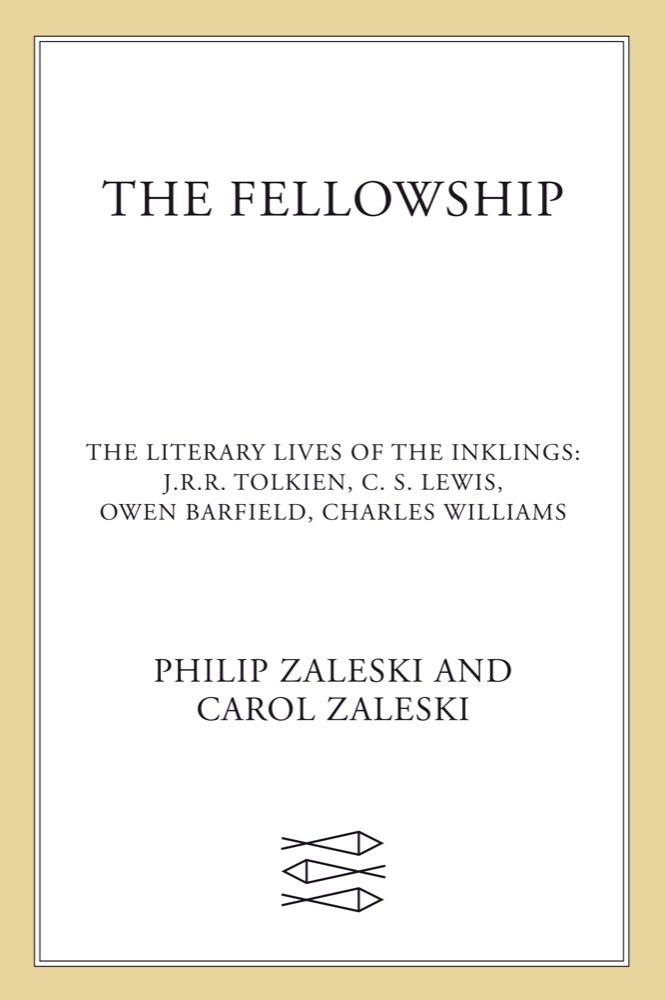
A stirring group biography of the Inklings, the Oxford writing club featuring J.R.R. Tolkien and C. S. Lewis C.S. Lewis is the twentieth century’s most widely read Christian writer and J.R.R. Tolkien its most beloved mythmaker. For three decades, they and their closest associates formed a literary club known as the Inklings, which met weekly in Lewis’s Oxford rooms and in nearby pubs. They discussed literature, religion, and ideas; read aloud from works in progress; took philosophical rambles in woods and fields; gave one another companionship and criticism; and, in the process, rewrote the cultural history of modern times.In The Fellowship, Philip and Carol Zaleski offer the first complete rendering of the Inklings’ lives and works. C. S. Lewis accepts Jesus Christ while riding in the sidecar of his brother's motorcycle, maps the medieval and Renaissance mind, becomes a world-famous eva
Book details
- First published
- 2015
- Author
- Philip Zaleski
- Genre
- Biography
- Goodreads rating
- 4.09 (2k ratings)
Keep reading
The Letters of J.R.R. Tolkien
 The Swerve: How the World Became Modern
 The Common Reader
 Arthur & George
 Negotiating with the Dead: A Writer on Writing
 Mystery and Manners: Occasional Prose
 Joseph Anton: A Memoir
 The Longest Journey
 Ben-Hur: A Tale of the Christ
 The Mill on the Floss
 J.R.R. Tolkien: A Biography
 Illuminations: Essays and Reflections
 Too Like the Lightning
 The Education of Henry Adams
 The Jewel in the Crown
 Stoner
 The Children's Book
 Ravelstein
 When I Was a Child I Read Books
 The Magic Mountain
 Armadale
 Orlando
 The Fall of Babel
 Monday or Tuesday
 My Friends
 The Rebel Angels
 Howards End
 The Life and Opinions of Tristram Shandy, Gentleman
 Aspects of the Novel
 The Grace of Kings
 River of Stars
 The Accursed
 The Last Bookaneer
 Scenes of Clerical Life
 Memoirs of Hadrian
 Weaveworld
 Romola
 The Scarlet Letter
 The Name of the Rose
 One Way Street And Other Writings
 Julian Comstock: A Story of 22nd-Century America
 The Ministry of Fear
 Time Regained
 Complete Works of Oscar Wilde
 Hyperion
 TransAtlantic
 Martin Eden
 The Luminaries
 The Narrow Road to the Deep North
 One of Ours
 The Great Mistake
 The Marriage Plot
 The Tunnel
 The Real Life of Sebastian Knight
 From Dawn to Decadence: 500 Years of Western Cultural Life, 1500 to the Present
 In Search of Lost Time
 The Essays of Ralph Waldo Emerson
 The Pillars of the Earth
 The Guermantes Way
 The House of the Seven Gables