
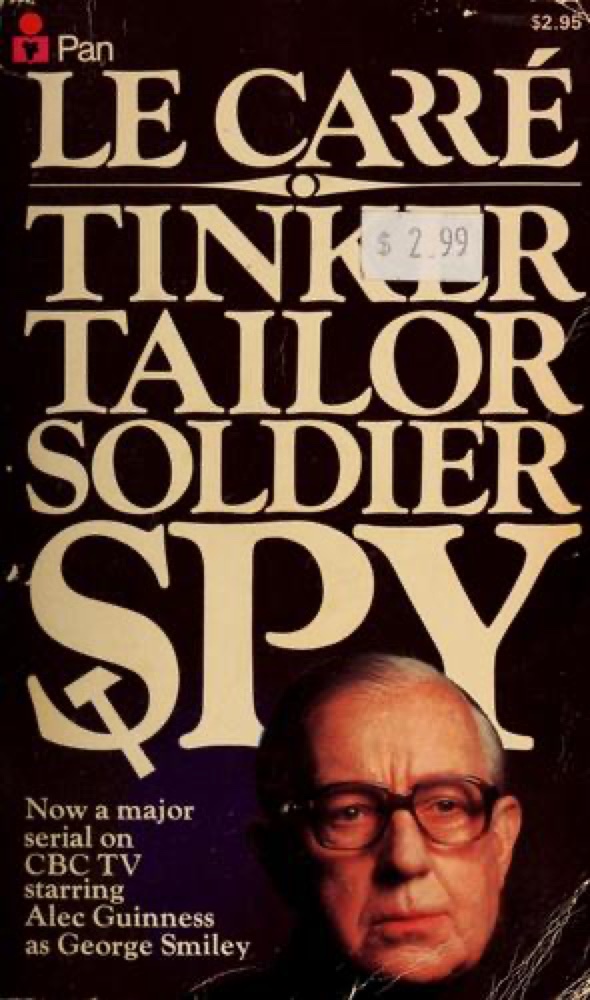
 Tinker Tailor Soldier Spy
Quotes from the Book
Do you know what love is? I'll tell you: it is whatever you can still betray.
164
There were times when he confronted his own image as a man confronts an empty valley, and the vision propelled him forward again to experience as despair compels us to extinction. Sometimes he was like a man in flight, but running toward the enemy, desperate to feel upon his vanishing body the blows that would prove his being; desperate to imprint upon his sad conformity the mark of real purpose, desperate perhaps, as Leclerc had hinted, to abdicate his conscience in order to discover God.
6
He was witnessing an insane relay race in which each contestant ran faster and longer than the last, arriving nowhere but his own destruction
4
For Heaven’s sake, Adrian, do you think Intelligence consists of unassailable philosophical truths? Does every priest have to prove that Christ was born on Christmas Day?
2
They’re crazy people, the English! That old fellow by the river: they think the Thames is the biggest river in the world, you know that? And it’s nothing! Just a little brown stream, you could nearly jump across it some places!
1
Now Haldane swung round on Avery, furious. ‘You of all people should not complain! You wanted a faith, didn’t you? You wanted an eleventh Commandment that would match your rare soul!’ He indicated Smiley and Leclerc. ‘Well, here you have it: here is the law you were looking for. Congratulate yourself; you found it. We sent him because we needed to; we abandon him because we must. That is the discipline you admired.’ He turned to Smiley. ‘You too: I find you contemptible. You shoot us, then preach to the dying. Go away. We’re technicians, not poets. Go away!
1
Leclerc said casually, everyone watching, ‘And the schedule? Who takes care of that? We’ve an agent in the field, you know.’ It was only a small point. ‘He’ll have to manage by himself.’ ‘The war rules.’ Leclerc spoke proudly. ‘We play the war rules. He knew that. He was well trained.’ He seemed reconciled; the thing was dismissed.
1
Smiley still did not go. ‘I wonder,’ he said. ‘You’ll never tell me, will you? I just wonder.’ He was not looking at Control. ‘My dear George, what has come over you?’ ‘We handed it to them. The passport that was cancelled . . . a courier service they never needed . . . a clapped-out wireless set . . . papers, frontier reports . . . who told Berlin to listen for him? Who told them what frequencies? We even gave Leclerc the crystals, didn’t we? Was that just Christian charity too? Plain, idiot Christian charity?’ Control was shocked. ‘What are you suggesting? How very distasteful. Who ever would do a thing like that?’ Smiley was putting on his coat. ‘Goodnight, George,’ Control said; and fiercely, as if he were tired of sensibility: ‘Run along. And preserve the difference between us: your country needs you. It’s not my fault they’ve taken so long to die.
1
Smiley watched him with scepticism. ‘We could have stopped them,’ he said. ‘We knew enough.’ ‘Of course we could,’ Control said blandly. ‘D’you know why we didn’t? Plain, idiot Christian charity. We let them have their war game.
1
What Ministry?’ Smiley asked. ‘Leclerc’s. Have you any idea what’s going on?’ Smiley said, ‘Yes. Haven’t you?’ ‘Leclerc’s so vulgar. I admit, I find him vulgar. He thinks we compete. What on earth would I do with his dreadful militia? Scouring Europe for mobile laundries. He thinks I want to gobble him up.’ ‘Well, don’t you? Why did we cancel that passport?’ ‘What a silly man. A silly, vulgar man. However did Haldane fall for it?’ ‘He had a conscience once. He’s like all of us. He’s learnt to live with it.’ ‘Oh dear. Is that a dig at me?
1
He heard Johnson’s benign voice running on about the aerial: ‘If it’s indoors it’s a headache, and indoors it’ll be. Now listen: zig-zag fashion across the room, quarter the length of your wave and one foot below the ceiling. Space them wide as possible, Fred, and not parallel to metal girders, electric wires and that. And don’t double her back on herself, Fred, or you’ll muck her up properly, see?’ Always the joke, the copulative innuendo to aid the memory of simple men.
1
He remembered Avery: the warmth and English decency of their early companionship; he remembered his young face glistening in the rain, and his shy, dazzled glance as he dried his spectacles, and he thought: he must have said thirty-two all the time. I misheard.
1
He caught himself thinking, it’s all right for them, and he remembered that nothing ever bridged the gulf between the man who went and the man who stayed behind, between the living and the dying.
1
When we met him he was a man without love. Do you know what love is? I’ll tell you: it is whatever you can still betray. We ourselves live without it in our profession. We don’t force people to do things for us. We let them discover love. And, of course, Leiser did, didn’t he? He married us for money, so to speak, and left us for love. He took his second vow. I wonder when.
1
You know, it doesn’t seem real. In the war, there was no question. They went or they refused. Why did he go, Avery? Jane Austen said money or love, those were the only two things in the world. Leiser didn’t go for money.
1
A hurried handshake and he walked away towards the hill. There were no fine words; not even from Leclerc. It was as if they had all taken leave of Leiser long ago. The last they saw of him was the rucksack gently bobbing as he disappeared into the darkness. There had always been a rhythm about the way he walked.
1
I’ve been trying to remember,’ he continued, ‘at home. There was this school. A big courtyard like a barracks with nothing but windows and drainpipes. We used to bang a ball round after lunch. Then a gate, and a path to the church, and the river on the other side . . .’ He was laying out the town with his hands, placing bricks. ‘We went on Sunday, through the side door, the kids last, see?’ A smile of success. ‘That church was facing north,’ he declared, ‘not east at all.
1
It was us three. The Captain, you and me. It was all right, then. Don’t worry about the others, John. They don’t matter.’ ‘That’s right, Fred.’ Leiser smiled. ‘It was the best ever, that week, John. It’s funny, isn’t it: we spend all our time chasing girls, and it’s the men that matter; just the men.’ ‘You’re one of us, Fred. You always were; all the time your card was there, you were one of us. We don’t forget.
1
Avery, sitting next to Leiser, was sunk in his own thoughts. He realised with what he took to be utter detachment that, whilst his own mission had unfolded as comedy, Leiser was to play the same part as tragedy; that he was witnessing an insane relay race in which each contestant ran faster and longer than the last, arriving nowhere but at his own destruction.
1
By way of emphasis the Western side is adorned with the grotesque statuary of political impotence: a plywood model of the Brandenburg Gate, the screws rusting in their sockets, rises absurdly from an untended field; notice boards, broken by wind and rain, display fifteen-year-old slogans across an empty valley.
1
The extreme northern part of the frontier which divides the two halves of Germany is largely a thing of depressing inconsequence. Those who look eagerly for dragon’s teeth and substantial fortifications will be disappointed. It crosses land of considerable variety; gullies and small hills overgrown with bracken and patches of untended forest. Often the Eastern defences are set so far behind the demarcation line as to be hidden from Western eyes – only a forward pillbox, crumbling roads, a vacated farmhouse or an occasional observation tower excite the imagination.
1
Leclerc now addressed himself to the question of Leiser’s target; he gave a résumé of the indicators, implying somehow that they only confirmed suspicions which he himself had long harboured. He employed a tone which Avery had not heard in him before. He sought to imply, as much by omission and inference as by direct allusion, that theirs was a Department of enormous skill and knowledge, enjoying in its access to money, its intercourse with other services and in the unchallenged authority of its judgements an unearthly, oracular immunity, so that Leiser might well have wondered why, if all this were so, he need bother to risk his life at all.
1
Leclerc had a habit, when making a joke, of holding himself at attention and lifting his heels from the ground as if to launch his wit upon the higher air.
1
In the war it was easier because, however bad it got, you thought one day we’d win. Even if you were picked up, you thought, “They’ll come and get me, they’ll drop some men or make a raid.” You knew they never would, see, but you could think it. You just wanted to be left alone to think it. But nobody wins this one, do they?
1
Woodford had brought drawings of Soviet rockets. They had been made by Ministry draughtsmen from photographs held in Research Section, enlarged to about two foot by three, neatly mounted on showcards. Some were stamped with a security classification. Prominent features were marked with arrows; the nomenclature was curiously childish: fin, cone, fuel compartment, payload. Beside each rocket stood a gay little figure like a penguin in a flying helmet, and printed beneath him: ‘size of average man’.
1
There was a particularly absurd scene one breakfast. Leiser raised the lid of a jam-pot, peered inside and, turning to Avery, asked, ‘Is this bee-honey?’ Johnson leant across the table, knife in one hand, bread and butter in the other. ‘We don’t say that, Fred. We just call it honey.’ ‘That’s right, honey. Bee-honey.’ ‘Just honey,’ Johnson repeated. ‘In England we just call it honey.’ Leiser carefully replaced the lid, pale with anger. ‘Don’t you tell me what to say.
1
I hear the flowers are coming out in Blackfriars Road,’ he said. ‘Leclerc’s driving around in a Rolls-Royce.’ ‘It’s a perfectly ordinary Humber,’ Smiley retorted. ‘From the Ministry pool.’ ‘Is that where it comes from?’ Control asked, his eyebrows very high. ‘Isn’t it fun? So the black friars have won the pool.
1
Avery too had gone out alone. To Haldane he had said he was taking a walk, to Johnson that he was going to the cinema. Avery had a way of lying which defied rational explanation. He found himself drawn to the old places he had known; his college in the Turl; the bookshops, pubs and libraries. The term was just ending. Oxford had a smell of Christmas about it, and acknowledged it with prudish ill will, dressing the shop windows with last year’s tinsel.
1
He had acquired from his neighbourhood or his clients certain turns of phrase which, though wholly without meaning, impressed his foreign ear. He would speak, for instance, of ‘some measure of satisfaction’, using an impersonal construction for the sake of dignity. He had assimilated also a variety of clichés. Expressions like ‘not to worry’, ‘don’t rock the boat’, ‘let the dog see the rabbit’, came to him continually, as if he were aspiring after a way of life which he only imperfectly understood, and these were the offerings that would buy him in. Some expressions, Avery remarked, were out of date.
1
Even in these first few days, it had become apparent that Leiser looked to Haldane as an ailing man looks to his doctor; a sinner to his priest. There was something terrible about a man who derived his strength from such a sickly body. Haldane affected to ignore him. He adhered stubbornly to the habits of his private life. He never failed to complete his crossword. A case of burgundy was delivered from the town, half-bottles, and he drank one alone at each meal while they listened to the tapes. So complete, indeed, was his withdrawal that one might have thought him revolted by the man’s proximity. Yet the more elusive, the more aloof Haldane became, the more surely he drew Leiser after him. Leiser, by some obscure standards of his own, had cast him as the English gentleman, and whatever Haldane did or said only served, in the eyes of the other, to fortify him in the part.
1
Watch on YouTube
About John le Carré
We have collected 352 quotes from 17 books by John le Carré on BookQuoters.
More about the author →More by John le Carré
All books by John le Carré →
About the book
John le Carré's classic novels deftly navigate readers through the intricate shadow worlds of international espionage with unsurpassed skill and knowledge, and have earned him unprecedented worldwide acclaim. THE LOOKING GLASS WAR Once upon a time the distinction had been the Circus handled all things political while the Department dealt with matters military. But over the years, power shifted and the Circus elbowed the Department out. Now, suddenly, the Department has a job on its hands. Evidence suggests Soviet missiles are being positioned close to the German border. Vital film is missing and a courier is dead. Lacking active agents, but possessed of an outdated mandate to proceed, the Department has to find an old hand to prove its mettle. Fred Leiser, German-speaking Pole turned Englishman -- once a qualified radio operator, now involved in the motor trade -- must be called back to
Book details
- First published
- 1965
- Author
- John le Carré
- Genre
- Fiction
- Goodreads rating
- 3.73 (19k ratings)
Keep reading
 The Honourable Schoolboy
 Smiley's People
 The Spy Who Came In from the Cold
 The Nutmeg of Consolation
 The Enemy
 Epitaph for a Spy
 The Redbreast
 The Surgeon's Mate
 Decline and Fall
 Precipice
 The Splendid and the Vile: A Saga of Churchill, Family, and Defiance During the Blitz
 Tigerman
 Slough House
 From Here to Eternity
 Reamde
 Parade's End
 Zero History
 The Confusion
 Radio Free Albemuth
 A Burnt-Out Case
 Night Soldiers
 Use of Weapons
 The Human Factor
 The Road Back
 Death at the Sign of the Rook
 Joe Country
 Slippery Creatures
 The Last Lion: Winston Spencer Churchill: Alone, 1932-40
 The Wars
 Post Captain
 The Hundred-Year-Old Man Who Climbed Out of the Window and Disappeared
 London Rules
 The Liar
 Casino Royale
 The Winds of War
 The Last Hero
 Don't Look Now and Other Stories
 The Fear Institute
 The Mask of Dimitrios
 The Finkler Question
 The Killer Angels
 The Day of the Scorpion
 That Hideous Strength
 Jingo
Jingo
 The Ministry of Fear
 Destination Unknown
 Matterhorn
 The Bedlam Stacks
 Agent Zigzag: A True Story of Nazi Espionage, Love, and Betrayal
 The Fifth Elephant
 In Other Lands
 The Truth: Stage Adaptation
 Alas, Babylon
 The Bonfire of the Vanities
 Fall of Giants
 My Father's House
 Sherlock Holmes
 Ptolemy's Gate
 The Ringed Castle
 Apt Pupil