
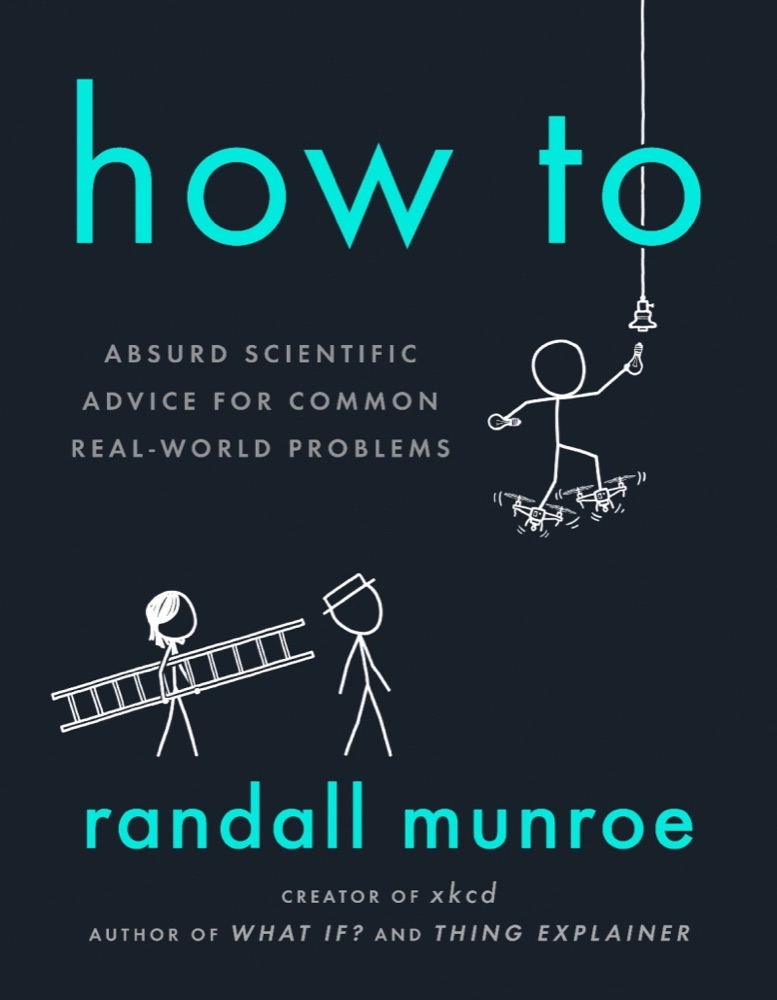
 How To: Absurd Scientific Advice for Common Real-World Problems
Quotes from the Book
But I’ve never seen the Icarus story as a lesson about the limitations of humans. I see it as a lesson about the limitations of wax as an adhesive.
There’s no material safety data sheet for astatine. If there were, it would just be the word “NO” scrawled over and over in charred blood.
I got in touch with a friend of mine who works at a research reactor, and asked him what he thought would happen to someone who tried to swim in their radiation containment pool. “In our reactor?” He thought about it for a moment. “You’d die pretty quickly, before reaching the water, from gunshot wounds.
They say there are no stupid questions. That’s obviously wrong; I think my question about hard and soft things, for example, is pretty stupid. But it turns out that trying to thoroughly answer a stupid question can take you to some pretty interesting places.
Your plane would fly pretty well, except it would be on fire the whole time, and then it would stop flying, and then stop being a plane.
Do not try any of this at home. The author of this book is an Internet cartoonist, not a health or safety expert. He likes it when things catch fire or explode, which means he does not have your best interests in mind. The publisher and the author disclaim responsibility for any adverse effects resulting, directly or indirectly, from information contained in this book.
Remember: I am a cartoonist. If you follow my advice on safety around nuclear materials, you probably deserve whatever happens to you.
The scholarly authorities on freezing to death seem to be, unsurprisingly, Canadians.
Maybe civilization will collapse, we’ll all succumb to disease and famine, and the last of us will be eaten by cats. Maybe we’ll all be killed by nanobots hours after you read this sentence. There’s no way to know.
Space is about 100 kilometers away. That’s far away—I wouldn’t want to climb a ladder to get there—but it isn’t that far away. If you’re in Sacramento, Seattle, Canberra, Kolkata, Hyderabad, Phnom Penh, Cairo, Beijing, central Japan, central Sri Lanka, or Portland, space is closer than the sea.
A world of random soul mates would be a lonely one. Let’s hope that’s not what we live in.
It’s not the fall that kills you, it’s the sudden stop at the end.
If humans escape the solar system and outlive the Sun, our descendants may someday live on one of these planets. Atoms from Times Square, cycled through the heart of the Sun, will form our new bodies. One day, either we will all be dead, or we will all be New Yorkers.
So Yoda sounds like our best bet as an energy source. But with world electricity consumption pushing 2 terawatts, it would take a hundred million Yodas to meet our demands. All things considered, switching to Yoda power probably isn't worth the trouble — though it would definitely be green.
But what kind of person makes tea in a blender?
We don’t know what astatine looks like, because, as Lowe put it, “that stuff just doesn’t want to exist.” It’s so radioactive (with a half-life measured in hours) that any large piece of it would be quickly vaporized by its own heat. Chemists suspect that it has a black surface, but no one really knows. There’s no material safety data sheet for astatine. If there were, it would just be the word “NO” scrawled over and over in charred blood.
I like it when things catch fire and explode, which means I do not have your best interests in mind.
The explosion would be just the right size to maximize the amount of paperwork your lab would face. If the explosion were smaller, you could potentially cover it up. If it were larger, there would be no one left in the city to submit paperwork to.
A 1-watt laser is an extremely dangerous thing. It’s not just powerful enough to blind you—it’s capable of burning skin and setting things on fire. Obviously, they’re not legal for consumer purchase in the US. Just kidding! You can pick one up for $300. Just do a search for “1-watt handheld laser.” So, suppose we spend the $2 trillion to buy 1-watt green lasers for everyone. (Memo to presidential candidates: This policy would win my vote.)
The US isn’t a perfect model of the world,
Lastly, we need to know the strength of gravity on Dagobah. Here, I figure I’m stuck, because while sci-fi fans are obsessive, it’s not like there’s gonna be a catalog of minor geophysical characteristics for every planet visited in Star Wars. Right? Nope. I’ve underestimated the fandom. Wookieepeedia has just such a catalog,
Sure, we seem like we’ve taken over the planet, but if I had to bet on which one of us would still be around in a million years—primates, computers, or ants—I know who I’d pick.
In the Clarendon Library at Oxford University sits a battery-powered bell that has been ringing since the year 1840. The bell “rings” so quietly it’s almost inaudible, using only a tiny amount of charge with every motion of the clapper. Nobody knows exactly what kind of batteries it uses because nobody wants to take it apart to figure it out.
Think of the elements as dangerous, radioactive, short-lived Pokémon.
For starters, would your soul mate even still be alive? A hundred billion or so humans have ever lived, but only seven billion are alive now (which gives the human condition a 93 percent mortality rate). If we were all paired up at random, 90 percent of our soul mates would be long dead.
If you set out a cup of warm water on Mars, it’ll try to boil, freeze, and sublimate, practically all at once. Water on Mars seems to want to be in any state except liquid.
Every night, around midnight GMT, the Sun sets on the Cayman Islands, and doesn’t rise over the British Indian Ocean Territory until after 1:00 a.m. For that hour, the little Pitcairn Islands in the South Pacific are the only British territory in the Sun. The Pitcairn Islands have a population of a few dozen people, the descendants of the mutineers from the HMS Bounty. The islands became notorious in 2004 when a third of the adult male population, including the mayor, were convicted of child sexual abuse. As awful as the islands may be, they remain part of the British Empire, and unless they’re kicked out, the two-century-long British daylight will continue.
While researching this answer, I managed to lock up my copy of Mathematica several times on balloon-related differential equations, and subsequently got my IP address banned from Wolfram|Alpha for making too many requests. The ban-appeal form asked me to explain what task I was performing that necessitated so many queries. I wrote, “Calculating how many rental helium tanks you’d have to carry with you in order to inflate a balloon large enough to act as a parachute and slow your fall from a jet aircraft.” Sorry, Wolfram.
Without us, Earth’s geology will grind on. Winds and rain and blowing sand will dissolve and bury the artifacts of our civilization. Human-caused climate change will probably delay the start of the next glaciation, but we haven’t ended the cycle of ice ages. Eventually, the glaciers will advance again. A million years from now, few human artifacts will remain.
Watch on YouTube
About Randall Munroe
We have collected 59 quotes from 2 books by Randall Munroe on BookQuoters.
More about the author →More by Randall Munroe
How To: Absurd Scientific Advice for Common Real-World Problems
Book details
- Author
- Randall Munroe
- Genre
- Nonfiction
- Goodreads rating
- 4.14 (199k ratings) →
Keep reading
How To: Absurd Scientific Advice for Common Real-World Problems
 Soonish: Ten Emerging Technologies That'll Improve and/or Ruin Everything
 Pocket Apocalypse
 A Short History of Nearly Everything
 Billions & Billions: Thoughts on Life and Death at the Brink of the Millennium
 The Three-Body Problem
 Space Chronicles: Facing the Ultimate Frontier
 Parasite
 Death by Black Hole: And Other Cosmic Quandaries
 Cryptonomicon
 Humble Pi: A Comedy of Maths Errors
 Packing for Mars: The Curious Science of Life in the Void
 Friday
 Earth
Earth
 Maelstrom
 Jurassic Park
 The Salmon of Doubt
 The Futurological Congress: From the Memoirs of Ijon Tichy
 Death's End
 The Hitchhiker's Guide to the Galaxy
 Robopocalypse
 On the Steel Breeze
 The Future of Humanity: Terraforming Mars, Interstellar Travel, Immortality and Our Destiny Beyond Earth
 Falter: Has the Human Game Begun to Play Itself Out?
 Heaven's River
 The Fifth Science
 The Kraken Wakes
 Grunt: The Curious Science of Humans at War
 To Be Taught, If Fortunate
 Genome
 The Martian
 The Gone-Away World
 The Stone Gods
 Physics of the Future: How Science Will Shape Human Destiny and Our Daily Lives by the Year 2100
 Bad Science
 Last Chance to See
 Snow Crash
 Blindsight
 Caliban’s War
 A Midsummer's Equation
 Vanishing Treasures: A Bestiary of Extraordinary Endangered Creatures
 The Rise and Fall of D.O.D.O.
 Ancestral Night
 The Lost World
 Songs of Distant Earth
 The Universe Versus Alex Woods
 The Last Continent
 Half-Off Ragnarok
 Echopraxia
 The Disappearing Spoon: And Other True Tales of Madness, Love, and the History of the World from the Periodic Table of the Elements
 Sleeping Giants
 Delta-v
 Microserfs
 The Naked Sun
 There Is No Antimemetics Division
 The Long Way to a Small, Angry Planet
 2312
2312
 Cibola Burn
 Waking Gods
 Wired
Wired