
 The Wager: A Tale of Shipwreck, Mutiny and Murder
Quotes from the Book
[...] what's the use of lying down to die as long as we can stand up and walk.
6
Hamet, Seid, and Abdallah were stung by the irony that on the wild desert, where people had virtually nothing, they shared freely, but here, where resources were comparatively abundant, no one would offer them so much as a drink.
5
Riley had no doubt that an "immediate and merciful act of the Almighty" had saved them from the surf at Bojador. According to him, all of his men believed this too. Later, when a friend advised him to play down this conviction, because skeptics would use it to discredit the rest of his account of the voyage, Riley refused.
1
Riley, who was not wholly above the racial prejudices typical of his era, had higher hopes for Mohammed, in part based on his light complexion.
Since at least Homer’s day, such accounts of distant voyages, especially voyages gone bad, have mesmerized their audiences, reawakening them from domestic slumber to the world’s wonders: its raging elements, its exotic and unyielding geography, its isolated peoples.
Massa was also where British merchant James Grey Jackson once saw a pair of colossal whale jawbones arching up from the sand. A local informed him that they had always been there and that, when the whale had beached, a man named Jonah had emerged from it's belly. Jackson laughed at the tale. His earnest informant responded only that 'nobody but a Christian would doubt the fact.
Before Riley, the French traveler Saugnier had wrestled with the Sahrawi ethic regarding property. According to him, on the desert things stolen unperceived became rightfully the property of the thief, and things unwatched, it followed, deserved to be stolen.
... while we were in inhabited country every Bedu for miles around would come to feed at our expense. It would be impossible to refuse them food: in the desert one may never turn a guest away, however unwanted he may be. T.E. Lawrence observed that 'the desert was held in a crazed communism by which Nature and the elements were for the free use of every known friendly person for his own purposes and no more.
To the Arabs, hardened by life on the desert, tears from a man were shameful. When the Frenchman Brisson was reduced to weeping in front of the Bou Sbaa, he wrote, "some women perceiving it, instead of being moved to compassion threw sand in my eyes, as they said, to wipe away my tears.
For all their piety- they prayed regularly and devoutly, as their religion required - Riley wondered how the Arabs could ignore the fact that under their care he and his men lacked the most basic necessities of life and suffered inhumanly.
The women in this camp examined the tattered Christians, whose skin had turned to chaff before the sun. Instead of arousing sympathy, the spectacle ignited a fit of disgust in women deeply encumbered with superstitious fears. In a culture where females were often denounced as conduits of evil, any contact with Christians was dangerous. They reviled the men with shrill curses and spat on them.
What they could use and carry from a shipwreck, the Sahrawis took. What they could not take, it was their custom to burn. To the victims who witnessed this destruction of their personal articles and the cargo of their vessel, it was often the last cruel blow before they assumed the life of a slave to some of the poorest people on earth, living in some of the harshest conditions imaginable.
In Lincoln’s day, Riley’s account also spoke to a burning issue: the troubling institution of slavery. Inverting the American paradigm, it provided a useful perspective and helped expose the brutality of that abysmal practice. In our time, when one of the great challenges we face is to find common ground for Muslims, Christians, and Jews, the plight of the crew of the Commerce achieves a new relevance. It
Watch on YouTube
About Dean King
We have collected 13 quotes from 1 book by Dean King on BookQuoters.
More about the author →About the book
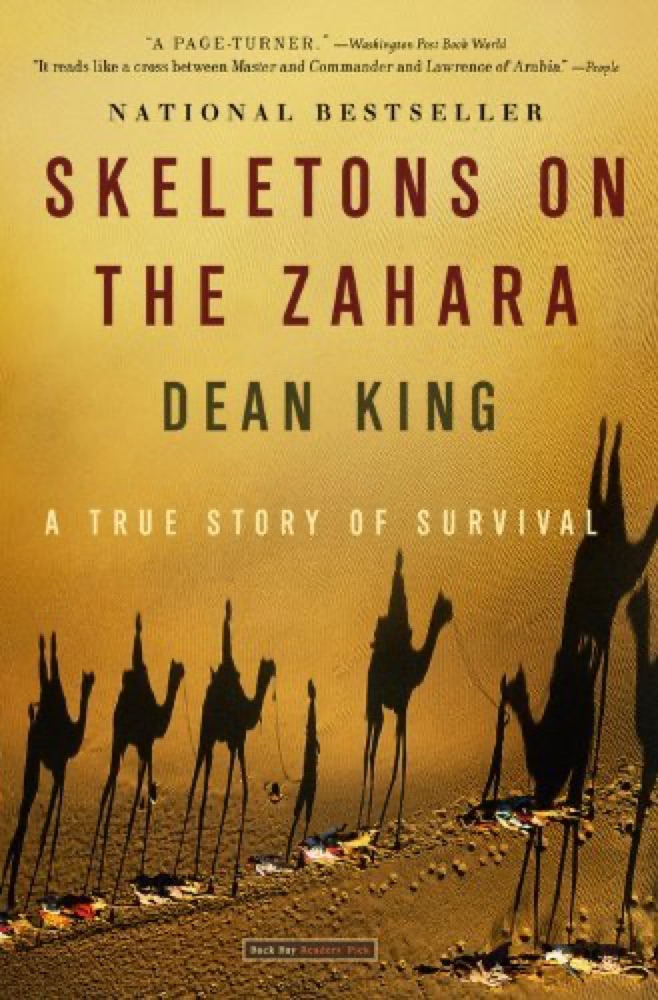
A spectacular true odyssey through the extremes of the Sahara Desert in the early 19th century. Reader and protagonist alike are challenged into new ways of understanding culture clash, slavery and the place of Islam in the social fabric of desert-dwelling peoples.
In a calm May morning in 1815, Captain James Riley and the crew of the Commerce left port in Connecticut for an ordinary trading voyage. They could never have imagined what awaited them.
Their nightmare began with a dreadful shipwreck off the coast of Africa, a hair-raising confrontation with hostile native tribesmen within hours of being washed ashore, and a hellish confinement in a rickety longboat as they tried, without success, to escape the fearsome coast. Eventually captured by desert nomads and sold into slavery, Riley and his men were dragged along on an insane journey through the bone-dry heart of the Sahara—a
Book details
- First published
- 2004
- Author
- Dean King
- Genre
- Nonfiction
- Goodreads rating
- 4.07 (12k ratings)
Keep reading
The Wager: A Tale of Shipwreck, Mutiny and Murder
 The Lost City of Z: A Tale of Deadly Obsession in the Amazon
 River of Smoke
 The Histories
 Barracoon: The Story of the Last "Black Cargo"
 Petals of Blood
 King Leopold's Ghost
 The Moor's Account
 The Prophets
 Typee: A Peep at Polynesian Life
 Nathaniel's Nutmeg: How One Man's Courage Changed the Course of History
 The Bedlam Stacks
 The Bad-Ass Librarians of Timbuktu and Their Race to Save the World’s Most Precious Manuscripts
 Roughing It
 What Strange Paradise
 The Innocents Abroad
 Almanac of the Dead
 Princess Sultana's Daughters
 The Love Songs of W.E.B. Du Bois
 From Beirut to Jerusalem
 Of Plymouth Plantation, 1620-1647
 The Water Dancer
 How Beautiful We Were
 The Underground Railroad
 The Enchantress of Florence
 Gold Fame Citrus
 The Stardust Thief
 Washington Black
 Exodus
 1491: New Revelations of the Americas Before Columbus
 Joseph Anton: A Memoir
 The Nutmeg of Consolation
 Julian Comstock: A Story of 22nd-Century America
 Barkskins
 The Last Train to Zona Verde: My Ultimate African Safari
 The Burning Soul
 Endurance: Shackleton's Incredible Voyage
 Seven Pillars of Wisdom: A Triumph
 Sea of Poppies
 The Devil and the Dark Water
 The Mysterious Island
 In the Shadow of the Sword: The Birth of Islam and the Rise of the Global Arab Empire
 The Warrior Prophet
 The Naked and the Dead
 Incidents in the Life of a Slave Girl
 A Bend in the River
 Ship of Fools
 People of the Book
 South: The Story of Shackleton's Last Expedition 1914-1917
 Redemption in Indigo
 Shaman
 Tell My Horse: Voodoo and Life in Haiti and Jamaica
 The Sex Lives of Cannibals: Adrift in the Equatorial Pacific
 The Wretched of the Earth
 A History of the World in 100 Objects
 The Yacoubian Building
 No Name in the Street
 Voyage of the Beagle
 Following the Equator: A Journey Around the World