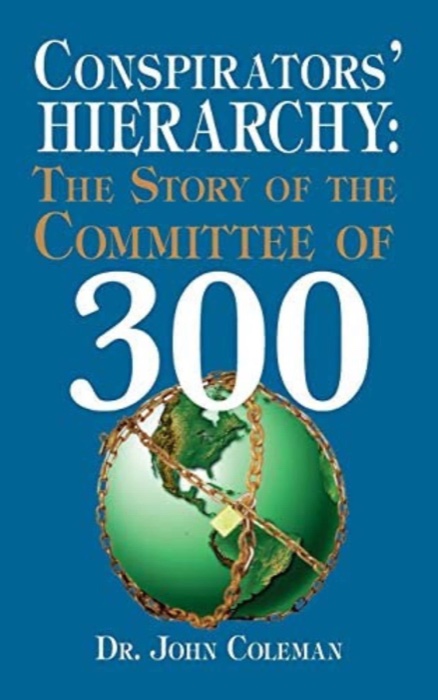
 Conspirators' Hierarchy: The Story of the Committee of 300
Quotes from the Book
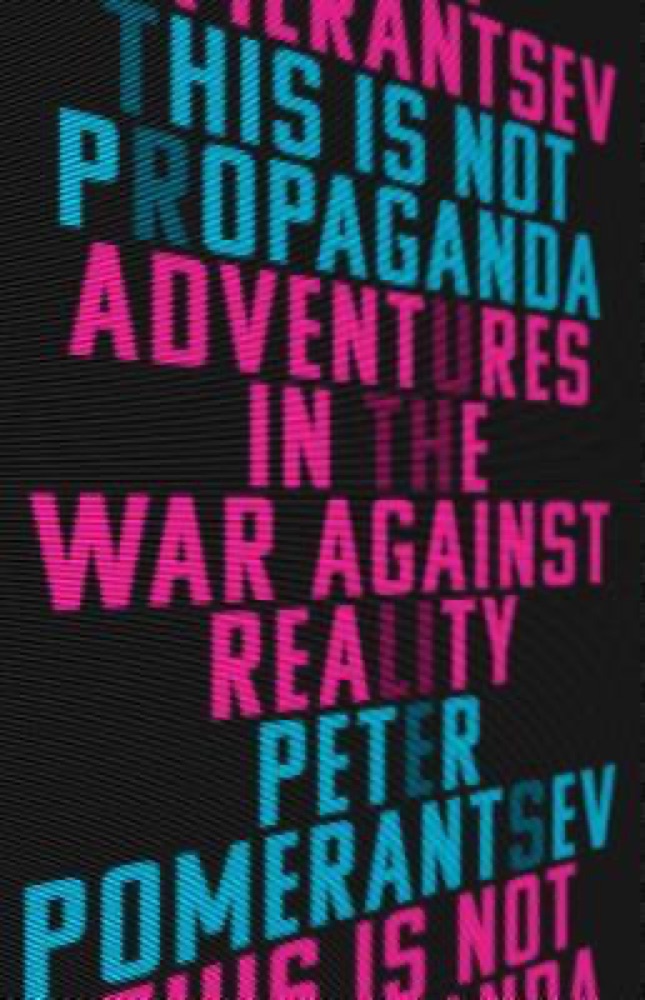
Conspiracy theories have long been used to maintain power: the Soviet leadership saw capitalist and counter-revolutionary conspiracies everywhere; the Nazis, Jewish ones. But those conspiracies were ultimately there to buttress an ideology, whether class warfare for Communists or race for Nazis. With today’s regimes, which struggle to formulate a single ideology – indeed, which can’t if they want to maintain power by sending different messages to different people – the idea that one lives in a world full of conspiracies becomes the world view itself. Conspiracy does not support the ideology; it replaces it. In Russia this is captured in the catchphrase of the country’s most important current affairs presenter: ‘A coincidence? I don’t think so!’ says Dmitry Kiselev as he twirls between tall tales that dip into history, literature, oil prices and colour revolutions, which all return to the theme of how the world has it in for Russia. And as a world view it grants those who subscribe to it certain pleasures: if all the world is a conspiracy, then your own failures are no longer all your fault. The fact that you achieved less than you hoped for, that your life is a mess – it’s all the fault of the conspiracy. More importantly, conspiracy is a way to maintain control. In a world where even the most authoritarian regimes struggle to impose censorship, one has to surround audiences with so much cynicism about anybody’s motives, persuade them that behind every seemingly benign motivation is a nefarious, if impossible-to-prove, plot, that they lose faith in the possibility of an alternative, a tactic a renowned Russian media analyst called Vasily Gatov calls ‘white jamming’. And the end effect of this endless pile-up of conspiracies is that you, the little guy, can never change anything. For if you are living in a world where shadowy forces control everything, then what possible chance do you have of turning it around? In this murk it becomes best to rely on a strong hand to guide you. ‘Trump is our last chance to save America,’ is the message of his media hounds. Only Putin can ‘raise Russia from its knees’. ‘The problem we are facing today is less oppression, more lack of identity, apathy, division, no trust,’ sighs Srdja. ‘There are more tools to change things than before, but there’s less will to do so.
9
If all information is seen as part of a war, out go any dreams of a global information space where ideas flow freely, bolstering deliberative democracy. Instead, the best future one can hope for is an ‘information peace’, in which each side respects the other’s ‘information sovereignty’: a favoured concept of both Beijing and Moscow, and essentially a cover for enforcing censorship.
4
With today’s regimes, which struggle to formulate a single ideology, the idea that one lives in a world full of conspiracies becomes the worldview itself. Conspiracy theory replaces ideology with a mix of self-pity, paranoia, self-importance, and entertainment.
3
The display, which was called 'Can Democracy Survive the Internet?' was dedicated to a 'global election management' company called Cambridge Analytica. Cambridge Analytica claimed to have gathered 5,000 data points on every American voter online: what you liked and what you shared on social media; how and where you shopped; who your friends were... They claimed to be able to take this imprint of your online self, use it to understand your deepest drives and desires, and then draw on that analysis to change your voting behaviour. The boast seemed to be backed up by success: Cambridge Analytica had worked on the victorious American presidential campaign of Donald Trump; it had also run successful campaigns for US Senator Ted Cruz (twice); and others all across Africa, Asia, the Caribbean, Latin America.
3
Social media, that little narcissism machine, the easiest way we have ever had to place ourselves on a pedestal of vanity, also is the mechanism that most efficiently breaks you up.
2
Some of the farm's work reached a level of granularity that stunned Lyudmilla. Two trolls would go on the comments sections of small' provincial newspapers and start chatting about the street they lived in, the weather, then caually recommend a piece about the nefarious West attacking Russia. No one who worked at the farm described themselves as trolls. Instead, they talked about their work in the passive voice ('a piece was written', 'a comment was made'). Most treated the farm as if it was just another job, doing the minimum required and then clocking off. Many of them seemed pleasant enough young people, with open, pretty faces, and yet they didn't blink when asked to smear, degrade, insult and humiliate their victims. The ease with which victims were attacked, the scale at which the farm operated, it all stunned Lyudmilla.
1
The twentieth century began with Utopia and ended with nostalgia. The twenty-first century is not characterized by the search for new-ness, but by the proliferation of nostalgias,” wrote the late Russian-American philologist Svetlana Boym,
Hoy tenemos acceso a más información y hechos demostrables que nunca, pero parecen haber perdido su poder. No es novedoso que los políticos mientan, lo que sí lo parece es que ahora saquen pecho cuando dicen que les da igual decir la verdad que mentir.
Watch on YouTube
About Peter Pomerantsev
We have collected 8 quotes from 1 book by Peter Pomerantsev on BookQuoters.
More about the author →About the book
Learn how the perception of truth has been weaponized in modern politics with this “insightful” account of propaganda in Russia and beyond during the age of disinformation (New York Times).
When information is a weapon, every opinion is an act of war.
We live in a world of influence operations run amok, where dark ads, psyops, hacks, bots, soft facts, ISIS, Putin, trolls, and Trump seek to shape our very reality. In this surreal atmosphere created to disorient us and undermine our sense of truth, we’ve lost not only our grip on peace and democracy — but our very notion of what those words even mean.
Peter Pomerantsev takes us to the front lines of the disinformation age, where he meets Twitter revolutionaries and pop-up populists, “behavioral change” salesmen, Jihadi fanboys, Identitarians, truth cops, and many others. Forty years after his dissident parents were pursued by the
Book details
- First published
- 2019
- Author
- Peter Pomerantsev
- Genre
- Nonfiction
- Goodreads rating
- 4.03 (5k ratings)
The buzz
- The New York TimesReview in The New York Timesprofessional review (via Book Marks)
- The GuardianReview in The Guardianprofessional review (via Book Marks)
- The TimesReview in The Timesprofessional review (via Book Marks)
- Kirkus ReviewsReview in Kirkus Reviewsprofessional review (via Book Marks)
- TelegraphReview in Telegraphprofessional review (via Book Marks)
- NewrepublicReview in Newrepublicprofessional review (via Book Marks)
Keep reading
Conspirators' Hierarchy: The Story of the Committee of 300
 Brave New World Revisited
 On Tyranny: Twenty Lessons from the Twentieth Century
 What's Our Problem?: A Self-Help Book for Societies
 Empire of Illusion: The End of Literacy and the Triumph of Spectacle
 Understanding Power: The Indispensable Chomsky
 Patriot: A Memoir
 Twilight of Democracy: The Seductive Lure of Authoritarianism
 Doppelganger: A Trip into the Mirror World
 The Coming Insurrection
 Trust Me, I'm Lying: Confessions of a Media Manipulator
 First As Tragedy, Then As Farce
 Amusing Ourselves to Death: Public Discourse in the Age of Show Business
 What's Left?
 Dead Fall
 I Hate the Internet
 The Origins of Totalitarianism
 Fascism: A Warning
 Propaganda
 The Influencing Machine: Brooke Gladstone on the Media
 Behold a Pale Horse
 You Are Not a Gadget
 Gnomon
 Chomsky On Anarchism
 The Age of Magical Overthinking: Notes on Modern Irrationality
 Endgame, Vol. 1: The Problem of Civilization
 The Futurological Congress: From the Memoirs of Ijon Tichy
 America: The Farewell Tour
 Imperium
 Koba the Dread: Laughter and the Twenty Million
 Power Systems: Conversations on Global Democratic Uprisings and the New Challenges to U.S. Empire
 Blowout
 The Biggest Secret: The Book That Will Change the World
 Death of the Liberal Class
 One Day, Everyone Will Have Always Been Against This
 But What If We're Wrong? Thinking About the Present As If It Were the Past
 The Utopia of Rules: On Technology, Stupidity, and the Secret Joys of Bureaucracy
 Brave New World / Brave New World Revisited
 Secondhand Time: The Last of the Soviets
 The Technological Republic: Hard Power, Soft Belief, and the Future of the West
 The Strange Death of Europe: Immigration, Identity, Islam
 Technopoly: The Surrender of Culture to Technology
 The Next 100 Years: A Forecast for the 21st Century
 The Message
 The World Is Flat: A Brief History of the Twenty-first Century
 Homo Deus: A History of Tomorrow
 Distraction
 America Alone: The End of the World As We Know It
 Modern Times: The World from the Twenties to the Nineties
 The Madness of Crowds: Gender, Race and Identity
 Psychopolitics: Neoliberalism and New Technologies of Power
 Starry Messenger: Cosmic Perspectives on Civilization
 How Should We Then Live? The Rise and Decline of Western Thought and Culture
 The Ministry for the Future
 Understanding Media: The Extensions of Man
 Live Not by Lies: A Manual for Christian Dissidents
 Trick Mirror: Reflections on Self-Delusion
 Permanent Record
 Blackshirts and Reds: Rational Fascism and the Overthrow of Communism
 Arguably: Selected Essays