
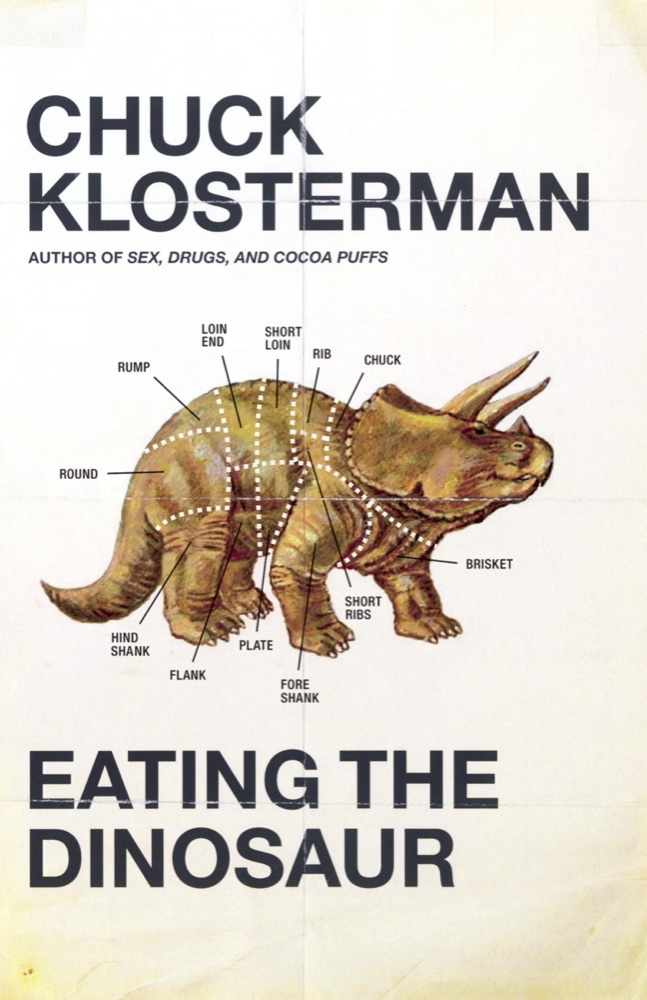
 Eating the Dinosaur
Quotes from the Book
The contemporary proliferation of bullshit also has deeper sources, in various forms of skepticism which deny that we can have any reliable access to an objective reality and which therefore reject the possibility of knowing how things truly are. These "anti-realist" doctrines undermine confidence in the value of disinterested efforts to determine what is true and what is false, and even in the intelligibility of the notion of objective inquiry. One response to this loss of confidence has been a retreat from the discipline required by dedication to the ideal of correctness to a quite different sort of discipline, which is imposed by pursuit of an alternative ideal of sincerity. Rather than seeking primarily to arrive at accurate representations of a common world, the individual turns toward trying to provide honest representations of himself. Convinced that reality has no inherent nature, which he might hope to identify as the truth about things, he devotes himself to being true to his own nature. It is as though he decides that since it makes no sense to try to be true to the facts, he must therefore try instead to be true to himself. But it is preposterous to imagine that we ourselves are determinate, and hence susceptible both to correct and to incorrect descriptions, while supposing that the ascription of determinacy to anything else has been exposed as a mistake. As conscious beings, we exist only in response to other things, and we cannot know ourselves at all without knowing them. Moreover, there is nothing in theory, and certainly nothing in experience, to support the extraordinary judgment that it is the truth about himself that is the easiest for a person to know. Facts about ourselves are not peculiarly solid and resistant to skeptical dissolution. Our natures are, indeed, elusively insubstantial -- notoriously less stable and less inherent than the natures of other things. And insofar as this is the case, sincerity itself is bullshit.
202
It is impossible for someone to lie unless he thinks he knows the truth. Producing bullshit requires no such conviction.
101
Bullshit is unavoidable whenever circumstance require someone to talk without knowing what he is talking about.
57
Someone who lies and someone who tells the truth are playing on opposite sides, so to speak, in the same game. Each responds to the facts as he understands them, although the response of the one is guided by the authority of the truth, while the response of the other defies that authority and refuses to meet its demands. The bullshitter ignores these demands altogether. He does not reject the authority of the truth, as the liar does, and oppose himself to it. He pays no attention to it at all. By virtue of this, bullshit is a greater enemy of the truth than lies are.
33
Our natures are, indeed, elusively insubstantial—notoriously less stable and less inherent than the nature of other things. And insofar as this is the case, sincerity itself is bullshit.
24
When an honest man speaks, he says only what he believes to be true; and for the liar, it is correspondingly indispensable that he considers his statements to be false. For the bullshitter, however, all these bets are off: he is neither on the side of the true nor on the side of the false. His eye is not on the facts at all, as the eyes of the honest man and of the liar are, except insofar as they may be pertinent to his interest in getting away with what he says. He does not care whether the things he says describe reality correctly. He just picks them out, or makes them up, to suit his purpose.
20
Telling a lie is an act with a sharp focus. It is designed to insert a particular falsehood at a particular point in a set or system of beliefs, in order to have that point occupied by the truth. This requires a degree of craftsmanship, in which the teller of the lie submits to objective constraints imposed by what he takes to be the truth. The liar is inescapably concerned with truth-values. In order to invent a lie at all, he must think he knows what is true. And in order to invent an effective lie, he must design his falsehood under the guidance of that truth. On the other hand, a person who takes to bullshit his way through has much more freedom. His focus is panoramic rather than particular. He does not limit himself to inserting a certain falsehood at a specific point, and thus he is not constrained by the truths surrounding that point or intersecting it. He is prepared, so far as is required, to fake the context as well. This freedom from the constraints to which the liar must submit does not necessarily mean, of course, that his task is easier than the task of the liar. But the mode of creativity upon which it relies is less analytical and less deliberative than that which is mobilized in lying. It is more expansive and independent, with more spacious opportunities for improvisation, color and imaginative play. This is less a matter of craft than of art. Hence the familiar notion of the 'bullshit artist'.
20
Bullshit is unavoidable whenever circumstances require someone to talk without knowing what he is talking about. Thus the production of bullshit is stimulated whenever a person’s obligations or opportunities to speak about some topic exceed his knowledge of the facts that are relevant to that topic. This discrepancy is common in public life, where people are frequently impelled – whether by their own propensities or by the demands of others – to speak extensively about matters of which they are to some degree ignorant. Closely related instances arise from the widespread conviction that it is the responsibility of a citizen in a democracy to have opinions about everything, or at least everything that pertains to the conduct of his country’s affairs.
13
After all, every use of language without exception has some, if not all, of the characteristic features of lies.
12
When we characterize talk as hot air, we mean that what comes out of the speaker’s mouth is only that. It is mere vapor. His speech is empty, without substance or content. His use of language, accordingly, does not contribute to the purpose it purports to serve. No more information is communicated than if the speaker had merely exhaled. There are similarities between hot air and excrement, incidentally, which make hot air seem an especially suitable equivalent for bullshit. Just as hot air is speech that has been emptied of all informative content, so excrement is matter from which everything nutritive has been removed. Excrement may be regarded as the corpse of nourishment, what remains when the vital elements in food have been exhausted. […] In any event, it cannot serve the purposes of sustenance, any more than hot air can serve those of communication.
7
The notion of carefully wrought bullshit involves, then, a certain inner strain. Thoughtful attention to detail requires discipline and objectivity. It entails accepting standards and limitations that forbid the indulgence of impulse or whim. It is this selflessness that, in connection with bullshit, strikes us as inapposite. But in fact it is not out of the question at all. The realms of advertising and of public relations, and the nowadays closely related realm of politics, are replete with instances of bullshit so unmitigated that they can serve among the most indisputable and classic paradigms of the concept. And in these realms there are exquisitely sophisticated craftsmen who - with the help of advanced and demanding techniques of market research, of public opinion polling, of psychological testing, and so forth - dedicate themselves tirelessly to getting every word and image they produce exactly right.
6
However, it must not be assumed that bullshit always and necessarily has pretentiousness as its motive.
4
We may seek to distance ourselves from bullshit, but we are more likely to turn away from it with an impatient or irritated shrug than with the sense of violation or outrage that lies often inspire. The problem of understanding why our attitude towards bullshit is generally more benign than our attitude toward lying is an important one...
3
Is the bullshitter by his very nature a mindless slob? Is his product necessarily messy or unrefined? The word shit does, to be sure, suggest this. Excrement is not designed or crafted at all; it is merely emitted or dumped. It may have a more or less coherent shape, or it may not, but it is in any case certainly not wrought.
2
As conscious beings, we exist only in response to other things, and we cannot know ourselves at all without knowing them. Moreover, there is nothing in theory, and certainly nothing in experience, to support the extraordinary judgment that it is the truth about himself that is the easiest for a person to know. Facts about ourselves are not peculiarly solid and resistant to skeptical dissolution. Our natures are, indeed, elusively insubstantial — notoriously less stable and less inherent than the natures of other things. And insofar as this is the case, sincerity itself is bullshit.
1
That is why she cannot be regarded as lying; for she does not presume that she knows the truth, and therefore she cannot be deliberately promulgating a proposition that she presumes to be false: Her statement is grounded neither in a belief that it is true, not, as a lie must be, in a belief that it is not true. It is just this lack of connection to a concern with truth - this indifference to how things really are - that I regard as the essence of bullshit.
1
What is wrong with a counterfeit is not what it is like, but how it was made. This points to a similar and fundamental aspect of the essential nature of bullshit: although it is produced without concern with the truth, it need not be false. The bullshitter is faking things. But this does not mean that he necessarily gets them wrong.
1
Her fault is not that she fails to get things right, but that she is not even trying.
Indifference to the truth is extremely dangerous. The conduct of civilized life, and the vitality of the institutions that are indispensable to it, depend very fundamentally on respect for the distinction between the true and the false. Insofar as the authority of this distinction is undermined by the prevalence of bullshit and by the mindlessly frivolous attitude that accepts the proliferation of bullshit as innocuous, an indispensable human treasure is squandered. Unintelligibility bears its fault on its face in a way that falsehood does not. For this reason, even apart from anything else, it is less insidious. The nonsense generated by negligent or pretentious or silly academics can be an irritating distraction from productive inquiry and an impediment to intellectual progress. I do not mean to dismiss it as inconsequential. It seems to me, however, that the harms promulgated by a lack of concern for the truth is a deeper and more urgent issue.
One of the most salient features of our culture is that there is so much BS.
There are similarities between hot air and excrement, incidentally, which make hot air seem an especially suitable equivalent for bullshit. Just as hot air is speech that has been emptied of all informative content, so excrement is matter from which everything nutritive has been removed. Excrement may be regarded as the corpse of nourishment, what remains when the vital elements in food have been exhausted. In this respect, excrement is a representation of death which we ourselves produce and which, indeed, we cannot help producing in the very process of maintaining our lives. Perhaps it is for making death so intimate that we find excrement so repulsive. In any event, it cannot serve the purposes of sustenance, any more than hot air can serve those of communication.
Watch on YouTube
About Harry G. Frankfurt
We have collected 21 quotes from 1 book by Harry G. Frankfurt on BookQuoters.
More about the author →About the book
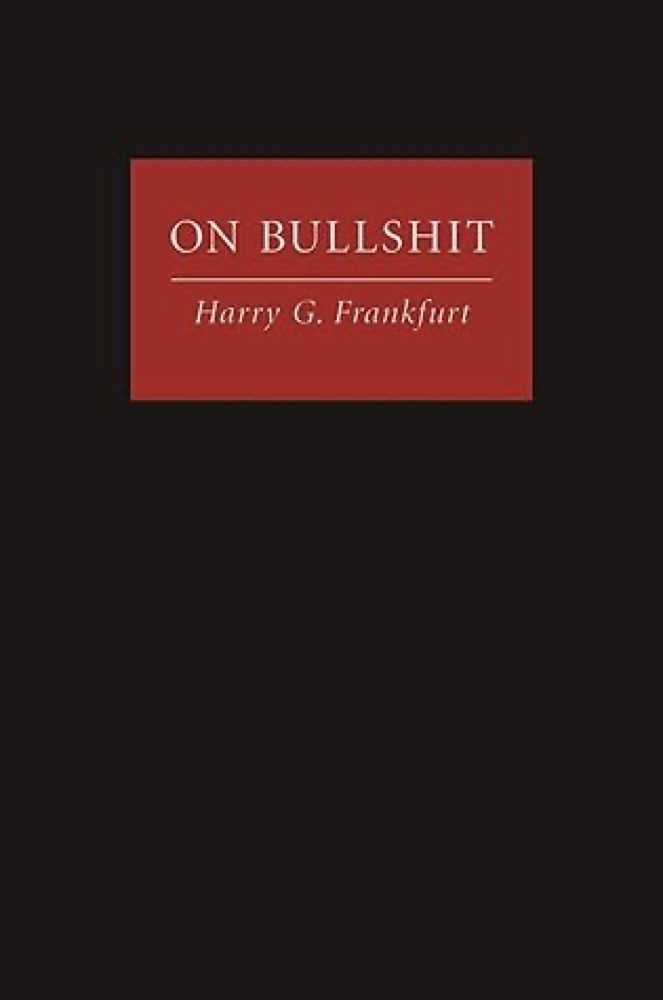
One of the most salient features of our culture is that there is so much bullshit. Everyone knows this. Each of us contributes his share. But we tend to take the situation for granted. Most people are rather confident of their ability to recognize bullshit and to avoid being taken in by it. So the phenomenon has not aroused much deliberate concern. We have no clear understanding of what bullshit is, why there is so much of it, or what functions it serves. And we lack a conscientiously developed appreciation of what it means to us. In other words, as Harry Frankfurt writes, "we have no theory."
Frankfurt, one of the world's most influential moral philosophers, attempts to build such a theory here. With his characteristic combination of philosophical acuity, psychological insight, and wry humor, Frankfurt proceeds by exploring how bullshit and the related concept of humbug are distinct
Book details
- First published
- 2005
- Author
- Harry G. Frankfurt
- Genre
- Philosophy
- Goodreads rating
- 3.58 (16k ratings)
Keep reading
Eating the Dinosaur
 Radical Honesty : How to Transform Your Life by Telling the Truth
 Science and Sanity: An Introduction to Non-Aristotelian Systems and General Semantics
 God's Debris: A Thought Experiment
 But What If We're Wrong? Thinking About the Present As If It Were the Past
 On the Decay of the Art of Lying
 21 Lessons for the 21st Century
 Why People Believe Weird Things: Pseudoscience, Superstition, and Other Confusions of Our Time
 Rationality: From AI to Zombies
 Being Wrong: Adventures in the Margin of Error
 Letters to a Young Contrarian
 You Are Not So Smart
 Stranger in a Strange Land
 The Blank Slate: The Modern Denial of Human Nature
 Golden State
 Bad Science
 Infinite Jest
 Lila: An Inquiry Into Morals
 You Are Now Less Dumb: How to Conquer Mob Mentality, How to Buy Happiness, and All the Other Ways to Outsmart Yourself
 Consider the Lobster and Other Essays
 The Meaning of It All: Thoughts of a Citizen-Scientist
 Heretics
 Trust Me, I'm Lying: Confessions of a Media Manipulator
 Foucault's Pendulum
 Wampeters, Foma and Granfalloons
 Amusing Ourselves to Death: Public Discourse in the Age of Show Business
 The Influencing Machine: Brooke Gladstone on the Media
 Mistakes Were Made (But Not by Me): Why We Justify Foolish Beliefs, Bad Decisions, and Hurtful Acts
 What's Wrong with the World
 The Story of My Experiments With Truth
 Tactics: A Game Plan for Discussing Your Christian Convictions
 Hitch-22: A Memoir
 How to Talk Dirty and Influence People
 Gödel, Escher, Bach: An Eternal Golden Braid
 Alchemy: The Surprising Power of Ideas That Don't Make Sense
 A Language Older Than Words
 Misbelief: What Makes Rational People Believe Irrational Things
 The Anomaly
 The Magic Mountain
 Endgame, Vol. 1: The Problem of Civilization
 Corpus Delicti. Ein Prozess
 Imager
 Villa Incognito
 Just a Couple of Days
 Tractatus Logico-Philosophicus
 Human, All Too Human
 The Age of Magical Overthinking: Notes on Modern Irrationality
 American Pastoral
 Critique of Pure Reason
 Zen and the Art of Motorcycle Maintenance
 Think: A Compelling Introduction to Philosophy
 Sex, Drugs, and Cocoa Puffs: A Low Culture Manifesto
 Back Story
 Gnomon
 The Moral Landscape: How Science Can Determine Human Values
 A Practical Guide to Conquering the World
 On Certainty
 Even Cowgirls Get the Blues
 Daybreak: Thoughts on the Prejudices of Morality