 Walkaway
Quotes from the Book
Our theory is simply this: a person counts as an asshole when, and only when, he systematically allows himself to enjoy special advantages in interpersonal relations out of an entrenched sense of entitlement that immunizes him against the complaints of other people.
9
Assholes are a given fact of life. They are a fact of life we must somehow make peace with if we are to be at peace with life itself.
6
If we look at global trends, though, asshole production seems to be on the rise.
4
To summarize, then, our three requirements for a good theory of assholes are as follows. We are looking for (1) a stable trait of character, (2) that leads a person to impose only small or moderate material costs upon others, (3) but that nevertheless qualifies the person as morally repugnant.
4
If someone treats you disrespectfully or speaks unkindly about you, remember that he or she does so from [his or her] impression that it is right to do so. It is unrealistic to expect that this person sees you as you see yourself. If another person reaches conclusions based on false impressions, he or she is the one hurt rather than you, because it is that person who is misguided.
3
The asshole, by contrast, traffics in and is moved by moral justification—except that moral justification, for him, leads to an entrenched sense of special entitlement
2
As we will see, assholes threaten to destabilize whole societies, especially capitalist societies of the particular sort that we increasingly have.
2
No amount of angry protest will get a true asshole to listen. As we explained in chapter 1, he is entrenched in his outlook; he is exceedingly good at walling out complaints, and, in this, he will most likely never change. Although neither resignation nor all-out resistance seems finally acceptable, we often have only the faintest sense of an ever-elusive better way.
2
the asshole’s “entrenched sense of entitlement” leads him to systematically think or assume that he has special entitlements that, from a moral point of view, he does not have.
2
Should you devote your life to asshole aikido? While that would not be entirely unworthy, there are probably better things to do with the limited time one has in life, things such as learning to paint large canvases in the abstract; refining one’s taste in jazz; or, indeed, learning the martial art of aikido for the sake of the practice itself (rather than for the few occasions one will ever use it in a fight). Life affords only so much time, and there are better things to do—sweeter spots to hit—than perfection in the asshole management arts.
2
of view, may show that he is not getting the respect he deserves. Although our theory is a definition of the term “asshole,” we should emphasize that it is not necessarily a dictionary definition. It is not necessarily a claim about how the word “asshole
2
The fight can become extraordinarily frustrating because the asshole usually wins: his sense of entitlement is entrenched, so there is usually no getting through.
1
Fully cooperative people, we may say, see themselves as equals, as having grounds for special treatment only in special circumstances that others will equally enjoy at the appropriate times.
1
However misguided, the asshole is morally motivated. He is fundamentally different from the psychopath, who either lacks or fails to engage moral concepts, and who sees people as so many objects in the world to be manipulated at will. The asshole takes himself to be justified in enjoying special advantages from cooperative relations. Given
1
The key is to understand why we are easily tempted to fight on the asshole’s terms: we are fighting for moral recognition in his eyes.
1
Assholes are found daily on cable news, where hosts repeatedly interrupt their guests, and also on talk radio, where airtime is given to commentators who thrive on falsehood and invective. Even
1
All too often, fair is foul and foul is fair. Yet the witches of social life cannot foretell our fates. Social life can be fairer and less foul, if, but only if, cooperators of the world unite.
Those who are already cooperatively disposed can hold out in cooperative faith and adopt the attitudes that encourage it—attitudes such as tolerance, mutual understanding, and long-suffering.
Grounds for reasonable hope don’t have to be conclusive or decisive. Reasonable hope, again, isn’t predictive confidence.
We might put the idea this way: much of what is given, including our fleshly nature, is, in a certain sense, to be respected. It is to be respected for what it just is, and therefore not to be wholly shaped or controlled (at least not without a pretty good justification).
Quite far along a certain continuum there sits a man who is surveying his own fleshly parts, that is, those of his parts which are still made of flesh, which includes some of his brain-flesh parts, and he is replacing defective bits of his flesh by perfect artificial substitutes, made out of whatever best serves, such as silicon, tungsten, reprocessed dung, and so forth. The man has been doing this for some time, and a lot of him is already artificial. That is surely a ghastly scenario.
Wishful thinking does not require basic credibility, whereas reasonable hope depends on having good enough reason to support efforts toward reform over the longer haul. When reasons for hope aren’t “good enough,” resignation is justified.
financial markets worked better from a crisis-avoidance point of view before they became mathematically sophisticated),
They’ve got a set of Republican waiters on one side and set of Democratic waiters on the other side, but no matter which set of waiters brings you the dish, the legislative grub is all prepared in the same Wall Street kitchen”).
According to Rousseau, healthy self-love does not require comparing oneself to others at all; feeling worthy does not necessarily involve feeling superior to someone.
It is not the maleness of males per SE that explains the proliferation of masculine assholes. It is not that men are assholes, as though non-asshole men have somehow overcome their inherently asshole tendencies. Rather, the influence of gender culture is just very deep. Deep gender culture, not maleness, is primarily to blame for the fact that assholes are mainly men.
When anyone seems to be provoking you, remember that it is only your judgement of the incident that provokes you
That is why otherwise coolheaded people fall into a fit of rage or lash out at the asshole: they are fighting to be recognized.
one of our basic moral responsibilities is to hear people out, to at least take seriously the reasons they give for wanting to be treated differently, even if we ultimately object. The expectation, in other words, is for us to recognize the person objecting, in something like the way a deliberative body grants someone in the room the right to speak before the group. This is, as we might put it, part and parcel of basic moral respect—that is, respect not simply for the person’s complaint but for the person who makes it. The
Watch on YouTube
About Aaron James
About the book
Don't take this personally*, but assholes seem to be everywhere lately, and we need a rigorous theory to account for and deal with them. In the spirit of the mega-selling On Bullshit, philosopher Aaron James has done just that, providing us all** (in Aristotelian terms) with some much-needed catharsis.
*Unless you happen to be Donald Trump or Kanye West or Dick Cheney, in which case you may take it personally.
**Unless you are a real asshole yourself.
Book details
- First published
- 2012
- Author
- Aaron James
- Genre
- Nonfiction
- Goodreads rating
- 3.13 (5k ratings)
Keep reading
Walkaway
 Consider the Lobster and Other Essays
 Arguably: Selected Essays
 The Witches Are Coming
 The Blank Slate: The Modern Denial of Human Nature
 Worm
Worm
 We Learn Nothing
 People of the Lie: The Hope for Healing Human Evil
 The Anatomy of Peace: Resolving the Heart of Conflict
 The Virtue of Selfishness: A New Concept of Egoism
 The Theory of Moral Sentiments
 Letters to a Young Contrarian
 12 Rules for Life: An Antidote to Chaos
 The Sociopath Next Door
 Mistakes Were Made (But Not by Me): Why We Justify Foolish Beliefs, Bad Decisions, and Hurtful Acts
 The Moon is a Harsh Mistress
 Hitch-22: A Memoir
 Moral Tribes: Emotion, Reason, and the Gap Between Us and Them
 What's Wrong with the World
 Seven Deadly Sins: Settling the Argument Between Born Bad and Damaged Good
 The Righteous Mind: Why Good People Are Divided by Politics and Religion
 Opinions: A Decade of Arguments, Criticism, and Minding Other People’s Business
 When Will Jesus Bring the Pork Chops?
 Blachart
 Endgame, Vol. 1: The Problem of Civilization
 The Laws of Human Nature
 Humankind: A Hopeful History
 The Moral Landscape: How Science Can Determine Human Values
 Ancillary Justice
 Radical Honesty : How to Transform Your Life by Telling the Truth
 Is It Just Me?: Or Is It Nuts Out There?
 The True Believer: Thoughts on the Nature of Mass Movements
 Cunt: A Declaration of Independence
 Friday
 Justice: What's the Right Thing to Do?
 How to Be Free: An Ancient Guide to the Stoic Life
 Parasitic Mind: How Infectious Ideas Are Killing Common Sense
 The Measure of a Man: A Spiritual Autobiography
 The Girl in the Spider's Web
 How to Win Friends & Influence People
 The Moral Animal: Why We Are the Way We Are - The New Science of Evolutionary Psychology
 Rules for Radicals: A Pragmatic Primer for Realistic Radicals
 Lila: An Inquiry Into Morals
 Discourses and Selected Writings
 Stranger in a Strange Land
 The Coddling of the American Mind: How Good Intentions and Bad Ideas Are Setting up a Generation for Failure
 How to Be Perfect: The Correct Answer to Every Moral Question
 The Lucifer Effect: Understanding How Good People Turn Evil
 Heretics
 Bright-Sided: How the Relentless Promotion of Positive Thinking Has Undermined America
 Straight Man
 Nonviolent Communication: A Language of Life
 The Way of All Flesh
 Disclosure
 Only Human
 You're Making Me Hate You: A Cantankerous Look at the Common Misconception That Humans Have Any Common Sense Left
 Twelve Steps to a Compassionate Life
 Getting More: How to Negotiate to Achieve Your Goals in the Real World
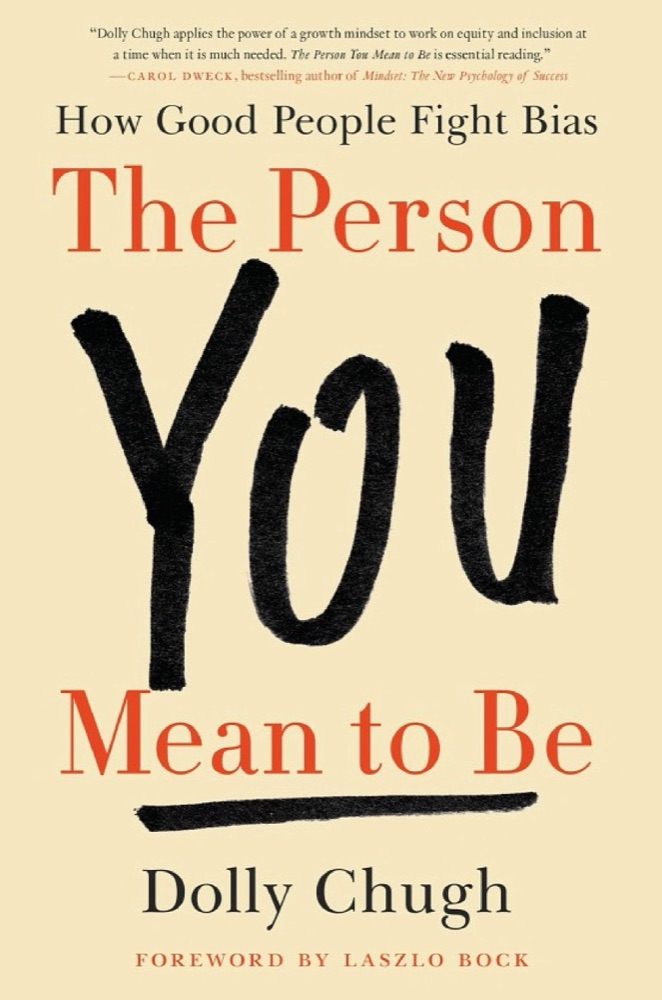 The Person You Mean to Be: How Good People Fight Bias
 Human, All Too Human