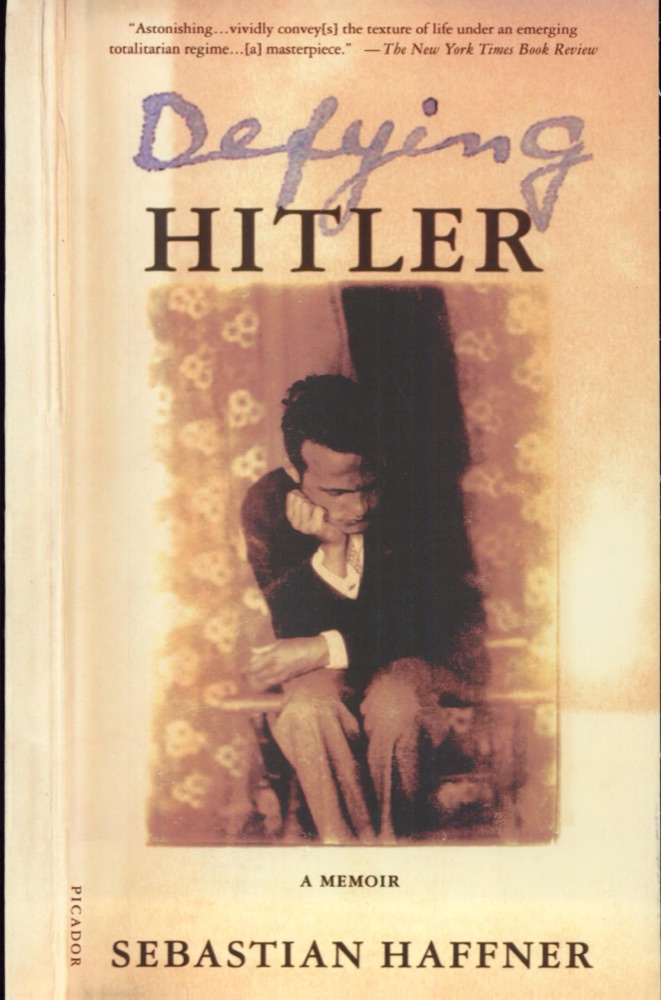
 Defying Hitler
Quotes from the Book
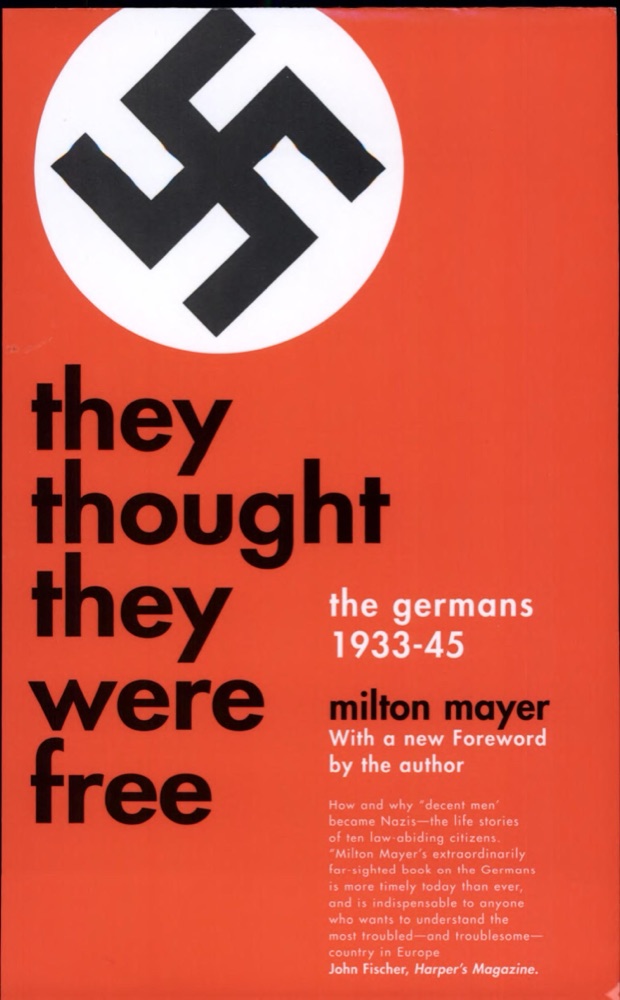
But the one great shocking occasion, when tens or hundreds or thousands will join with you, never comes. That’s the difficulty. If the last and worst act of the whole regime had come immediately after the first and smallest, thousands, yes, millions would have been sufficiently shocked—if, let us say, the gassing of the Jews in ’43 had come immediately after the ‘German Firm’ stickers on the windows of non-Jewish shops in ’33. But of course this isn’t the way it happens. In between come all the hundreds of little steps, some of them imperceptible, each of them preparing you not to be shocked by the next. Step C is not so much worse than Step B, and, if you did not make a stand at Step B, why should you at Step C? And so on to Step D. And one day, too late, your principles, if you were ever sensible of them, all rush in upon you. The burden of self-deception has grown too heavy, and some minor incident, in my case my little boy, hardly more than a baby, saying ‘Jewish swine,’ collapses it all at once, and you see that everything, everything, has changed and changed completely under your nose. The world you live in—your nation, your people—is not the world you were born in at all. The forms are all there, all untouched, all reassuring, the houses, the shops, the jobs, the mealtimes, the visits, the concerts, the cinema, the holidays. But the spirit, which you never noticed because you made the lifelong mistake of identifying it with the forms, is changed. Now you live in a world of hate and fear, and the people who hate and fear do not even know it themselves; when everyone is transformed, no one is transformed. Now you live in a system which rules without responsibility even to God. The system itself could not have intended this in the beginning, but in order to sustain itself it was compelled to go all the way.
109
As the Nazi emphasis on nonintellectual virtues (patriotism, loyalty, duty, purity, labor, simplicity, “blood,” “folk-ishness”) seeped through Germany, elevating the self-esteem of the “little man,” the academic profession was pushed from the very center to the very periphery of society. Germany was preparing to cut its own head off. By 1933 at least five of my ten friends (and I think six or seven) looked upon “intellectuals” as unreliable and, among these unreliables, upon the academics as the most insidiously situated. Tailor
35
Hitlerism was a mass flight to dogma, to the barbaric dogma that had not been expelled with the Romans, the dogma of the tribe, the dogma that gave every man importance only in so far as the tribe was important and he was a member of the tribe.
33
On this new level you live, you have been living more comfortably every day, with new morals, new principles. You have accepted things you would not have accepted five years ago, a year ago, things that your father, even in Germany, could not have imagined.
23
The other nine, decent, hard-working, ordinarily intelligent and honest men, did not know before 1933 that Nazism was evil. They did not know between 1933 and 1945 that it was evil. And they do not know it now. None of them ever knew, or now knows, Nazism as we knew and know it; and they lived under it, served it, and, indeed, made it. As
17
I think," says Professor Carl Hermann, who never left his homeland, "that even now the outside world does not realize how surprised we non-Nazis were in 1933. When mass dictatorship occurred in Russia, then in Italy, we said to one another, 'That is what happens in backward countries. We are fortunate, for all our troubles, that it cannot happen here.' But it did, worse even than elsewhere, and I think that all the explanations leave some mystery. When I think of it at all, I still say, with unbelief, 'Germany—no, not Germany.
11
In the years of its rise the movement little by little brought the community's attitude toward the teacher around from respect and envy to resentment, from trust and fear to suspicion. The development seems to have been inherent; it needed no planning and had none. As the Nazi emphasis on nonintellectual virtues (patriotism, loyalty, duty, purity, labor, simplicity, "blood," "folkishness") seeped through Germany, elevating the self-esteem of the "little man," the academic profession was pushed from the very center to the very periphery of society. Germany was preparing to cut its own head off. By 1933 at least five of my ten friends (and I think six or seven) looked upon "intellectuals" as unreliable and, among those unreliables, upon the academics as the most insidiously situated.
11
In the body politic as in the body personal, nonresistance to the milder indulgences paves the way for nonresistance to the deadlier.
11
The fact is, I think, that my friends really didn't know. They didn't know because they didn't want to know; but they didn't know. They could have found out, at the time, only if they had wanted to very badly.
10
Ordinary people—and ordinary Germans—cannot be expected to tolerate activities which outrage the ordinary sense of ordinary decency unless the victims are, in advance, successfully stigmatized as enemies of the people, of the nation, the race, the religion. Or, if they are not enemies (that comes later), they must be an element within the community somehow extrinsic to the common bond, a decompositive ferment (be it only by the way they part their hair or tie their necktie) in the uniformity which is everywhere the condition of common quiet. The Germans’ innocuous acceptance and practice of social anti-Semitism before Hitlerism had undermined the resistance of their ordinary decency to the stigmatization and persecution to come. In
9
How is this to be avoided, among ordinary men, even highly educated ordinary men? Frankly, I do not know. I do not see, even now. Many, many times since it all happened I have pondered that pair of great maxims, *Principiis obsta* and *Finem respice*—'Resist the beginnings' and 'Consider the end.' But one must foresee the end in order to resist, or even see, the beginnings. One must foresee the end clearly and certainly and how is this to be done, by ordinary men or even by extraordinary men?
8
To live in this process is absolutely not to be able to notice it—please try to believe me—unless one has a much greater degree of political awareness, acuity, than most of us had ever had occasion to develop. Each step was so small, so inconsequential, so well explained or, on occasion, ‘regretted,’ that, unless one were detached from the whole process from the beginning, unless one understood what the whole thing was in principle, what all these ‘little measures’ that no ‘patriotic German’ could resent must some day lead to, one no more saw it developing from day to day than a farmer in his field sees the corn growing. One day it is over his head.
7
I fooled myself. I had to. Everybody has to. If the good had been twice as good and the bad only half as bad, I still ought to have see it, all through as I did in the beginning, because I am, as you say, sensitive. But I didn't want to see it, because I would have then had to think about the consequences of seeing it, what followed from seeing it, what I must do to be decent. I wanted my home and family, my job, my career, a place in the community.
7
Worse, certainly, than Communism; for it is not the performance of political systems which justifies or condemns them, but their principles. Communism, in principle, supposes itself to represent the wretched of the earth and bars no man by nature from Communist redemption; the Nazis, in categorical contrast, took themselves to be the elite of the earth and consigned whole categories of men to perdition by their nature. The distinctions between these two totalitarianisms may not command much interest in the present temper of the Western Christian; they are still distinctions. National
7
Now I see a little better how Nazism overcame Germany—not by attack from without or by subversion from within, but with a whoop and a holler. It was what most Germans wanted—or, under pressure of combined reality and illusion, came to want. They wanted it; they got it; and they liked it. I came back home a little afraid for my country, afraid of what it might want, and get, and like, under pressure of combined reality and illusion.
6
But your friends are fewer now. Some have drifted off somewhere or submerged themselves in their work. You no longer see as many as you did at meetings or gatherings. Informal groups become smaller; attendance drops off in little organizations, and the organizations themselves wither. Now, in small gatherings of your oldest friends, you feel that you are talking to yourselves, that you are isolated from the reality of things. This weakens your confidence still further and serves as a further deterrent to—to what? It is clearer all the time that, if you are going to do anything, you must make an occasion to do it, and then you are obviously a troublemaker. So you wait, and you wait. “But the one great shocking occasion, when tens or hundreds or thousands will join with you, never comes. That’s the difficulty. If the last and worst act of the whole regime had come immediately after the first and smallest, thousands, yes, millions would have been sufficiently shocked—if, let us say, the gassing of the Jews in ’43 had come immediately after the ‘German Firm’ stickers on the windows of non-Jewish shops in ’33. But of course this isn’t the way it happens. In between come all the hundreds of little steps, some of them imperceptible, each of them preparing you not to be shocked by the next. Step C is not so much worse than Step B, and, if you did not make a stand at Step B, why should you at Step C? And so on to Step D. “And one day, too late, your principles, if you were ever sensible of them, all rush in upon you. The burden of self-deception has grown too heavy, and some minor incident, in my case my little boy, hardly more than a baby, saying ‘Jew swine,’ collapses it all at once, and you see that everything, everything, has changed and changed completely under your nose. The world you live in—your nation, your people—is not the world you were born in at all. The forms are all there, all untouched, all reassuring, the houses, the shops, the jobs, the mealtimes, the visits, the concerts, the cinema, the holidays. But the spirit, which you never noticed because you made the lifelong mistake of identifying it with the forms, is changed. Now you live in a world of hate and fear, and the people who hate and fear do not even know it themselves; when everyone is transformed, no one is transformed. Now you live in a system which rules without responsibility even to God. The system itself could not have intended this in the beginning, but in order to sustain itself it was compelled to go all the way.
6
You wait for one great shocking occasion, thinking that others, when such a shock comes, will join with you in resisting somehow... But the one great shocking occasion when tens or hundreds of thousands will join with you, ... never comes. If the last and worst act of the whole regime had come immediately after the first and smallest, thousands, yes, millions, would have been sufficiently shocked ... but of course, this isn't the way it happens. In between comes all the hundreds of little steps, some of them imperceptible, each of them preparing you not to be shocked by the next. And one day, too late, your principles, if you were ever sensible of them, all rush in upon you ... and you see that everything - everything - has changed ... Now you live in a world of hate and fear, and the people who hate and fear do not even know it themselves; when everyone is transformed, no one is transformed.
6
When I asked Herr Wedekind, the baker, why he had believed in National Socialism, he said, “Because it promised to solve the unemployment problem. And it did. But I never imagined what it would lead to. Nobody did.” I thought I had struck pay dirt, and I said, “What do you mean, ‘what it would lead to,’ Herr Wedekind?” “War,” he said. “Nobody ever imagined it would lead to war.” The
6
Did they know what Communism, “Bolshevism,” was? They did not; not my friends. Except for Herr Kessler, Teacher Hildebrandt, and young Horstmar Rupprecht (after he entered the university, in 1941), they knew Bolshevism as a specter which, as it took on body in their imaginings, embraced not only the Communists but the Social Democrats, the trade-unions, and, of course, the Jews, the gypsies, the neighbor next door whose dog had bit them, and his dog; the bundled root cause of all their past, present, and possible tribulations.
5
I can tell you,” my colleague went on, “of a man in Leipzig, a judge. He was not a Nazi, except nominally, but he certainly wasn’t an anti-Nazi. He was just—a judge. In ’42 or ’43, early ’43, I think it was, a Jew was tried before him in a case involving, but only incidentally, relations with an ‘Aryan’ woman. This was ‘race injury,’ something the Party was especially anxious to punish. In the case at bar, however, the judge had the power to convict the man of a ‘nonracial’ offense and send him to an ordinary prison for a very long term, thus saving him from Party ‘processing’ which would have meant concentration camp or, more probably, deportation and death. But the man was innocent of the ‘nonracial’ charge, in the judge’s opinion, and so, as an honorable judge, he acquitted him. Of course, the Party seized the Jew as soon as he left the courtroom.” “And the judge?” “Yes, the judge. He could not get the case off his conscience—a case, mind you, in which he had acquitted an innocent man. He thought that he should have convicted him and saved him from the Party, but how could he have convicted an innocent man? The thing preyed on him more and more, and he had to talk about it, first to his family, then to his friends, and then to acquaintances. (That’s how I heard about it.) After the ’44 Putsch they arrested him. After that, I don’t know.” I said nothing.
4
National Socialism was a revulsion by my friends against parliamentary politics, parliamentary debate, parliamentary government—against all the higgling and the haggling of the parties and the splinter parties, their coalitions, their confusions, and their conniving. It was the final fruit of the common man's repudiation of "the rascals". Its motif was, "Throw them all out.
4
None of my ten friends, even today, ascribes moral evil to Hitler, although most of them think (after the fact) that he made fatal strategical mistakes which even they themselves might have made at the time. His worst mistake was his selection of advisers—a backhand tribute to the Leader's virtues of trustfulness and loyalty, to his very innocence of the knowledge of evil, fully familiar to those who have heard partisans of F. D. R. or Ike explain how things went wrong.
4
one doesn’t see exactly where or how to move. Believe me, this is true. Each act, each occasion, is worse than the last, but only a little worse. You wait for the next and the next. You wait for one great shocking occasion, thinking that others, when such a shock comes, will join with you in resisting somehow. You don’t want to act, or even talk, alone; you don’t want to ‘go out of your way to make trouble.’ Why not?—Well, you are not in the habit of doing it. And it is not just fear, fear of standing alone, that restrains you; it is also genuine uncertainty.
3
the country and the countrymen together. This was the Bewegung, the movement, that restored my friends and bewitched them. Those Germans who saw it all at the beginning—there were not very many; there never are, I suppose, anywhere—called Hitler the Rattenfanger, the “rat-catcher.” Every American child has read The Pied-Piper of Hamlin. Every German child has read it, too. In German its title is Der Rattenfänger von Hameln.
2
This separation of government from people, this widening of the gap, took place so gradually and so insensibly, each step disguised (perhaps not even intentionally) as a temporary emergency measure or associated with true patriotic allegiance or with real social purposes. And all the crises and reforms (real reforms, too) so occupied the people that they did not see the slow motion underneath, of the whole process of government growing remoter and remoter.
2
What happened here was the gradual habituation of the people, little by little, to being governed by surprise; to receiving decisions deliberated in secret; to believing that the situation was so complicated that the government had to act on information which the people could not understand, or so dangerous that, even if the people could understand it, it could not be released because of national security. And their sense of identification with Hitler, their trust in him, made it easier to widen this gap and reassured those who would otherwise have worried about it.
2
Thus Nazism, as it proceeded from practice to theory, had to deny expertness in thinking and then (this second process was never completed), in order to fill the vacuum, had to establish expert thinking of its own—that is, to find men of inferior or irresponsible caliber whose views conformed dishonestly or, worse yet, honestly to the Party line. The nonpolitical pastor satisfied Nazi requirements by being nonpolitical. But the nonpolitical schoolmaster was, by the very virtue of being nonpolitical, a dangerous man from the first. He himself would not rebel, nor would he, if he could help it, teach rebellion; but he could not help being dangerous—not if he went on teaching what was true. In order to be a theory and not just a practice, National Socialism required the destruction of academic independence.
2
The fact that I was not prepared to resist, in 1935, meant that all the thousands, hundreds of thousands, like me in Germany were also unprepared, and each one of these hundreds of thousands was, like me, a man of great influence or of great potential influence. Thus the world was lost.
1
Watch on YouTube
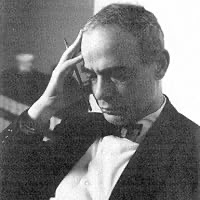
About Milton Sanford Mayer
We have collected 28 quotes from 1 book by Milton Sanford Mayer on BookQuoters.
More about the author →About the book
“When this book was first published it received some attention from the critics but none at all from the public. Nazism was finished in the bunker in Berlin and its death warrant signed on the bench at Nuremberg.” That’s Milton Mayer, writing in a foreword to the 1966 edition of They Thought They Were Free. He’s right about the critics: the book was a finalist for the National Book Award in 1956. General readers may have been slower to take notice, but over time they did—what we’ve seen over decades is that any time people, across the political spectrum, start to feel that freedom is threatened, the book experiences a ripple of word-of-mouth interest. And that interest has never been more prominent or potent than what we’ve seen in the past year. They Thought They Were Free is an eloquent and provocative examination of the development of fascism in Germany. Mayer’s book is a study of
Book details
- First published
- 1955
- Author
- Milton Sanford Mayer
- Genre
- History
- Goodreads rating
- 4.09 (6k ratings)
Keep reading
Defying Hitler
 The Rise and Fall of the Third Reich: A History of Nazi Germany
 Eichmann in Jerusalem: A Report on the Banality of Evil
 Berlin Diary: The Journal of a Foreign Correspondent 1934-1941
 In the Garden of Beasts: Love, Terror, and an American Family in Hitler's Berlin
 Modern Times: The World from the Twenties to the Nineties
 The Gulag Archipelago 1918-1956
 I Will Bear Witness 1933-41 A Diary of the Nazi Years
 Koba the Dread: Laughter and the Twenty Million
 On Tyranny: Twenty Lessons from the Twentieth Century
 What's Left?
 Bloodlands: Europe Between Hitler and Stalin
 A Quiet Flame
 No Name in the Street
 Witness
 The Origins of Totalitarianism
 Brave New World Revisited
 Fascism: A Warning
 You Can't Be Neutral on a Moving Train: A Personal History of Our Times
 The Last Lion: Winston Spencer Churchill: Alone, 1932-40
 Radio Free Albemuth
 The Third Reich at War
 The Pianist: The Extraordinary Story of One Man's Survival in Warsaw, 1939–45
 Under the Same Stars
 The Strange Death of Europe: Immigration, Identity, Islam
 Arguably: Selected Essays
 Free: A Child and a Country at the End of History
 The Untold History of The United States
 Darkness at Noon
 Epitaph for a Spy
 The Captive Mind
 Book and Dagger: How Scholars and Librarians Became the Unlikely Spies of World War II
 A People's History of the United States
 Stasiland: Stories from Behind the Berlin Wall
 One Day, Everyone Will Have Always Been Against This
 The Road Back
 A Collection of Essays
 Conspirators' Hierarchy: The Story of the Committee of 300
 It Can't Happen Here
 Closing the Ring
 Still Alive: A Holocaust Girlhood Remembered
 Address Unknown
 Understanding Power: The Indispensable Chomsky
 The Road to Serfdom
 How Should We Then Live? The Rise and Decline of Western Thought and Culture
 Auschwitz: A Doctor's Eyewitness Account
 The Light of Days: The Untold Story of Women Resistance Fighters in Hitler's Ghettos
 If This Is a Man / The Truce
 The Betrayal of Anne Frank: A Cold Case Investigation
 Postwar: A History of Europe Since 1945
 Where Do We Go from Here: Chaos or Community?
 Nobody Knows My Name
 The Boys from Brazil
 The Invisible Bridge: The Fall of Nixon and the Rise of Reagan
 Fatherland
 Everything Flows
 Joseph Anton: A Memoir
 The Winds of War
 Why We Can't Wait
 The Autobiography of Eleanor Roosevelt