 In the Dream House
Quotes from the Book
The opposite of trauma is not the absence of trauma. The opposite of trauma is order, proportion. It is everything in its place. It is one long green couch in a sunlit corner, looking like it was built for the space and waiting for you. It is an act of wilful seeing, a conscious choice about perspective.
13
If we all talked to each other in this way, with warm camaraderie and complete non-judgement, much pain would be spared and happiness generated.
12
Compassion, Brené Brown explains, is the expression of ‘a deeply held belief that we are inextricably connected to each other’ by the bonds of shared human imperfection, of suffering and of love and of goodness. If we make the vulnerable choice to connect with empathy—to be vulnerable, excruciatingly so, in order to access that in me which has suffered as you are now suffering—we bring compassion alive by communicating that bond, so others know they are never alone.
6
what chips some people like a mug cracks others like an egg.
5
Hoarding does not discriminate on the basis of income or intellect.
5
Standing in the hallway, I imagine the smell settling like snow on my hair and my skin, breathing it like smoke into my nose and mouth; how it curls its way into the fibers of my clothing and the hollows of my ears. Like death, it is an old smell; so fundamentally human that it can only be disavowed. You avoid this smell each time you take a shower and each time you wash your hands. Each time you brush your teeth or flush the toilet, or launder your sheets and towels. With every plate you scrub clean, every spill you mop up and every bag of trash you tie up and throw out. Every time you open a window or walk outside, breathing deeply, to stretch your legs and stand in sunlight. This smell is the lingering presence of all the physical things we put into and wash off ourselves. But it is equally the ineffable smell of defeat, of isolation, of self-hate. Or, more simply, it is the smell of pain.
3
In the taxonomy of pain there is only the pain inflicted by touching and the pain inflicted by not touching. Peter grew up an expert in both. Malnourished, the skin on his thin neck perpetually covered in boils, he was as scarred as the surface of Mercury; a planet lacking atmospheric protection, exposed to the hurtling debris of space and wearing its history of collision and battery on its face.
3
But it is equally the ineffable smell of defeat, of isolation, of self-hate. Or, more simply, it is the smell of pain.
3
I call him from the car and ask him about his morning, tell him about mine. 'What kind of hoarder was she?' he asks. 'Books and cats, mainly,' I tell the man who loves his cats and who I know is now actively considering his extensive book collection. 'What's the difference between a private library and a book hoarder?' he wonders. We are both silent before chuckling and answering in unison: 'Faeces.' But the difference is this phone call. And the others like it I could make. And how strong we are when we are loved.
2
It is because they’ve told their stories more often. Because they were consistently surrounded by friends or parents or partners or children who were interested in seeing them as a whole person. This is how true connection occurs. This is how events become stories and stories become memories and memories become narratives of self and of family from which we derive identity and strength.
2
My anger is Sandra's Scotch. It is her wine, her sleeping pills, her years of speed and 'mandies make you randy', her denial, her forgetting. These are the ways we numb the pain of vulnerability, but emotion cannot be selectively numbed. If we are too good at it for too long we will numb our ability to form true connections, with ourselves and with others, which is the only thing we are here for--if we are here, glued to the same crumb busily suspended in infinity, for anything at all.
2
As a person, Janice is of course more than her house; but it is also true that her house is an indicator of what it feels like to be Janice. And what it feels like to be Janice is to be asphyxiating, slowly and helplessly, under the crushing and ever-multiplying weight of the past and the present. I picture her here on this couch, curled into herself like a fern at 4 a.m. And though it must feel like a catacomb in that dark hour, and though every hour behind these blinds has been dark, the house is spinning with movement: mould is travelling up and down the walls, food is rotting, cans are rusting, water is dripping, insects are being born and they are living and dying, Janice's hair is growing, her heart is beating, she is breathing. Which is to say that this, too, is life. Like the creatures that swim in the perfect blackness of the ocean floor, the ecosystem here would be unrecognisable to most people but this, too, is our world. The Order of Things includes those who are excluded.
2
But the opposite of trauma is not the absence of trauma. The opposite of trauma is order, proportion; it is everything in its place.
2
I think back to the years when I barely left my room, when the pills I took each day for anxiety and depression made the light hurt my skin and my hands tremble too hard to hold a pen. How I devoured books, lying in the fetal position in the dark until my hips hurt against the mattress. How much I needed the desolate predictability, the safeties of stillness and solitude. Beyond distraction or entertainment was just the perfect permanence of the written word and the camaraderie embroidered in its silence.
1
One should, for example, be able to see that things are hopeless and yet be determined to make them otherwise.
1
In a world that changes so quickly, and where everyone eventually leaves, our stuff is the one thing we can trust. It testifies, through the mute medium of Things, that we were part of something greater than ourselves.
1
Sandra has lived largely in stealth since the early 1980s. I didn't realise it at the time, but it was singular that halfway through our first interview she told me - a stranger still - that she had been assigned male at birth. I didn't know then why she chose to be that candid with me that early; maybe I was lucky enough to ask the right questions in the right way at the right time. But knowing her now, I suspect it had less to do with me personally and more to do with the fact that I crossed paths with her at the point in her life when she was, finally, bursting at the seams with her story, with the need to tell and be truly known.
1
What kind of hoarder was she?' he asks. 'Books and cats, mainly,' I tell the man who loves his cats and who I know is now actively considering his extensive book collection. 'What's the difference between a private library and a book hoarder?' he wonders. We are both silent before chuckling and answering in unison: 'Faeces.' But the difference is this phone call. And the others like it I could make. And how strong we are when we are loved.
1
In a dream I sometimes have, I am frantically trying to save as much as I can from my childhood home before I am forced to leave forever because of some disaster. In this dream, from which I awake with my jaw clenched like a fist, I grab whatever I can reach, take whatever I can carry. Always my childhood books and our family photo albums, but sometimes also the silver candlesticks, the things on my father's desk, the paintings on the walls. Maybe it comes from the speed with which my family changed shape one day, maybe it comes from moving, maybe it comes from my grandmother's hinted horror of losing everything in the Holocaust, but I cannot part with a dented pot that I remember my mother putting on the stove each week. Or the sofa my father bought with his first pay cheque, which was never comfortable when I was growing up and is not comfortable now. I cannot part with the lipstick I found softly rolling in an empty drawer months after my mother left. Or a shopping list on an envelope in her handwriting. In a world that changes so quickly, and where everyone eventually leaves, our stuff is the one thing we can trust. It testifies, through the mute medium of Things, that we were part of something greater than ourselves.
1
Down the highway she has driven a thousand times before, without ever realizing that while everyone is moving at the same speed the trucks hauling the heaviest loads have the most momentum.
1
She has been intuitively righting her environment - cleaning it, organizing it, coordinating it, filling in gaps where she can, hiding them where she can't - since she was a child. It is her way of imposing order on her world, and it brings her profound satisfaction.
I have a firm belief that we change the concept of the house from what it was, so that they have in their mind that things are different now. It helps with their processes of dealing with the change, and then it's a constant reminder that they're not following the same patterns and things need to be different.
The undeniable boost this gives her is not a simple question of schadenfreude or, at the other end of the spectrum, altruism. It is the product of meaningful work: the sense of purpose we create by cultivating our gifts and sharing them with the world.
We weren't very rich, but I didn't know the difference,' she says.' Sandra nods in agreement. 'We were all pretty well equal then. There were the multi-rich, and if there were, you didn't really know about it because there wasn't the media presence that we have now. Everyone was the same.'
I want to explain about my dark room and shaking hands and how the road back starts in thick forest.
I'm not sure I will ever be able to tell you, exactly, how Sandra has made it through.' ..... 'I believe it has much to do with the emotional machinery she has jettisoned in order to stay afloat. That is the buoying wonder and the sinking sadness of the particular resilience of Sandra.
So loudly does this anger scream inside me - this anger of, and for, the abandoned child - that I forget - for weeks, I forget - my one task: to listen for the truer sound.
...hard loneliness, that type of desperation that makes one accept the stab wound of familiarity as a substitute for true connection.
Really, to me it’s false bullshit when we all say, “Oh, such a lovely person.” Oh, crap! I was a bitch at times, I was this, I was that, sometimes I was nice; get over it. Everyone who dies is perfect.
Watch on YouTube
About Sarah Krasnostein
About the book
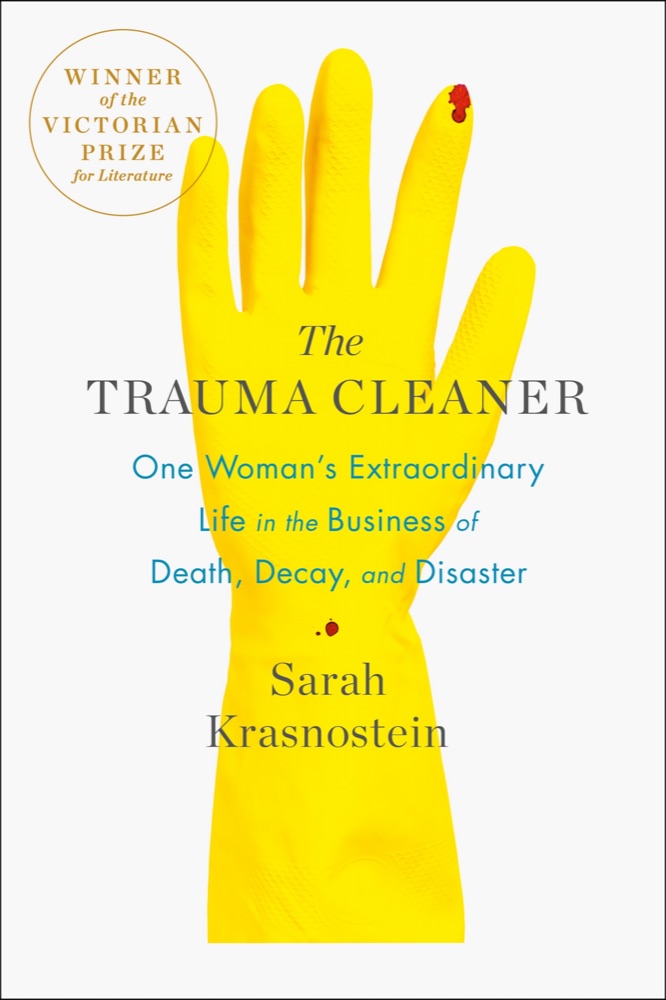
Husband, father, drag queen, sex worker, wife. Sarah Krasnostein's The Trauma Cleaner is a love letter to an extraordinary ordinary life. In Sandra Pankhurst she discovered a woman capable of taking a lifetime of hostility and transphobic abuse and using it to care for some of society's most in-need people.
Sandra Pankhurst founded her trauma cleaning business to help people whose emotional scars are written on their houses. From the forgotten flat of a drug addict to the infested home of a hoarder, Sandra enters properties and lives at the same time. But few of the people she looks after know anything of the complexity of Sandra's own life. Raised in an uncaring home, Sandra's miraculous gift for warmth and humour in the face of unspeakable personal tragedy mark her out as a one-off.
Book details
- First published
- 2017
- Author
- Sarah Krasnostein
- Genre
- Nonfiction
- Goodreads rating
- 3.90 (31k ratings)
The buzz
- Publishers WeeklyReview in Publishers Weeklyprofessional review (via Book Marks)
- BooklistReview in Booklistprofessional review (via Book Marks)
Keep reading
In the Dream House
 Managing Expectations: A Memoir in Essays – A Poignant Collection of Personal Stories on Acting, Failure, and Motherhood's Joy
 Anthropology of an American Girl
 All Is Not Forgotten
 Any Ordinary Day
 Conviction
 The Girl Before
 Old Babes in the Wood: Stories
 Now Is the Time to Open Your Heart
 The Beauty of Living Twice
 A Manual for Cleaning Women: Selected Stories
 Banyan Moon
 Good Morning, Destroyer of Men's Souls: A Memoir of Women, Addiction, and Love
 The Shock of the Fall
 The Likeness
 Make It Scream, Make It Burn
 They're Going to Love You
 When Women Were Dragons
 Journal of a Solitude
 What I Loved
 The End of Men
 To Throw Away Unopened
 Grief Is for People
 The Harder I Fight the More I Love You: A Memoir
 The Hidden Girl and Other Stories
 A Small Indiscretion
 The Broom of the System
 Saint X
 The Tsar of Love and Techno
 Just Ignore Him
 Motherthing
 The Cost of Living: A Working Autobiography
 The Folded Clock: A Diary
 The Bedwetter: Stories of Courage, Redemption, and Pee
 Joan Is Okay
 Too Much Happiness: Stories
 The Collected Stories of Lydia Davis
 In The Blood
 The Return
 Range of Motion
 Burnt Sugar
 The Raw Shark Texts
 House of Glass
 The House of Hidden Meanings
 Dream Count
 Breasts and Eggs
 Notes on an Execution
 The Color Master: Stories
 The Woman Destroyed
 The Chronology of Water
 The Chimes
 Aftermath: On Marriage and Separation
 Orphan Train
 Inheritance: A Memoir of Genealogy, Paternity, and Love
 What Is Not Yours Is Not Yours
 Belong to Me
 Bright Young Women
 The Color of Everything: A Journey to Quiet the Chaos Within
 The Museum of Intangible Things