 Ring of Bright Water
Quotes from the Book
I tell myself not to count the years ahead in which she might never again come, but rather cherish the days she has given me of her own free will, when she lowered her species’ instinctive guard against humans, and shared the beauty and mystery of her presence in silent and graceful companionship. I will remember her leaving, but I will always know that before she did, she always, first, looked back.
27
She has taught me patience. And as someone who has made their living through words, she has made me consider the dignity and persuasiveness of silence.
14
Despite having spent thousands of hours asleep in the house, the only traces the hare has left are a shallow, almost imperceptible indentation in the carpet where her warm, long body has worn the surface smooth with its minute daily adjustments; six of her whiskers, scattered over the years; and a few weightless tufts of fur. The damp footprints she leaves on the floor on wet or dewy mornings evaporate within minutes. The emotional impact she has left, by contrast, is immense.
13
we do not achieve all upon which we have set our hearts, or are beaten back by headwinds stronger than our desires, we too can lay up a while, watch the glitter on the grass, and renew our strength.
9
Perhaps the witch-hare’s true magic, I thought, is the wish she inspires, just for a moment, to step out of the human form. To race across the ground with the speed and power of a hare, without tiring; to inhabit its senses and revel in a world of sound, scent and sensation far greater than our own; and to move through the night as effortlessly as if through sunlight.
8
to be a good advisor, you have to set aside your own personal opinions and feelings in a kind of detachment or camouflage – since self-interest is incompatible with objectivity – and avoid the limelight. Maintained over years, this steady, watchful, guarded attitude had become a way of life for me – one in which I constantly looked out for pitfalls, anticipated threats coming over the horizon, and readied myself to move and adapt at a moment’s notice and melt from the picture. Was it possible that that I had blended too much into the background of my own life… blurring my own identity
8
to see a world in a grain of sand,” then perhaps we can see all nature in a hare: its simplicity and intricacy, fragility and glory, transience and beauty.
6
Under the subtle influence of the hare, my own wants have simplified. To be dependable in love and friendship more than in work. To leave the land in a more natural state than I found it. And to take better care of what is to hand, seeing beauty and value in the ordinary.
5
It had never occurred to me that wild animals could be so predictable in their habits. Seeing a flutter of wings, I would note in passing that there was “a bird” in the garden. I hadn’t thought that it might be the same bird, coming at the same time, to do the same things, day after day, and I felt a greater sense of connection to the wildlife around me. I wondered how much of the nature of animals is obscured from us simply because of the limitations of our senses and powers of observation.
5
I flicked on the switch in the sitting room to find the hare lying on her front, her slim legs stretched out before her as though she had never left, instead of being absent for two weeks. She stared inscrutably into the fire. She was a Dürer painting come to life—her coat a blaze of warm brown and golden tones, her eyes reflecting firelight.
4
I felt a new spirit of attentiveness to nature, no less wonderful for being entirely unoriginal, for as old as it is as a human experience, it was new to me.
4
I was moved by the leveret’s dignity, the sense of well-being and calm it spread, and the simplicity of its life.
4
wondered how much of the nature of animals is obscured from us simply because of the limitations of our senses and powers of observation.
2
The hare can move at thirty-seven of its own body lengths a second, more than the twenty-three body lengths per second achieved by a vigorous cheetah.
1
There is no reason why we could not decide to give a little more space to hares and other creatures and to take a little less ourselves—following the example of the hare itself—while ensuring sufficient sustainable food production to meet human needs.
1
And when one day I can no longer see her, I will watch the hares in the field knowing that her being is woven into theirs, and that I have only to look up at night to see her symbol etched in the stars.
1
There is nothing original in finding consolation and inspiration in nature. It is there for all of us.
1
The hare lends itself as a symbol of the transience of life and its fleeting glory, and our dependence on nature and our careless destruction of it. But in the hare—and nature’s—endless capacity for renewal, we can find hope. If it is possible, as William Blake would have it, “to see a world in a grain of sand,” then perhaps we can see all nature in a hare: its simplicity and intricacy, fragility and glory, transience and beauty.
1
Were it in my power, I would replace “mad as a March hare” in our language with “as gentle as a hare,” “as faithful as a hare” and “as constant.
1
If it is possible, as William Blake would have it, ‘to see a world in a grain of sand’, then perhaps we can see all nature in a hare: its simplicity and intricacy, fragility and glory, transience and beauty.
1
Antoine de Saint-Exupéry, author of The Little Prince, wrote that “there is no comradeship except through unity on the same rope, climbing towards the same peak,” and he might as well have been describing the single-mindedness that animated me and my colleagues.
1
The grass in the centre of the field reached my waist in places, and I startled hares that ran and leapt, cresting the tops of the grass with a smooth flowing motion, dolphins of the meadow.
1
On the other hand, the hare is also associated with the divine. In Julius Caesar’s account of the Gallic Wars, he wrote that native Britons refused to eat the hare because it was sacred to them. Images of hare-headed deities adorn the walls of ancient Egyptian burial chambers. In Buddhism, there is a story about a hare sacrificing itself into fire for others.
1
...I found a paradoxical happiness in realizing how little I knew of the realm of grasses and trees, and what pleasure could lie in acquiring even a slender store of knowledge. Starting anew brings a sense of renewal and possibility. I rapidly reached the limit of my understanding, losing my way in thickets of scientific language, absorbing gleams and glimmers of new information. The details slipped from my mind faster than the grass seeds that scattered as I walked, quicker than down blown from a dandelion. But each discovery, like the passage of a comet through the sky, enlarged my sense of the world and left behind excitement and warmth in my heart... and my gratitude to the hare expanded as my perception deepened.
1
On hot days the leveret seemed to prefer the cool of the house, and would lie panting with quickened breath, as if in discomfort. Most of the books I had read agreed that hares drink little or no water, and gain all the moisture they need from the plants they consume.
1
The hare…greatly likes to return to its home and loves every spot with which it is familiar. That, you see, is why it is generally caught, because it cannot endure to abandon its native haunts. —Aelian (c. 175–235 AD), On the Nature of Animals
1
The leveret, when fully grown, would be capable of running at between thirty to fifty miles per hour, compared to the six miles an hour managed by the average human, and nearly twenty-seven miles per hour for the fastest.
1
Noticing that it avoided the slippery wooden floors, preferring instead to navigate by jumping between covered surfaces, I positioned cushions as stepping stones up the short flight of wooden steps into the office.
1
Watch on YouTube
About Chloe Dalton
About the book
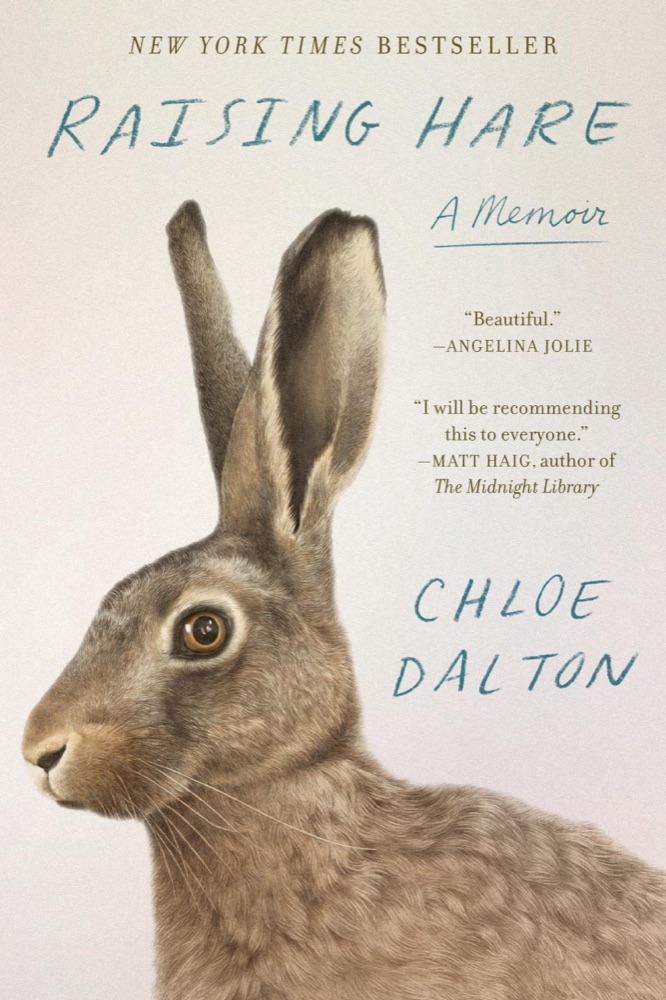
A moving and fascinating meditation on freedom, trust, loss, and our relationship with the natural world, explored through the story of one woman’s unlikely friendship with a wild hare.Imagine you could hold a baby hare and bottle-feed it. Imagine that it lived under your roof and lolloped around your bedroom at night, drumming on the duvet cover when it wanted your attention. Imagine that, over two years later, it still ran in from the fields when you called it and slept in your house for hours on end and gave birth to leverets in your study. For political advisor and speechwriter Chloe Dalton, who spent lockdown deep in the English countryside, far away from her usual busy London life, this became her unexpected reality.In February 2021, Dalton stumbles upon a newborn hare—a leveret—that had been chased by a dog. Fearing for its life, she brings it home, only to discover how impossible
Book details
- First published
- 2025
- Author
- Chloe Dalton
- Genre
- Nonfiction
- Goodreads rating
- 4.29 (40k ratings)
The buzz
- The New York TimesReview in The New York Timesprofessional review (via Book Marks)
- The Wall Street JournalReview in The Wall Street Journalprofessional review (via Book Marks)
- The GuardianReview in The Guardianprofessional review (via Book Marks)
- Associated PressReview in Associated Pressprofessional review (via Book Marks)
- The Times Literary SupplementReview in The Times Literary Supplementprofessional review (via Book Marks)
- Kirkus ReviewsReview in Kirkus Reviewsprofessional review (via Book Marks)
Keep reading
Ring of Bright Water
 Winter Hours: Prose, Prose Poems, and Poems
 Vesper Flights
 Mozart's Starling
 The Snow Leopard
 The Atomic Weight of Love
 Hollow Kingdom
 H is for Hawk
 Upstream: Selected Essays
 High Tide in Tucson
 Amy Snow
 Watership Down
 Year of Wonders
 Swann's Way
 Weyward
 In the Heart of the Heart of the Country and Other Stories
 The Elegance of the Hedgehog
 Fifteen Dogs
 Ahab's Wife, or The Star-Gazer
 The Zookeeper's Wife
 Deerskin
 Watchers
 Refuge: An Unnatural History of Family and Place
 Turtle Diary
 Arctic Dreams
 Allan Quatermain
 Beasts of Extraordinary Circumstance
 Elizabeth and Her German Garden
 The Grass Harp, Including A Tree of Night and Other Stories
 The Journey Home: Some Words in Defense of the American West
 The Tropic of Serpents
 Dog Songs: Poems
 My Friends
 The Year of the Hare
 Villette
 A Book of Simple Living
 In Search of Lost Time
 Tracks: A Woman's Solo Trek Across 1700 Miles of Australian Outback
 The Complete Poems of Emily Dickinson
 Nature and Selected Essays
 Walking
 Deep Creek: Finding Hope in the High Country
 The Place of Tides
 The Mill on the Floss
 The Song of the Lark
 The Children's Book
 Prodigal Summer
 Merle's Door: Lessons from a Freethinking Dog
 Out of Africa
 Piranesi
 Rebecca
 How To Catch A Mole
 A Lion Among Men
 The Return of the Native
 The Pox Party
 My Ántonia
 Elephant Whisperer
 West with the Night